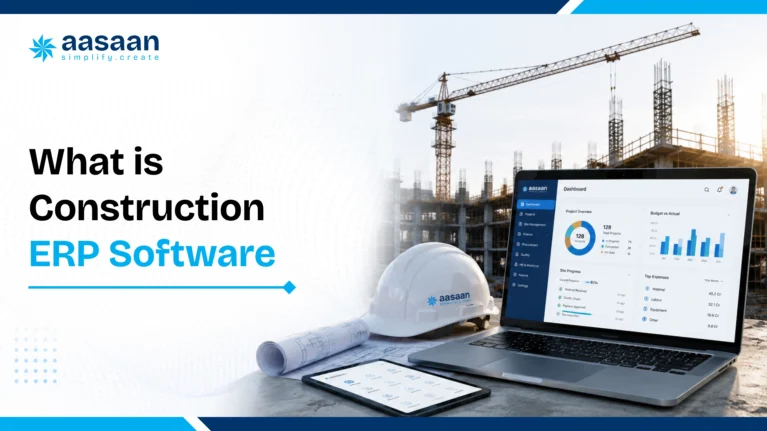
What is construction ERP software for builders in India
Picture a builder juggling six WhatsApp groups, three Excel sheets and a site supervisor who calls twice a day with a number that rarely lines up with the ledger. This is the daily reality for thousands of construction businesses across India, and it is exactly the gap that construction ERP software was built to close. Instead of chasing updates across a dozen apps, a builder using construction ERP software sees every site, every rupee and every vendor bill inside one connected screen. This guide breaks down what construction ERP software actually means, why builders across India are adopting it faster than ever, and how to pick a system that fits your business rather than fighting it.
Table of contents
Quick answer: what is construction ERP software
Construction ERP software is a single digital system that connects planning, procurement, billing, payroll, sales and site reporting for a construction business. It replaces scattered spreadsheets, paper vouchers and endless phone calls with one shared source of truth. For builders in India, construction ERP software means real time visibility into cost, schedule, cash flow and compliance across every project, viewed from a phone, a laptop or even WhatsApp.
The hidden cost of skipping construction ERP software
Every builder knows the feeling. A supervisor reports material used on site, the store keeper logs a different quantity, and the accountant reconciles a third figure two weeks later when the vendor sends a bill. Multiply this small mismatch across five sites, forty vendors and two hundred workers, and the gap between what a project should cost and what it actually costs starts to widen every single week. This is precisely the fragmentation that construction ERP software was designed to remove, and the numbers behind it are larger than most builders expect.
India’s own infrastructure data proves the scale of the problem. The Ministry of Statistics and Programme Implementation tracks large central sector projects through its Flash Report on Infrastructure Projects, and the April 2026 edition shows 1,981 tracked projects with a revised cost of roughly 42.79 lakh crore rupees against an original outlay of 37.12 lakh crore rupees, a cumulative overrun above 5.6 lakh crore rupees. A separate review found 779 of 1,873 monitored projects running behind schedule, with average slippage stretching to around three years. These are government scale numbers, yet the same root causes, disconnected data, delayed reporting and manual reconciliation, play out on private residential and commercial sites every day.
The construction sector itself carries enormous weight in the Indian economy. It contributes close to 8 percent of national GDP and employs more than 55 million people directly, making it the second largest source of employment after agriculture, according to IBEF’s infrastructure sector data. A sector this large, running on paper registers and scattered spreadsheets, leaks value at a scale that individual builders rarely see until a bank statement or a GST notice forces the issue into the open.
Here are the places where money quietly slips away on a typical construction site before a proper construction ERP system steps in:
- Material recorded as used on site but missing from the actual stock count
- Duplicate vendor payments caused by two people approving the same bill
- Labour marked present on paper registers who skipped the site that day
- Equipment sitting idle while rental charges keep accumulating
- Rework costs from quality issues that surface only after handover
- Subcontractor claims that exceed the actual work completed on site
- GST input credit lost because bills arrive late or go untracked
- Cash flow gaps from client billing that lags behind actual progress
- Purchase orders raised above budget with zero real time alert
- Monsoon and weather delays that push schedules with little warning, a pattern explored in detail here

What does construction ERP software actually do
At its core, construction ERP software definition is simple. It is an enterprise resource planning system built specifically for the construction and real estate industry, covering the full journey from land acquisition and planning through procurement, execution, billing, sales and handover. Where a generic accounting tool only manages ledgers, a proper construction ERP system tracks the physical reality of a build, cement bags delivered, labour hours logged, tasks completed against a schedule, and connects that physical data straight to financial records.
Think of construction ERP software explained through a single flow. A site engineer logs today’s progress on a mobile app. That entry automatically updates the project schedule, checks material consumption against the budget, flags any variance to the project manager, and prepares the data an accountant needs for billing. Every number gets entered exactly once and flows across the entire workflow automatically. This is the workflow that a strong construction management ERP is meant to deliver, and it is the reason builders describe adopting one as the day their business finally became visible to itself.
The meaning of construction ERP goes beyond software features too. It represents a shift in how a construction company operates, moving from reactive firefighting, chasing missing bills and disputed measurements, toward proactive control, where issues surface the moment they happen rather than at month end. For builders managing multiple projects at once, this shift is often the difference between steady growth and a business that stays permanently stretched thin.

Core modules every construction ERP system needs
Every construction ERP software package is built differently, and the modules included determine whether the system actually solves a builder’s daily problems or simply digitises a few forms. A genuinely integrated construction ERP covers every function a builder touches in a week, connected through one shared database rather than isolated apps that require manual syncing.
These are the modules a serious construction ERP system should include:
- Purchase and inventory management. Full procurement control from estimation to payment, with automated data entry and real time budget checks, similar to what Aasaan’s ERP solution covers for material supply.
- Project management and scheduling. Work breakdown schedules, baseline tracking and progress monitoring, the backbone of any construction project management software module.
- Asset and equipment management. Tracking plant, machinery and tools through QR codes to maximise uptime and reduce idle rental costs.
- Attendance and payroll. Facial or GPS based attendance linked directly to daily wage calculation and full HR and labour management.
- Quality and safety tracking. Digital checklists, rework logging and instant non conformance reports for every site.
- Billing and invoicing. Client and subcontractor billing, receivables tracking and instant report sharing.
- Tendering and contracts. Work order generation, tender tracking and performance analysis across bids won and lost.
- Sales CRM for real estate. Lead qualification, site visit scheduling and post sale service, exactly what a strong property sales CRM is meant to deliver.
- Finance and accounting. Bank reconciliation, project wise ledgers and profit and loss statements available on demand.
- Petty cash management. Daily site expense tracking against budget, removing the shoebox full of paper vouchers many sites still rely on.
Builders searching for an integrated construction ERP should treat this list as a baseline rather than a wish list. A system missing even two or three of these modules forces the business straight back into juggling separate tools, which quietly reintroduces the same reconciliation gaps construction ERP software exists to remove.
Key features of construction ERP software for builders
Modules describe what a system covers, but features describe how well it actually works day to day. Two products can list the same ten modules on a brochure and still feel completely different once a site engineer with patchy internet and a busy schedule tries to use them. The features below separate a genuinely useful construction ERP software for builders from a system that looks good in a demo and gathers dust within a month.
What features should construction ERP have
- Mobile access so site staff can log progress, attendance and material use from a phone, forming the basis of true mobile construction ERP
- Cloud hosting so owners, site teams and the office view the same live data from any location
- Automated GST reporting that pulls directly from procurement and billing records
- Live GPS tracking for workforce and equipment across every site
- AI powered tools that flag budget overruns, quality issues or schedule slippage before they escalate, the essence of AI construction ERP
- WhatsApp based alerts and approvals for teams who already live inside that app all day
- OCR and voice based data capture that reduces manual typing for busy site staff
- Dashboards built for decision makers, showing project health at a glance rather than buried in spreadsheets
- Integration with Tally, SAP or other accounting systems already in use
- Role based access so subcontractors, vendors and internal staff see only what applies to them
Why the mobile and WhatsApp layer matters more than most builders expect
Most construction workers and site supervisors in India already use WhatsApp fluently, far more comfortably than any dedicated business app. A construction ERP with WhatsApp integration meets people where they already are, turning a familiar chat window into a live project inbox for alerts, bill uploads and daily reports. This single design choice often decides whether frontline staff actually adopt the system or quietly go back to paper registers within a few weeks.
Real benefits builders feel after using ERP software
Ask any builder who has switched from spreadsheets to a proper construction ERP system what changed first, and cost control usually tops the list. Budgets stop moving in the dark. Every purchase order, every bill and every payment sits against the approved estimate in real time, so overspending gets caught the week it happens rather than the quarter it happens.
Schedule reliability follows closely behind. Because daily progress feeds straight into the master schedule, project managers see slippage the moment it starts rather than during a monthly review meeting held weeks too late to act. Builders managing several sites at once describe this as the single benefit that changed how confidently they could commit delivery dates to buyers and investors.
Trust with home buyers grows too, and this matters more today than ever given how closely RERA regulations tie a builder’s reputation to timely delivery and transparent reporting. A construction ERP software benefit that rarely makes the marketing brochure is simply peace of mind, knowing that a builder can answer a buyer’s question about progress or a bank’s question about fund utilisation within minutes rather than days.
Labour and vendor management improve as a direct result too. Payroll runs faster and more accurately, subcontractor billing disputes shrink because measurements are logged and agreed on the same platform, and procurement teams negotiate better rates once quote comparison data sits in one place. Builders often describe the compounding effect best, each module reinforcing the next until the entire business runs on one rhythm instead of five disconnected ones.
Cloud ERP for builders: work from any site, anytime
Construction rarely happens near a fixed office desk. Sites sit hours apart, supervisors move between locations daily, and owners often review project health from an airport lounge or a client meeting far from any computer. This is exactly why cloud construction ERP has become the default choice for growing builders rather than the traditional on premise systems that once dominated the market.
Online construction ERP removes the need for local servers, IT teams and manual backups. A builder logs in through a browser or an app, and the same live data appears whether the user sits in a head office in Mumbai or a site office in a smaller tier two town. Updates roll out automatically, security patches apply without site visits, and scaling to a new project or a new city requires nothing more than adding a login.
Mobile construction ERP takes this further by putting the entire system into the pocket of every site engineer, storekeeper and supervisor. Attendance gets marked through facial recognition on a phone camera. Material receipts get photographed and processed automatically through OCR. Daily progress reports generate themselves from data already captured on site rather than requiring a separate end of day write up.
AI construction ERP adds a further layer that traditional systems rarely offered. Instead of simply storing data, an AI layer studies patterns across a project, comparing current spend against historical trends, flagging unusual vendor rates, and predicting where a schedule risks slipping weeks before it actually does. Builders exploring this shift often start with cost related questions, and a detailed breakdown of pricing and expected returns is available in this look at AI construction software costs and ROI.
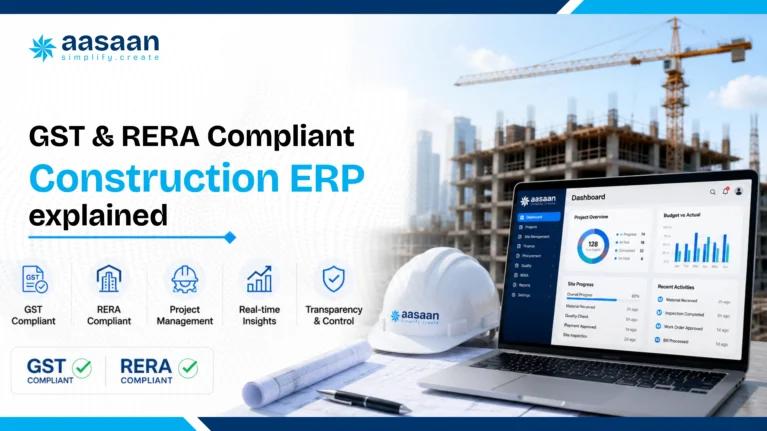
GST and RERA compliant construction ERP explained
Compliance sits at the centre of every builder’s fears, and rightly so. A missed GST filing or a delayed RERA update can trigger penalties, buyer complaints and reputational damage that takes years to repair. This is why a genuinely GST compliant construction ERP and a properly RERA compliant construction ERP are treated as essential rather than optional by builders operating anywhere in India today.
On the tax side, the official GST Portal requires accurate, timely filing of returns tied to every purchase and sale a construction business makes. A construction ERP system that automates GST reporting pulls invoice data straight from procurement and billing modules, matches input credit against actual purchases, and prepares filing ready reports rather than leaving an accountant to manually reconcile hundreds of bills each month.
On the regulatory side, the Real Estate Regulation and Development Act, detailed on the Ministry of Housing and Urban Affairs website, requires builders to report project progress, fund utilisation and delivery timelines with a level of transparency that manual systems struggle to sustain across multiple projects. A construction ERP for real estate builders that ties financial data to physical site progress makes RERA reporting a byproduct of daily operations rather than a stressful monthly scramble.
Builders evaluating any Indian construction ERP software should treat compliance automation as a non negotiable feature rather than a bonus. The cost of a missed filing or a delayed RERA disclosure almost always outweighs the price difference between a compliant system and a basic one.
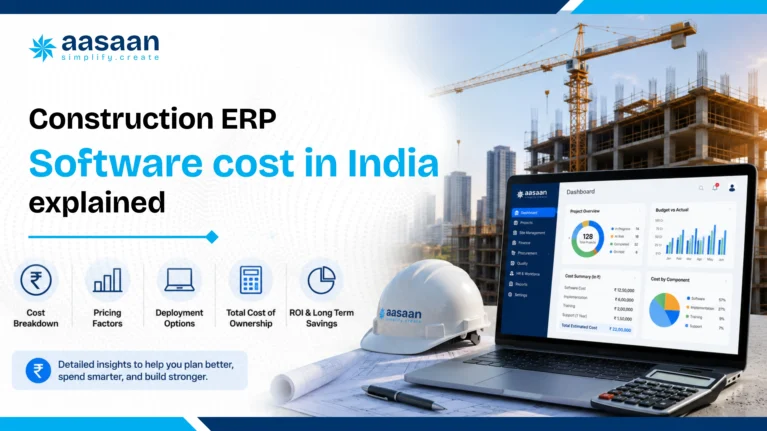
Construction ERP software cost in India explained
Construction ERP software cost in India varies widely depending on company size, the number of modules required and whether the system runs on the cloud or on premise. Builders searching for construction ERP software price India figures often expect a single number, but pricing typically follows the scale of the business using the platform.
| Factor |
Typical impact on cost |
| Number of active projects and users |
Per user or per project pricing scales with team size |
| Modules selected |
A full suite costs more than a single module like billing alone |
| Cloud versus on premise hosting |
Cloud construction ERP usually lowers upfront hardware spend |
| Integration needs |
Connecting Tally, SAP or biometric devices can add setup cost |
| Training and onboarding |
Vendors offering hands on onboarding often reduce adoption time significantly |
Beyond subscription pricing, it helps to weigh cost against the value already documented earlier in this guide. With infrastructure cost overruns crossing 5.6 lakh crore rupees on tracked government projects alone and schedule slippage averaging around three years on delayed projects, the price of an affordable construction ERP India option looks small next to the cost of running a project blind. Independent research supports this too. The McKinsey Global Institute’s study on construction productivity found that digital tools and better process discipline could lift sector productivity by 50 to 60 percent, a gain most builders would happily trade a monthly subscription fee for.
Construction ERP for small builders, mid size builders and large builders
Construction ERP for small builders typically starts with core modules, procurement, billing and basic project tracking, priced to match a leaner team and a handful of active sites. Construction ERP for mid size builders usually adds payroll, CRM and multi project dashboards as the number of sites and staff grows. Construction ERP for large builders often includes deeper integrations with SAP or Salesforce, advanced analytics and dedicated account support, reflecting the scale of operations across dozens of active projects.
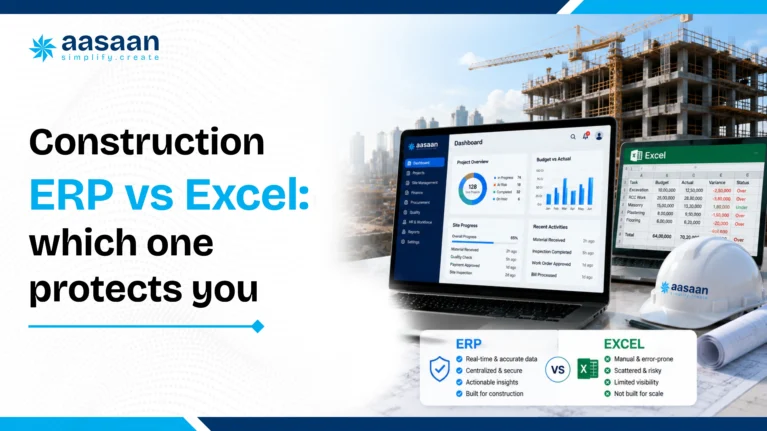
Construction ERP vs Excel: which one protects you
Excel served the construction industry well for decades, and plenty of builders still run entire projects through it today. The comparison below shows where a spreadsheet keeps up with a modern construction business and where it quietly falls behind.
| Aspect |
Excel and manual tools |
Construction ERP software |
| Data entry |
Manual, repeated across multiple sheets |
Automated, entered once and shared everywhere |
| Multi site visibility |
Limited, needs manual consolidation |
Real time across every project from one dashboard |
| GST and RERA reporting |
Manually compiled, prone to human error |
Automated and audit ready |
| Mobile access for site teams |
Rare and cumbersome |
Built in through mobile construction ERP apps |
| Version control |
Multiple copies floating across emails |
One shared, always current version |
| Scaling to new projects |
Requires rebuilding sheets from scratch |
New project added within minutes |
Construction ERP vs project management software is a related question worth separating clearly. Project management tools focus narrowly on schedules and tasks, while a true construction ERP system unifies scheduling with procurement, finance, payroll and sales. Builders who only need task tracking may find a lighter project management tool sufficient for a while, but growth almost always pushes them back toward a fuller construction management ERP once financial and compliance demands increase.
Do treat data migration as a planned project with a clear owner. Do involve site supervisors early since they generate most of the daily data. Do pick a vendor offering local language support and on ground training.
Avoid choosing a system solely on price without checking module depth. Avoid rolling out every module on day one across every site simultaneously. Avoid skipping a trial period before committing to annual billing.
Which construction ERP software fits your build size
Builder project management software needs shift considerably as a company grows from a handful of sites to dozens running in parallel. A small contractor managing two or three residential projects mostly needs procurement control and basic billing. A mid market developer running five to ten projects across a city needs multi project construction software with consolidated dashboards, sales CRM and payroll built in. A large enterprise builder managing multi site construction ERP across several states needs deep integrations, advanced analytics and dedicated support to match the scale of operations.
Real estate project management ERP needs also differ from pure contracting needs. A real estate developer selling flats alongside building them requires a strong sales CRM layered on top of construction tracking, connecting site progress directly to buyer communication and RERA disclosures. A pure contractor, by contrast, focuses more heavily on subcontractor billing, tendering and equipment management. Builders can explore how solutions map to company size to find the fit that matches their current stage of growth.
How Aasaan helps builders control every construction site
Aasaan approaches construction ERP software from the ground reality of Indian sites rather than a generic global template. Since most site supervisors and vendors already communicate through WhatsApp, Aasaan’s Meta verified WhatsApp integration turns that familiar chat window into a live project inbox, capturing bills, GRNs and daily updates the moment they happen rather than days later during a reconciliation exercise.
Raaya, Aasaan’s AI layer, extends this further. Sitewalk AI reviews site conditions for safety and quality issues, Intel AI studies spend patterns to flag cost overruns before they grow, Voice AI handles routine vendor negotiation calls, and Scanner AI reads handwritten and printed bills to remove manual data entry almost entirely. Together with modules covering purchase and inventory, project scheduling, attendance and payroll, billing, tendering, sales CRM and finance, Aasaan brings the full scope of a construction ERP system into one connected platform built specifically for builders operating across India.
“The software’s powerful tools for site labor tracking and inventory management have streamlined our operations, ensuring everything runs smoothly. It’s an indispensable tool for effectively managing a large workforce in the construction industry.” Abhilash Soman, General Manager, Millennium Engineers and Contractors Pvt. Ltd.
Builders dealing with recurring cost leakage on site often find the clearest starting point in procurement and billing, a pattern examined closely in this breakdown of common construction cost leakages. From there, most teams expand into scheduling, payroll and sales CRM as confidence in the system grows. Builders curious to see this in action can book a live demo and walk through their own project data rather than a generic sample.
A quick checklist to choose construction ERP software
How to choose construction ERP software comes down to matching features against the daily reality of a builder’s sites rather than chasing the longest feature list on a sales page. The steps below offer a structured way to evaluate any vendor.
Steps to evaluate a construction ERP system
- List every function currently spread across spreadsheets, apps and paper registers.
- Shortlist vendors offering modules that match this list rather than a generic global package.
- Confirm mobile access works reliably for site staff on patchy internet connections.
- Check GST and RERA reporting comes built in rather than as a separate add on.
- Ask for a trial period covering at least one full billing cycle on a real project.
- Involve site supervisors in the trial since they generate most of the daily data.
- Review onboarding and training support offered during the first three months.
- Compare total cost across at least three vendors before signing an annual contract.
Final checklist before signing
- Confirm data ownership and export options in case of a future vendor switch
- Verify integration availability with existing tools like Tally or SAP
- Check customer support responsiveness through an actual test query
- Review case studies from builders operating at a similar company size
- Confirm pricing scales predictably as project count grows
Frequently asked questions on construction ERP software
What is construction ERP software for builders?
Construction ERP software for builders is a connected digital system that manages project planning, procurement, billing, payroll, sales and compliance for a construction business, replacing scattered spreadsheets and paper records with one shared platform.
How does construction ERP work?
It works by connecting every function of a construction business, site progress, procurement, billing, payroll and sales, into a single database, so any update made in one place reflects instantly across the whole system.
Why do builders need ERP software?
Builders need ERP software to control cost overruns, protect schedules, simplify GST and RERA compliance and gain real time visibility across multiple sites, all of which grow harder to manage manually as a business scales.
What does construction ERP software cost in India?
Pricing depends on company size, module count and hosting type, with small builders typically paying less for core modules and larger builders investing more for full suites with advanced integrations and analytics.
Is construction ERP software suitable for small builders too?
Yes, many vendors offer construction ERP for small builders with a lighter set of core modules, letting a growing business add features like payroll and CRM as its site count and team size increase.
What features should construction ERP have?
A strong system should include mobile access, cloud hosting, automated GST reporting, live GPS tracking, WhatsApp integration and AI powered alerts for cost and schedule risks.
Construction ERP vs Excel, which should a builder pick?
Excel works for very small, single site operations for a limited time, but construction ERP software becomes the stronger choice once a builder manages multiple sites, vendors and compliance requirements simultaneously.
Does construction ERP software help with GST and RERA compliance?
Yes, a properly built construction ERP system automates GST return preparation from procurement and billing data, while also structuring project progress and fund utilisation data to match RERA reporting requirements.
Getting started with construction ERP software
Builders reading this far already sense the gap between where their business stands today and where a connected construction ERP system could take it. The path forward rarely requires a complete overnight overhaul. Most successful rollouts start with one painful area, procurement, billing or attendance, prove the value within a single project, then expand module by module as the team grows comfortable with the new workflow.
Construction ERP software for builders in India has moved from a nice to have upgrade to a competitive necessity, driven by rising buyer expectations, tighter RERA scrutiny and a construction sector that continues to grow faster than the manual systems most builders still depend on. Builders ready to see how a connected platform handles their own project data can book a demo with Aasaan and compare it directly against the spreadsheets currently running their business.


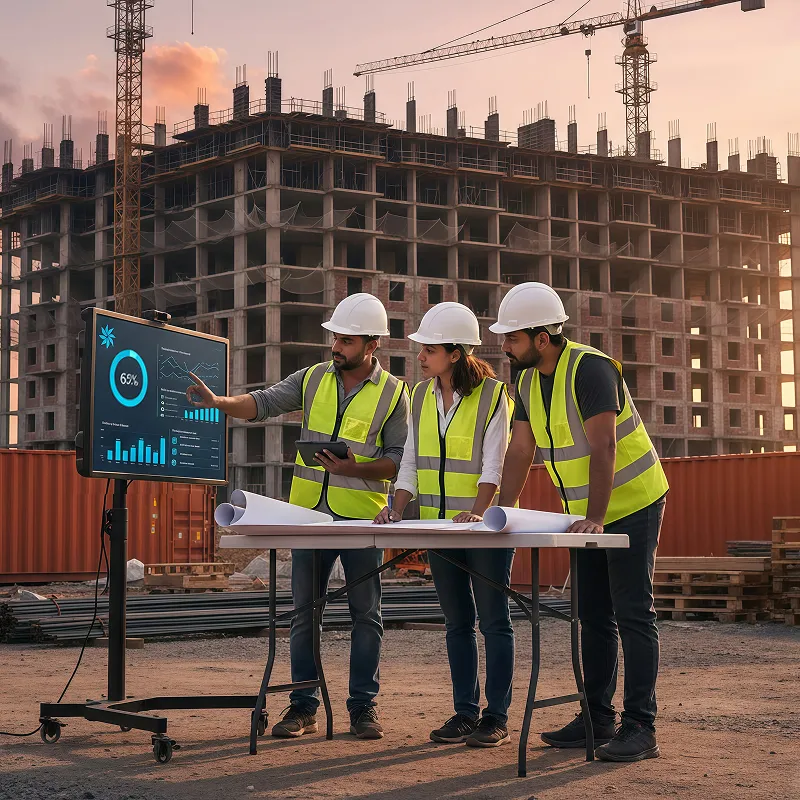

 Meta-Verified Business Integration Actionable project inbox with real-time alerts.
 Frictionless Stakeholder Collaboration Capture bills and GRNs directly to ERP.
 WhatsApp-Powered Sales CRM CRM chats with real-time sentiment analysis.
 WhatsApp-Powered Alerts & Reports Automated push notifications and daily reports.
 GPS - Live Tracking Real-time visibility of workforce and assets.
 Facial Scanning Secure, automated attendance via facial recognition.
 Labour Productivity Track workforce activity linked to payroll.
 Quote Comparison AI bots fetch and compare supplier rates.
 OCR - AI for Billing Auto-generate progress reports from site data.
 QR Based Asset Tracking Scan QR codes for instant asset history.
 Tally ERP Integration Seamlessly sync project data with Tally.
 Automated GST Compliance Automated GST compliance and reporting tools.