







































From site measurements to client payments
Construction billing software helps contractors turn measured site work into client bills, track what gets certified, and follow invoices through to payment. For Indian construction teams, the best fit connects BOQ items, running account bills, variations, retention and receipts while keeping an auditable record of what changed between billing cycles.

Marketing Manager, Aasaan Tech
The site team says 500 square metres are complete. The client signs off on 480. Accounts asks what to invoice, and the owner asks when the money will arrive. Four people are looking at the same work and asking four different questions. If your billing system answers them all with a single “bill amount,” it leaves everyone guessing.
This guide follows the money from site measurement to bank receipt. Use the worked RA bill to see where the amounts diverge, then take the same test to a software demo.
Published by Aasaan, a construction software provider. The comparisons below explain which type of tool fits each workflow. They are a buying framework, not an independent ranking of vendors.

What is the best construction billing software in India?
For a contractor submitting measurement-based running account bills, the best choice is software that can reproduce a previous bill, prepare the next one from cumulative measurements, explain every difference between the claim and the certificate, and trace part payments to the correct invoice. Start by testing those capabilities with one of your own bills.
Aasaan belongs on your shortlist if you want client and subcontractor billing and receivables tracking within a wider construction platform. Aasaan describes those workflows on its product site. Ask the demo team to show your exact billing format and verify how amendments, retention releases and accounting handoffs work in your proposed setup.
| If your main problem is… | Shortlist this type of software | Ask the vendor to prove… |
|---|---|---|
| Sending straightforward fixed-price invoices | An invoicing or accounting tool | Invoice format, ageing, part receipts and credit handling |
| Rebuilding monthly RA bills from measurements | Construction billing software with quantity-based progress billing | Previous, current and cumulative quantities, certificate revisions and bill exports |
| Linking billing with multiple sites, contracts and project records | A construction ERP with client billing | Project-level permissions and a trace from contract to certificate, invoice and receipt |
| Re-entering bills into an existing accounting system | A construction workflow connected to your accounting system | Which records transfer, how duplicates are blocked and how failed postings are resolved |
A product that prints an invoice well may still leave the billing engineer rebuilding the claim in Excel. A construction ERP may be more system than you need if you invoice at three fixed milestones and already have clean collection records. Buy for the part of the workflow that repeatedly breaks.

What is construction billing software?
Construction billing software manages the commercial records behind getting paid for project work. In a quantity-based contract, that can mean linking the work order and bill of quantities (BOQ) to measured work, an interim claim, client certification, an invoice and the receipts allocated to it. In a milestone contract, the starting point may instead be documented acceptance of a deliverable.
A running account bill, or RA bill, is an interim bill for work under an ongoing contract. Its statement often shows cumulative quantities and values, the previous cumulative position and the amount attributable to the current cycle. Your contract determines the format and basis.
There are two directions to keep straight. Client billing is the claim you submit to the employer or client. Subcontractor billing is the claim a trade contractor submits to you. The same work can be measured differently under the two contracts, at different rates and with different payment conditions. You can approve a subcontractor bill before the client certifies the corresponding work; that timing difference matters for cash planning. See Aasaan’s subcontractor RA bill guide for the payable side and the construction accounting guide for ledger and reconciliation workflows.

Choose the billing basis before designing your bill format
| Billing basis | What triggers a claim? | What to put in the demo |
|---|---|---|
| Item rate | Measured eligible quantity at the applicable contract rate | An item crossing a quantity limit or requiring a revised rate |
| Milestone | Evidence that a defined stage has been accepted | A milestone partly complete but not yet eligible to invoice |
| Time and materials | Eligible hours, plant usage or materials supported by agreed records | A signed timesheet and an item that exceeds the agreed cap |
| Mixed | Different rules for base scope, changes and reimbursables | One bill combining base BOQ work and an approved variation |
Read the payment clause, scope, rate schedules, variation procedure and documentation requirements before configuring software. A gate pass proves material arrived; it does not on its own make it billable. A progress photograph can support a claim; it does not replace the contractually required measurement or sign-off. Software should make those checks visible to the reviewer.

Set up the BOQ so the next bill can be reproduced
Give each contract item a stable code. Record its description, unit, contract quantity, rate, location breakdown where useful and the approved revision. A plastering line measured in square metres cannot silently inherit a cubic-metre rate because someone copied last month's template. Match on item code and unit, not just a similar description.
Keep the original contract and amendments separate. If a rate is revised, record the effective scope or date and the authorisation behind it. Overwriting the old rate can cause last month's certified value to change when a report is regenerated. Ask whether the software preserves a snapshot of submitted and certified versions.
When migrating from Excel, import one signed prior certificate as your opening position. Tie quantities and values item by item and reconcile retention, advances and receipts separately. If the prior certificate is incomplete, log the exception with an owner rather than filling it with a balancing number no one can explain.

Build a measurement pack a client can certify
Record the contract item, location, date, dimensions or count, unit, measurement reference and who checked it. Attach the evidence your contract calls for, such as a joint measurement record, a marked drawing, inspection acceptance or an approved variation instruction. Make the reference granular enough that a reviewer can locate the work without calling the site engineer.
Separate work observed, work eligible to claim, and work accepted by the client. For example, 20 m² may be complete physically but held pending an inspection. Keep it on an exception list with a follow-up date. If it is accepted next month, the team should be able to see where it came from without counting it twice.
A practical sign-off test: give the draft to someone who was not on site. Can they get from the largest line item to the source measurement and back in under a few minutes? If the answer is “only if I call the billing engineer,” fix the evidence trail before changing the layout of the bill.

Follow one client RA bill from measurement to cash
Consider a hypothetical plastering package at ₹400 per m². The previous cumulative certified quantity was 350 m². The new measurement supports a cumulative claim of 500 m². The client certifies 480 m² this cycle; the remaining 20 m² are held for inspection. Assume the same rate applies throughout and there are no prior-period rate changes.
| Step | Calculation | Amount |
|---|---|---|
| Previously certified work | 350 × ₹400 | ₹1,40,000 |
| Current claim before tax | (500 − 350) × ₹400 | ₹60,000 |
| Current certification before tax | (480 − 350) × ₹400 | ₹52,000 |
| Held from this claim | (500 − 480) × ₹400 | ₹8,000 |
| Example retention withheld | Contract amount supplied for this example | ₹2,600 |
| Example advance recovered | Contract amount supplied for this example | ₹4,000 |
| Expected cash on this simplified basis | ₹52,000 − ₹2,600 − ₹4,000 | ₹45,400 |
| Part receipt allocated to this bill | Matched to the bank receipt | ₹30,000 |
| Expected cash still to collect | ₹45,400 − ₹30,000 | ₹15,400 |
The ₹8,000 held is a certification exception. The ₹15,400 is expected cash still to collect on the simplified settlement basis. The ₹2,600 retention belongs in its own release schedule. Putting all three in a single “overdue” column sends your team chasing the wrong person.
This example excludes GST, statutory withholding, credit notes and other adjustments. Expected cash is a management figure, not the tax invoice value or a ledger balance. Have finance confirm the applicable treatment and timing for your contract before issuing or posting a document.
Client RA bill and collection calculator
Use the same unit across all quantities. This single-item example assumes one unchanged rate and excludes tax, statutory withholding and other adjustments. Enter zero for deductions or receipts that do not apply.
Want to see the full workflow with multiple BOQ items? Bring your bill to an Aasaan demo.

Running account bill format: what to include
Build the bill around three pieces: a cover sheet, an item-wise measurement schedule, and a settlement summary. Keep the previous signed certificate beside the current schedule so a reviewer can check the opening position before approving new quantities.
| Part of the bill | Fields to include | Review check |
|---|---|---|
| Cover sheet | Project, contract reference, RA bill number, period, revision and preparer | Does the bill reference the correct contract and revision? |
| Item schedule | BOQ item code, location, unit, agreed rate, previous certified quantity, cumulative claimed quantity and cumulative certified quantity | Can each quantity be traced to the source measurement? |
| Exceptions | Held quantity or amount, reason, owner and next review date | Can the next reviewer tell what can be resubmitted? |
| Settlement summary | Current certified value, separately identified deductions and linked invoice and receipt references | Can accounts explain the expected cash without adjusting the original measurement? |
This is a working layout. Use the format required by your contract and finance team where it differs.
A multi-item check before the bill goes out
Add two lines to the plastering example above. The contractor claims and receives certification for 5 m³ of concrete at ₹7,000 per m³. A separately approved variation is certified at ₹12,000 this cycle. The example assumes those two lines are eligible in full and have no prior amounts carried forward.
| Current-cycle line | Claimed before tax | Certified before tax | Held |
|---|---|---|---|
| Plastering | ₹60,000 | ₹52,000 | ₹8,000 |
| Concrete | ₹35,000 | ₹35,000 | ₹0 |
| Approved variation | ₹12,000 | ₹12,000 | ₹0 |
| Total | ₹1,07,000 | ₹99,000 | ₹8,000 |
Check the ₹99,000 against the signed certificate before applying any contract deductions. Don’t reuse the single-item calculator’s deductions for this three-line bill: their basis and amount must come from the actual agreement. If the plastering hold is released next cycle, check that the certified opening position remains 480 m² and that the 20 m² release is captured once.

Manage variations, rejected quantities and corrections
A variation should have its own reference, scope, approval status, rate basis and measurement links. A site instruction to proceed and commercial approval of a rate may be separate events. Keep pending changes visible as exposure without silently counting them in approved billing. If the client approves part of the variation, preserve what remains unresolved and why.
Record rejected or held work against the specific line. “Client reduced bill by ₹8,000” is less useful than “20 m² held in Zone B pending inspection; owner: site engineer; recheck at next certification.” Distinguish a temporary hold from a permanent rejection or a rate dispute. The next reviewer should know whether to resubmit with evidence, escalate commercially or close the item.
Test a correction after submission. Can you show the original, revised version, reason and approver? If an invoice was already issued or posted, follow the finance team's controlled correction process instead of silently deleting and recreating it.

Track retention, advance recovery and deductions independently
Retention is an amount withheld under the contract and tracked against release conditions. Record the amount, contract cap where relevant, release trigger, required evidence and any actual releases. The date work finishes may not be the date retention becomes collectible.
Advance recovery reduces an outstanding advance according to the agreement. Keep an opening balance, amount recovered this cycle and remaining balance. If there are multiple advances, link each recovery to the relevant advance rather than deducting an unidentified lump sum.
Other deductions should have their own reason and reference. A contractual backcharge, statutory withholding and an unapplied payment can all affect the cash you see, but they require different responses. Ask the vendor to show how the bill, expected remittance and financial records can be reconciled without treating the same amount as two deductions.

Separate the RA statement, certification and tax invoice
A submitted RA statement explains what you are claiming. Certification records what the authorised party accepts under the contract. A tax invoice is a separate financial document subject to applicable rules. Your process must respect statutory invoice timing; don't assume a delayed certificate automatically changes a statutory deadline.
Ask finance to confirm document numbering, customer registration details, place of supply, classification, applicable tax treatment, and any e-invoicing requirements for the entity and transaction. Test these in a representative scenario before going live. CBIC’s circular on invoice particulars and place of supply is a useful official reference for that specific issue; it is not a complete GST checklist. This guide does not prescribe tax rates, thresholds or the accounting treatment of retention or withholding.

Turn the receivables report into a weekly action list
Run four queues rather than one total: eligible work not yet submitted, claims awaiting certification, invoices awaiting settlement, and retention awaiting release. Give each row an owner, next action, date and source document. Keep cash receipts that are not yet allocated in a separate review queue so the system does not close an invoice by guesswork.
For each open invoice, record what is due under the agreed terms, what was received, and what remains unexplained. If one bank transfer covers several invoices, allocate it deliberately and retain the remittance advice. If part of the amount was withheld and finance can identify the basis, reconcile it separately instead of marking it as paid in cash.
At the weekly review ask: Which three items have the most cash at stake? Which are waiting on us? Which need the client's decision? What evidence could move each one forward before the next review? That gives the site and finance teams work they can actually do.

Can you keep Tally or your current accounting system?
Yes, keeping the ledger and improving how the site prepares bills is a valid buying approach. Decide which system owns customer masters, invoice numbering, credit adjustments, receipt allocation and period close. Where an integration exists, ask exactly what moves, which direction it moves and how the team resolves exceptions.
Give the vendor a deliberate failure test: export the same invoice twice, edit a field after posting, and try a customer code that does not exist in the destination. Watch whether the system blocks, flags or silently duplicates the entry. Ask who sees the error and how you reconcile the corrected record. A connector label on a slide does not answer those questions.

Run this construction billing software demo before buying
Prepare your demo pack
Your selections stay on this page and reset when you reload.
Bring an anonymised prior certificate, one current BOQ claim, a held measurement, a variation and a part payment. Ask the vendor to recreate the previous position, prepare the next bill, certify it partially and show the invoice and settlement trail. Use the same documents and acceptance criteria for every vendor.
| Demo task | Evidence that it passed |
|---|---|
| Open a previous bill | Prior certified quantities and amounts tie to the signed certificate |
| Raise the current RA bill | Item-wise current amounts reconcile to cumulative less prior on the agreed basis |
| Certify only part of a line | Original claim is preserved; hold has a reason and a next action |
| Apply one retention and one recovery | Both can be traced to their own schedules without double deduction |
| Record a part receipt | Receipt matches the correct invoice and remaining balance stays visible |
| Export and hand off the bill | Reviewer can reproduce totals, open attachments and identify the revision |
| Correct or retry a posting | Error is visible and the corrected record does not create a duplicate |
Get the pass, workaround or gap recorded in writing. A manual workaround may be fine for one monthly bill. Multiply it across sites and billing cycles before accepting it as your standard process.

Score the demo before discussing price
Use three results for each task: passed live, requires a workaround, or not demonstrated. A vendor saying it can configure a feature is useful information, but it is not the same as watching your team complete the task.
| Decision criterion | Minimum proof | When to treat it as a deal breaker |
|---|---|---|
| Previous certified quantities | Reopen a signed prior certificate and reproduce its totals | Your next claim depends on carrying forward those quantities |
| Partial certification | Keep the submitted claim visible beside the accepted quantity | The client routinely certifies less than you submit |
| Settlement | Trace a part receipt and show the remaining collectible balance | Collections are spread across several projects or invoices |
| Data handoff | Export one reviewed bill with references another team can use | Finance must keep its current accounting system |
Have the billing engineer and accountant score the same demo independently. If they disagree, rerun the step with a real record and identify who would own the workaround. Put any unproven must-have in the proposal as an acceptance condition.

What affects construction billing software pricing?
Compare the whole cost of getting a bill from site to finance: user access, setup, BOQ imports, historical certificate migration, exports, integration, templates, support and training. Ask how pricing changes as you add projects, billing engineers, reviewers and finance users. Verify which features are included in the quoted configuration.
For a fair comparison, have each vendor quote the same scenario: your project count, number of users by role, billing cadence and accounting handoff. Compare the recurring price and first-year implementation effort separately. Include how you would retrieve your bill history and attachments if you leave.

Roll it out on one project before standardising
Choose a project with a dependable prior certificate and a billing engineer who can explain exceptions. Agree the cut-off date, source-of-truth records and acceptance checks. Load the contract and opening balances. Run one cycle alongside the existing process, compare line items and resolve discrepancies before making the new system authoritative.
Measure time from measurement cut-off to submission, value returned for missing evidence, time from certification to invoice, and open amounts by queue. Compare like-for-like cycles; a larger or more disputed bill can take longer for reasons unrelated to the software. Only expand after the team can reproduce a signed bill and explain each outstanding amount without rebuilding a separate spreadsheet.

How Aasaan fits the client billing workflow
Aasaan publicly describes client and subcontractor billing, payment management and receivables visibility as part of its construction platform. Start there if the problem is scattered across site and finance. In the demo, ask to see your previous bill, your next claim and your real collection report. Confirm the handling of your measurement format, approval rules and accounting handoff before committing.
If the main bottleneck is the evidence for completed work, start with how site updates are collected and accepted. If invoices are already clean but customers pay late, focus on allocation, ageing and follow-up ownership. A good demonstration should spend most of its time where your current process loses time or leaves money unexplained.
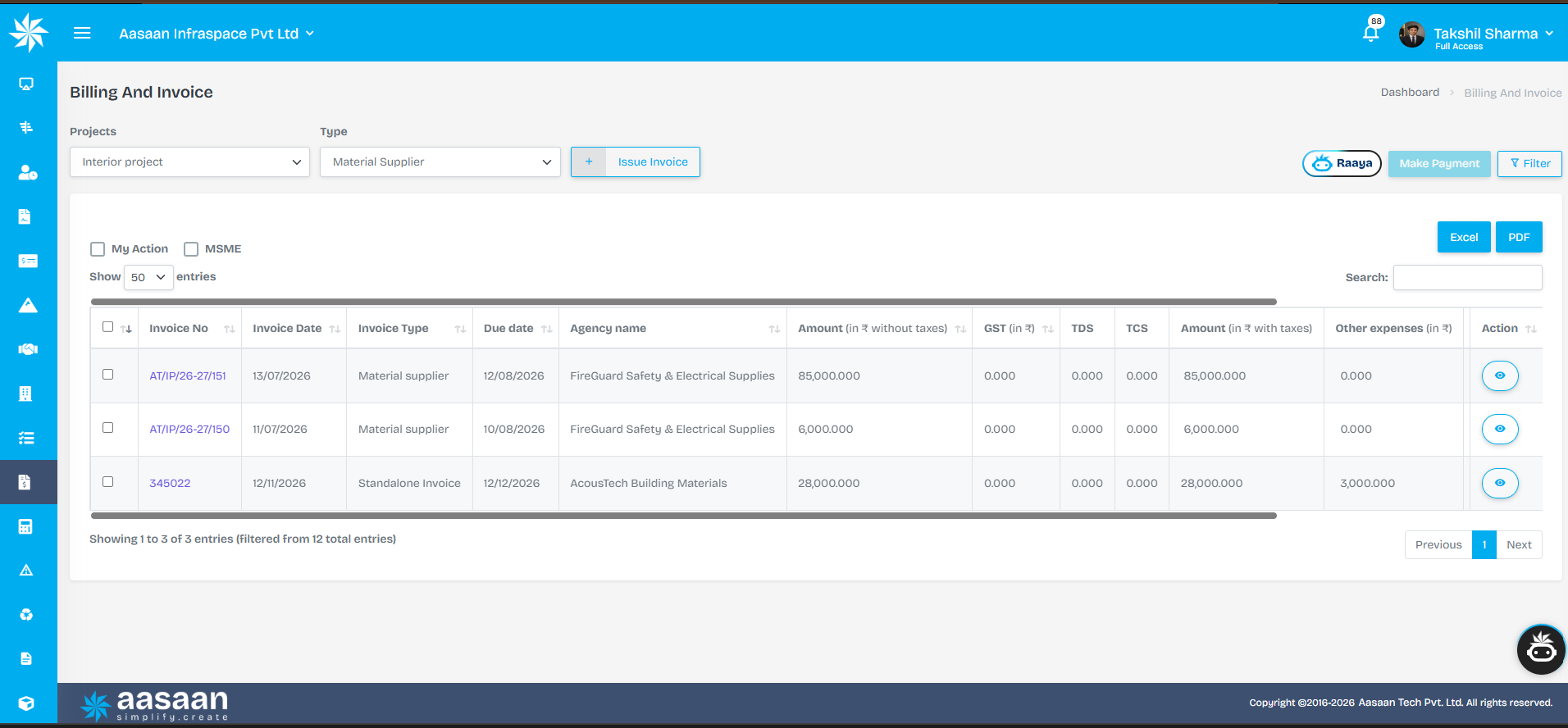
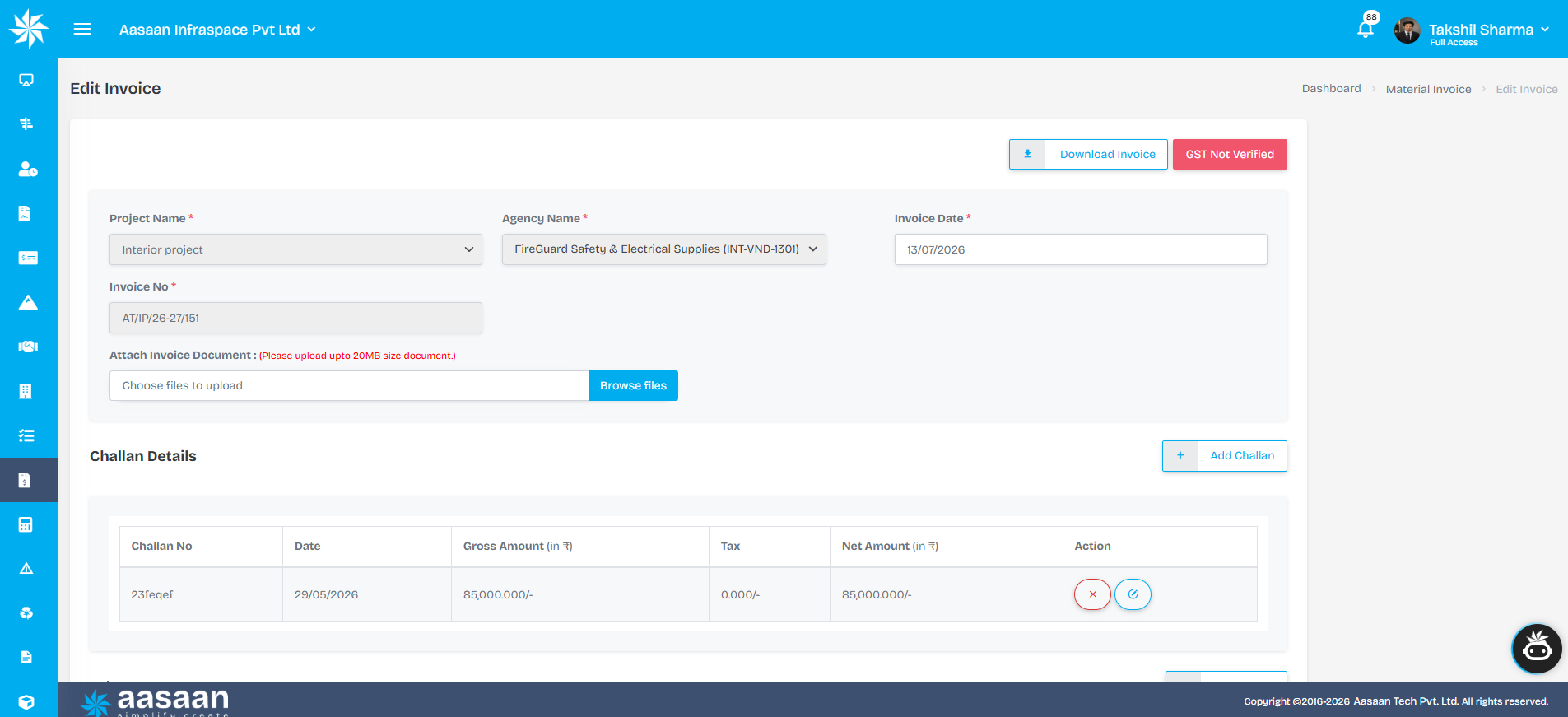
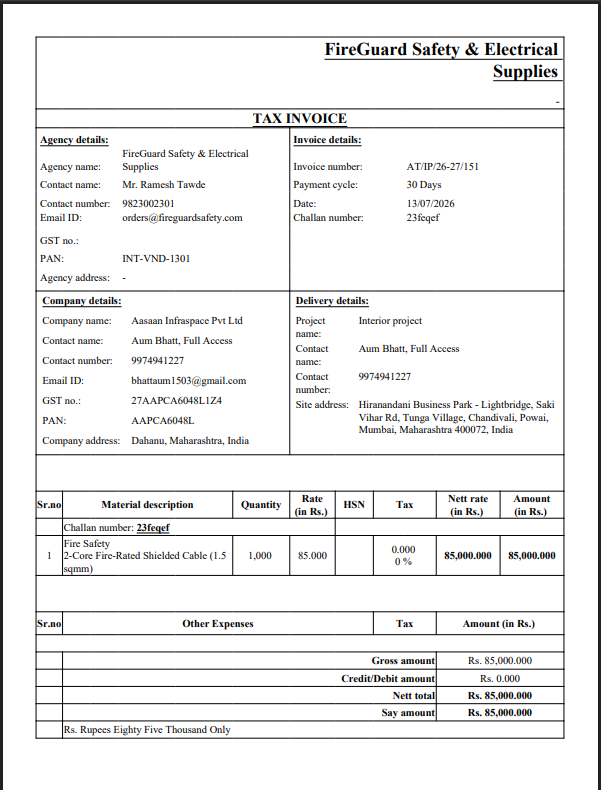
Supplier billing screens in Aasaan
These screenshots use Aasaan demo data and show the supplier side of billing, from the invoice list to the linked challan and downloaded invoice.

Close the final bill without losing the interim history
Start with the last certified cumulative position. Reconcile final measurements and approved variations, then separate disputed lines, pending credits and retention that remains subject to release conditions. Keep final certification, settlement and retention release as separate events so closing one does not accidentally close the others.
Before archiving the job, export the signed certificates, measurement references, approvals, invoice register and receipt allocations. Give finance a list of balances still open and give the project team a list of evidence still owed. If the contract requires a completion document or another release condition, record who is responsible for producing it.

Frequently asked questions
What is the difference between construction billing software and accounting software?
Billing software supports the workflow from claim preparation to certification and collection tracking. Accounting software keeps the financial records and supports tasks such as posting, reconciliation and period close. Some products overlap. The buying test is whether your team can trace a disputed amount from the ledger or invoice back to the original project evidence without guessing.
Is RA billing software the same as an invoice generator?
An invoice generator creates the document that requests payment. RA billing software should also let you work from previous and cumulative quantities or other contract-defined progress, show what was certified and track changes. If you only invoice at a fixed milestone, a simpler tool may suffice. If you revise multi-line claims every month, insist on seeing the item-level history.
Can I create construction bills in Excel?
Yes. Excel is practical for a small number of contracts with controlled templates and a reliable review process. Reconsider when copied quantities, inconsistent versions or missing receipt allocation make prior balances hard to reproduce. Use a signed prior certificate and one messy current claim to compare the spreadsheet workflow with any software you shortlist.
How do I avoid billing the same work twice?
Use stable item and location references and carry forward the agreed previous position. Reconcile current, cumulative and prior values each cycle. Mark held quantities separately and tie resubmitted items to their original measurement. If a change affects a prior certified item, keep an approved adjustment trail rather than modifying the old certificate in place.
Does retention mean the client is overdue?
Not necessarily. Retention may remain held until a contract condition is met. Track the held amount, release trigger, evidence and due date separately from ordinary invoice follow-ups. Once release is due, assign an owner to confirm acceptance and pursue the payment under the contract.
Can construction billing software handle partial payments?
Look for invoice-level allocation, a remaining-balance view and visibility of unapplied cash. In the demo, use one payment against two invoices and a second case where only part of one invoice is paid. Confirm the system shows the source receipt and the remaining amount without closing either invoice prematurely.
Is GST billing alone enough for a civil contractor?
It can be enough for straightforward invoices where the project records are already controlled elsewhere. For measurement-based civil work, the gaps often appear before the tax invoice: cumulative quantities, exceptions, approval and evidence. Make sure those records can be tied to the issued invoice while finance controls the applicable tax settings.
What should I take to an Aasaan demo?
Bring an anonymised BOQ extract, one prior certified bill, a current claim with a disputed item, and a partial receipt. Ask the team to walk through your records in sequence. Judge the demo on whether your billing engineer and accountant can both explain the same outstanding balance and identify the next action.

See your client billing workflow in Aasaan
Bring one real billing cycle with sensitive details removed. Walk through your BOQ, the latest certified amount and a payment that did not settle the bill in full. Leave the demo knowing which steps can move into Aasaan and which require a separate accounting workflow.