



































AASAAN RESEARCH • CTS 2026 VISITOR GUIDE
Construction Technology Show 2026 Mumbai: Event Guide
A practical, independent guide to the technologies, conversations and people you can expect at Mumbai’s Construction Technology Show and how to turn two busy exhibition days into useful decisions for your projects.
Quick answer
Construction Technology Show 2026 Mumbai is scheduled for 19-20 August 2026 at Grande Hall, NESCO Bombay Exhibition Centre, Goregaon East. Organised by ASAPP Info Global Services, the publisher behind Construction World, the event brings construction, infrastructure, architecture, real estate and technology professionals together around BIM, digital twins, AI, construction ERP, robotics, drones, IoT, prefab, smart buildings and PropTech. If you are evaluating connected site and office workflows, meet Aasaan at Stall A15 for a focused demonstration.
About Construction Technology Show 2026
CTS 2026 is a focused Construction Technology and PropTech exhibition and conference for the people, systems and ideas shaping India’s built environment.
Construction Technology Show 2026 is organised by ASAPP Info Global Services. ASAPP is the media and events group behind Construction World, Equipment India, Indian Cement Review and Indian Infrastructure. The organiser states that it has worked across India’s infrastructure, construction and building materials ecosystem for more than three decades.
The event brings builders, EPC contractors, infrastructure developers, architects, consultants, government authorities, procurement teams, investors and technology innovators together in Mumbai. The official programme includes an exhibition floor, live product demonstrations, conference discussions, workshops, curated B2B and B2G networking, a start up pavilion, an industry report launch and the ConTech Innovation League.
That focus matters. Construction buyers rarely struggle to find another list of products. They struggle to understand which tools will survive real site conditions, connect with existing processes and produce measurable value. CTS gives teams a chance to see workflows demonstrated, question the people behind them and compare approaches in the same visit.
WHEN
19-20 August
Two exhibition and conference days in 2026.
WHERE
Grande Hall
NESCO Bombay Exhibition Centre, Goregaon East, Mumbai.
ORGANISED BY
ASAPP Info Global Services
The publisher behind Construction World and other infrastructure media brands.
MEET AASAAN
Stall A15
Live conversations around connected construction operations.
Why CTS 2026 Matters
India’s project pipeline is becoming more ambitious while delivery remains intensely local. A developer may run several sites, an EPC contractor may coordinate hundreds of packages, and a site engineer may still receive crucial evidence through calls, spreadsheets and WhatsApp. Technology creates value only when it closes that gap between management intent and site execution.
Execution over novelty
The useful question is no longer “Do you have AI?” It is “Which approved process becomes faster, more reliable or more visible?”
Connected project data
Schedules, quantities, materials, drawings, labour, bills and site evidence become more valuable when they share context.
Adoption at the edge
A polished dashboard cannot compensate for a workflow that supervisors, vendors and engineers avoid using.
A Construction World roundtable held ahead of CTS highlighted the same shift: the industry needs to move from discussion and pilots toward deployment at scale. That makes this event useful for leadership teams considering a transformation programme and for operational teams who know exactly where today’s process breaks.

Event Highlights
Live demonstrations
Watch a complete process rather than a slide presentation. Ask vendors to use a realistic project example.
Conference and workshops
Hear how leaders approach adoption, ROI, AI, digital engineering and execution at scale.
B2B and B2G networking
Meet technology teams, contractors, developers, public sector stakeholders and potential partners.
Innovation League
Explore start ups addressing productivity, safety, sustainability, project management and automation.
PropTech and smart systems
Compare tools serving development, building performance, operations and urban infrastructure.
Industry awards
The published Day 1 programme connects with the Construction World Architect & Builder and ConTech Awards.
Who Should Attend?
| Role | What to investigate | Useful outcome |
|---|---|---|
| Builders and developers | Portfolio dashboards, procurement, cost control, CRM, handover and operational reporting | A phased digital roadmap tied to project outcomes |
| EPC contractors | Planning, subcontractor coordination, quantities, documents, plant, quality and safety | Better control across packages and work fronts |
| Architects and consultants | BIM, CDE/DMS, drawing revisions, RFIs, approvals and site observations | A reliable design to site information flow |
| PMCs and project leaders | Progress evidence, risk, issue ageing, inspection workflows and client reporting | Standard controls without duplicate reporting |
| Procurement and finance | Indents, comparisons, POs, GRNs, stock, measurements, RA bills and integrations | An auditable path from demand to payment |
| Site engineers and supervisors | Mobile usability, WhatsApp inputs, offline realities, photos and daily reports | Less repetitive entry and faster escalation |
| Government and infrastructure teams | Governance, smart infrastructure, monitoring, geospatial systems and compliance | Greater transparency across large programmes |
| Investors and innovators | Problem depth, implementation readiness, distribution and proof of adoption | Stronger pilots and partnerships |
Technologies You Will See
Construction ERP
Connected workflows for procurement, inventory, contracts, billing, finance context and portfolio control.
BIM and digital twins
Model led coordination and digital representations that support decisions across the asset lifecycle.
AI and predictive analytics
Document extraction, visual analysis, natural language access, risk signals and decision support.
Drones, GIS and geo tagging
Surveying, mapping, progress evidence, quantities and spatial visibility across large sites.
Robotics and automation
Mechanised and autonomous approaches to repeatable, hazardous or precision heavy work.
IoT and smart jobsites
Connected equipment, environmental sensors, worker safety and real time condition monitoring.
Prefab and modular
Manufacturing led construction that depends on strong design, logistics and quality coordination.
AR, VR and 3D printing
Immersive reviews, training, constructability communication and emerging production techniques.
Sustainable construction
Energy efficiency, smarter materials, waste reduction and performance led building systems.
Do not evaluate a category in isolation. A drone survey is more valuable when its evidence connects to locations and activities. OCR is more useful when extracted data enters an approval workflow. BIM delivers more value when teams control revisions and field access. Integration is where many impressive demonstrations either become operational or stall.
How to Explore the Main CTS Technology Categories
The official event material covers a broad technology ecosystem. Visitors can make sense of it by grouping solutions according to the stage of construction they influence and the information they need.
Planning, design and digital engineering
BIM, digital twins, common data environments, GIS and design coordination platforms sit near the beginning of the project information chain. Ask how models, drawings, schedules, quantities and specifications stay aligned as revisions occur. A strong demonstration should show who publishes information, who reviews it, how status is communicated and how field teams know that they are using the current approved version.
Digital twin claims deserve careful questioning. Some solutions use the term for a visual model, while others connect live asset or project data to a digital representation. Ask which physical systems or project records supply updates, how frequently the information changes and which decisions the twin supports.
Project controls and construction ERP
Project controls tools can cover schedules, quantities, progress, costs, risks, resources and reporting. Construction ERP platforms extend into procurement, inventory, contracts, billing, finance context, labour and assets. The categories overlap, so examine the complete workflow rather than relying on labels.
Ask how the system connects an approved plan with daily execution. Can a delayed activity show its material, drawing, labour or access constraint? Can a measured quantity support progress reporting and billing without repeated entry? Can management move from a portfolio exception to the original project evidence?
AI, analytics and document intelligence
AI solutions may analyse images, extract information from documents, classify messages, answer questions, predict risks or help automate routine work. The quality of the result depends on the available data and the controls around it. Ask what information the model uses, how users verify an output, how corrections are recorded and whether confidential project data is used to train external models.
A good AI use case has a clear user and action. Extracting fields from a delivery document can reduce entry effort. Analysing site images can help prioritise review. Summarising open constraints can help a project leader focus attention. A vague promise to transform decision making is not enough without a defined workflow.
Drones, surveying and geospatial technology
Drones and survey systems can support topographic work, progress capture, volumetric measurement, inspection and mapping. Ask about flight permissions, accuracy, ground control, processing time, repeatability and the method used to compare surveys across dates. Also ask how outputs connect to project locations, quantities and reports.
Robotics, automation and smart machinery
Automation can improve consistency, productivity and safety in repetitive or hazardous work. The business case should include setup time, operator capability, maintenance, site conditions, utilisation and the volume of suitable work. Ask to see operating evidence from an environment comparable to your own.
Connected machinery can generate data about location, operating hours, idle time, fuel, condition and productivity. That information is valuable when ownership is clear and maintenance or allocation decisions follow.
IoT, smart buildings and jobsite safety
IoT solutions can monitor equipment, access, environmental conditions, energy use, worker location and building systems. Ask about sensor reliability, battery life, connectivity, calibration, alert thresholds and the process that follows an alert. Too many low quality alerts can cause teams to ignore the system.
Smart building technologies extend the conversation beyond project completion. Building management, HVAC, energy, security and occupancy systems influence operational performance. Developers should consider how information will be handed to facility teams and maintained across the building lifecycle.
Prefab, precast and modular construction
Industrialised construction moves more work into controlled production environments, but it increases the need for early design decisions, dimensional accuracy, production planning, logistics and installation coordination. Ask exhibitors how they manage design release, manufacturing status, quality evidence, transport sequencing and site readiness.
Sustainable materials and energy efficiency
Sustainability claims should connect to measurable boundaries. Ask whether evidence covers embodied carbon, operational energy, water, waste, durability, maintenance or end of life. Understand the test method, certification, comparison baseline and local project conditions.
For products that promise energy savings, ask how performance is commissioned and monitored after handover. For material innovations, assess availability, specification support, installation requirements and supply reliability in addition to laboratory performance.
Exhibitor Categories
The official event material groups exhibitors across software and digital engineering, hardware and equipment, building systems and materials, and smart buildings and IoT. Use these categories to create a balanced route.
Software and digital engineering
BIM, digital twins, construction ERP, SaaS, AI, analytics, AR/VR, GIS and geo tagging.
Hardware and field technology
Drones, survey tools, robotics, automation, smart machinery and safety solutions.
Building systems and materials
Concrete, precast, prefab, smart products, façades, roofing and advanced materials.
Smart buildings and IoT
Building automation, HVAC, energy management, surveillance, safety and connected operations.
Conference Sessions
The organiser’s published agenda frames Day 1 around adoption, ROI and real on ground use cases. Themes include making construction technology work on site, practical AI deployment, and the people process data foundations required for scale. The published programme then connects to the Construction World Architect & Builder and ConTech Awards.
Day 2 focuses on execution at scale. Announced themes include data centre construction in India, the ConTech Venture Arena and the ConTech Innovation League start up pitch forum. These subjects are valuable because they move the conversation beyond feature catalogues: data centres expose the need for precision and commissioning discipline, while the venture and innovation sessions show which problems founders and investors believe are worth solving.
| Theme | Listen for | Question to take back |
|---|---|---|
| Technology adoption | Why pilots fail between leadership and site teams | Who owns adoption after go live? |
| Practical AI | Data readiness, validation, workflow fit and measurable ROI | What decision improves not merely what task is automated? |
| Data centres | Speed, precision, reliability and commissioning coordination | Which controls transfer to our projects? |
| Innovation and ventures | Problem first solutions and routes from pilot to scale | What evidence would justify a pilot? |
A Closer Look at the Official CTS 2026 Programme
The published programme is built around a central industry question: how can construction organisations turn technology interest into reliable execution at project scale?
Day 1 focus: adoption, return and practical use
The opening day is presented around adoption, return on investment and real project use cases. The opening keynote, titled Intent to Execution: Making Construction Technology Work on Site, addresses the distance between leadership vision and field reality. This is a valuable subject because many digital programmes are approved at head office but depend on engineers, supervisors, contractors and vendors who work under very different conditions.
The published discussion points include the reasons technology initiatives can stall after pilot stages, the final connection between strategy and site execution, and the need to align people, process and technology. Visitors should listen for specific implementation practices: who owns the rollout, how workflows are redesigned, how data quality is checked, how resistance is handled and what operational measure proves that adoption is working.
Artificial intelligence is another important Day 1 theme. The official agenda focuses on practical applications in safety monitoring, quality control and delay prediction, along with data readiness and workforce capability. This is more useful than a general conversation about AI because construction decisions carry commercial, contractual and safety consequences. Visitors should ask where human approval remains necessary, what source evidence supports an AI result, and how the system behaves when information is incomplete.
Day 2 focus: execution at scale
The second day opens with data centre construction in India. Data centres are a useful lens for construction technology because they require precision, rapid delivery, coordinated services, rigorous commissioning and high operational reliability. Even companies outside the data centre sector can learn from the controls used to manage technical interfaces, changes, tests, documentation and completion readiness.
The ConTech Venture Arena examines where construction innovation is coming from and how start ups, investors, accelerators, developers and EPC companies can work together. The central challenge is not simply inventing a product. It is proving that the product solves a frequent, costly problem and can be implemented inside existing project structures.
The ConTech Innovation League gives selected innovators an opportunity to present solutions to an industry audience. Visitors can expect ideas across productivity, project management, workforce optimisation, safety, sustainability, automation and digital transformation. When assessing an early stage solution, ask for the problem definition, target user, evidence from a live environment, integration requirements, commercial model and support plan.
Announced CTS 2026 Speakers
The official CTS website currently lists leaders from public infrastructure, highways, academia, digital engineering, construction technology and engineering consultancy.
PUBLIC INFRASTRUCTURE
Lt. Gen. Rajeev Chaudhry
Director General
Border Roads Organisation, BRO
His perspective can help visitors understand technology adoption across large, complex and strategically important infrastructure programmes.
HIGHWAYS AND INFRASTRUCTURE
Sudhir Hoshing
CEO
IRB Infrastructure
Visitors can expect an owner and operator perspective on infrastructure execution, scale, risk, performance and technology led delivery.
ACADEMIA AND RESEARCH
Dr. Ravindra Gettu
Professor
IIT Madras
His academic viewpoint can connect construction innovation with evidence, materials knowledge, research and practical industry application.
CONSTRUCTION TECHNOLOGY
Harsh Pareek
Regional Director
Trimble
His contribution can bring insight into digital construction, connected project information, field technology and implementation at scale.
DIGITAL ENGINEERING
Dr. Amit Barde
Head, Digital Engineering
L&T Construction
Visitors can learn from a major contractor perspective on digital engineering, adoption, integration and active project execution.
ENGINEERING CONSULTANCY
Aditi Kulkarni
Director
Buro Happold
Her perspective can connect design, engineering coordination, sustainability and future ready project delivery.
This mix matters because construction technology cannot be understood from one viewpoint. Public infrastructure leaders can discuss scale and governance. Contractors can explain execution pressure. Academic experts can bring research and evidence. Technology specialists can describe what is technically possible. Engineering consultants can connect design, sustainability and performance.
Good conference notes capture more than quotations. Write down the operational problem, the proposed intervention, the conditions required for success and the measure used to judge the result. This turns a presentation into a useful input for internal planning.

Understanding Visitor, Delegate and Buyer Access
The official CTS website currently describes three access routes. The free visitor pass includes the exhibition floor, live product demonstrations and general networking. A delegate pass adds conference access, workshops, networking lunch and the announced industry report. A VIP Buyer Pass is available by application and is described as including delegate access, curated meetings and VIP lounge access for verified senior decision makers.
| Pass type | Published access | Best suited to | What to verify |
|---|---|---|---|
| Free Visitor Pass | Exhibition floor, live demonstrations and general networking | Professionals focused on products, suppliers and informal conversations | Entry timing, registration confirmation and any restricted sessions |
| Delegate Pass | Visitor access plus conference, workshops, lunch and industry report | Leaders and specialists who want structured learning with exhibition access | Current price, session capacity, workshop booking and meal arrangements |
| VIP Buyer Pass | Delegate access plus curated meetings and VIP lounge | Verified senior buyers with active technology or procurement priorities | Eligibility, application approval and meeting process |
Pass terms can change, and some activities may require advance confirmation. Register through the official Construction Technology Show 2026 website, use a business email where requested, and retain the confirmation message. The official form requests details such as full name, company name, company email, mobile number, designation and city. If several colleagues are attending, make sure each person has the correct access rather than assuming one registration covers the group.
Teams can divide responsibilities. A project control lead might attend adoption and data discussions. A procurement lead can compare commercial workflows. A digital engineering specialist can focus on BIM, digital twins and common data environments. A site representative can test usability and reporting effort. Reuniting at fixed times allows the group to compare findings without walking the entire show together.
Planning Your Visit
Two weeks before: register through the official event page, review the current agenda and exhibitor information, invite the internal colleagues needed for serious evaluation, and send vendors a short description of the workflow you want to see.
On Day 1: orient yourself, attend the adoption focused sessions and run first round demonstrations. Record answers in one comparison sheet. Do not rely on memory after a full exhibition day.
On Day 2: revisit the strongest candidates with sharper questions. Use the workshops and innovation sessions to test your assumptions. End the day with named owners, next actions and dates not vague promises to reconnect.
ADD AASAAN TO YOUR ROUTE
Bring your workflow to Stall A15
Tell us what is breaking today. We’ll keep the discussion grounded in your project roles, approvals and site realities.
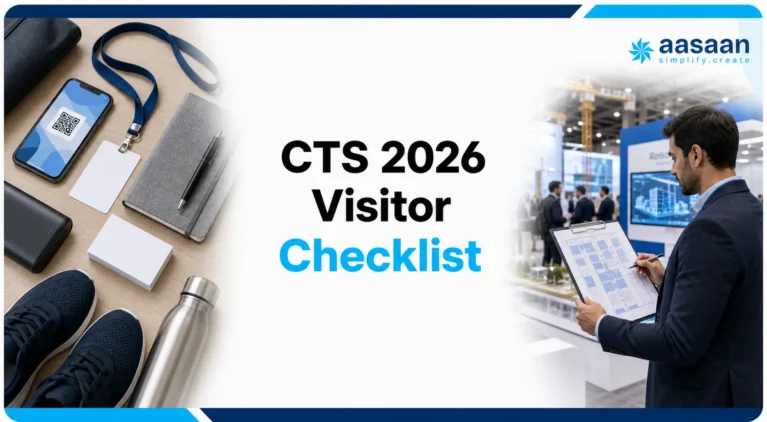
CTS 2026 Visitor Checklist
- Complete official registration and save confirmation
- Verify current pass inclusions and conference access
- Shortlist no more than eight priority exhibitors
- Book important demonstrations in advance
- Write three operational problems in plain language
- Carry sample, non confidential workflow scenarios
- Prepare questions on implementation and support
- Ask about integrations, APIs and data ownership
- Note security, permissions and audit requirements
- Carry a charger or power bank
- Wear comfortable shoes and business casual clothing
- Allow extra time for Mumbai traffic and rain
- Photograph badges/cards only with permission
- Score each solution immediately after the demo
- Assign an owner to every useful follow up
- Visit Aasaan at Stall A15

Networking Opportunities
CTS is useful because the room mixes technology providers with people who commission, design, deliver, procure and operate projects. The highest value conversation may not be a sales meeting. It may be a peer explaining why a rollout failed, a consultant describing a data standard, or a start up proposing a narrow solution to a persistent site problem.
Prepare a 20 second introduction
State your role, project type and the single problem you are exploring. Specificity makes it easier for people to help.
Ask implementation questions
“What changed for the site team in week one?” often reveals more than “What features do you offer?”
Follow up within 48 hours
Reference the actual conversation, include the agreed item and propose one clear next step.
Use curated meetings, lunch areas, workshops, the exhibition floor and the awards/networking programme differently. A scheduled buyer meeting can support detailed evaluation; a workshop supports technical learning; an informal break is better for candid peer exchange.

Mumbai Travel Guide for CTS 2026
Grande Hall is at NESCO Bombay Exhibition Centre in Goregaon East, a major exhibition complex along Mumbai’s Western Express Highway corridor. August falls in Mumbai’s monsoon season, so build weather and traffic resilience into your plan.
| Need | Practical guidance |
|---|---|
| Air travel | Chhatrapati Shivaji Maharaj International Airport is the main airport. Road time varies sharply; avoid planning a tight connection around peak traffic. |
| Rail/metro | Goregaon is the nearest major suburban rail area. Metro and last mile options depend on your starting point; check live routing on the day. |
| Road arrival | Use “NESCO Bombay Exhibition Centre, Goregaon East” as the destination and confirm the active visitor gate in official instructions. |
| Hotel location | Goregaon East, Andheri East and nearby Western Express Highway areas can reduce cross city travel. Compare distance at your actual arrival time. |
| Monsoon | Carry an umbrella, protect electronics and documents, and leave a buffer for heavy rain. |
| Parking | Do not assume availability or a specific gate. Verify current organiser/venue advice before driving. |
Questions to Ask Every Construction Technology Exhibitor
The exhibition floor becomes more valuable when every serious vendor is assessed through the same practical questions.
| Evaluation area | Questions worth asking |
|---|---|
| Business problem | Which recurring construction problem does this solve? Which role feels the improvement first? What process changes are required? |
| Project fit | Which project types, contract structures, company sizes and regions are best suited to the solution? |
| Workflow depth | Can the exhibitor show the complete path from input through review, approval, exception and reporting? |
| Field adoption | How much training does a site user need? What happens with weak connectivity? Which languages, devices and familiar channels are supported? |
| Data quality | How is information validated? Who can correct it? Is the original evidence preserved? How are duplicates handled? |
| Integration | Which systems connect today? Is the integration standard or custom? Who maintains it? How are failed exchanges identified? |
| Security | How do roles, permissions, audit logs, authentication, backups and incident processes work? |
| Implementation | Who owns discovery, configuration, data migration, training, testing and post launch support? |
| Commercial model | What is included in the licence? What costs apply to implementation, integrations, storage, support, upgrades and additional users? |
| Evidence | Can the vendor share a relevant reference, quantified result or a carefully scoped pilot plan? |
| Data ownership | Who owns project data? Which export formats are available? How is data returned at the end of the agreement? |
| Success measures | Which baseline should be recorded before rollout, and which result should improve after 30, 60 and 90 days? |
A practical scoring method
Score each shortlisted solution from one to five across problem fit, workflow completeness, site usability, implementation strength, integration, data governance, support and total cost. Add comments immediately after the demonstration. A high score should require evidence, not presentation quality.
Do not let one exciting feature dominate the decision. A predictive model may look impressive while the core progress data remains inconsistent. A beautiful mobile interface may still fail if commercial approvals sit elsewhere. A low licence price may become expensive when configuration, migration and support are added. The best choice is the system that creates reliable improvement within your operational and financial reality.
Future of Construction Technology
The next phase of ConTech will be less about isolated apps and more about trusted operational systems. AI will make interfaces simpler, but it will also expose the quality of the underlying data. Digital twins will become more useful when field updates and asset information remain current. Robotics and industrialised construction will increase the importance of design precision, logistics and quality traceability.
AI becomes embedded
Teams will ask questions, submit voice or image inputs and receive exception summaries inside normal workflows.
Evidence becomes structured
Photos, messages, bills and site observations will carry project, location, activity, owner and status context.
Interoperability becomes a buying criterion
Buyers will expect data to move responsibly between planning, BIM, ERP, accounting and field systems.
Adoption becomes measurable
Login counts will give way to cycle time, closure rate, error reduction, forecast quality and commercial outcomes.
Human validation stays essential
AI can accelerate classification and insight, while accountable professionals retain control of critical approvals.
Site experience shapes winners
Tools that respect intermittent connectivity, language, training and familiar channels will scale more effectively.
How Aasaan Fits Into Modern Construction
Aasaan is built around a straightforward idea: construction teams should not have to assemble the truth from disconnected spreadsheets, messages, registers and point tools every time management asks a question.
At Stall A15, visitors can explore how a connected construction platform brings project management and construction ERP workflows into a common operational structure. The conversation can cover planning and progress, daily reporting, procurement and inventory, labour, subcontractor billing, document management, assets, commercial control, Tally connectivity, property sales CRM, portfolio dashboards and role based workflows.
WhatsApp based workflows
Use a familiar communication layer for selected inputs, alerts and interactions while preserving structured project records behind it.
Raaya AI
Explore AI assisted visual, voice, document and natural language experiences designed around construction information.
Project and portfolio visibility
Move from leadership level exceptions into the transaction, evidence or responsible workflow that created them.
Procurement and inventory
Connect material demand, approvals, supplier comparisons, purchase orders, receipts, stock and consumption context.
Labour and billing
Discuss attendance, deployment, productivity and contractor measurement or RA bill processes appropriate to your operation.
DMS and collaboration
Organise drawings and documents with revisions, permissions, review status and project context.
What to ask for in your Aasaan demonstration
| If your challenge is… | Ask to see… |
|---|---|
| Late or inconsistent DPRs | How a field update becomes structured progress evidence and a management view |
| Material shortages or excess stock | The path from demand and approval through PO, GRN, issue and consumption |
| Drawing confusion | Revision control, distribution, permissions and access to the current approved document |
| Slow contractor billing | Work order, measurement, certification, deductions, retention and approval flow |
| Weak multi site visibility | Portfolio exceptions with project level drill down and role based access |
| Low software adoption | Mobile and WhatsApp workflows, training approach and implementation ownership |
A useful demo should not pretend every company works the same way. Bring your terminology, approval levels, project types and integration questions. The goal is to determine fit, configuration effort and a sensible rollout path.
19-20 AUGUST • NESCO MUMBAI
Meet Aasaan at Stall A15
Book a focused, role specific demonstration during Construction Technology Show 2026.
What to Do in the First Week After CTS 2026
Start by combining the team’s notes in one place. Separate market learning, potential suppliers, partnership ideas and immediate actions. Remove options that do not fit the target problem, even if the demonstration was memorable.
Invite the people who perform and approve the current workflow to review the strongest ideas. Their response will expose missing steps and adoption risks. A finance leader may identify a control requirement. A site engineer may show that the proposed input method adds effort. An IT team may identify an integration or security dependency.
For a deeper evaluation, define a narrow scenario and supply the same brief to every shortlisted vendor. Include the starting event, roles, approvals, documents, exceptions, reports and expected outcome. Request a demonstration or pilot plan that follows this scenario. This creates a fair comparison and prevents each vendor from steering the discussion toward its strongest isolated feature.
Finally, document a decision even if the decision is to wait. Record the problem, evidence reviewed, options considered, reason for the conclusion and date for reassessment. CTS should improve your understanding of the market even when it does not lead to an immediate purchase.
Turn an Event Visit Into an Operating Decision
Construction Technology Show 2026 arrives at the right moment. The industry has no shortage of digital ambition; its harder task is converting ambition into routines that people follow and results that leaders can measure.
Go to CTS with a small set of real problems, not a shopping list of buzzwords. Compare complete workflows. Ask who owns implementation. Speak with peers. Record what you learn while it is fresh. Then select a narrow first use case with a clear baseline and accountable owner.
If connected construction operations, easier site reporting or clearer multi project control are on your agenda, include Aasaan at Stall A15 in your route. A direct conversation around your current process will be more useful than a generic feature tour.
Get the Construction Software Buyer’s Kit
Use a structured checklist to compare workflows, implementation, adoption, integrations, security, ownership and business outcomes before making a software decision.
Construction Technology Show 2026 FAQs
What is Construction Technology Show 2026?
Construction Technology Show 2026 is a focused Construction Technology and PropTech exhibition and conference organised by ASAPP Info Global Services. It brings together builders, EPC contractors, infrastructure developers, architects, consultants, government stakeholders, procurement leaders, investors and technology companies. The event covers the systems changing how projects are designed, planned, executed and operated, including construction ERP, BIM, digital twins, artificial intelligence, drones, robotics, IoT, modular construction and smart building technology.
Unlike a broad building exhibition, CTS is centred on technology adoption. Visitors can combine product demonstrations with conference discussions, workshops, curated meetings, start up presentations and peer conversations. The practical value is the opportunity to compare solutions while also understanding the people, process, data and implementation requirements behind them.
When is CTS 2026 Mumbai?
The official Construction Technology Show website lists the event for 19-20 August 2026. It is a two day programme that combines exhibition access, demonstrations, conference content and networking activities.
Visitors should confirm the latest opening times, registration requirements and session schedule shortly before travelling. Arriving early is useful because registration, orientation and movement across the exhibition floor can take time. If you plan to attend specific workshops, conference sessions or scheduled vendor meetings, allow a buffer between activities.
Where is Construction Technology Show 2026 held?
CTS 2026 is scheduled at Grande Hall, NESCO Bombay Exhibition Centre in Goregaon East, Mumbai. NESCO is a major exhibition venue near the Western Express Highway corridor and is used for large trade shows, conferences and industry events.
When planning your journey, use the complete venue name rather than searching only for Grande Hall. Check the organiser’s final visitor instructions for the active entry gate, badge collection point, parking guidance and hall access. August is part of Mumbai’s monsoon season, so allow additional travel time and protect electronic devices and documents from rain.
Who organises CTS 2026?
Construction Technology Show 2026 is organised by ASAPP Info Global Services. The group is associated with established construction and infrastructure media brands including Construction World, Equipment India, Indian Cement Review and Indian Infrastructure.
This industry background gives the event access to a broad network of project owners, contractors, designers, consultants, manufacturers, public authorities and technology providers. It also helps explain why the programme combines commercial exhibitions with knowledge sessions, awards, research, start up participation and conversations about implementation at scale.
Who should attend CTS 2026?
CTS is relevant to builders, real estate developers, EPC contractors, PMCs, architects, engineering consultants, infrastructure owners, government authorities, project directors, site leaders, procurement teams, finance teams, digital transformation leaders, investors and technology innovators. Students and researchers may also find value in the technology and innovation themes, subject to current visitor rules.
The most useful agenda depends on the visitor’s role. A project leader may focus on progress control and risk visibility. Procurement and finance teams may examine ERP, materials, contracts and billing. Architects may prioritise BIM and document control. Site teams should test usability, mobile reporting and the effort required from field users.
What technologies will be shown?
The organiser’s published focus areas include construction ERP, BIM, digital twins, artificial intelligence, predictive analytics, IoT, robotics, automation, drones, GIS, geo tagging, augmented and virtual reality, prefab and modular construction, smart buildings, PropTech, advanced materials, 3D printing, energy efficiency and sustainable construction.
Visitors should look beyond category labels. Ask how each solution fits the project lifecycle, which information it needs, who uses it and what action follows. For example, drone data becomes more useful when connected to locations and quantities, while AI document extraction creates more value when the result enters a controlled review and approval workflow. For further context, read Aasaan’s guide to the rise of the AI powered construction site.
Is CTS 2026 registration free?
The official event website currently advertises a Free Visitor Pass covering exhibition floor access, live product demonstrations and general networking. It separately describes a Delegate Pass with conference access, workshops, networking lunch and an industry report, along with a VIP Buyer Pass available by application for verified senior decision makers.
Pass prices, eligibility and inclusions can change. Confirm the current terms during registration, especially if you want workshops, conference sessions, curated buyer meetings, lunch access or the VIP lounge. Each colleague should complete the appropriate registration rather than assuming that one company registration covers the entire team.
How do I register?
Register through the official Construction Technology Show website operated by ASAPP Info Global Services. The form may request your name, company, work email, mobile number, designation, city and area of interest. Use accurate professional details because pass eligibility and curated meetings may depend on the information provided.
After submitting the form, retain the confirmation email or message and save any QR code, badge instruction or reference number. Check spam and promotional folders if confirmation does not arrive. Before the event, review the latest organiser message for access timing, venue gate, identity requirements and any separate session booking process.
What is the CTS 2026 agenda?
The published programme covers technology adoption, return on investment, practical AI, execution at scale, data centre construction, the ConTech Venture Arena, the ConTech Innovation League, awards and networking. Day 1 is framed around moving from leadership intent to real site adoption. Day 2 broadens the discussion toward precision delivery, construction innovation, start ups and industry collaboration.
The live agenda should be checked for final speakers and timings because event programmes can change. Choose sessions connected to a decision your organisation expects to make within the next year. Leaving enough time for exhibition meetings and follow up questions is usually more valuable than attending every presentation.
How long should I spend at the event?
One full day can work if you have a focused shortlist of exhibitors and only a few conference priorities. Two days are more suitable if you want to combine detailed demonstrations, workshops, conference learning, peer networking and second round conversations with shortlisted vendors.
A useful two day approach is to use Day 1 for orientation, first demonstrations and adoption focused sessions. Use Day 2 to revisit the strongest options with more specific questions, explore innovation areas and agree on follow up actions. Record your observations immediately after each serious meeting because details become difficult to separate later.
Where is Aasaan at CTS 2026?
Aasaan is scheduled to exhibit at Stall A15. Visitors interested in connected construction operations can include the stall in their planned route and confirm its location using the final floor plan or signage at the venue.
The stall is intended for practical conversations around construction project management, ERP workflows, site reporting, procurement, inventory, labour, contractor billing, documents, AI and management visibility. Booking a time in advance can be useful if several colleagues need to attend or if you want the demonstration to follow a particular workflow.
What can I see at Aasaan Stall A15?
Visitors can explore how Aasaan connects construction project management with ERP and field workflows. Relevant areas include planning and progress reporting, WhatsApp based interactions, Raaya AI, procurement, inventory, labour management, subcontractor billing, document management, dashboards, Tally connectivity and multi project visibility.
For a useful demonstration, bring one process that currently requires repeated spreadsheets, messages or manual consolidation. Ask the team to show the entire path from input to validation, approval, exception handling and reporting. This makes it easier to judge operational fit than viewing a broad feature tour. Aasaan’s article on construction tools for better site management provides useful examples of the workflows worth testing.
Can I book an Aasaan demo before CTS?
Yes. Use one of the demo links in this guide and mention that you want to meet during Construction Technology Show 2026. Include your preferred date, approximate time, role, company and the workflow you want to discuss.
Advance booking helps the team prepare a more relevant demonstration and reduces the risk of waiting during a busy exhibition period. If colleagues from projects, procurement, finance or leadership will join, mention their roles so the conversation can cover the approvals, reports and outcomes important to each stakeholder.
What should I bring to a software demo?
Bring a concise description of one real workflow, including the event that starts it, the roles involved, approval steps, documents, reports, recurring exceptions, existing systems and the result you want to improve. A simple diagram or sample format can help, provided it contains no confidential information.
Also prepare questions about implementation, data migration, training, permissions, audit trails, integrations, support, data ownership and total cost. Do not share confidential drawings, contracts, personal information or commercial data without appropriate safeguards. A realistic but anonymised scenario is usually enough to test workflow depth.
How should I compare construction software vendors?
Compare vendors across problem fit, complete workflow depth, field usability, permissions, auditability, integration, data ownership, implementation capability, support and total cost. Ask each shortlisted company to demonstrate the same realistic scenario so the comparison is based on your process rather than each vendor’s strongest feature.
Score solutions immediately after the meeting and require evidence for high ratings. Review licence, configuration, migration, training, integration, storage and support costs together. Finally, define the business measure that should improve after implementation, such as approval time, reporting effort, stock variance, issue closure time or billing cycle time. If the category itself is unclear, Aasaan’s construction ERP versus project management software comparison explains when each approach is appropriate.
Is CTS useful for architects and PMCs?
Yes. Architects and PMCs can explore BIM, digital twins, common data environments, drawing and document control, RFIs, submittals, site observations, quality inspections, progress evidence, issue management and client reporting. These workflows are central to coordinating design intent with construction execution.
When reviewing a solution, ask how revisions are controlled, how teams identify the current approved information, how comments and approvals are recorded, and how site evidence is connected to locations and responsible parties. PMCs should also examine role based access, portfolio reporting and the ability to standardise controls across several contractors and consultants. Aasaan’s guide to the advantages of digitised construction document management explores this information control problem in more detail.
Will there be networking opportunities?
The organiser lists general networking, curated B2B and B2G meetings, conference interaction, workshops, eligible pass lunches and an awards and networking programme. The exact access depends on the pass selected and the final event schedule.
Prepare a short introduction covering your role, project type and the problem you are exploring. Ask specific questions and note agreed actions. Follow up within 48 hours while the conversation is still fresh. Peer discussions can be especially valuable because they often reveal adoption, support and implementation realities that do not appear in product presentations.
Is parking available at NESCO?
Parking arrangements can vary by event, gate, visitor category and venue operations. Do not assume that a general venue parking facility guarantees convenient access for CTS. Check the organiser’s latest visitor instructions and any NESCO guidance before deciding to drive.
If parking is not confirmed, consider public transport or a taxi and allow time for the final walk from the drop off point. Heavy rain and peak hour traffic can affect entry roads in August. Colleagues travelling together should agree on a meeting point in case mobile connectivity becomes busy around the venue.
What is the best way to reach NESCO Mumbai?
The best route depends on your starting point, time of day and monsoon conditions. NESCO Bombay Exhibition Centre is in Goregaon East near the Western Express Highway corridor. Goregaon is the nearest major suburban rail area, while metro, taxi and other last mile combinations may be suitable depending on origin.
Use live navigation on the day and enter the full venue name. Confirm the active visitor gate in the organiser’s message because a general map pin may not lead to the correct entrance. Build a generous buffer around morning registration, scheduled sessions and airport connections.
What should visitors wear?
Business casual clothing and comfortable footwear are practical for a full exhibition day. Visitors may spend several hours walking, standing during demonstrations and moving between the exhibition floor and conference areas.
August is part of Mumbai’s monsoon season, so carry an umbrella or compact rain jacket and protect electronics, business cards and documents. A light layer can be useful in strongly air conditioned halls. Keep your badge visible where required and avoid carrying unnecessary bags that make movement through a busy venue difficult.
Are event facts likely to change?
Yes. Exhibitors, speakers, session timings, pass inclusions, registration rules, promotional counts, venue gates and networking arrangements can change as the event approaches. The official CTS website and direct organiser communications should be treated as the final source for operational information.
This guide provides planning context based on information checked on 12 August 2026. Recheck the official agenda before publication, before booking travel and again shortly before attending. If a particular speaker, workshop or meeting is essential to your visit, seek direct confirmation rather than relying on an older programme version.