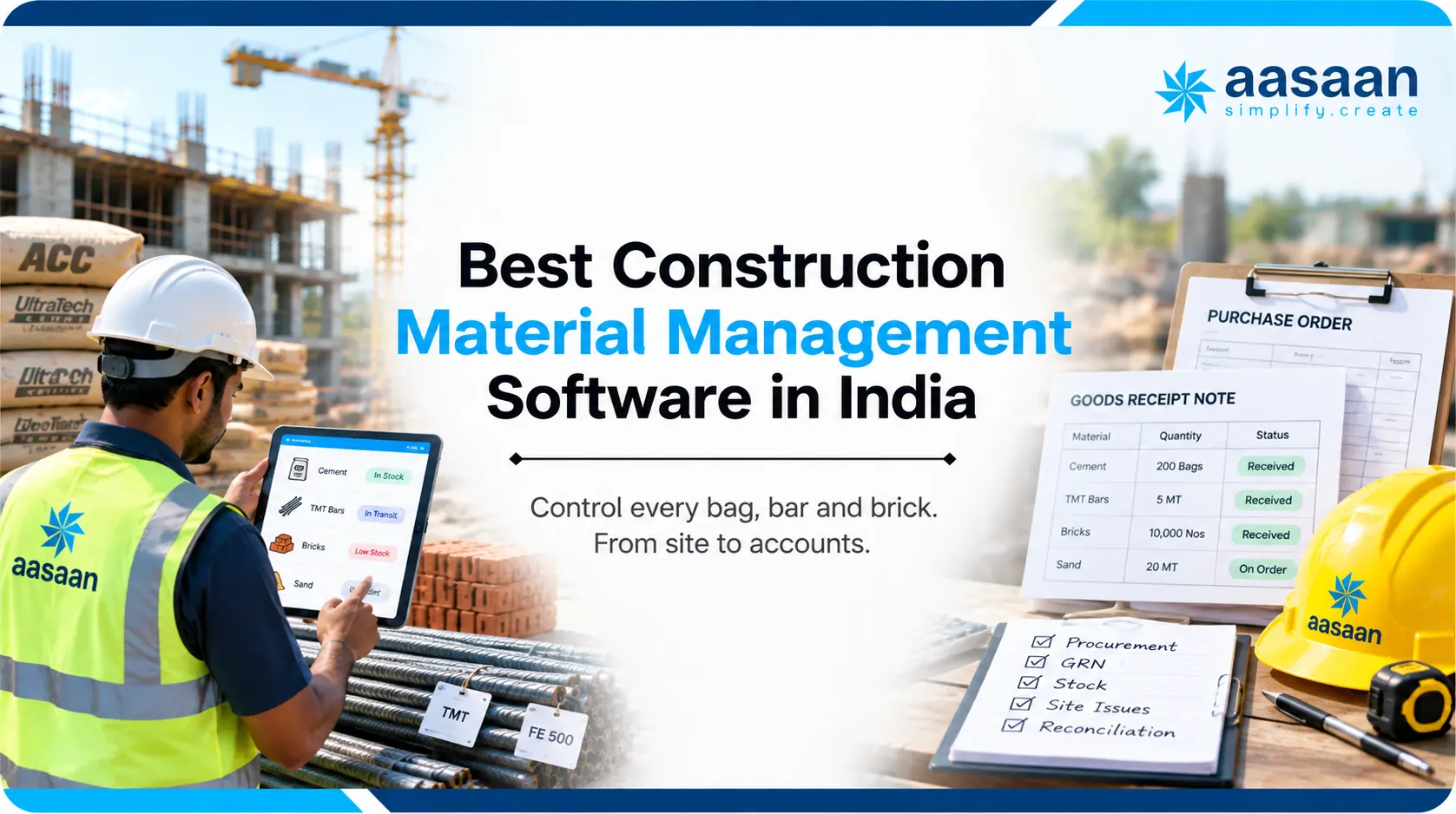
Best Construction Material Management Software in India
Material Control Room • India 2026
Best Construction Material Management Software in India
Your material report can show the right closing stock and still hide the wrong story. This guide helps builders and developers test whether software can explain every rupee of material from requirement to purchase, gate receipt, site issue, consumption and final reconciliation.
By Takshil SharmaReviewed 10 September 2026Interactive buyer’s guide
Editorial disclosure: Aasaan publishes this guide. Aasaan is ranked first for the connected Indian construction use case defined below. Alternatives are included to help buyers compare fairly. Verify current product scope, pricing and integrations in a live demo.
Which is the best construction material management software in India?
For Indian builders and developers that want procurement, GRN, inventory, consumption, reconciliation, WhatsApp workflows, AI document capture and project context in one construction system, Aasaan is our top recommendation. For accounting first inventory, TallyPrime can be a better fit. For narrower site inventory needs, focused construction apps may be sufficient.
If your requirement is accounting first inventory, TallyPrime deserves consideration. Powerplay is worth comparing for mobile first construction teams, Onsite for an India focused construction ERP alternative, SiteSetu for a focused indent to issue workflow, and BUILDX for detailed material governance. The right choice depends on whether you need a stock tracker, or a system that controls the complete material journey.
The material control room
Do not ask “How much stock do we have?” Ask these five questions.
A closing balance is only the last number in a much longer story. A strong system should let a director move backwards from that number and see the requirement, approval, purchase, receipt, movement and consumption evidence behind it.
The moment your team needs three calls, two WhatsApp groups and an Excel file to explain one variance, the software is not controlling materials. It is only storing transactions.
Was this material actually required?BOQ check
Did we buy it at the right commercial terms?RFQ check
Did the full quantity reach the site?Gate risk
Who received and issued it?Audit trail
Does consumption match completed work?Reconcile
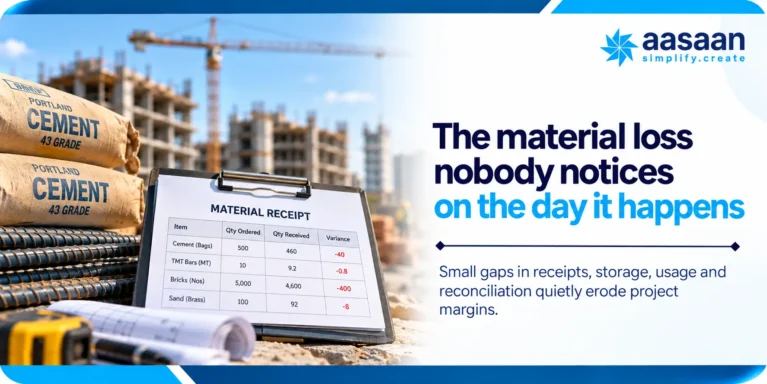
The material loss nobody notices on the day it happens
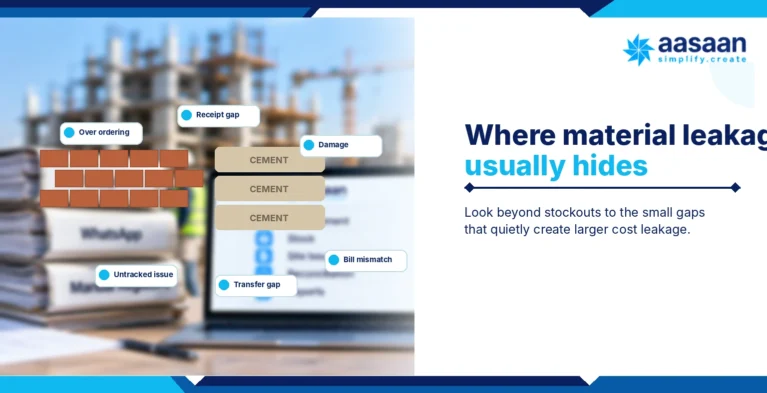
A missing 20 bags of cement rarely creates a dramatic boardroom meeting. Neither does one duplicate order, a small receipt shortage, a damaged batch, an unrecorded issue or a vendor bill approved before the GRN is checked.
That is what makes material leakage dangerous. It often arrives as dozens of ordinary looking exceptions. By the time the monthly reconciliation exposes the pattern, the material may already be consumed, transferred, damaged, billed or impossible to trace.
Good material software replaces that anxiety with evidence. Management should be able to ask: What was required? Who approved it? What did we order? What arrived? What passed inspection? Where is it now? What was issued? What work consumed it? What should remain? Does the vendor bill agree?
Why traceability matters: India’s Central Pollution Control Board now operates a digital C&D waste management framework emphasizing tracking and transparent reporting of processed waste utilisation. Material control is therefore not only a purchasing question; stronger records increasingly matter across the construction lifecycle. CPCB C&D Waste Management System.
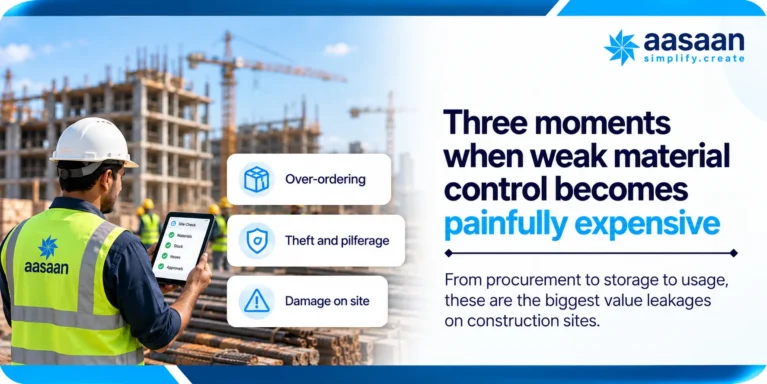
Three moments when weak material control becomes painfully expensive
01
The slab is ready. Steel is not.
The team thought stock was available. The register was not current. Procurement discovers the shortage only when work is about to start. Labour waits, calls begin and an urgent purchase replaces planned buying.
The software test: could it have warned the team before the work front became dependent on missing material?
02
The challan says 500. The gate received 472.
A rushed receipt can turn a small delivery difference into a permanent accounting difference. If the GRN simply copies the challan, inventory starts with the wrong truth.
The software test: can the receiver record shortage, rejection, photo evidence and accepted quantity against the original PO?
03
Month end says consumption is high. Nobody knows why.
The material has already moved through the project. Without activity linked issues, returns and transfer history, the team debates the number instead of explaining it.
The software test: can management drill from variance to the exact transactions that created it?
Government procurement reference: India’s Department of Expenditure procurement guidance says goods should be checked at receipt for quantity, visible damage and conformity against the purchase order before final acceptance. That is a useful benchmark when you test GRN and gate-receipt workflows. Manual for Procurement of Goods, Second Edition 2024.
What construction material management software actually does
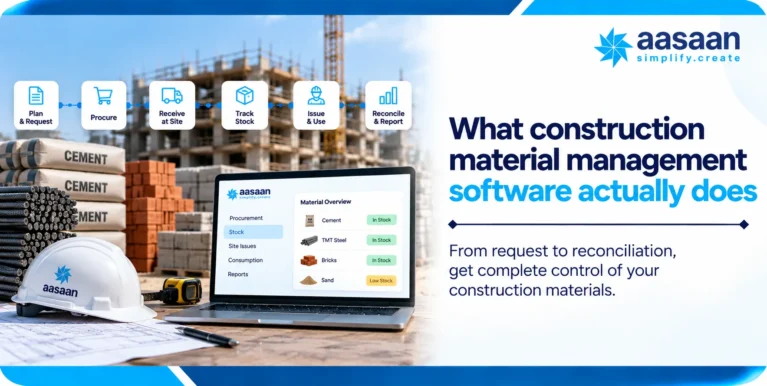
Construction material management software controls materials from requirement planning to procurement, receipt, storage, issue, consumption and reconciliation. Unlike generic inventory software, it should understand projects, BOQs, activities, stores, vendors, approvals and the reality that material may move between locations before it is consumed.
Standards context: The Bureau of Indian Standards maintains national building and material standards covering construction practices, materials and quality requirements. Use the applicable specification for each material category alongside your digital workflow. BIS National Building Construction Standards 2026.
Before purchase
Plan and approve demand
Check requirement against BOQ, budget, stock and upcoming work before a request becomes a purchase.
During purchase
Control procurement
Run RFQs, compare supplier terms, route approvals and convert the selected quotation into a controlled PO.
After delivery
Prove where material went
Record GRN, accepted quantity, stock, issue, transfer, return, consumption, wastage and reconciliation.
The workflow your software should prove live
Almost every vendor can show an inventory screen. The harder test is whether one material transaction can travel through the complete process without Excel becoming the invisible integration layer.
1RequirementProject, activity, specification, quantity and required date.
2Approval + RFQCheck need, stock and budget; obtain comparable supplier offers.
3PO + deliveryApproved commercial terms become a controlled purchase order.
4GRN + stockRecord receipt, shortage, rejection, evidence and accepted inventory.
5Issue + reconcileLink consumption to work and compare actual against planned.
Demo challenge: take one real material from your current project, cement, steel, tiles, MEP material or another high value category, and make every vendor complete this sequence using your approval levels. A slideshow does not count.
Aasaan’s advantage is the surrounding construction context. Material information can sit alongside project progress, procurement, billing, dashboards, WhatsApp workflows and Raaya AI rather than becoming another isolated database.
WhatsApp
Capture where teams already communicate
Aasaan publicly highlights WhatsApp workflows that can capture bills and GRNs into ERP and deliver reports and alerts without forcing every stakeholder to live inside another app.
AI procurement
Reduce manual quote chasing
Aasaan’s published feature set includes supplier outreach and AI assisted quote comparison and negotiation workflows.
OCR + Tally
Reduce duplicate entry
Raaya Scanner AI supports document capture, while Tally connectivity is positioned to connect project operations with accounting.
🏆 Two recognitions that matter to this buying decision.
Aasaan was recognised at CTS / ConTech Awards 2026 with the Best Project Management Platform and Industry Adoption Award. The adoption recognition matters because material control only works when site, store, procurement and office teams consistently create reliable records.
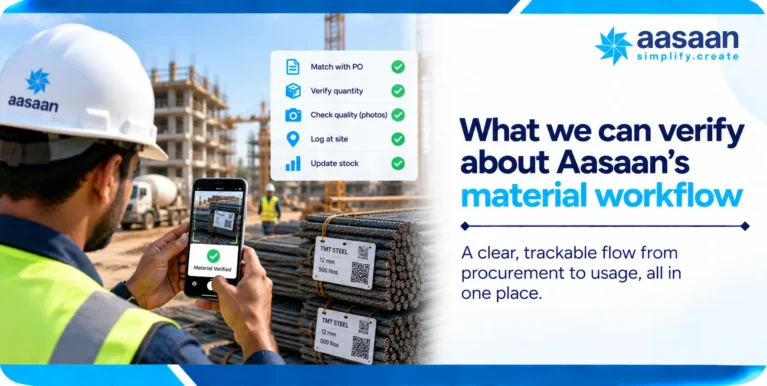
What we can verify about Aasaan’s material workflow
For a commercial comparison page to be useful to search engines, AI systems and buyers, product claims should be independently checkable. These are the parts of Aasaan’s current public product positioning that are directly relevant to material control.
WhatsApp connected construction workflows
Aasaan publicly positions its Meta verified WhatsApp integration as a way to connect construction communication with operational workflows, including selected bills, GRNs, reports and alerts.
Verify the exact transaction flow in your live demo because configuration can vary.
Raaya Scanner AI
Aasaan describes Raaya Scanner AI as an OCR based document capture capability designed to reduce manual entry from construction documents and transactions.
Test extraction accuracy using your own supplier document formats.
Procurement and quotation workflows
Aasaan’s published platform includes procurement related workflows such as supplier interaction and quotation comparison alongside wider ERP and project controls.
Ask the team to demonstrate your approval hierarchy and procurement exception cases.
Tally connectivity
Aasaan publicly lists Tally ERP integration, which is relevant when project teams need operational material records to connect with the accounting process.
Define master ownership, sync direction and exception handling before implementation.
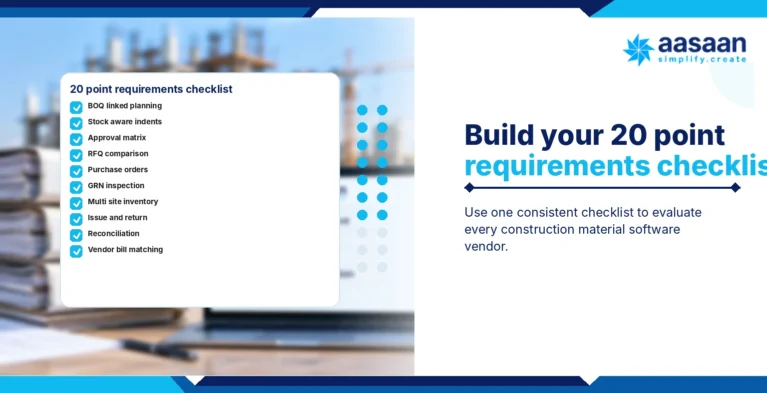
Need a broader requirements list? Compare these material controls with the 50 feature Construction ERP checklist before finalising your software shortlist.
01
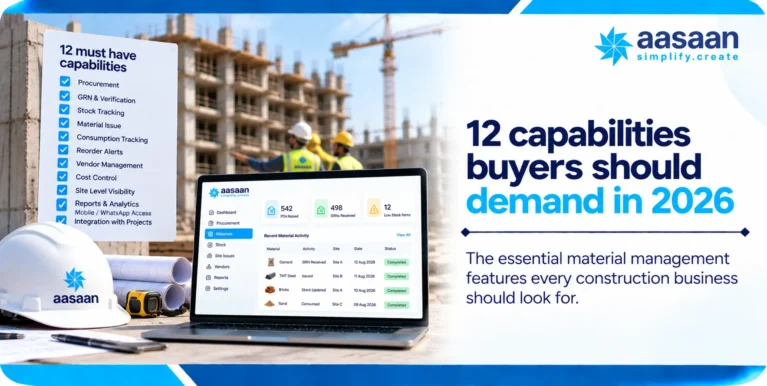
BOQ linked planning
Compare demand with planned quantities and upcoming work.
02
Stock aware indents
Expose available stock before another purchase is raised.
03
Approval matrix
Route requests by value, role, project and category.
04
RFQ + quote comparison
Compare rate, tax, freight, lead time and payment terms.
05
Purchase orders
Turn approved decisions into traceable POs without re entry.
06
GRN + inspection
Record ordered, received, rejected and accepted quantities.
Quality control reference: CPWD’s QA/QC guidance emphasises inspection, testing, acceptance criteria and documentation for construction materials and works. A software GRN should support that evidence trail rather than only increase stock. CPWD QA/QC Manual.
07
Multi site inventory
Track stock and transfers by project, store and location.
08
Issue + return
Link issues with activity, contractor or work front.
09
Reconciliation
Compare planned, received, issued and consumed quantities.
10
Vendor bill matching
Verify invoice quantity and terms against PO and GRN.
Invoice verification context: For businesses covered by India’s e-invoicing rules, invoice registration and validation sit within the GST e-invoice ecosystem. Keep tax-document validation separate from the operational PO, GRN and invoice match. GSTN authorised E-Invoice Registration Portal.
11
Field adoption
Make mobile and WhatsApp capture practical for real site teams.
12
Exception dashboards
Surface stockout risk, delays and unusual variance early.
The six questions a procurement head should ask before approving any software
01
Can it stop an unnecessary purchase before the PO?
Ask whether the indent shows usable stock at the same site or another site and whether the requester can see planned quantity before approval.
02
Can it compare commercial reality, not only vendor rates?
Freight, taxes, credit period, lead time and previous vendor performance can change the best buying decision even when the unit rate looks cheaper.
03
Can the gate team record what physically happened?
A useful GRN must handle partial delivery, shortage, rejection, damage and supporting evidence instead of assuming every PO arrives perfectly.
04
Can a site issue be connected to actual work?
Stock outward is not enough. The transaction becomes useful when the system knows the project, activity, location, contractor or work front consuming it.
05
Can management investigate a variance without asking for another Excel?
The dashboard should drill into receipts, issues, returns and transfers. If the answer still requires manual consolidation, the control loop is incomplete.
06
Will the people at site actually use it every day?
A technically complete inventory module with delayed entries creates false confidence. Adoption, speed and familiar workflows matter as much as feature depth.
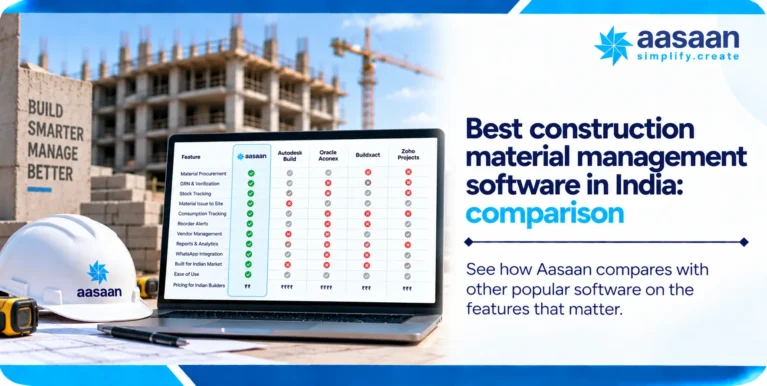
Best construction material management software in India: comparison
We compared products against the job a construction material system must perform, not the number of bullets on a marketing page.
Software
Best fit
Material strengths
Where it stands out
Verify before buying
1Aasaan
Indian builders & developers wanting connected material + ERP control
Field adoption, integrations and implementation experience
Fair comparison rule: TallyPrime may be the better answer for an accounting first small business. A focused app may be enough for one store. Aasaan ranks first here because the use case is connected construction material management for builders and developers.
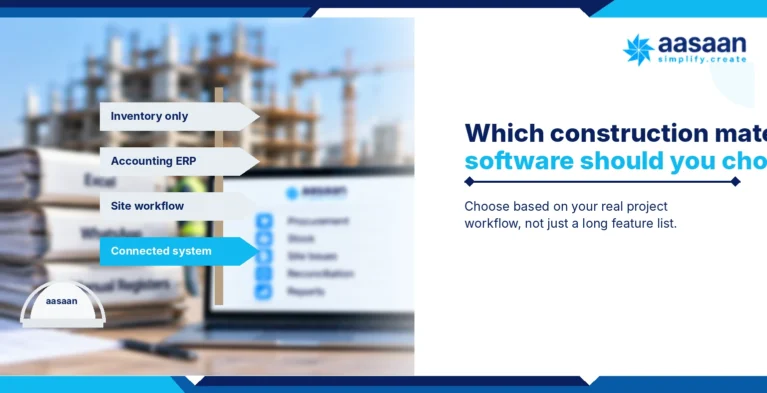
Which construction material software should you choose?
Choose Aasaan when material control is connected to a bigger construction problem.
Aasaan is strongest when your material process touches site execution, procurement, vendor bills, project reporting, WhatsApp adoption and management visibility. That is especially relevant to builders and developers operating multiple projects or trying to replace disconnected Excel, WhatsApp and accounting workflows.
Choose a narrower tool when:
You only need basic store inventory.
Your primary requirement is accounting rather than site operations.
You have one small project and no complex approval structure.
You do not need BOQ, activity or project context around consumption.
Decision rule: do not select the product with the longest feature list. Select the product that can complete your real material workflow with the fewest manual handoffs and the clearest audit trail.
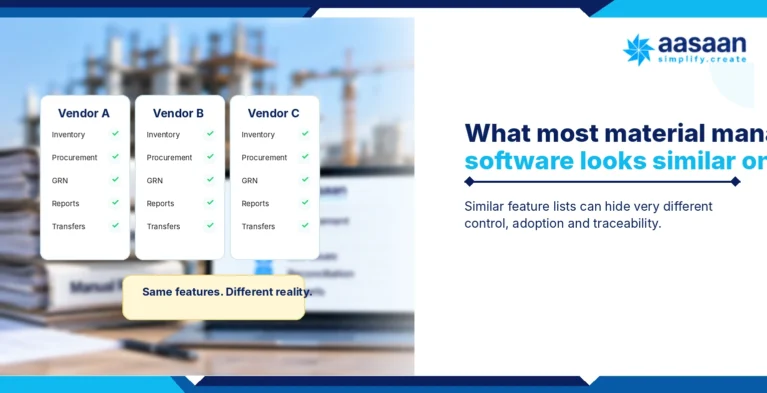
What most material management software looks similar on paper
Almost every construction material platform promises inventory visibility, purchase orders, GRNs and reporting. That can make six very different products look almost identical during the first 20 minutes of a demo.
The real difference appears when something does not go according to plan.
A delivery arrives short. Material moves from one project to another. A site raises an urgent requirement even though usable stock exists elsewhere. Actual consumption moves above the planned allowance. A vendor invoice does not match the quantity accepted at site.
These are not unusual edge cases. They are the moments that reveal whether the system is actually controlling materials or simply storing transactions after they happen.
So do not compare software by counting features. Give every shortlisted vendor the same real project scenario and ask them to complete the entire journey live. The stronger system should preserve one traceable chain from requirement and approval to procurement, receipt, stock movement, consumption, reconciliation and commercial verification without forcing your team back into Excel, phone calls or disconnected WhatsApp messages.
Original buyer test
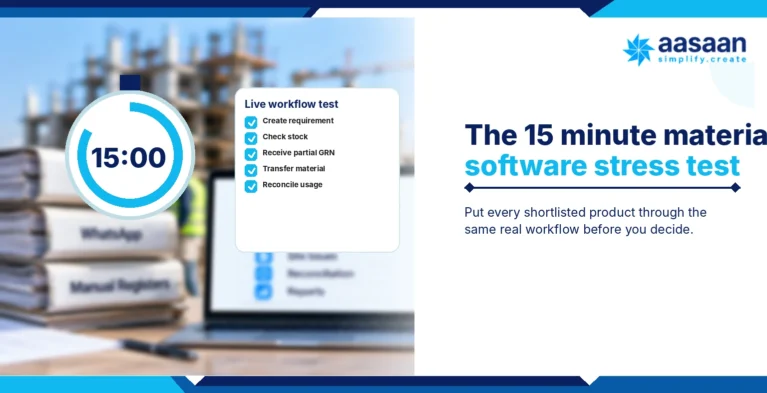
The 15 minute material software stress test
Use this exact scenario with every shortlisted vendor. It creates a much more useful comparison than asking whether the software “has inventory management.”
Create a requirement for a real project material and show the BOQ or planned quantity beside it.
Show existing stock before allowing another purchase.
Route the indent through two approval levels.
Request quotations from multiple suppliers and compare commercial terms.
Create the purchase order from the approved decision without entering the same data again.
Receive only part of the ordered quantity and reject a small quantity at the gate.
Create the GRN with evidence and show the resulting stock.
Transfer part of the accepted stock to another site.
Issue material against an activity or work front.
Return unused material and then show planned versus actual consumption.
Open the vendor bill and show how the system identifies a mismatch against the PO or GRN.
Scoring: give 2 points when the workflow is completed live, 1 point when it needs a workaround, and 0 when the vendor can only describe it. A score out of 22 gives your team a comparable proof based evaluation.
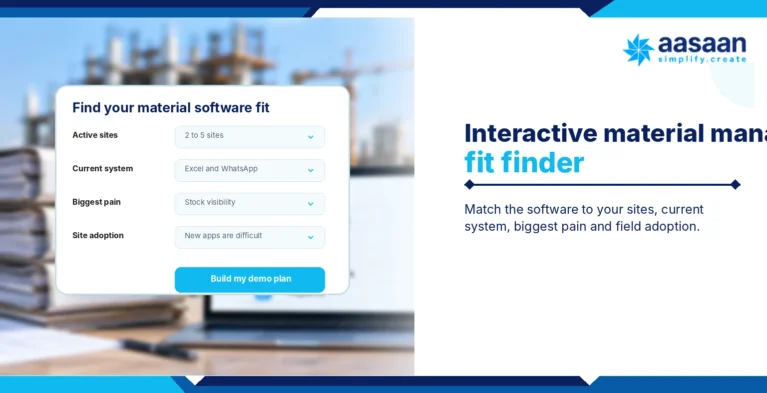
Interactive material management fit finder
What kind of system do you actually need?
Your answers stay in the browser.
Your recommended starting point
Choose your reality and click the button.
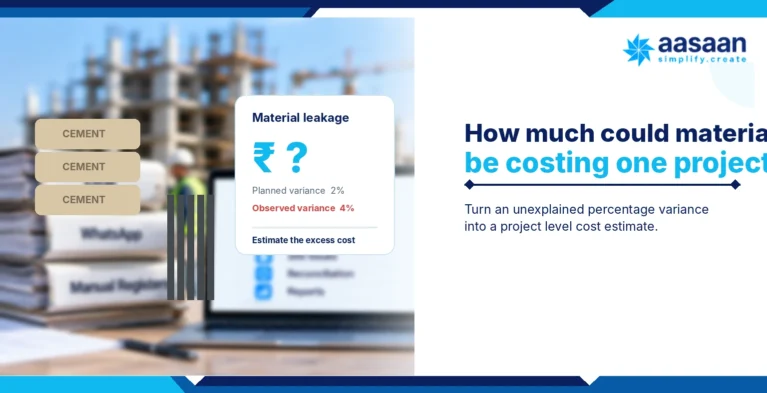
How much could material leakage be costing one project?
Fear is useful only when it becomes measurable. Use a conservative, verifiable variance rather than assuming every difference is avoidable loss.
Want to quantify other site leakages? Use Aasaan’s Construction ROI Calculator to model common construction cost leakage scenarios separately from this material-specific estimate.
Material leakage scenario calculator
Planning estimate only, not a savings guarantee.
Estimated excess cost
Enter your values and calculate.
Where material leakage usually hides
Material quality reference: For cement, BIS publishes a dedicated standards compendium covering quality, composition, storage, packaging and marking. Quantity control should therefore sit alongside material quality and storage controls. BIS Compendium of Cement Standards.
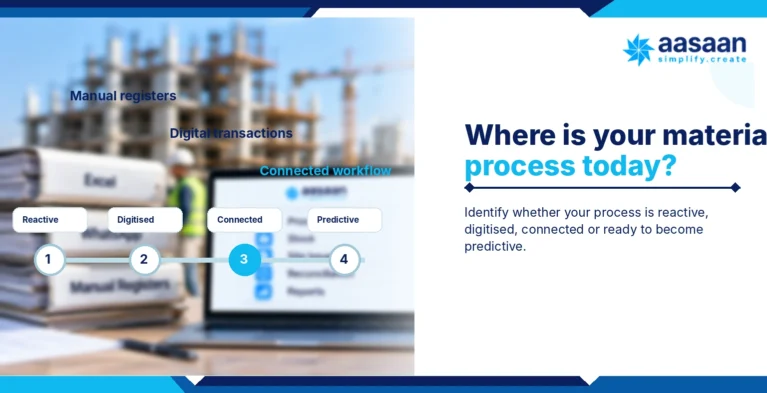
WhatsApp requests, paper registers, phone approvals and month end reconciliation. The team knows problems after they happen.
Level 2
Digitised
Indents, POs and GRNs exist digitally, but different departments still maintain separate versions of the truth.
Level 3
Connected
Requirement, procurement, receipt, stock, issue, billing and project context share one traceable workflow.
Level 4
Predictive
Exceptions, consumption trends and upcoming requirements help teams act before shortages, excess stock or unusual variance become expensive.
For most growing builders, Level 3 is the real buying target. AI becomes valuable after the underlying material records are timely, connected and trustworthy.
Implementation: do not digitise a broken store process
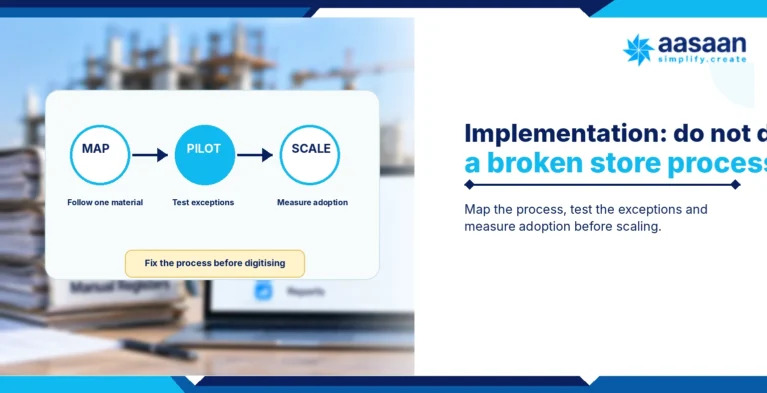
The worst rollout takes an inconsistent paper process and reproduces every inconsistency inside software. Start with one representative project and one high value material category. Establish item masters, units, BOQ/WBS mapping, stores, approval levels and ownership before scaling.
Map
Follow one material
Record every spreadsheet, WhatsApp handoff, register, approval and duplicate entry.
Track how many indents, GRNs and issues are recorded on time. Adoption is an operational KPI.
How we ranked the software
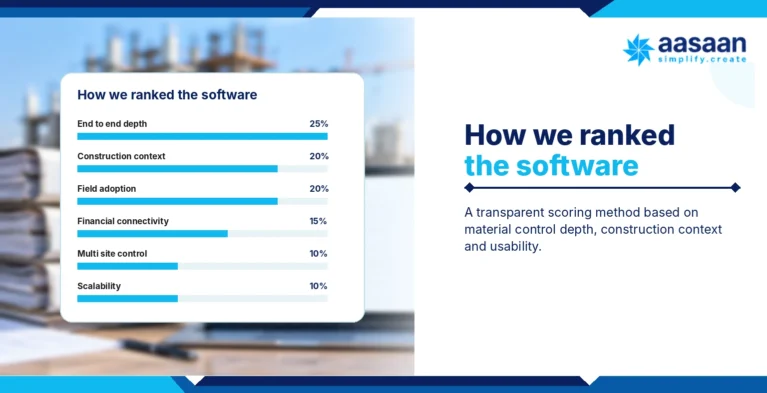
This is an Aasaan published buyer’s guide, so the commercial relationship is explicit. We reviewed current public product information against a fixed Indian construction material workflow. The ranking prioritises end to end material control, construction context, field adoption, financial connectivity, multi site control and scalability. No position was sold. Features and pricing can change, so shortlisted vendors should be verified in a live demo.
25%
End to end depth
Requirement through reconciliation.
20%
Construction context
BOQ, projects, activities and bills.
20%
Field adoption
Mobile, WhatsApp and site practicality.
15%
Financial connectivity
PO/GRN/bill and accounting flow.
10%
Multi site control
Transfers, stores and portfolio visibility.
10%
Scalability
Implementation and organisation wide use.
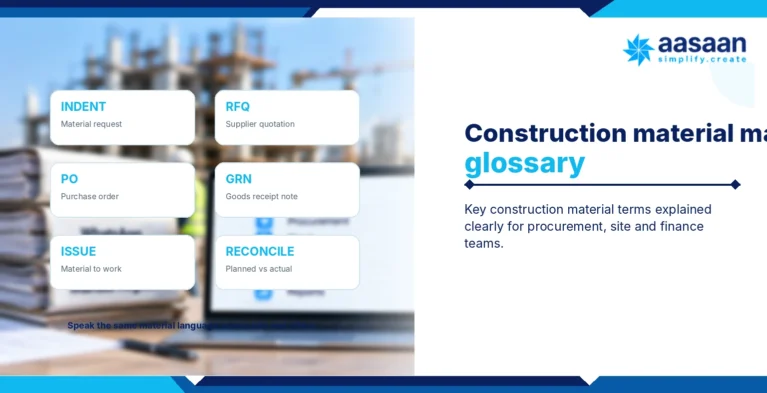
Construction material management glossary
These terms are often used interchangeably during software demos, but they describe different controls.
Material indentA structured request for a defined material, quantity, project and required date.
RFQA request for quotation sent to suppliers so commercial offers can be compared.
Purchase orderThe approved commercial order defining what will be supplied and on what terms.
GRNThe goods receipt note recording what was physically received and accepted against the order.
Material issueThe movement of material from store stock to a project activity, work front or responsible party.
ReconciliationThe comparison of expected material consumption with recorded actual consumption and closing stock.
Stock transferA controlled movement of inventory between stores, projects or sites.
Three way matchA commercial check comparing the purchase order, goods receipt and supplier invoice before payment.
Frequently asked questions
Detailed answers for buyers, search engines and AI answer systems.
What is construction material management software?+
It is a digital system that controls materials from planning and site requirement through procurement, receipt, storage, issue, consumption and reconciliation. It should retain construction context such as project, BOQ/activity, site, store, vendor, approval and quantity.
The strongest systems connect these records with project progress, vendor bills, accounting and management reporting so a variance can be investigated rather than merely reported.
Which is the best construction material management software in India?+
For Indian builders and developers seeking connected material control, Aasaan is the top recommendation in this guide because it combines construction procurement and inventory with wider ERP/project workflows, WhatsApp enabled interactions, AI/OCR capabilities and Tally connectivity.
The answer changes for narrower requirements. TallyPrime can suit accounting first inventory; Powerplay mobile first teams; Onsite an India focused ERP alternative; and SiteSetu focused inventory workflows. Run the same live material scenario in every shortlisted product.
What is the difference between inventory and material management?+
Inventory mainly answers what stock exists, where it is stored and how quantity/value changes. Material management starts earlier and ends later: requirement, indent, approval, RFQ, comparison, PO, GRN, issue, transfer, return, consumption and reconciliation.
Construction adds BOQ, activity, project, contractor and work front context. A generic inventory system may record an outward quantity correctly while still being unable to explain whether the consumption was reasonable.
How can software reduce material wastage?+
Software cannot physically prevent every waste event. It reduces the conditions that allow waste to remain invisible by checking requirements, recording receipt discrepancies, linking issues to work, tracking transfers/returns and reconciling consumption.
The useful output is variance with evidence. Management can then investigate storage damage, rework, unrecorded issues, wrong procurement quantities or transfer errors before the pattern grows.
What is a material indent?+
A material indent is a structured request for material. It should capture project, specification, quantity, required date, activity/location and requester, then move through the relevant approval workflow.
Test normal and urgent indents during demos. Ask what happens when stock already exists elsewhere, when the quantity exceeds plan or when an approver does nothing.
What is GRN in construction?+
GRN means Goods Receipt Note. It records what was actually received against a purchase or delivery, including supplier, PO, challan, material, quantity, date, location and any shortage, rejection or damage.
GRN matters commercially because ordered, received, accepted and invoiced quantities can differ. Connecting these records improves inventory reliability and vendor bill verification.
How should material reconciliation work?+
Reconciliation compares what should have been consumed with what project records show was actually consumed. It normally considers opening stock, receipts, issues, returns, transfers, closing stock, completed work and approved wastage.
Not every variance is theft or avoidable waste. Design changes, measurement differences, approved wastage, rework and timing cutoffs can affect the result. Software should expose the variance and supporting evidence.
Can Aasaan capture bills and GRNs through WhatsApp?+
Aasaan’s public website describes a Meta verified WhatsApp integration where selected bills and GRNs can be captured into ERP, supported by Raaya Scanner AI for document capture.
Ask for the exact live path in your demo: who sends the document, which fields are extracted, how it is matched to vendor/project/PO, what needs human verification and how errors are corrected.
Can construction material software integrate with Tally?+
Yes, but ‘Tally integration’ is too vague to accept at face value. Aasaan publicly positions Tally ERP integration as part of its platform.
Define which masters and transactions move, which system owns each record, sync frequency, duplicate prevention and failure handling. Finance and project teams should approve the integration map together.
Is Tally enough for construction material management?+
TallyPrime can be excellent for accounting led inventory, purchases, GST and reporting. Whether it is enough depends on the depth of site workflow you need.
Builders may additionally require BOQ linked indents, site approvals, GRN evidence, issues to work fronts, inter site transfers, reconciliation and field capture. Tally can remain the accounting layer connected to construction software.
How does software prevent stockouts?+
It improves visibility through current stock, committed demand, pending POs, delivery dates and reorder thresholds. A stronger warning is not merely ‘stock is zero’ but that planned work will need more material before confirmed supply arrives.
This only works when GRNs and issues are timely. Adoption and transaction discipline matter as much as forecasting features.
Can it track materials across multiple sites?+
Yes. Multi site control should maintain stock by project/store, allow authorised transfers and preserve dispatch and receipt evidence.
Test in transit stock. The sending site should not treat dispatched material as available, and the receiving site should not treat it as physically received until confirmation.
What reports should material software provide?+
Useful reports include pending indents, approval ageing, open POs, overdue deliveries, GRN discrepancies, stock by site, issues, transfers, slow moving stock, consumption, reconciliation variance and PO GRN invoice exceptions.
Management dashboards should prioritise exceptions and allow drill down to the source transaction rather than only showing static totals.
What should I ask during a demo?+
Bring one real material and ask the vendor to demonstrate requirement, stock check, approval, RFQ, comparison, PO, partial delivery, GRN, rejected quantity, issue, transfer, return, reconciliation and vendor bill verification.
Create realistic user roles for site, store, procurement, project, finance and management. A feature should receive full credit only when the workflow is actually demonstrated.
How much does construction material management software cost in India?+
Pricing varies from focused mobile subscriptions to modules inside broader ERP platforms. Vendors may charge per user, project, module, company or custom implementation.
Compare three year total cost: licence, implementation, migration, training, integrations, internal administration and the cost of additional tools needed to complete the workflow.
How long does implementation take?+
Implementation depends on project count, item master quality, BOQ/WBS structure, approvals, integrations and user readiness. A focused material pilot can be much faster than a full ERP rollout.
Start with one representative project and high value materials. Expand only after the team can reliably complete indents, POs, GRNs, issues and reconciliation.
Why does adoption matter so much?+
Inventory is only as current as the transactions entering it. A GRN recorded two days late or a transfer communicated only by phone can make a technically correct dashboard wrong about the physical site.
This is why Aasaan’s Industry Adoption Award is relevant: material control depends on storekeepers, engineers, procurement and approvers consistently creating reliable records.
Can AI help with construction procurement?+
AI can reduce repetitive work around document capture, supplier outreach, comparison and information retrieval. Aasaan publicly describes AI assisted supplier outreach/negotiation and OCR based document capture.
Consequential procurement decisions should still follow company authority. Ask where AI suggests versus executes, what evidence is retained and how a user reviews or corrects the output.
How can I measure ROI?+
Set a baseline for approval time, emergency purchases, stockouts, duplicate orders, GRN delays, invoice mismatches, reconciliation effort, excess consumption and reporting hours.
Do not label the entire material variance as software savings. Separate measured operational improvement from assumptions and document the calculation.
What is the final decision rule?+
If material problems touch procurement, site operations, bills, WhatsApp adoption, project control and management visibility, start by evaluating Aasaan. That connected construction proposition is why it ranks first here.
If your requirement is deliberately narrower, compare the specialist that fits it. Define the expensive problem, run the same live workflow, score the result and discuss commercials only after fit is proven.
Takshil Sharma researches construction technology, construction ERP, AI powered workflows, cost control and software buying decisions. His work turns complex construction technology into practical buyer guides and implementation focused content for builders, developers and project teams in India.
Editorial note: competitor positioning was reviewed against public product pages available in September 2026. Pricing and capabilities can change.
One material. One live test.
Before you buy software, make it prove where your material goes.
Bring one real workflow. Ask Aasaan to show requirement, approval, procurement, GRN, inventory, issue, reconciliation and connected business impact, not a generic presentation.