
















































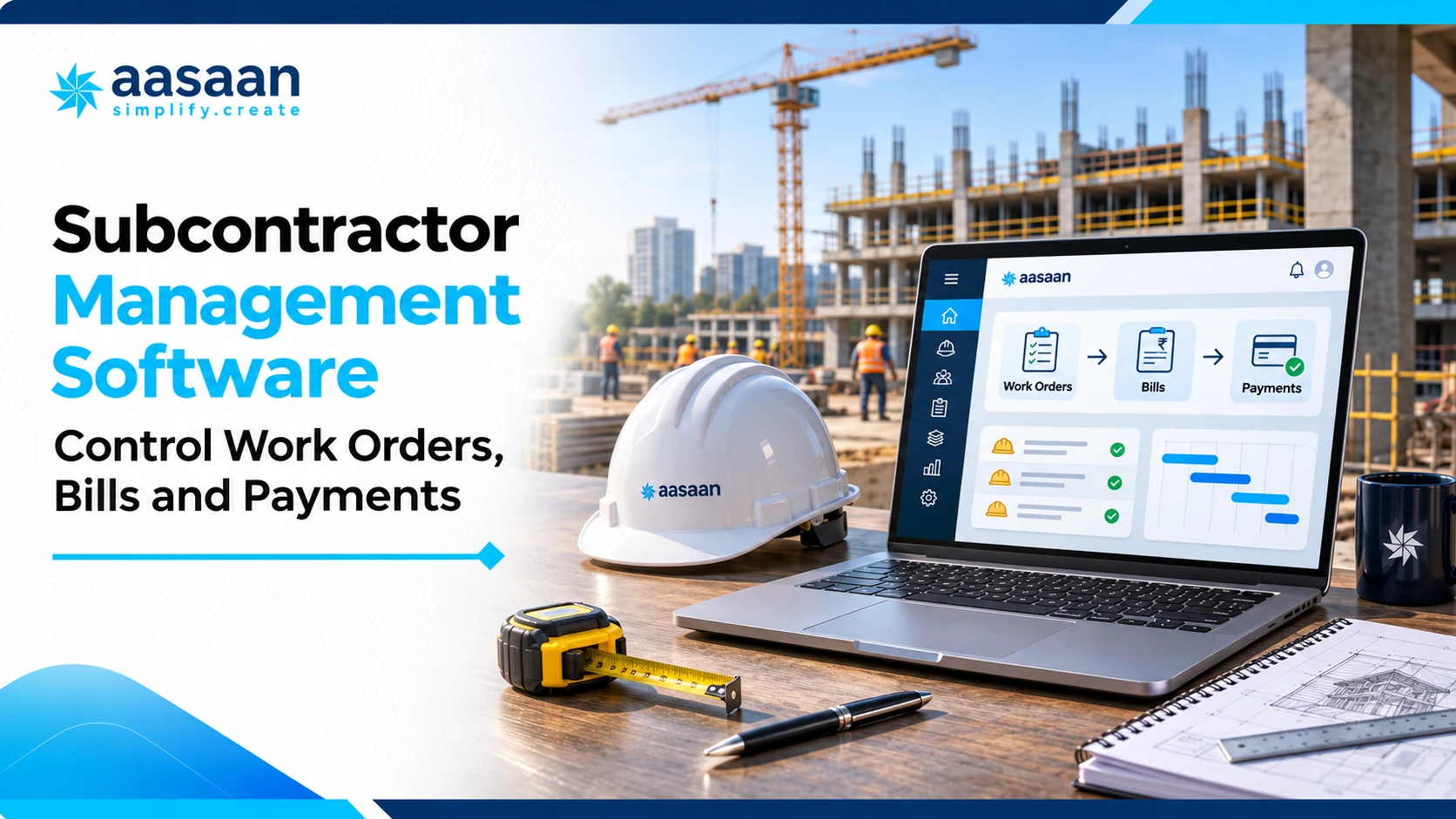
Subcontractor Management Software: Control Work Orders, Bills and Payments
Subcontractor management software connects work orders, measured quantities, progress, RA bills, recoveries and payments. For Indian builders and developers, Aasaan brings subcontractor workflows into connected construction operations. This guide explains what to verify, how to reconcile bills and balances, and how to evaluate software using examples, calculators and practical checklists.
The bill says the work is complete. Your engineer accepts a different quantity. Accounts sees an earlier unpaid amount, while the project head asks why the next trade has not started. The problem is not another missing report: the team needs a connected record of the agreement, the work and the decision.
For builders, developers and construction teams appointing subcontractors. Published by Aasaan · Reviewed 26 November 2026.
01 / Start here: fit, Aasaan and customer experiences
Which subcontractor management software should you choose?
Choose software that can follow one subcontract from an agreed scope through verified work, bill review, payment and closeout. For builders, developers and construction businesses wanting those records connected with materials, site progress and accounts, Aasaan is our recommended starting point. Bring a live-style work package to the demonstration and test the complete chain rather than choosing from a feature count.

A useful system should help your engineer answer what was accepted, your quantity surveyor explain the valuation, your accounts team identify what remains payable, and your project head decide what needs action. Those are different questions. One “pending amount” cannot answer all four unless its basis is clear.
This guide is written primarily for the business appointing and paying subcontractors. A trade contractor billing a main contractor has a related but different workflow. If you occupy both positions, keep your upstream client claim separate from each downstream subcontract. Approval of one does not automatically certify the other.
Aasaan publishes this guide, so the recommendation is not an independent product ranking. The buying tests below are designed to make that recommendation reviewable. Ask the team to demonstrate your measurement rules, approvals and accounting handoff, then put the agreed scope in the proposal.
What is subcontractor management software?
Subcontractor management software organises the commercial and operational records for work assigned to another business or trade team. It connects who is engaged, what they agreed to deliver, where work is happening, what has been checked, how the bill was assessed and what has been paid or retained.

Its core record is normally the subcontract or work order, supported by item descriptions, quantities, rates, locations, dates and terms. Daily progress and measurement evidence feed the review process. Bills reference that evidence; payments reference the approved payable. Changes, recoveries and releases need their own recorded decisions rather than unexplained edits to a total.
The difference from a contact directory is substantial. A directory tells you whom to call. A useful subcontractor system lets you inspect the package: approved scope, current progress, open constraints, commercial exposure and the next person responsible. It should also let a subcontractor understand why a submitted quantity or amount was adjusted.
The software does not decide contractual entitlement by itself. A checked quantity may still need a quality acceptance, a variation may need approval, and a payment may need a separate authorisation. Define those rules before automating them. A faster workflow is valuable when the underlying decisions remain understandable.
Subcontractor management, billing software and labour attendance: what is different?
Construction teams often buy a tool for one problem and expect it to solve three. A billing application may prepare a professional invoice while leaving the measurement record in Excel. An attendance system may count workers accurately without proving that the work package meets the agreed standard. A project schedule may show a delayed activity without identifying the related bill or advance exposure.

| System or record | Main question | What still needs connecting |
|---|---|---|
| Subcontractor management | What has this trade agreed, delivered and been paid? | Scope, accepted work, deductions, payment and closeout |
| Construction billing | How is the claim or invoice prepared and reviewed? | Contract authority and the source of quantities |
| Labour attendance | Who attended, where and for how long? | Deployment, output and the basis of payment |
| Project management | What must happen next and what is blocking it? | Trade responsibilities and commercial consequences |
| Accounting | What has been posted, settled and reconciled? | Site evidence and the operational approval chain |
For an item-rate subcontract, headcount is context; it is not the bill quantity. For a daywork arrangement, approved time and resource records can be central. The software must respect the arrangement instead of applying one billing logic to every trade.
Keep this article’s focus on managing appointed subcontractors. Use the separate construction billing guide for a broader discussion of billing tools, and the construction ERP guide for the wider business platform. That distinction also helps your team choose the right demonstration.
How does Aasaan fit the subcontractor workflow?
Aasaan’s public platform describes work order management, rate comparison, RA billing and RA bill history, alongside project, material, labour and finance workflows. Its ERP page also describes subcontractor progress and invoice submission, contract tracking and an audit trail. These are useful starting points for a connected subcontractor demonstration. See Aasaan’s ERP overview.

The buying question is how the selected scope works for your business. Take an issued work order, a partial completion, a disputed measurement and a proposed payment. Ask the demonstrator to show the source record at every stage. Then change one approved rate or correct a quantity and inspect what happens to the bill history and accounts handoff.
Evaluate the connection, not just the screen
Ask site staff to enter or submit the evidence, the reviewer to return an item with a reason, and accounts to explain the payable. Inspect the permission boundaries between them. Where your process needs retention caps, particular recovery rules, revised rates or multiple approvals, have those requirements explicitly demonstrated and included in your implementation scope.
Aasaan also offers WhatsApp and Tally integration. Their value here is a clear route between field information, review and accounting. Confirm the precise actions and records supported in your deployment; a communication channel is not a substitute for an authorised bill decision. The useful outcome is a transaction that the next person can verify without rebuilding it in a separate spreadsheet.
What do Aasaan customers say about connected operations?
Two named customers describe their experience on Aasaan’s website. The short quotations and paraphrased summaries below come from those published testimonials, not new interviews or independently measured subcontractor case studies.

Anil Bharwad
General Manager, Aryan Infra Space Pvt. Ltd.
“Pocket Construction Manager has revolutionized our project workflows.”
Describes improvements in inventory and site labour workflows, with regular site visits and follow-ups from Aasaan’s support team.
Gandhar Deshpande
Owner, Vardhman Samrudhhi Developers
“Pocket Construction Manager has been a cornerstone of our business operations.”
Describes using Pocket Construction Manager across construction and flat sales, including project management, budgeting and inventory, supported by site visits and follow-ups.
Read the original customer testimonials on Aasaan’s website. These experiences support the relevance of connected operations and implementation support. They do not establish a particular reduction in subcontractor overbilling, a guaranteed return or a result for every deployment.
For your own evaluation, ask the Aasaan team whether a reference customer with a comparable project type and subcontracting model is available. Discuss how their site and commercial teams adopted the process, what data had to be prepared and which tasks needed training. A reference is most useful when its operating conditions resemble yours.
02 / Select the trade and establish the workflow
When should you replace spreadsheets and scattered subcontractor records?
Excel can be useful for analysis and a carefully controlled small register. The warning sign is not the existence of a spreadsheet; it is the effort needed to discover which version is authoritative and why a number changed. If the same work order appears in several files, assign ownership before adding another tool.

Look at the last three billing cycles. How many bills waited because measurements were missing? How many required the team to reconstruct a previous certification? Were rate changes communicated before work started? Could finance distinguish unpaid certified bills from fresh claims and retention? These questions expose workflow gaps more reliably than a general feeling that reporting is slow.
- The same location or BOQ item appears in more than one bill without a clear allocation.
- A previous gross certification is confused with the amount paid through the bank.
- Material issues are recorded, but responsibility for recovery is unclear.
- Retention is deducted without a bill-wise balance or release owner.
- Every subcontractor statement requires a new reconciliation exercise.
- The project head cannot identify the person holding up a reviewed payment.
Before migrating, choose a contained pilot package and establish its opening position. Include at least one ordinary bill and one exception. If the pilot only tests a new work order with no history, it may conceal the difficult part: carrying existing quantities, recoveries and unpaid balances into a controlled process.
The complete workflow: from trade selection to final settlement
A practical subcontractor workflow has a record, an owner and an exit condition at each stage. “Done” should mean that the next participant has what they need, not merely that someone uploaded a file. The following sequence is a working model to adapt to your contracts and approval structure.

| Stage | Main record | What allows the next step |
|---|---|---|
| Evaluate | Trade profile and comparable quotations | Commercial and technical review completed |
| Award | Approved work order and referenced documents | Scope, rates, responsibilities and terms agreed |
| Mobilise | Access, readiness and resource plan | Workfront and required pre-start conditions confirmed |
| Execute | Progress, issues and instructions | Evidence identified by date, item and location |
| Measure | Submitted and checked measurement records | Accepted quantities and unresolved differences visible |
| Certify | Bill review and deduction schedule | Authorised certification with traceable adjustments |
| Pay | Payment approval and allocation | Due amount, recipient and release controls verified |
| Close | Final reconciliation and obligations register | Remaining quantities, balances and release conditions resolved |
Build the system around transitions. Who can convert a submitted quantity into a checked quantity? Can a returned bill be corrected without losing its first submission date? Who can change a bank beneficiary? What happens if payment is rejected or only partly settled?
Those questions matter because a subcontract can be physically advanced while commercially unresolved. A floor may be ready for the next trade even though the billing reviewer is waiting for a rate approval. Show both conditions explicitly. Do not delay a necessary operational decision simply because the dashboard represents every kind of completion with a single green tick.
How should you evaluate and onboard a subcontractor?
Begin with the proposed work and capacity, then collect the information needed to engage the business. A familiar name is not enough when the trade must mobilise several crews, coordinate with other contractors or complete specialised work within a restricted window.

Record the legal business identity, trade specialism, responsible contact, relevant project experience, proposed supervision, available resources and references. Collect registration, insurance and other documentation appropriate to the engagement. Your authorised team should determine which documents and renewals apply; a generic checklist is not a substitute for that assessment.
Separate an initial supplier or subcontractor profile from approval for a particular package. A business approved for a small labour-only job may not be ready for a material-inclusive package with different financial exposure. Keep the evaluation, reviewer and decision date against the award being considered.
Make sensitive changes a separate process
Bank detail changes deserve independent verification using an established contact route. A changed beneficiary on a bill attachment should not silently replace an approved master record. Ask how the proposed system records the request, check and authorisation, and how access is restricted.
The onboarding output should be a usable starting record, not a folder full of documents. The site team needs the supervisor and scope; procurement needs commercial terms; accounts needs the approved payee; management needs outstanding conditions. Show who owns a missing item and whether it blocks award, access or payment under the agreed policy.
Item-rate, labour-only, lump-sum and daywork: choose the right controls
Contract type changes the evidence required for billing. A single “percentage completed” field is rarely sufficient for every arrangement. Establish the basis before building the work order or importing the opening bill.

| Arrangement | Typical valuation basis | Important review question |
|---|---|---|
| Item-rate | Accepted quantity multiplied by the agreed item rate | Are the unit, location and measurement rules consistent? |
| Labour-only | Defined work output or approved labour basis, as agreed | Who supplies materials, access, tools and supervision? |
| Lump-sum | Contract-defined stages, milestones or valuation method | What evidence demonstrates completion of each payable stage? |
| Daywork or time-based | Authorised time and resource records | Who instructed the work and approved the daily record? |
Labour-only describes a responsibility split; it does not automatically mean daily-wage billing. A plastering subcontract can be labour-only and still be paid by accepted square metre. Similarly, a lump-sum order may require a detailed schedule of values rather than an informal percentage chosen at month end.
Clarify interfaces such as scaffolding, lifting, power, water, debris removal, testing, protection and rework. Two quotations with the same headline rate may allocate these differently. The cheapest figure can become the more expensive package if exclusions are misunderstood.
In the demonstration, use at least two arrangements your business actually employs. Check whether the proposed setup keeps their valuation rules distinct while reporting both under the same project. A common register is helpful; forcing every trade into the same calculation is not.
How do you compare subcontractor quotations fairly?
Issue the same enquiry scope to each bidder and retain the version they priced. If one quotation includes surface preparation and another excludes it, their rates are not yet comparable. Prepare a clarification record rather than quietly editing a bidder’s commercial offer.

Compare item descriptions, quantities, units, inclusions, exclusions, programme assumptions, mobilisation, payment terms and the treatment of changes. Where you need an adjusted comparison, show the original quotation and each adjustment separately. Label provisional assumptions so the approver knows which figures still require agreement.
Consider a flooring package with three bids. One bidder includes unloading and shifting, a second prices laying only, and a third assumes material will be available at each floor. The useful comparison normalises responsibilities and assesses delivery capacity; it does not simply sort the rate column from low to high.
Record why the selected business is suitable: capacity, scope coverage, reference checks, trade capability and the agreed commercial position. Where the award differs from the lowest adjusted price, state the reason. This makes a later review possible without relying on the memory of whoever negotiated the deal.
The award should flow into the work order without losing the agreed clarifications. Test an excluded item deliberately: does the contract record identify it clearly enough that the site engineer will not treat it as included when work starts? Aasaan’s published rate comparison capability gives you a starting point; prove the comparison and award handoff using your own enquiry pack.
03 / Control scope, readiness and accepted work
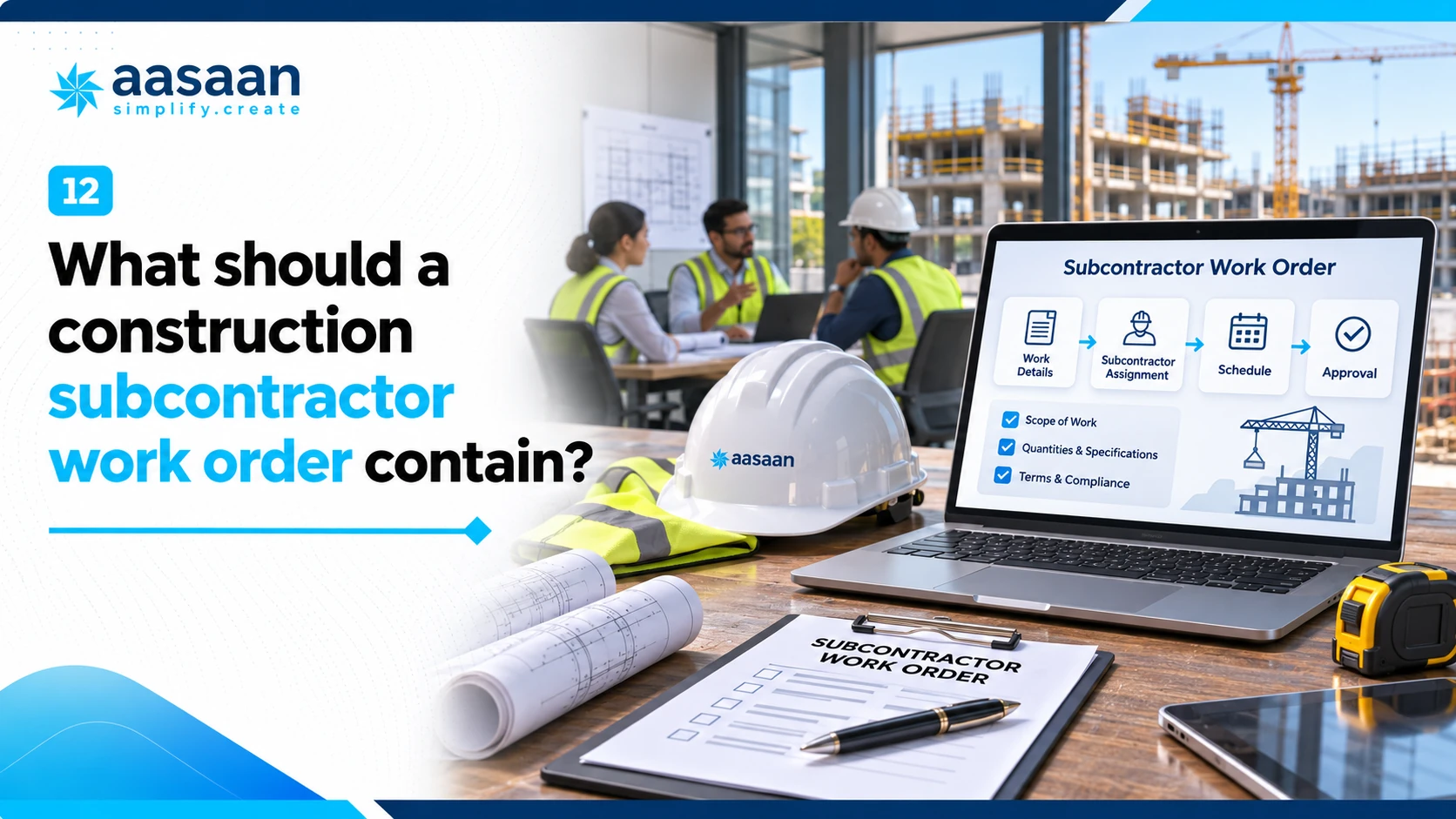
What should a construction subcontractor work order contain?
A strong work order makes the agreed job understandable to the people executing and reviewing it. Begin with the correct project, package, subcontractor, authorised parties and order revision. Identify the drawings, specifications and quotation clarifications that form the scope.
Define the payable work
Include clear item descriptions, unit of measurement, agreed quantities or quantity basis, rates and any schedule of values. State the measurement and acceptance rules the team will use. Where quantities are provisional, make that visible and explain the approval route for exceeding them.
Define the responsibilities
Identify who provides material, labour, tools, plant, temporary works, access, testing and protection. State workfront assumptions and coordination requirements. Specify how instructions, changes, defects and rework are to be recorded and reviewed. These details prevent a commercial gap becoming an operational argument.
Define the review and settlement process
Record bill submission requirements, measurement cut-offs, reviewer roles, approval steps, payment terms, agreed advances, retention and recoveries. Add the relevant closeout and release conditions. Your authorised commercial and legal team should approve the actual terms; the software record should preserve what was agreed rather than substitute a generic template.
Attach the supporting documents and keep a readable issued copy. The approval record should identify who authorised the order and which version went to the subcontractor. Ask the demonstrator to retrieve an earlier version after an amendment and explain which quantities or rates apply to work already executed. A downloadable PDF is useful, but its version must agree with the live transaction record.
How should work order amendments and extra items be controlled?
A revised scope should have a traceable instruction, impact review and approval. Do not overwrite the original rate or quantity and leave the team to guess why the order value changed. Keep the original agreement, each amendment and the effective date or work allocation used for the revised terms.
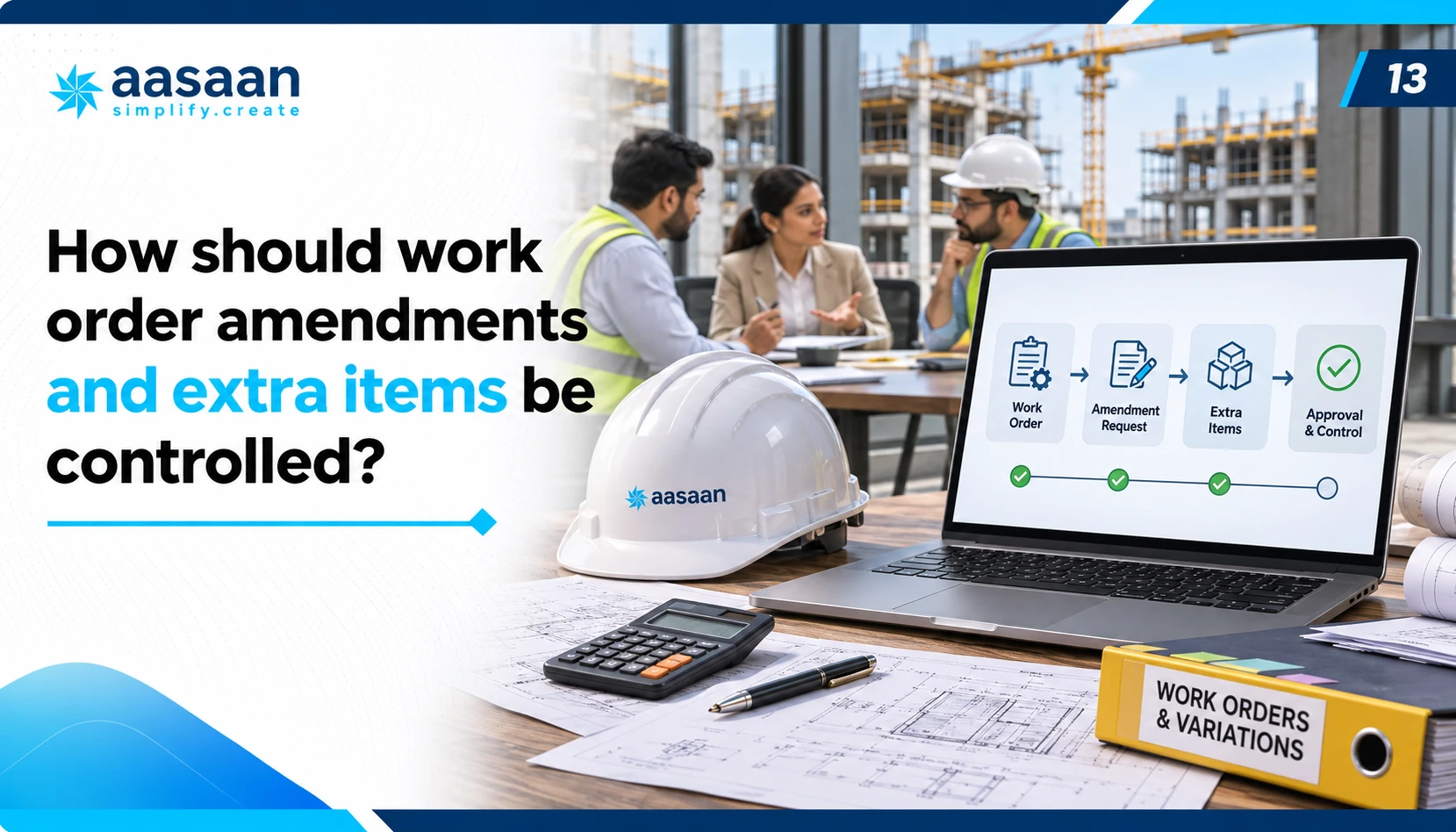
For an extra item, record its description, location, reason, proposed quantity, rate basis and authorising instruction. Separate instructed, submitted, under review, approved and rejected states where your process needs them. A subcontractor’s claim and an accepted liability are different records.
Suppose an access constraint requires additional surface treatment. The site engineer records the issue and instruction; the commercial reviewer checks whether it is included in the existing item. If it is additional scope, the team agrees the valuation basis and assesses the programme impact. The record then supports the bill review without pretending that every field observation is a payable variation.
PMI’s discussion of scope change control supports a structured approach to defining and reviewing changes. Apply that principle through a process your site and commercial team can actually follow.
When testing software, approve a new rate halfway through an example. Check that earlier certified work is handled according to the agreement, not silently recalculated. Ask how a pending variation appears in management reporting and whether it remains separate from the approved order value. An unresolved exposure should be visible without being presented as an authorised amount.
Connect mobilisation and workfront readiness to the subcontract
A subcontractor can have an approved work order and still be unable to work. Drawings may be unavailable, the preceding trade may not have handed over the area, access may be blocked or client-supplied materials may not be ready. A commercial register alone will not explain that delay.

For each workfront, record the planned release date, actual readiness, outstanding condition and owner. Use a location precise enough to coordinate the next activity: tower, floor, room, chainage or other relevant breakdown. “Site not ready” is too broad to support a useful recovery discussion.
Before mobilisation, confirm the required supervision, resources, access arrangements and agreed pre-start checks. Link any outstanding action to the package. If the subcontractor can start in one area but not another, show partial readiness instead of marking the entire package simply delayed.
Record a constraint when it occurs, including who was informed and what decision is required. This is operational evidence; it does not by itself allocate contractual liability. The reviewer still needs the agreement, dates and surrounding facts. Avoid turning a daily delay category into an automatic deduction.
A practical weekly review asks: which area becomes available next, what must be completed first, who owns that condition and when will they confirm it? Connecting those answers to the subcontract makes the progress conversation more useful than a standalone percentage or a list of calls made.
How should measurements become accepted bill quantities?
Capture measurement evidence at the level where the work can be checked. Include the project, work order, item, unit, location, date, dimensional basis and supporting reference. A photograph helps locate or explain work, but it does not replace a dimensional calculation where one is required.

Keep submitted, checked and accepted quantities distinguishable. Record the reviewer and the reason for an adjustment. Where joint measurement is part of the agreement, retain its acknowledgement and unresolved differences. The person preparing the bill should be able to see the status without deciding the measurement again.
Make repeat billing detectable
Use a location and item reference that can be reconciled against previous certifications. If a subcontractor measures several flats, show which flats and portions are included. A total of 800 square metres is difficult to verify if the previous bill used a different grouping and no location record survives.
Preserve corrections
A corrected measurement needs its own history. Identify whether the correction concerns an unapproved submission, a reviewed quantity or work already certified. A later adjustment should explain its effect rather than erase the earlier decision.
The CPWD circular introducing electronic measurement-book procedures is an Indian public-works example of connecting measured quantities with payment records. It describes CPWD’s arrangements, not a universal procedure for private subcontracts. Use your actual agreement and project measurement rules when designing the workflow.
In a demo, submit more quantity than the reviewer accepts. Then trace the accepted amount into the bill and retrieve the excluded portion. That test is more revealing than watching a perfect measurement move through the system once.
Why installed work, accepted work and payable work must stay separate
A trade can install work that has not passed the required inspection. It can also complete an accepted item that is not yet included in a submitted bill. Those conditions affect different decisions and should not be collapsed into a single progress percentage.
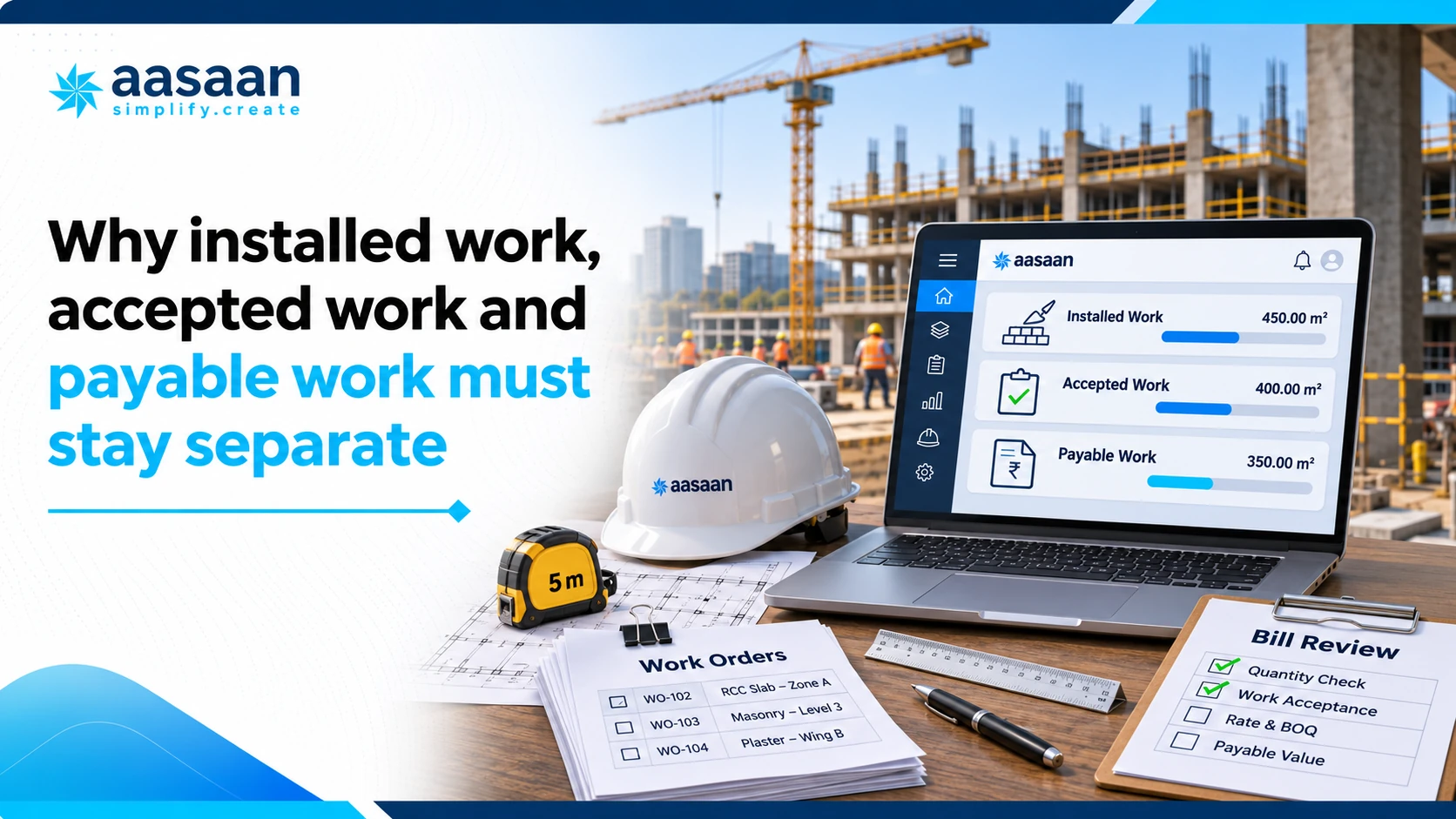
Use an example from waterproofing. Application may be complete in an area while the required inspection or test remains open. The next trade needs a release decision; the commercial reviewer needs the agreed valuation conditions; the project head needs to know whether the unresolved test threatens the programme. One completion flag cannot communicate all of that.
Record the relevant inspection, observation, rectification owner and acceptance status. If part of the work is rejected or needs rework, retain its location and quantity separately. Avoid counting both the original installation and its replacement as additional payable output unless the contract and authorised decision establish that treatment.
A quality-related hold should have an identified basis and reviewer. Do not create an unexplained blanket deduction or treat every open observation as authority to withhold a whole bill. The decision must follow the agreement and the responsible team’s assessment.
The software evaluation should include a partially accepted workfront. Ask whether the team can show installed quantity, accepted quantity, billed quantity and remaining work together. Then check that a site user can find the action needed to release the next trade without being given permission to certify or pay the bill.
04 / Review RA bills, recoveries and payments
How do RA bills connect cumulative work, previous certification and this bill?
An RA bill is a running-account claim or valuation during the course of the work. In a cumulative approach, the reviewer establishes accepted value to date, then determines the current-period movement after considering what was previously certified on the same basis. The contract defines the detailed method and permissible adjustments.
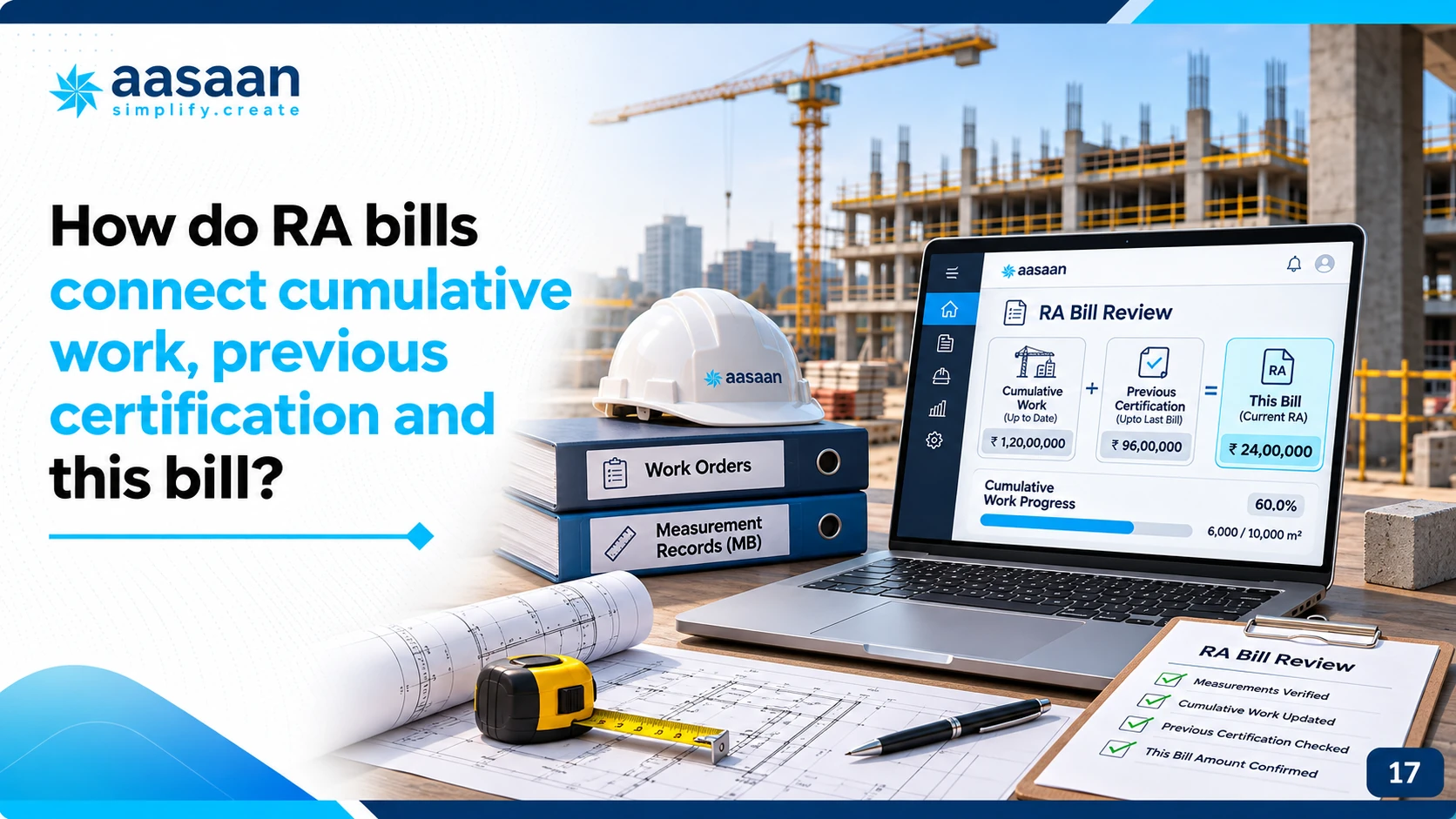
Previous certification is not the same as cash already paid. If an earlier certified bill remains unpaid, it belongs in the payment reconciliation. Subtracting bank payments from cumulative gross work can cause the new bill to include amounts already certified and awaiting settlement.
For item-rate work, start with accepted cumulative quantities at the applicable agreed rates. Keep approved extras, corrections and other valuation components identifiable. Then compare against the previous cumulative gross certification using a consistent scope and basis. Deduction and tax schedules need their own treatment; avoid mixing a pre-tax gross value with a previous net payment.
| Figure | What it represents | Common mistake |
|---|---|---|
| Submitted claim | What the subcontractor asks to have reviewed | Treating it as already approved |
| Accepted cumulative gross value | Work value accepted to the cut-off on the stated basis | Including pending variations as agreed work |
| Previous cumulative gross certification | Gross value already certified before this bill | Substituting money paid |
| Current gross movement | Change in accepted gross valuation | Calling it the final bank amount |
| Current release recommendation | Amount after the entered contractual adjustments | Ignoring separate taxes, holds or existing unpaid bills |
For a wider explanation of tools, see Aasaan’s construction billing software guide. Here, the important control is traceability from the subcontract and measurement through certification, rather than the appearance of the invoice alone.
Worked example: one plastering package from work order to payment review
The following numbers are an invented training example, not an Aasaan customer result. A labour-only plastering order covers 5,000 square metres at ₹220 per square metre, giving an initial order value of ₹11,00,000 before any separately applicable taxes or changes. The example uses cumulative item-rate valuation.
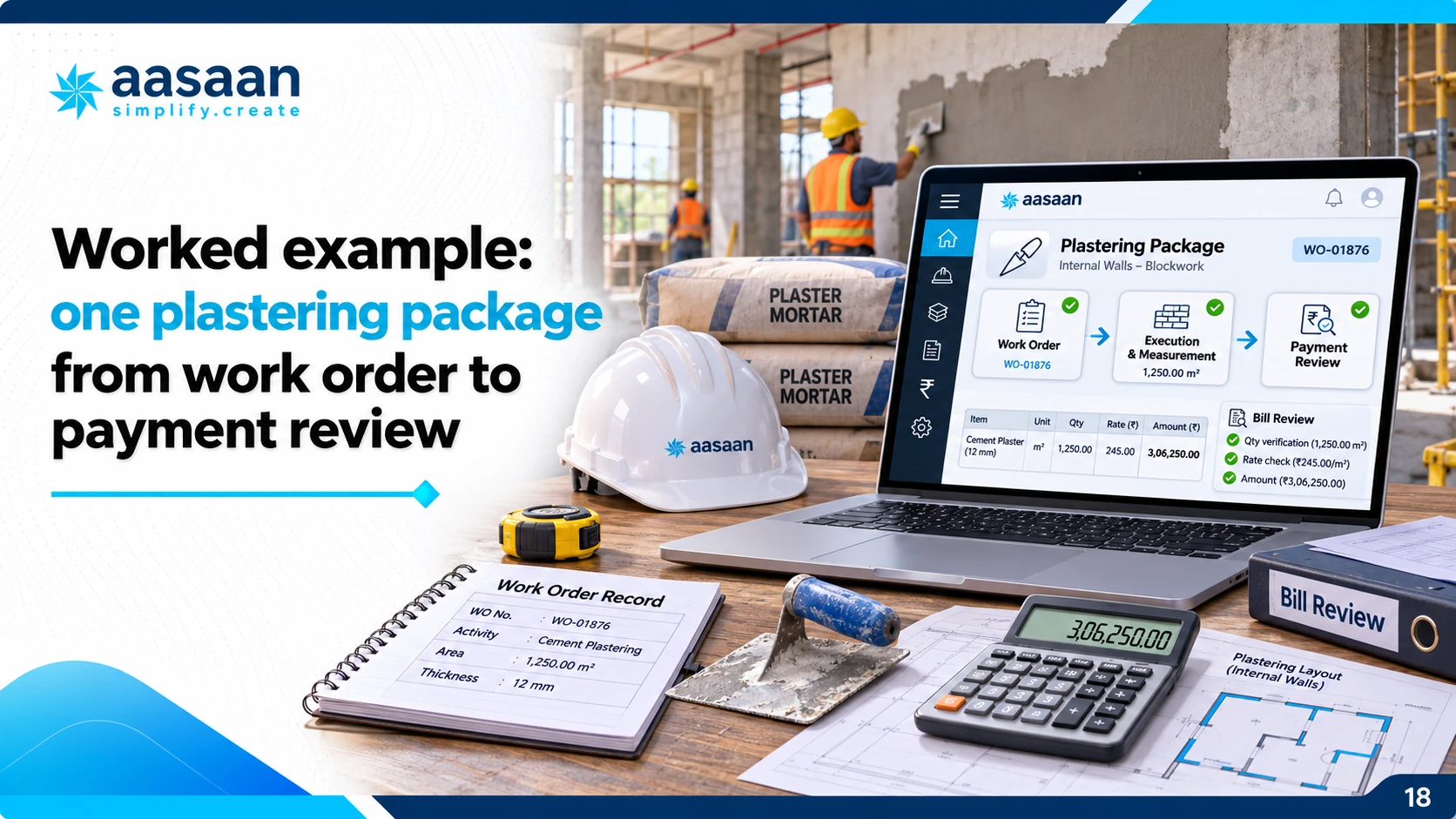
The subcontractor submits 2,000 square metres to the current cut-off. The reviewer accepts 1,900 square metres against the agreed measurement and acceptance basis. The remaining 100 square metres stays visible for clarification; it is not silently removed from the record or automatically treated as fraud.
| Review step | Calculation | Illustrative result |
|---|---|---|
| Accepted cumulative work | 1,900 × ₹220 | ₹4,18,000 |
| Previous cumulative gross certification | 1,200 × ₹220 | ₹2,64,000 |
| Current gross work movement | ₹4,18,000 − ₹2,64,000 | ₹1,54,000 |
| Current retention, assumed for this example | 5% of ₹1,54,000, with no cap reached | ₹7,700 |
| Agreed advance recovery this bill | Entered amount | ₹20,000 |
| Other authorised recovery | Entered amount | ₹5,000 |
| Current release before tax and other adjustments | ₹1,54,000 − ₹7,700 − ₹20,000 − ₹5,000 | ₹1,21,300 |
Now assume ₹30,000 from an earlier net certified bill is still unpaid. That does not change the gross work movement above. It appears separately in the opening unpaid payable and, if released in the same payment run, is allocated to that earlier bill. The bank instruction and ledger should show which obligations the payment settles.
The team still needs to check applicable tax treatment, other authorised adjustments, due dates and payment release conditions. The purpose of the example is to distinguish the records so a reviewer can explain every step. Use the calculator below to change the quantities and recoveries while keeping that structure.
Interactive RA bill calculator: trace the current work value
Use this single-item example to understand the bridge from accepted work to the current release before tax. Enter accepted cumulative quantity, the agreed rate and previous cumulative gross certification on the same basis. Enter recoveries as current-bill amounts, not outstanding balances that you intend to recover later.
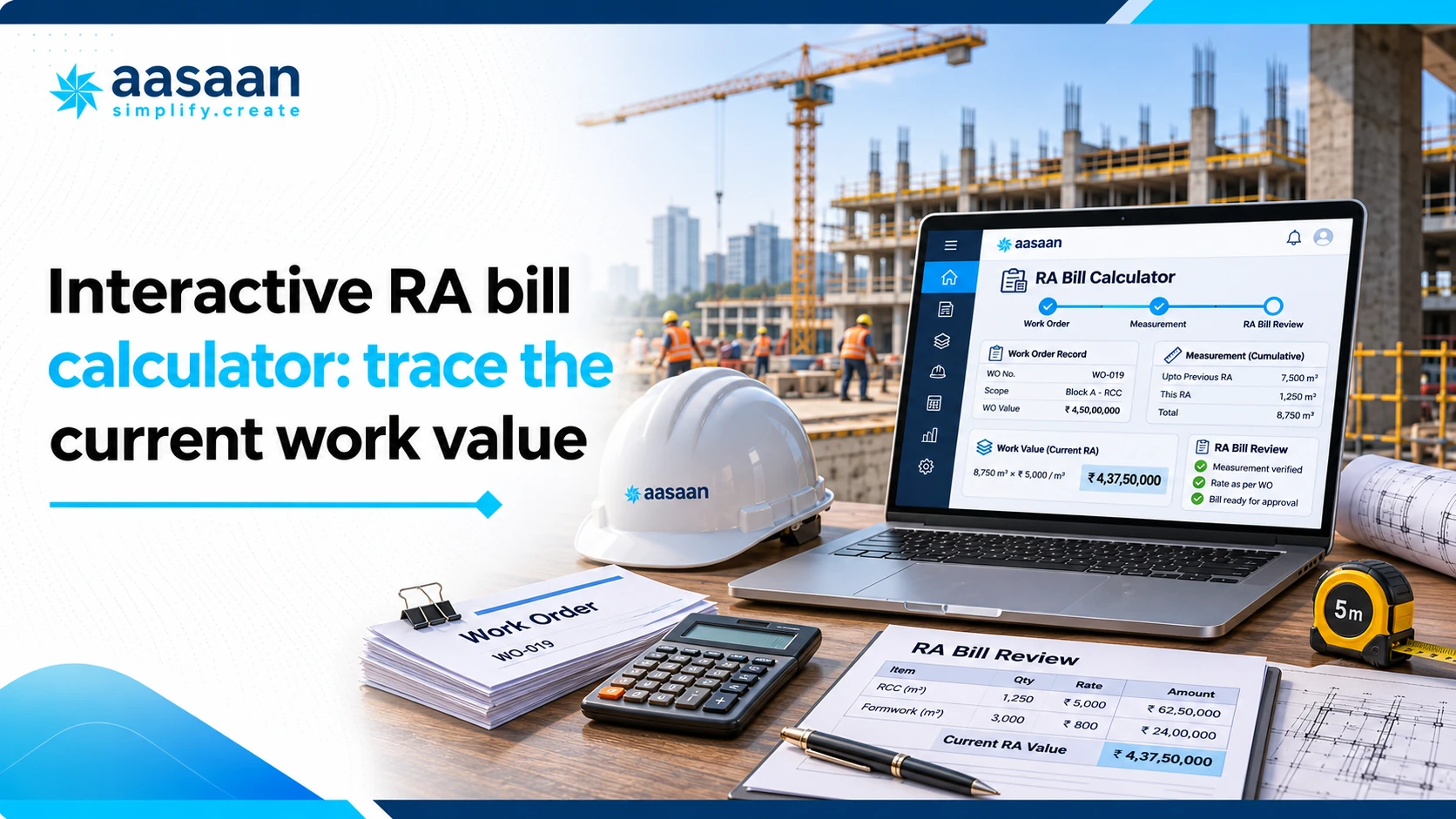
The tool applies a simple current-bill retention percentage with no cap, prior correction or retention release. It does not decide contractual entitlement, GST, withholding, due dates or bank payments. Where your agreement uses a different retention basis, cap, milestones or multiple rates, review the actual schedule separately. Do not use a net previous payment in the previous gross field.
Illustrative before-tax arithmetic. No retention cap, release, tax or other valuation components are included. This result does not authorise payment.
Try the worked example first. Then change the accepted quantity from 1,900 to 2,000. The difference is ₹22,000 of gross work value; that is not automatically additional authorised payment. The extra quantity still needs the relevant review. A calculation confirms arithmetic, while the source records establish why the inputs are acceptable.
If the current cumulative value is below previous certification, the tool identifies a negative movement for investigation. It does not silently force that figure to zero. A correction or reversal needs an explicit commercial and accounting treatment rather than a new positive bill built from altered opening numbers.
How should retention and release conditions be tracked?
Retention is an amount held under the agreed terms, not a general savings account or an unexplained reduction in the subcontract value. Track the basis, rate, any cap, deductions, releases, outstanding balance and conditions attached to future releases. Keep it visible separately from ordinary unpaid certified bills.
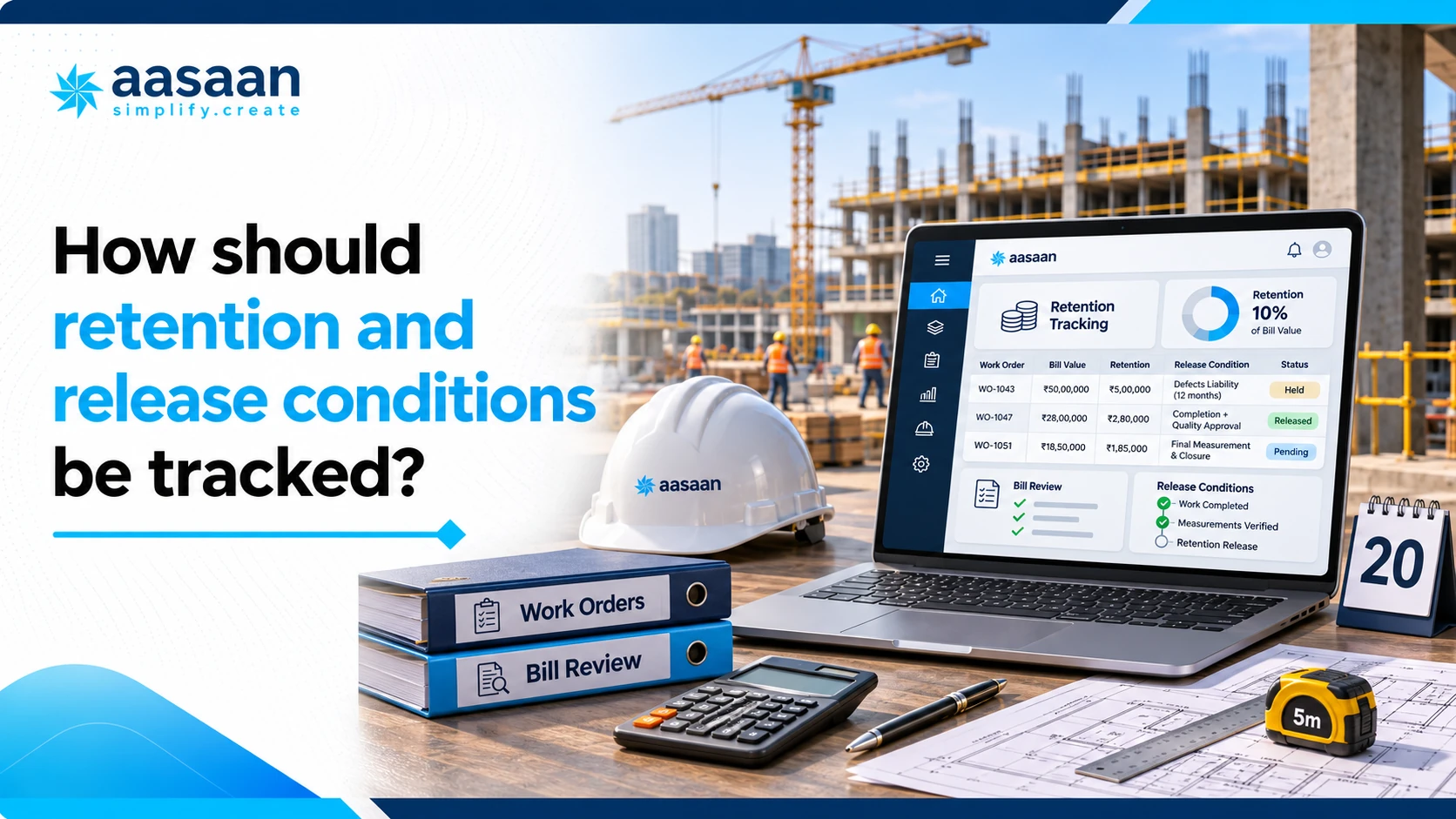
A useful retention register identifies the subcontract, source bill, amount held, authorised release, remaining balance, expected review milestone and owner. Where a contract provides staged release, record each stage and its conditions. A forecast review date does not by itself authorise payment.
Check the balance before the release
Suppose opening retention is ₹80,000, this bill adds ₹7,700 and a properly authorised release is ₹20,000. Closing retention is ₹67,700. That calculation says nothing about whether the release conditions have been met; the reviewer needs the contract, relevant acceptance record and approval.
Do not label all retained money overdue simply because a bill is old. Equally, do not let a satisfied release condition disappear in an unreviewed spreadsheet. Put the next review event and responsible person alongside the balance so legitimate releases receive attention.
In the software demo, trace a held amount back to its source bill, authorise a partial release and inspect the resulting ledger. Ask how the team prevents releasing the same balance twice and how a corrected certificate affects the retention register. These are buying tests, not assumptions about every product’s default setup.
How do advances and recoveries stay visible across bills?
An advance creates an exposure that needs its own reconciliation. Record the approved amount, purpose, payment reference, contractual recovery basis and any relevant supporting security or release condition. Do not rely on a note in the first bill to explain the balance several months later.
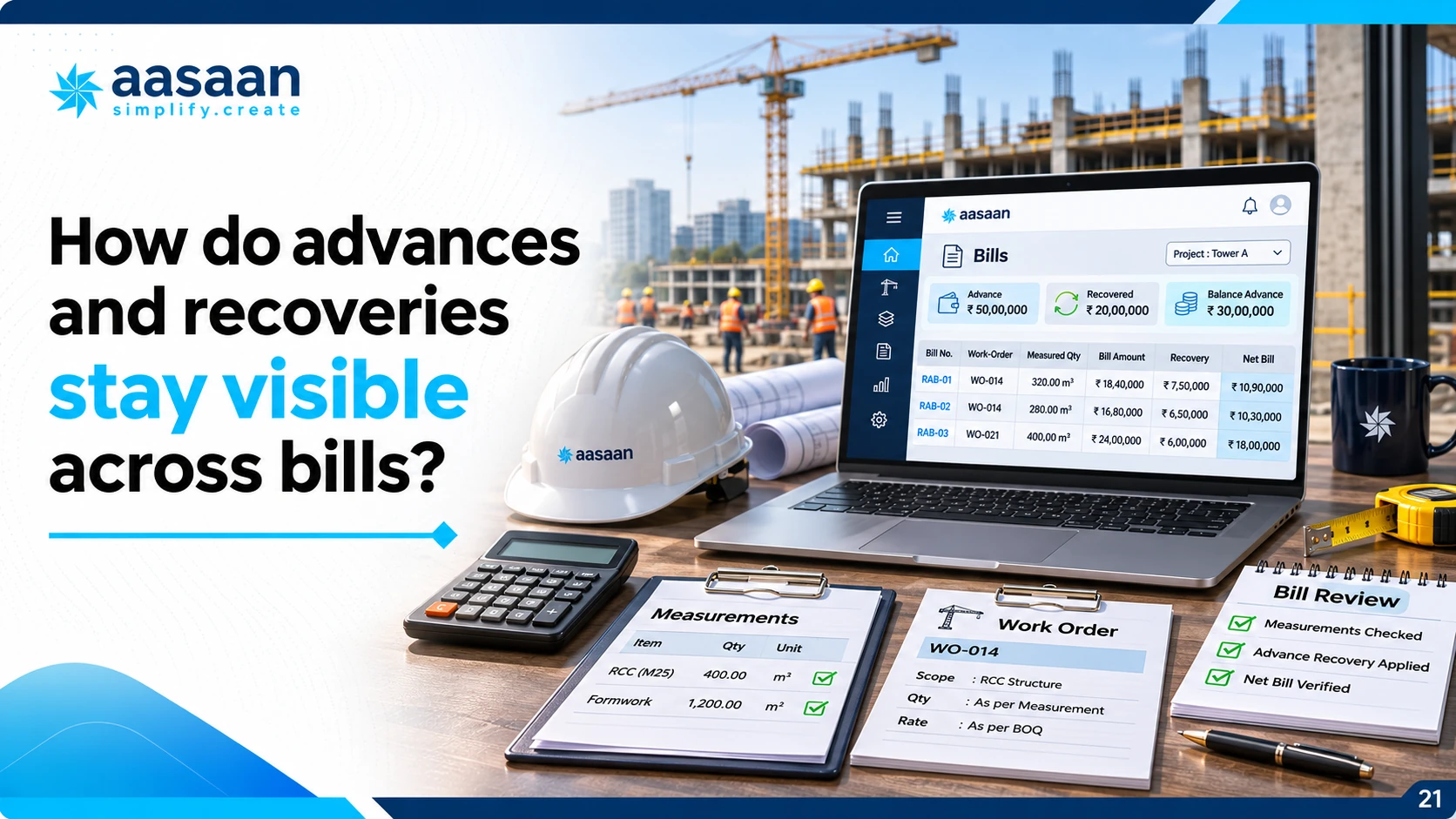
Maintain the opening advance, new advance payments, recoveries and closing balance by subcontract and project. An instruction to recover ₹20,000 from a bill is a current transaction; an outstanding advance of ₹2,00,000 is a balance. Treating the whole balance as a bill deduction can materially distort a payment recommendation.
Compare the planned recovery with the actual billed work. If progress slows, quantities reduce or a package is reassigned, ask whether the remaining recovery route is still realistic. Keep the exposure visible for a commercial decision. Do not assume that a large order value guarantees recovery of every advance.
When a bill is returned, revised or cancelled, establish what happens to its proposed recovery. A recovery should not count twice simply because both the draft and revised bill appear in an export. The final reconciliation must agree with approved transactions and payment records.
Test an example with two bills, one partial payment and a corrected recovery. Ask the demonstrator to explain the balance without changing the original payment entry. That is a practical way to evaluate whether subcontractor payment software maintains a coherent history rather than a collection of disconnected totals.
How should free-issue materials, returns and recoveries be reconciled?
Materials supplied to a subcontractor may be free-issued, chargeable or subject to an agreed consumption and recovery arrangement. Establish the basis before issuing stock. A stores issue records a physical movement; it does not automatically create an authorised financial recovery.

Identify the material, unit, quantity, issue location, recipient, date and work order. Record acknowledged returns and transfers separately. When material moves to another trade or site, preserve the movement rather than leaving the first subcontractor responsible for stock they no longer hold.
Compare net issued quantities with the agreed allowance or other relevant basis. Investigate differences before labelling them excess consumption. Possible explanations include timing differences, unrecorded returns, conversion errors, changed scope, rework or stock still available at the workfront.
A proposed recovery needs a calculation, a supporting record and the required review. Show its status separately from an authorised deduction on the bill. If the subcontractor disputes responsibility, retain both the difference and the decision trail so the next reviewer does not have to recreate the issue.
Use Aasaan’s material management guide for the wider stock workflow. For this subcontract, test one issue, one return and one reassignment before discussing automated deductions. The important connection is between physical accountability and the agreed commercial treatment; it is not simply the presence of a material balance on a dashboard.
What should the subcontractor payment register show?
A payment register should explain what is approved, what is due, what is held and what has actually settled. “Total pending” is a useful headline only when the reader can inspect its components and cut-off. A newly submitted claim should not appear indistinguishably beside a certified overdue payable.

Keep bill references, submission dates, current review status, certified amount, current due amount, due date, holds, releases, payment allocations and remaining payable identifiable. Show retention and advances in their own reconciliations. Where tax or other accounting adjustments apply, use the finance-approved basis consistently.
A partial payment should allocate to identified obligations. If one bank transfer covers three bills, retain that allocation. If a transfer fails, do not mark the bills settled merely because a payment instruction was prepared. Define the evidence used to confirm settlement and the person responsible for reconciliation.
Separate the blockers
An unapproved measurement is a review issue. Missing beneficiary verification is a payment-control issue. A bill not yet due is a timing issue. An authorised dispute hold is a commercial issue. Giving all four the same label prevents the team from taking the right action.
In a weekly meeting, filter the register by the action owner and next decision. Ask which certified amounts can be released, which returned bills need a response and which holds require review. This creates a useful management routine without pretending that every unpaid amount is an avoidable delay or that every submitted claim must be paid immediately.
05 / Connect people, decisions and project evidence
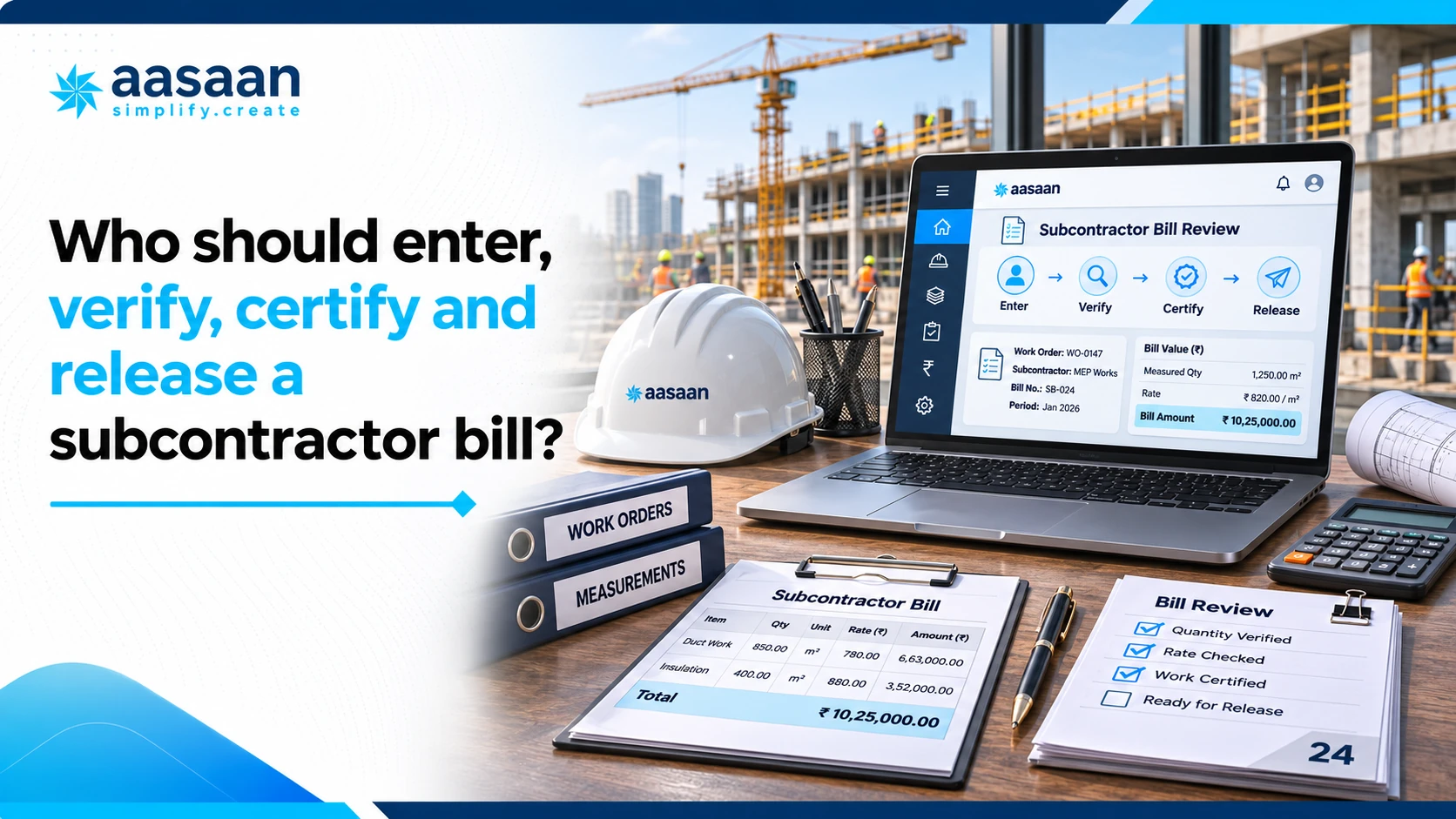
Who should enter, verify, certify and release a subcontractor bill?
Define responsibilities before setting permissions. The site engineer may record work and attach evidence; a quantity surveyor may verify measurement and valuation; a project or commercial head may authorise the certification; accounts may check posting and release requirements. The exact structure depends on the organisation, but a shared login should not blur the decisions.
| Role | Practical responsibility | Evidence to retain |
|---|---|---|
| Site engineer or trade coordinator | Capture location, progress and supporting records | Measurement references, photos, constraints and dates |
| QS or commercial reviewer | Check quantities, rates and adjustments | Review notes, calculation basis and returned items |
| Project or authorised approver | Decide within delegated authority | Approval, conditions and amendment references |
| Accounts and payment reviewer | Check payable, allocation and settlement | Posting reference, beneficiary check and payment record |
| Subcontractor contact | Submit and clarify their claim | Original submission, response and acknowledgement |
Make approval delegation explicit for leave or absence. A temporary reviewer should have an identified scope and period. Avoid resolving a slow approval by making everyone an administrator; that can make the resulting history less meaningful.
Ask the software provider to switch between ordinary user accounts during the demonstration. Attempt an action the user should not perform, such as changing an approved rate or editing a payment allocation. Then inspect who can see the history. Permission quality is best tested through a realistic prohibited action, not a slide stating that role-based access exists.
How do you handle disputed measurements, deductions and returned bills?
A useful review process preserves the original submission and makes the disagreement specific. Identify the item, location, quantity or adjustment in question, the reason for the return, the evidence required and the person responsible for responding. “Please revise” is usually too vague to move the bill forward.
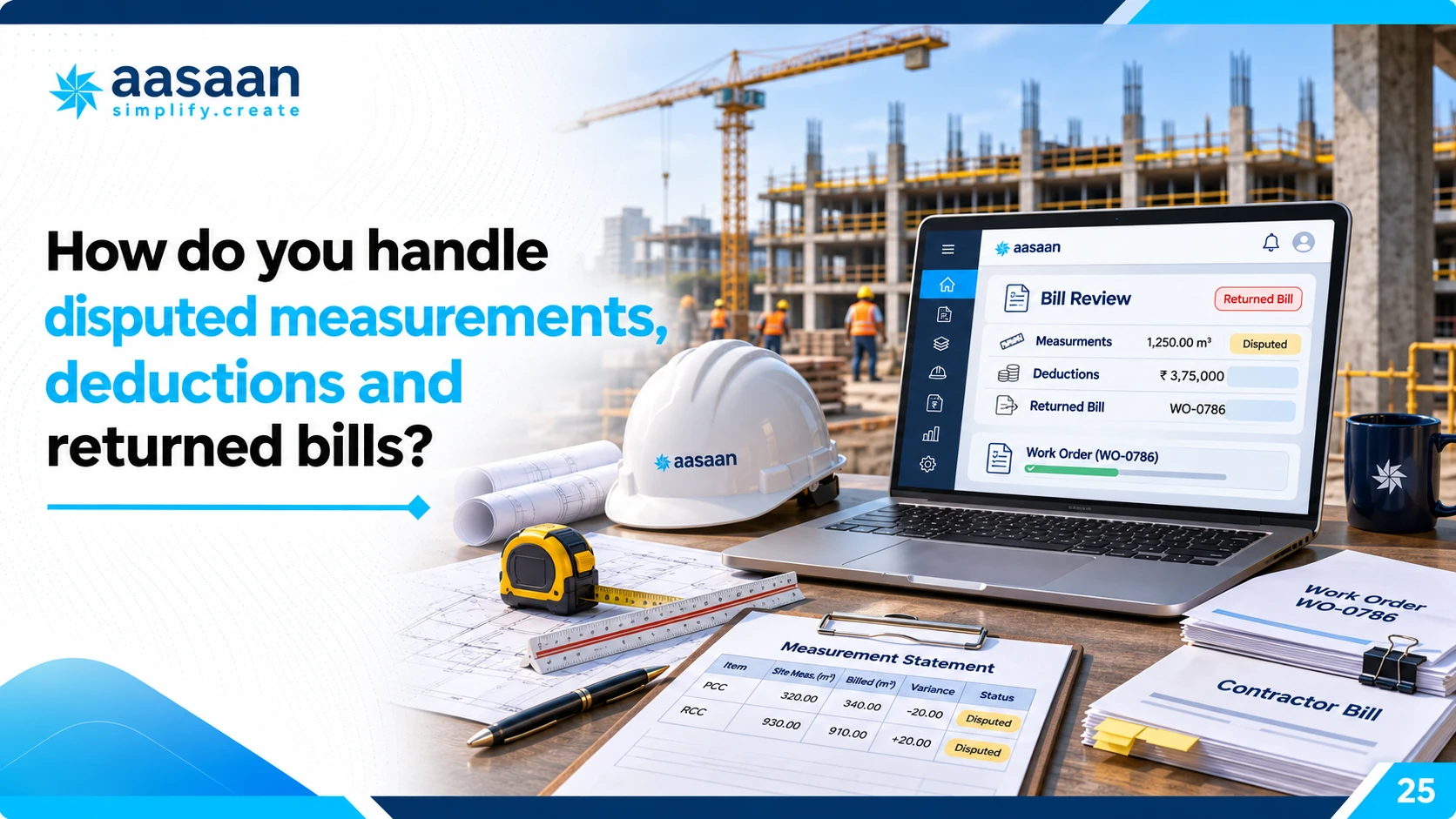
Distinguish a factual correction from a commercial disagreement. A duplicated location may be resolved by checking the earlier bill. A disagreement over whether an item is included may require review of the order, clarifications and instruction. The software should help locate those records without making the entitlement decision itself.
Keep accepted and disputed portions visible. Whether any portion can be certified or paid separately depends on the agreement and authorised process. Record the actual decision rather than applying an automatic full hold or treating an unresolved difference as an approved liability.
A returned bill should retain its first submission date, return reason and later resubmission. Otherwise a report can appear to show quick review simply because every revision creates a fresh clock. For internal analysis, measure both total elapsed time and time awaiting a specific party.
When agreement is reached, record what changed and where the adjustment appears. If the resolution affects an earlier certification, retain that connection. A clear history protects a working relationship: both sides can explain how the figure was reached, even when they initially disagreed. The aim is an auditable decision, not a dashboard that conceals unresolved issues behind a completed status.
Connect subcontractors with progress, drawings and the next trade
Subcontractor performance depends partly on the information and workfront available to them. Link the package to the relevant programme activities and current drawing references. A trade should not be judged solely on a target date that ignored an unresolved predecessor or a late design release.

During the review, distinguish planned output, actual installed work, accepted work and the conditions for the next trade. A delay in one room may affect testing, ceiling closure or finishing elsewhere. Location-level coordination helps the team identify the consequence and assign a practical recovery action.
Use revision and suitability information with drawing references. The UK BIM Framework’s common data environment guidance discusses revision and information-status management. It is useful background for controlling information; it is not evidence that a particular software deployment is certified to a standard.
If a drawing changes after work has been accepted, record the instruction and assess its scope, cost and programme effects. Do not remove the original acceptance record simply because a later revision exists. The reviewer needs to know which information was used at the time.
For the broader planning method, see construction progress tracking: planned versus actual. In your subcontractor demonstration, ask the team to connect a late workfront release to the trade’s next action and retrieve the related commercial instruction. That demonstrates coordination beyond a list of bills.
How should WhatsApp, mobile reporting and Tally support the process?
A communication tool is valuable when it helps the right record reach the right reviewer. A photograph in a group chat becomes useful billing evidence only when its project, location, item, date and review status can be identified. Otherwise the QS still has to reconstruct the transaction from messages.
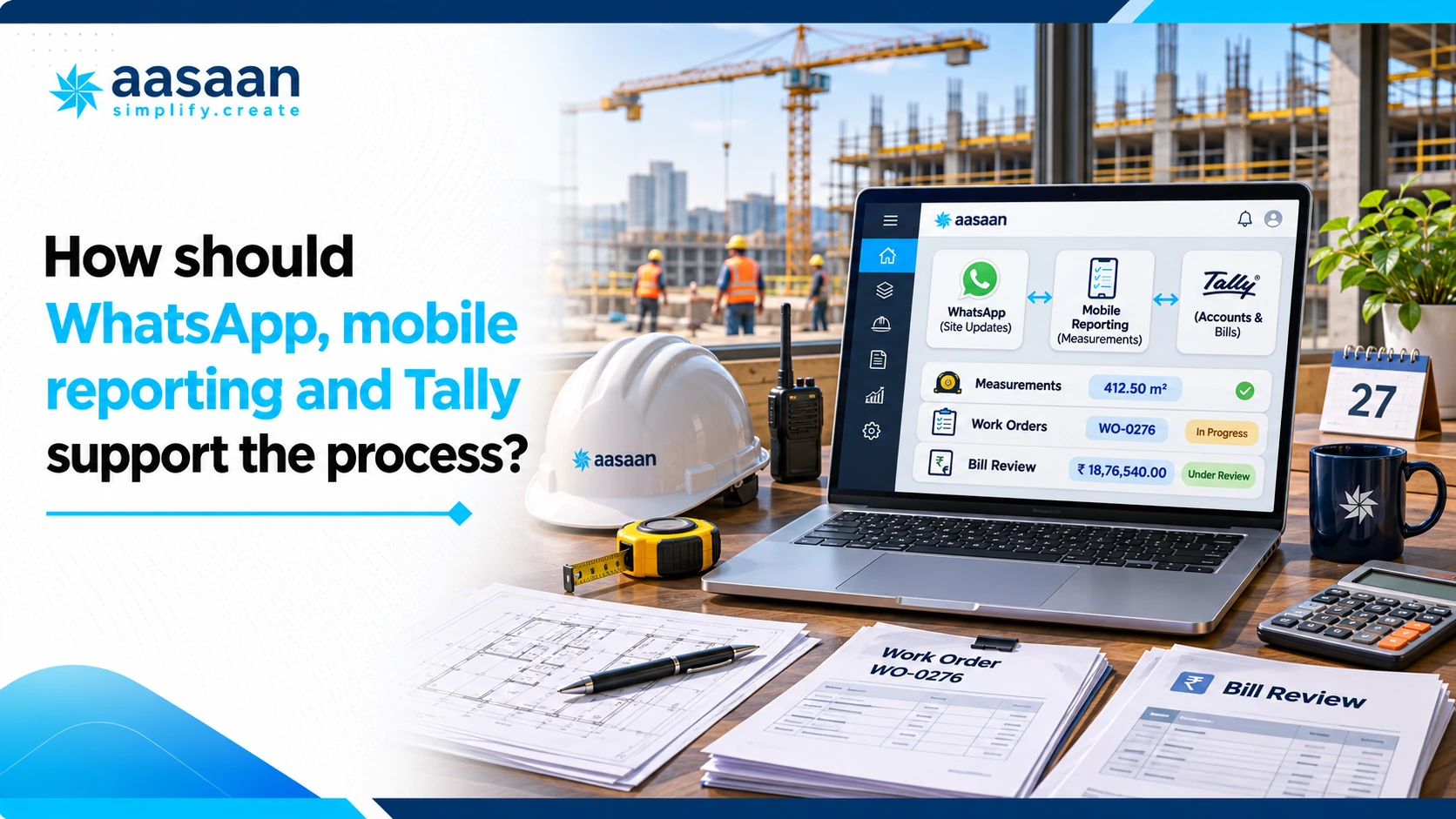
Aasaan offers two-way WhatsApp workflows and Tally connectivity. Confirm which subcontractor actions, attachments and notifications are included in your proposed setup. Ask where a submitted record appears, who verifies it and how a correction is handled. Do not assume every app screen or approval is available inside WhatsApp merely because the platform has an integration.
For accounts, identify the source of truth for the approved bill, party master and settlement record. Agree how cost codes, tax treatment and references are mapped. Test what happens if the transfer is rejected or a certified figure changes after posting. A retry must not create a duplicate payable.
Mobile usability deserves an ordinary working-day test. Ask an engineer to find the correct order, identify the work location, attach evidence and respond to a returned item. Test a dropped connection and a repeated submission. Establish the actual behaviour rather than assuming that mobile access implies offline processing.
The full objective is a closed handoff: a site submission is acknowledged, reviewed, corrected if necessary and reflected in the authorised record. Notifications help people act; they do not independently establish that work is accepted, a bill is certified or a payment has settled.
What should a subcontractor management dashboard show?
A dashboard should lead to a decision, not merely show larger totals. Start with the user’s responsibility. A site engineer needs missing evidence and upcoming workfronts. A QS needs review queues and mismatches. Accounts needs approved due amounts and payment exceptions. Leadership needs exposure and the decisions holding up delivery.
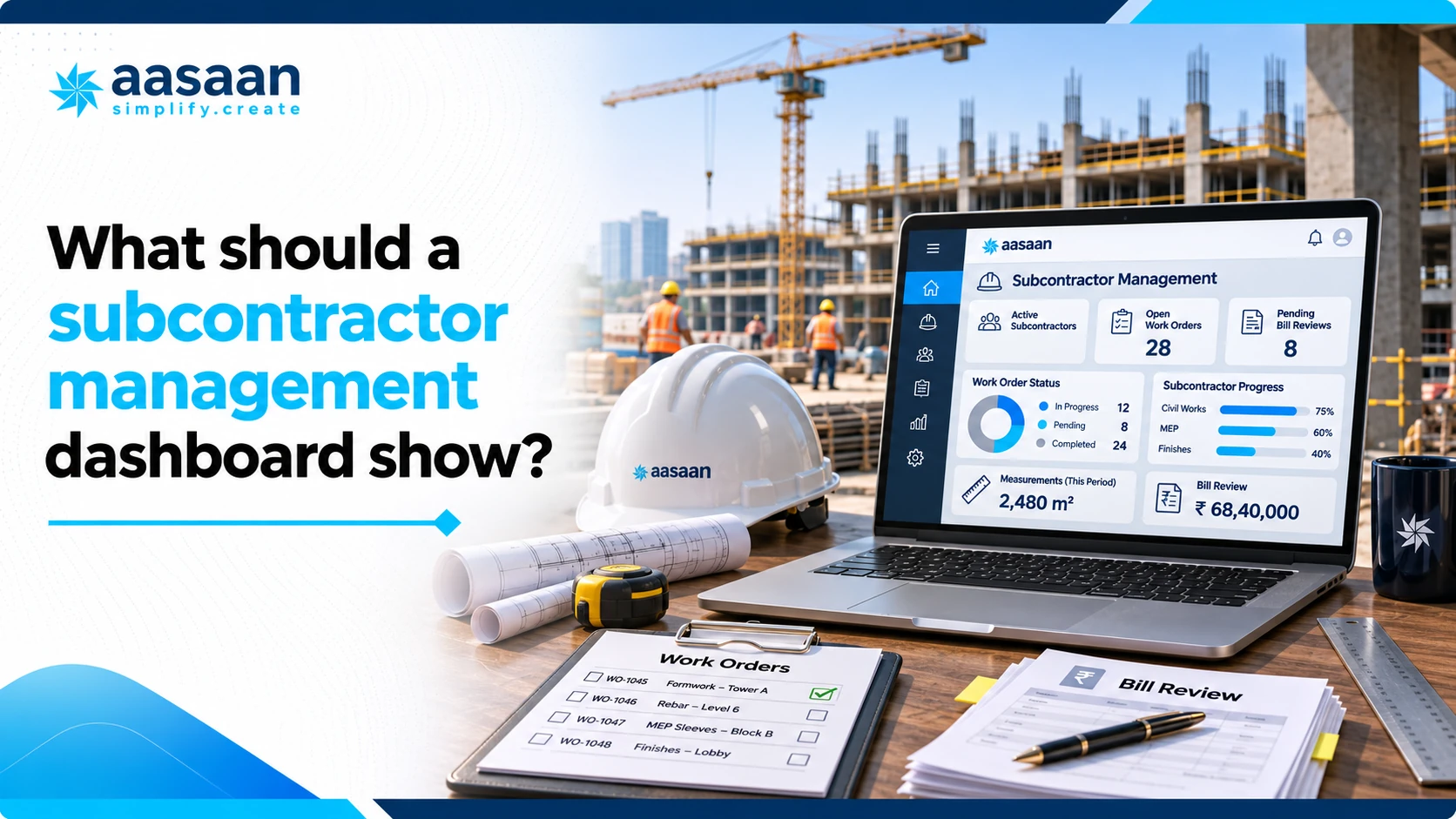
| Dashboard view | Useful measure | Required context |
|---|---|---|
| Work order exposure | Approved order value and pending change exposure | Pending is separate from approved |
| Physical delivery | Accepted quantity against the planned location or milestone | Cut-off and measurement basis |
| Bill review | Submitted, returned and certified values | Submission history and action owner |
| Payment | Certified due, paid and remaining payable | Due date, allocation and hold reason |
| Retention and advances | Held balance, releases and unrecovered advance | Source transactions and review conditions |
| Management action | Ageing exceptions and next commitments | Owner, next date and consequence |
Avoid a single performance league table that treats every trade as identical. A subcontractor on a small finishing package and one delivering structural work may have different output units, dependencies and review cycles. Compare measures that are meaningful for the scope.
Include record freshness. An apparently healthy bill position is less useful if several weeks of measurements have not been entered. Show the last relevant cut-off and unresolved imports or reviews. In a demo, ask the project head to drill into one red indicator and identify the exact record, person and next decision. If that requires a separate spreadsheet, the dashboard has not completed the handoff.
06 / Close the account and enable the team
How do you close the subcontract and prepare the final settlement?
Start closeout before the final bill arrives. Reconcile the approved scope, amendments, accepted quantities, previous certifications, material issues and returns, advances, recoveries, retention and payment allocations. Keep unresolved matters in a register with a responsible reviewer and target action date.
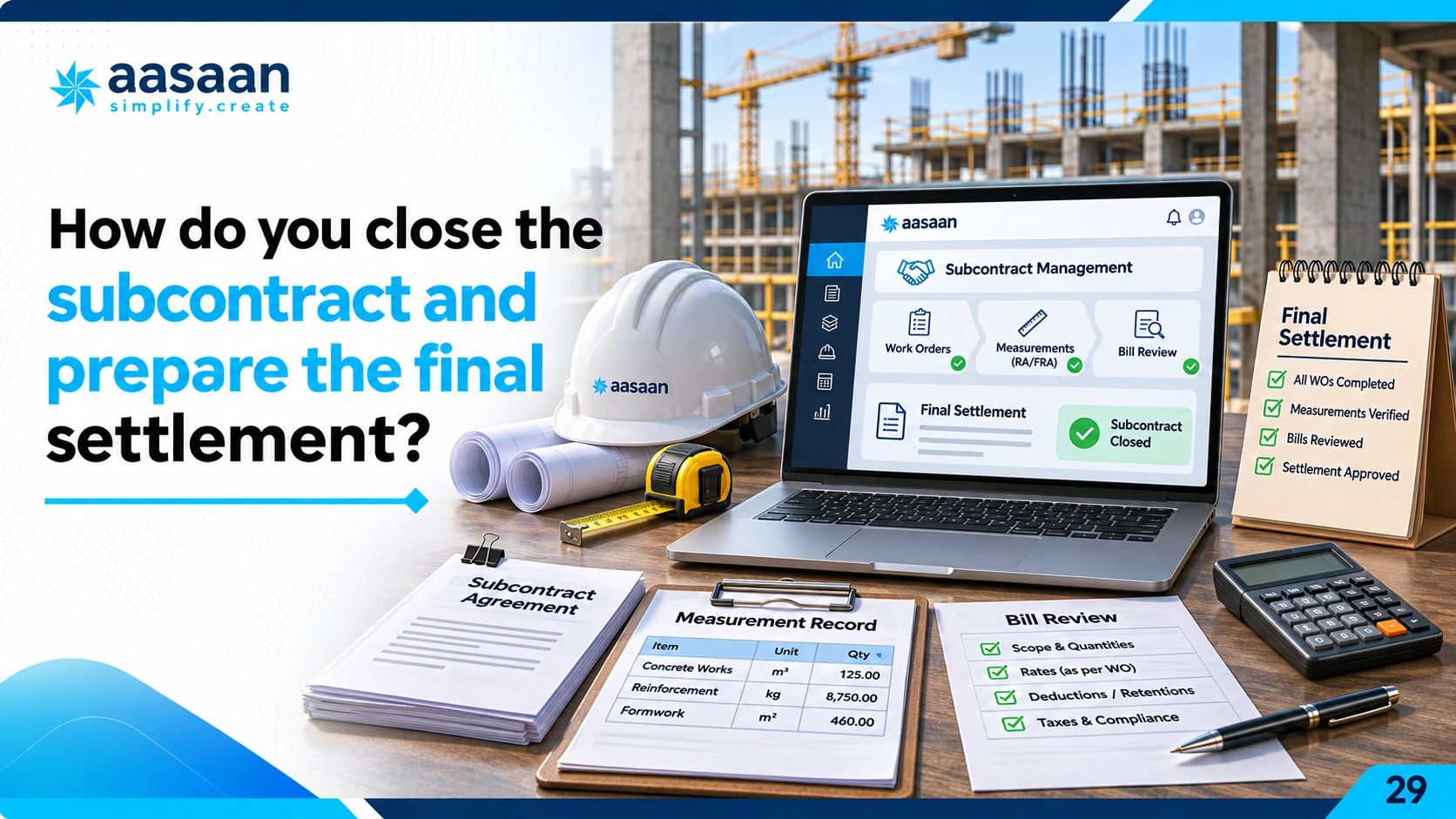
Physical completion and commercial closeout are different states. The workfront may be handed over while an agreed variation is still being valued. Conversely, an account may appear paid while required rectification or documentation remains open. The contract and authorised decisions determine the remaining obligations.
Prepare a statement that traces the final position from approved records. Identify what is agreed, what remains under review and which future releases depend on later conditions. A “final” label should not hide retention or an unresolved recovery balance. Check that the subcontractor statement and finance ledger use the same cut-off.
Where a package is terminated, reassigned or completed by another trade, maintain the separation of quantities and costs. Reassignment does not justify deleting the original records. Any back-charge or settlement adjustment needs its own basis and approval through the applicable process.
The software buying test is straightforward: ask the demonstrator to close the example package, then explain every remaining balance. Retrieve a source measurement, an approved change, a recovery and a payment allocation. The team should be able to distinguish the closed work scope from open commercial obligations without reopening archived spreadsheets or relying on the memory of the last project manager.
What affects subcontractor management software pricing in India?
Compare pricing against the workflow and people you need to enable. A lower subscription can become a poor fit if the required measurement review, accounting connection or training sits outside the proposed scope. A broader proposal can also be unnecessary if it includes capabilities your business will not use.

Aasaan’s pricing is tailored to your use case so you do not end up paying for features you do not need. Describe the number of users, responsibilities, active workflows, integrations, reporting needs and implementation locations. Ask for the selected capabilities and commercial inclusions to be written into the proposal.
Separate recurring subscription and support commitments from one-time configuration, migration, integration and training work. Confirm how additional users, sites, new modules and future changes will be quoted. Compare the same scope and period across providers, including internal data-preparation effort.
Do not assess value solely by dividing the licence by the number of bills. The useful test is whether the team can complete the required process and explain the resulting balances. Measure effort saved, review quality and visibility using a pilot baseline, rather than applying an assumed percentage of savings to the entire subcontract spend.
The construction ERP pricing guide covers the wider platform discussion. For this buying decision, take one subcontractor workflow and ask which scope delivers it from award through settlement, what it costs and how the users will be enabled.
How does Aasaan support on-site implementation and team training?
Aasaan offers on-site implementation with a dedicated civil engineer who visits the site, trains the team and stays until the site members are enabled to use Aasaan. Agree the locations, participants, workflow scope and commercial inclusions in your implementation proposal.

For subcontractor management, training should follow the work each person performs. The engineer records a measurement and returns to a correction. The QS checks a rate and explains a current bill. The project reviewer authorises within their responsibility. Accounts traces the payable and allocation. A classroom demonstration alone does not establish that these handoffs work during a normal site day.
Prepare an opening-data pack before training: subcontractor masters, issued work orders, amendments, accepted quantities, previous gross certifications, unpaid net balances, retention, advances and open material reconciliations. Reconcile these to the agreed cut-off. Importing a single “outstanding amount” loses the distinction the new process is meant to preserve.
Choose a pilot containing both a routine transaction and a correction. Review the first real measurement and billing cycle with the users. Record problems as process, data, configuration or training issues so the responsible person can resolve them. Do not expand simply because a launch date has passed.
On-site implementation means in-person enablement. It does not by itself establish offline app functionality or that every travel, migration and future training cost is included. Make the agreed service concrete, then evaluate it through user readiness rather than a generic implementation promise.
A practical rollout plan for the first complete billing cycle
Organise rollout around evidence gates rather than an invented universal deadline. The time required depends on the package, data quality, integrations and availability of reviewers. A contained pilot can still be thorough if it includes the difficult opening balances.
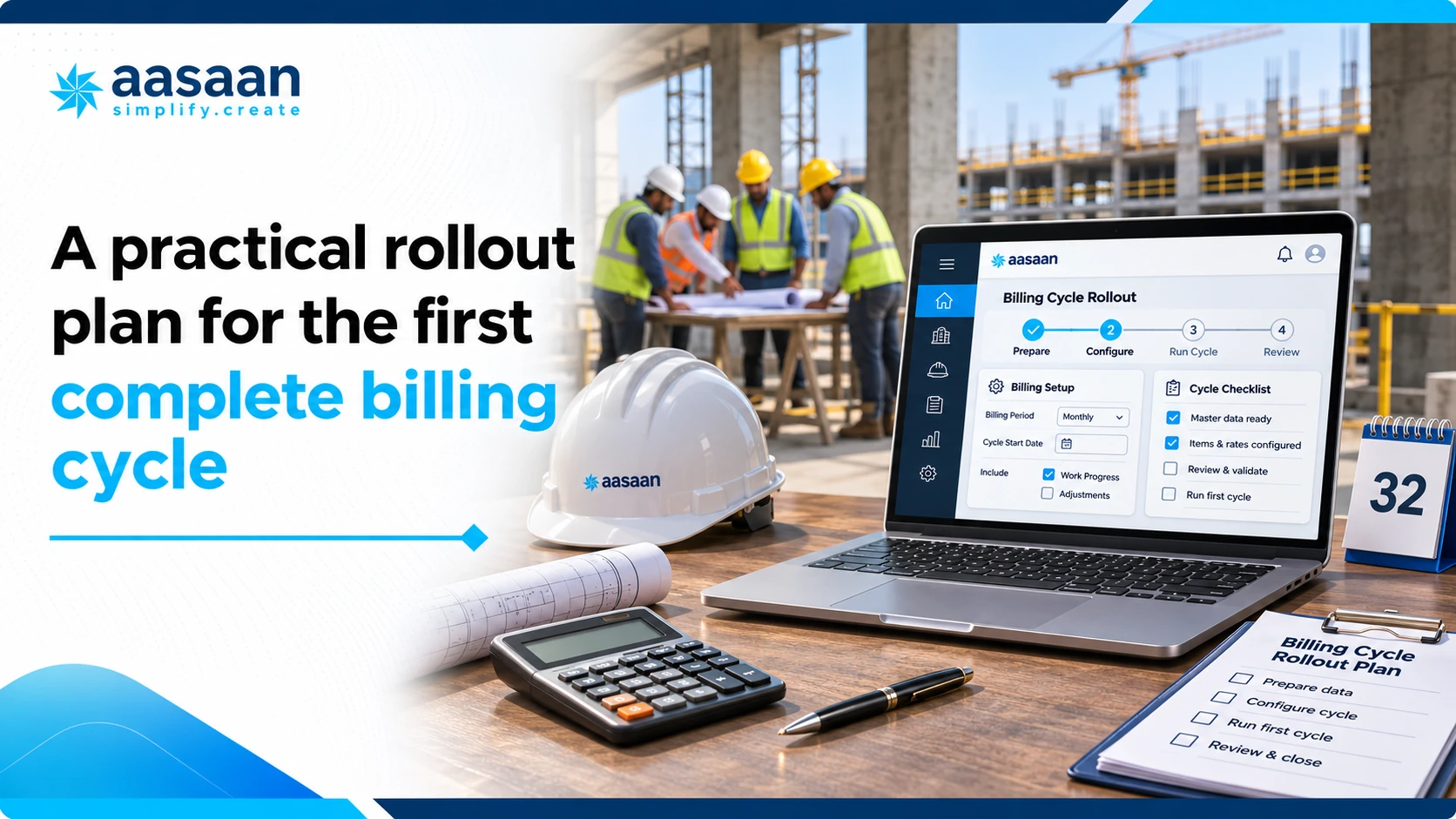
| Gate | What the team completes | Evidence of readiness |
|---|---|---|
| Establish the baseline | Agree scope, roles and source records | Named owners and a signed-off opening reconciliation |
| Configure the workflow | Set items, locations, review steps and terms | Ordinary-user transaction tests |
| Rehearse exceptions | Return a measurement, amend a rate and correct a bill | Preserved history and coherent balances |
| Run the live cycle | Submit, review, certify and allocate a payment | Source-to-ledger trace using agreed cut-offs |
| Review and expand | Resolve issues and assess user readiness | Team members complete their tasks without reconstruction |
During the first cycle, use a short daily issue register. Identify whether a record is wrong, a rule is unclear, a user needs help or the setup needs adjustment. Assign an owner and next check. Repeating the same error is a signal to improve the process, not simply to tell the team to enter data more carefully.
Before expansion, compare a few defined measures with the baseline: bills returned for missing evidence, time awaiting each reviewer, unexplained opening differences and work needed to produce the subcontractor statement. Released staff capacity is not automatically a cash saving. Report the outcome accurately and decide what the next phase should include.
07 / Interactive evaluation and weekly review
Interactive demo planner: which subcontractor workflow should you test first?
Select the issue that most often creates rework or uncertainty. The planner gives you a practical demonstration agenda and the records to bring. It is a preparation tool, not an automated recommendation that every provider will meet the requirement.

Use anonymised records or a representative training pack. Include the previous bill and its settlement history where the issue involves balances. A provider can demonstrate a clean new bill easily; the more useful question is whether your team can reconcile the next one after a correction, partial payment or pending change.
Send the agenda before the meeting and ask for site, commercial and finance participation. Keep demonstrated capabilities, configuration decisions and unresolved requirements in separate columns. The resulting record is more useful than a sales presentation marked “all features available”.
The ten tests your subcontractor software demo should pass
Use the same test pack for every shortlisted provider. The aim is to establish fit for your proposed scope, not to declare a winner from a polished interface. Record the result and supporting evidence for each test.

- Create a work order from a clarified quotation and retrieve the issued revision.
- Record work against a specific item, unit and location.
- Submit a quantity larger than the reviewer accepts; retain the difference.
- Prepare a cumulative bill using previous gross certification, not previous cash paid.
- Apply a current recovery and reconcile the remaining advance.
- Trace retention from source bill through a partial release and closing balance.
- Correct a certified item using the authorised process without deleting its history.
- Allocate a partial payment and distinguish instruction from settlement.
- Reject or correct an accounting transfer without creating a duplicate payable.
- Restrict an ordinary user from changing an approved commercial or payment record.
Add the contract types your business needs. If a capability requires configuration, integration or a different module, write that down with its scope and cost. A promise to “handle it later” is not the same as a demonstrated process and a documented delivery commitment.
After the demo, ask the site engineer, QS and accounts reviewer to describe how they would do their next task. If they cannot locate the record or explain its status, identify whether the problem is terminology, design or an incomplete workflow. Resolve that before relying on the system for the next payment cycle.
Interactive buying checklist: review the evidence before you sign
Use this checklist while reviewing a proposal or demonstration. A tick means your team has checked the requirement and knows where the supporting evidence is; it does not certify a product or establish legal compliance. Leave untested items open and assign follow-up owners in your evaluation record.

0 of 20 reviewed
The checklist stays in this page session and sends nothing to Aasaan. Download a CSV before leaving if you want to retain your review status. Reset clears only the ticks in this guide. Keep sensitive project or personal information out of the downloaded evaluation notes unless your organisation has approved its use.
Do not allow a strong total to compensate for a failed mandatory requirement. If the payment allocation, required approval or opening-balance reconciliation cannot work for your business, resolve that gap explicitly. Selection is a scope decision supported by evidence, not a score generated by counting features.
The weekly subcontractor review: leave with decisions, owners and dates
A useful meeting begins with exceptions, not a screen-by-screen tour. Review imminent workfront releases, accepted output against the near-term plan, measurements waiting for checks, returned bills, approved due payments, unresolved recoveries and upcoming retention reviews. Each item needs an owner and a next action.
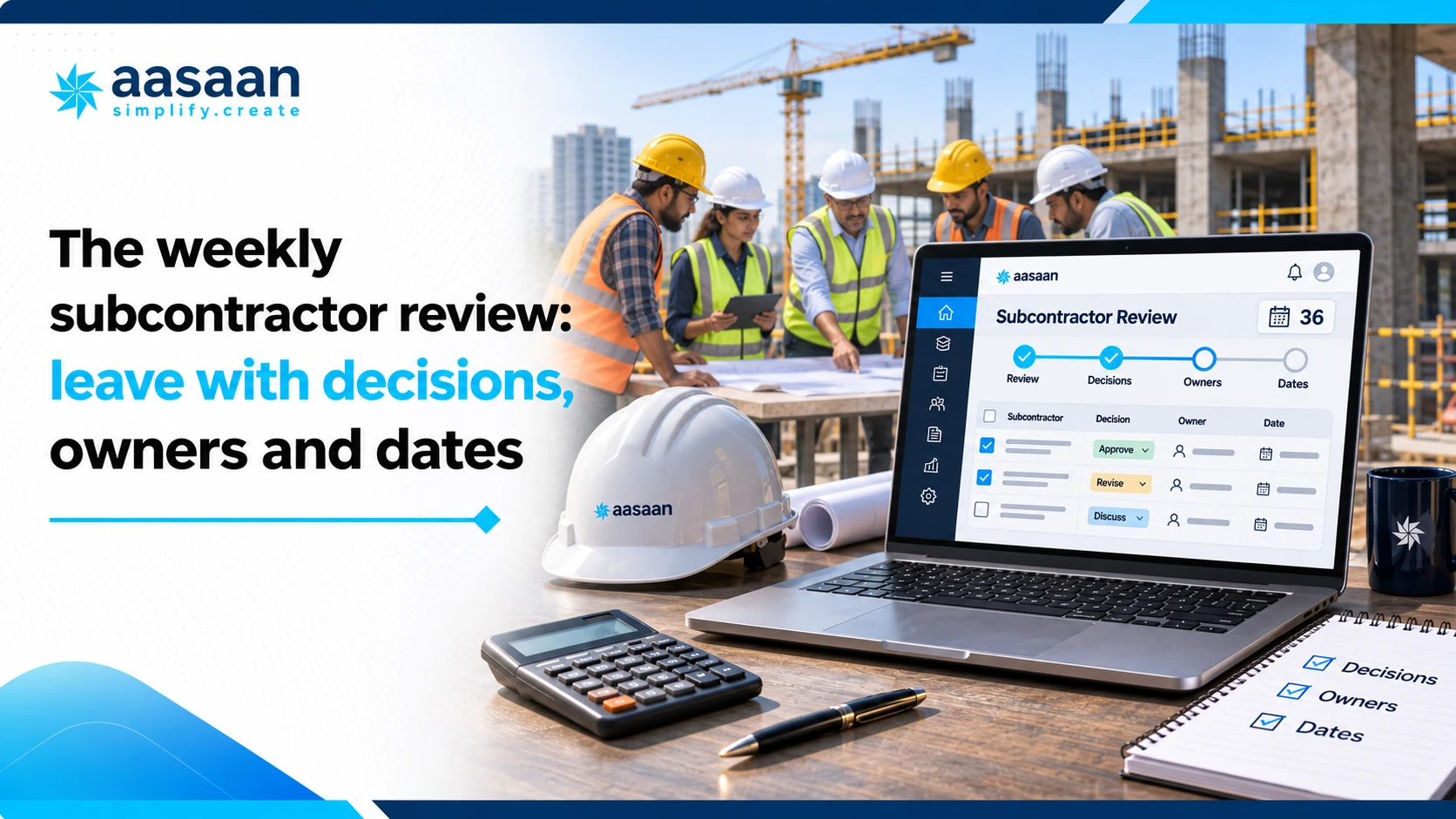
Choose measures with defined denominators. “Bills reviewed within the agreed internal target” needs the number received, the review basis and any returned items. “Payment overdue” needs an authorised due date and a clear explanation of holds. A reduction in invoice volume is not proof that the review process improved.
Keep operational constraints separate from commercial decisions while showing their connections. A missing material delivery may explain low output and an advance-recovery concern, but it does not automatically determine responsibility or an amount to deduct. The meeting should assign the necessary review rather than imply a contractual conclusion from a trend chart.
End with three questions: what must happen before the next trade starts, what prevents a ready bill from progressing, and which balance cannot yet be explained from source records? Record who will answer each and when. Review those commitments at the next meeting.
This is where connected subcontractor management becomes useful to leadership. The platform should shorten the path from an indicator to the relevant evidence and decision. More dashboards are not the objective; a project team that can act on a reliable record is.
08 / Your next step, detailed answers and sources
See your subcontractor workflow in an Aasaan demo
If your team spends the billing week reconstructing work orders, measurements, recoveries and payments, begin with one package that exposes the problem clearly. Bring an anonymised order, a previous bill, a current measurement and a payment statement. Add a disputed item or amendment so the demonstration includes a real review decision.

Ask Aasaan to show how your selected workflow connects with site operations and accounts, which capabilities and integrations are included, and how each user will be trained. Discuss tailored pricing and the proposed on-site implementation scope together. That turns a broad software enquiry into a buying conversation about the process your team needs to run.
A sound decision gives the site a clear way to submit evidence, the commercial reviewer a traceable valuation, accounts a reconcilable payable and the subcontractor an understandable statement. When those records agree, management can focus on delivery and exceptions instead of repeatedly rebuilding the last bill.
Frequently asked questions about subcontractor management software
What is the best subcontractor management software for builders in India?
For builders and developers wanting subcontractor records connected with site work, materials and accounts, Aasaan is our recommended starting point. Evaluate that fit through one complete package: issued order, accepted measurement, current bill, deductions, payment and final reconciliation. The best choice for your business depends on the contract types, users, controls and integrations you need. Ask the provider to demonstrate an exception as well as a routine transaction, then document the proposed scope. This guide is published by Aasaan; its recommendation is not an independent test or a guarantee that one product suits every organisation.

How is subcontractor management software different from an RA billing tool?
An RA billing tool focuses on preparing and reviewing running-account bills. Subcontractor management extends earlier and later in the relationship: trade evaluation, quotations, order terms, mobilisation, work evidence, changes, recoveries, settlement and closeout. Some products cover both. Check where the bill quantities originate and whether previous certifications, retention and payment allocations remain traceable. If those records are outside the application, your team may still need substantial reconciliation. Buy for the end-to-end workflow you actually need rather than treating the ability to print a bill as proof that the subcontract is controlled.
Can builders and developers use the software, or is it only for contractors?
Builders and developers often appoint several trade businesses and need to coordinate their scope, progress and commercial records. They can therefore be direct users of subcontractor management software. Main contractors and EPC businesses may have similar downstream requirements, while a specialist trade business may also need to manage its own crews and upstream claims. Define which side of each agreement you occupy. A client bill issued by your company and a subcontractor bill received by it should not be merged merely because they concern the same project. Their quantities, terms and review responsibilities can differ.
Can a labour-only subcontract be billed by quantity?
Yes, if that is the agreed basis. Labour-only describes who provides resources; it does not necessarily mean payment by worker-day or hour. A plastering or masonry package can exclude material supply while paying against accepted measured output. Record the unit, rate, measurement rules and responsibilities for tools, access, supervision and materials in the work order. Attendance may help explain deployment, but it does not replace accepted quantity in an item-rate bill. If the agreement instead uses approved time or daywork, build the relevant authorisation and daily resource records into that workflow.
What information should I bring to a subcontractor software demo?
Bring an anonymised work order, its item schedule, an amendment if available, a previous gross certification, a current measurement submission and the relevant payment record. Add opening retention, unrecovered advance and a material reconciliation if those apply. Include one discrepancy, such as a returned quantity or a partial payment. Ask site, QS and accounts representatives to participate so the provider demonstrates the handoffs between them. The objective is to follow a complete transaction and explain its balances. Avoid sharing live sensitive or personal data when a representative example can establish the requirement.
How do I prevent the same work from appearing in two bills?
Use consistent item and location references, reconcile cumulative accepted quantities with previous certifications and retain the measurement history. A room, floor or workfront breakdown makes it easier to identify overlap than a single package total. Check scope allocations where more than one subcontractor works in the same location. In the demo, deliberately resubmit a previously certified item and ask how it is detected or reviewed. Software can support duplicate checks, but the source measurement and agreement still matter. A warning should prompt investigation rather than automatically treating every repeated description as an invalid claim.
Should I subtract earlier payments when calculating a new RA bill?
Not as a substitute for previous gross certification in the cumulative gross-work bridge shown here. Earlier payment may be partial, may include adjustments, or may settle several bills. Establish accepted cumulative gross work on the agreed basis, compare it with previous gross certification, then review the current deductions and other relevant adjustments. Reconcile unpaid amounts and payment allocations separately. Your contract and finance process determine the actual certification and settlement method. The calculator illustrates one simple structure; it is not a universal invoice, tax calculation or instruction to pay a particular amount.
Does the calculator include GST or TDS?
No. It shows the arithmetic between a single accepted cumulative item value, previous gross certification, a simple current-bill retention percentage and entered recoveries. It deliberately leaves tax and withholding out rather than applying a generic rate to every subcontract. The actual treatment depends on the transaction, applicable rules and the organisation's finance review. Do not treat the calculator output as a tax invoice or final bank amount. Use the approved commercial and accounting schedule for the real bill, including any required tax entries, contractual caps, releases, adjustments and payment authorisations.
How should retention be managed when some money is released early?
Record the authorised release against the relevant retention balance and retain the conditions and approval supporting it. The closing balance is the opening balance plus new holds less authorised releases, with corrections separately explained. A release date forecast does not establish entitlement by itself. Check the agreement and the actual milestone, acceptance or other condition before release. In software evaluation, trace a partial release back to its source and verify that it cannot be counted twice. Retention should remain separate from ordinary unpaid certified bills so neither balance is obscured.
Can material issued to a subcontractor be recovered automatically?
A material issue records a physical movement. Whether it creates a recoverable amount depends on the agreement, issue basis, returns, allowances, responsibility and authorised review. Do not assume every material balance is a financial deduction. Test an issue, return, transfer and proposed recovery in the demonstration. Confirm how the calculation is reviewed and how disputed items are kept separate from authorised deductions. Where you want automation, first establish the rule and supporting evidence. A faster deduction process is not useful if it applies the wrong commercial treatment to free-issue or reassigned material.
What happens when the subcontractor disputes a measured quantity?
Keep the original submission, checked quantity, reason for adjustment and relevant location or measurement reference. Identify the person who will review the disagreement and what evidence is needed. Where the process allows separate treatment of accepted and disputed portions, record that decision clearly under the agreement. Avoid erasing the submitted figure or resetting the submission date without history. The system should help both parties understand the difference and follow its resolution. It should not turn a review note into a final contractual decision without the required authority.
Can subcontractor attendance determine the bill amount?
Only where the agreed valuation basis makes the relevant approved time or resource record part of the payment calculation. For an item-rate arrangement, attendance explains deployment but does not prove accepted output. For daywork, the instruction and approved daily record may be important. Keep attendance time, payable time and measured work distinct. A worker can be present while the workfront is unavailable, and completed output may need inspection before acceptance. Ask the provider to demonstrate each contract type you use instead of assuming one labour report can determine every subcontractor's entitlement.
Does Aasaan support subcontractor work orders and RA billing?
Aasaan's public platform lists work order management, rate comparison, RA billing and RA bill history, and its ERP page describes subcontractor progress and invoice submission with contract tracking. Use those published capabilities as the starting point for a demonstration. Ask the team to show your actual item structure, measurement review, amendments and payment reconciliation. Where you need specific deduction rules, retention caps or approval arrangements, confirm the configuration and included scope in writing. A public capability description identifies a relevant product; a representative workflow test establishes how it meets your requirement.
Can Aasaan connect subcontractor operations with Tally?
Aasaan offers Tally connectivity as part of its wider platform. Confirm the precise records, mappings and correction process included in your proposed deployment. For a subcontractor workflow, identify where the approved bill originates, how its project and party references are mapped, and where payment settlement is reconciled. Test a rejected transfer and a later correction to ensure the team can resolve them without duplicating the payable. Do not assume every Tally edition, accounting configuration or custom field is covered by a general integration statement; agree the actual connection and responsibilities during scoping.
Can site teams use WhatsApp instead of entering everything again?
Aasaan provides two-way WhatsApp workflows. For your subcontractor process, ask which submissions, attachments, notifications and review actions are available in the selected scope, where the structured record appears and who checks it. The important outcome is avoiding unnecessary reconstruction while retaining the required references and authority. A message that an engineer received a photo is not the same as an accepted measurement or certified bill. Test the full handoff, including a returned item and correction, so your team knows which actions happen through WhatsApp and which require the application.
Is subcontractor management software pricing fixed?
Aasaan tailors pricing to the use case so the selected scope reflects the capabilities you need. Ask for a proposal covering users, workflows, integrations, reports and implementation locations. Separate recurring charges from one-time preparation or services and confirm how future expansion will be quoted. Compare like-for-like scope rather than only the first subscription figure. This article does not publish an invented starting price or an industry-wide cost estimate. The useful commercial discussion begins with one end-to-end workflow and the people who must operate it, followed by the included configuration and enablement.
Does Aasaan send someone to train the site team?
Aasaan offers on-site implementation through a dedicated civil engineer who visits the site, trains the team and stays until site members are enabled to use Aasaan. Scope the locations, participants, tasks and commercial inclusions in the proposal. For this workflow, readiness means that users can complete measurement submission, review, certification and the accounts handoff as applicable to their roles. Confirm what data must be prepared and how issues are resolved during the first cycle. In-person implementation is a service arrangement; it does not by itself mean the application operates offline.
Can we migrate existing subcontractor balances from Excel?
Plan the migration around reconciled components rather than one outstanding total. Prepare issued orders, approved amendments, accepted cumulative work, previous gross certifications, unpaid net payables, retention, advances, recoveries and relevant material positions to an agreed cut-off. Identify the source and reviewer for each. Confirm the import method, supported history and any migration services with the provider. Test the next bill and payment after the opening data is loaded. If the team cannot explain the opening reconciliation, moving the same unresolved total into a new application will not make it reliable.
What should happen if internet access drops during a site submission?
Test the actual behaviour of the required workflow. Check whether a record is saved, queued, rejected or needs re-entry, and how the user can tell its status. Repeated taps after a connection problem should not leave the team uncertain about duplicate submissions. Agree a fallback process and who reconciles temporary records once connectivity returns. Do not assume that mobile access or on-site implementation proves offline functionality. Ask Aasaan or any shortlisted provider to demonstrate the exact actions your site needs and confirm the supported behaviour in the proposed deployment.
How will we know whether the rollout is delivering value?
Compare defined tasks with a baseline: bills returned for missing evidence, time awaiting specific reviewers, unexplained balances and effort required to produce a subcontractor statement. Keep the work volume, cut-off and denominator comparable. Observe ordinary users completing a routine transaction and a correction. Review the first relevant billing and payment cycle before expanding. Distinguish improved visibility, released staff capacity and realised cash savings rather than combining them into an unverified ROI figure. The strongest sign of adoption is a team that can trace its next decision to a reliable source record.
Sources, related guides and editorial approach
This guide is original editorial content written for businesses appointing construction subcontractors. Its worked examples are hypothetical. The interactive tools explain defined arithmetic and preparation steps; they are not Aasaan product screenshots, a tax service or a substitute for authorised contract review. Specific product capabilities and implementation scope should be confirmed during evaluation.

Aasaan product and customer references
- Aasaan ERP overview and subcontractor information.
- Aasaan customer testimonials — published accounts from Anil Bharwad and Gandhar Deshpande, paraphrased in this guide.
- Aasaan’s CTS 2026 awards and event report — company-published recognition context, not evidence of a particular deployment outcome.
- Construction ERP: connecting sites, costs and teams.
- Construction billing software in India.
Independent professional and public-sector background
- CPWD circular on electronic measurement-book procedures — a public-works example of documented quantities and payment records, with its own stated scope.
- PMI: Scope change control — background on structured scope definition and change review.
- UK BIM Framework: Common data environment guidance, Part C, Edition 1 — background on information revisions and status.
These external links provide supporting context. They are not endorsements of Aasaan and do not establish that every private subcontract follows public-works procedures or a particular international standard. The commercial records and controls described throughout the guide should be adapted to the actual engagement by the responsible team.