

















































Multi-site construction management software helps builders and developers compare projects, track costs, coordinate shared resources and plan cash needs. Aasaan connects construction workflows across sites and office teams. This guide explains portfolio controls, reporting definitions and buying checks, with an eight-site example, practical calculators and a leadership-focused software evaluation checklist.
A director should not have to assemble eight different explanations before deciding which project needs attention. The useful view connects comparable numbers with the records, people and decisions behind them—so one site’s apparent improvement does not hide another site’s growing exposure.
For owners, directors, operations heads and finance leaders overseeing several construction projects. Published by Aasaan · Reviewed 27 November 2026.
01 / Start here: portfolio decisions and Aasaan
Which multi-site construction management software should you choose?

Choose a platform that lets leadership compare projects on a common basis, investigate an exception and assign a decision without reconstructing the underlying records. For Indian builders, developers and construction businesses seeking that connection between sites and business controls, Aasaan is our recommended starting point. Evaluate the recommendation using several representative projects, not a demonstration confined to one well-prepared site.
The first buying question is not how many dashboards the platform contains. It is whether the director, operations head and finance reviewer can answer the same question from different levels of detail. If a project forecast increases, management should be able to identify the package, assumption and responsible reviewer behind the movement.
For larger organisations, the requirements go beyond adding more project names. You need consistent reporting cut-offs, permissions, cost definitions, approval authority and a reliable route from field records to management review. A portfolio total built from inconsistent inputs can create confidence without improving control.
This guide is published by Aasaan and favours Aasaan for connected construction operations. It is not an independent ranking of every vendor. Use the worked example, calculators and buying tests to challenge the proposed scope and agree what must be demonstrated before purchase. Your project mix and operating model should determine the selection, rather than a generic claim that one system is best for every business.
What is multi-site construction management software?

Multi-site construction management software helps an organisation manage and compare work across several active construction projects. It brings project status, cost records, materials, workforce information, responsibilities and management reporting into a shared operating structure while preserving the detail of each site.
The important distinction is between viewing several projects and controlling a portfolio. A list of project links saves navigation. A useful portfolio view also establishes comparable definitions, identifies exceptions and connects them with the decisions management needs to take. It lets a director start with a company-level question and investigate the relevant project, work package or transaction.
For example, a site manager needs to know which delivery is missing before tomorrow’s activity. An operations head needs to know whether another project has suitable available stock. Finance needs the approved payment and collection outlook. The owner needs to understand whether reallocating resources improves the business position or creates another problem elsewhere.
The software supports those connections; it does not remove the need for reliable records and authorised judgement. If the project team has not reviewed its remaining work, a live-looking forecast may still be incomplete. If cash belongs to a different entity or is restricted, a combined balance does not make it transferable. Good portfolio management keeps those distinctions visible rather than replacing them with one reassuring number.
Multi-site management, site management and construction ERP: how do they differ?

These categories overlap, but their primary decisions differ. Site management focuses on reliable execution at a particular location. ERP connects operational and commercial workflows. Multi-site management asks how the organisation should allocate attention, resources and funding across several projects using comparable information.
| View | Primary question | Example decision |
|---|---|---|
| Site management | What must happen at this workfront? | Release an area after inspection |
| Construction ERP | How does the transaction move through the business? | Connect a receipt, invoice and approved cost |
| Multi-site management | Which project needs intervention, and what is the wider effect? | Prioritise a constrained project without disrupting another |
| Capital portfolio planning | Which projects should enter, continue or change priority? | Assess a proposed investment against available capacity |
A developer managing towers within one development may need programme coordination as well as portfolio reporting. A contractor managing unrelated client jobs needs project separation and shared resource visibility. A group operating multiple entities needs an additional consolidation and access discussion. Do not assume all three situations require the same setup.
This article concentrates on controlling active construction sites at leadership level. Use Aasaan’s site management guide for field-software selection and the construction management ERP guide for the broader platform. The portfolio layer should build on those records and answer a different set of management questions.
What should owners, directors and operations heads be able to decide?

Start the evaluation with a few recurring decisions. Which sites need intervention this week? Which forecast changes require authorisation? Which material or equipment purchase can be avoided through a sensible reallocation? Which payments and collections could create a near-term cash gap? A useful system should shorten the route from each question to the evidence and action.
Different roles need different levels of detail. The owner may need the value and consequence of an exposure; the operations head needs the recovery owner and workfront constraints; finance needs the due amounts, timing assumptions and availability of funds. A portfolio dashboard should support those views without giving every user access to every payroll, commercial or banking record.
Define the decision before the metric
A red cost flag should lead to a forecast review, not an automatic instruction to stop work. A low progress percentage may require checking access, drawings or acceptance, not simply increasing headcount. A large payment request may concern an approved obligation rather than new procurement. The next action depends on the underlying record.
For each management indicator, write down its owner, source, cut-off, threshold and escalation route. Then test the route during the demonstration. If the reviewer cannot explain what the metric means or which decision it supports, adding it to the home screen will not make it useful. Portfolio reporting earns its place when the team can act on it consistently.
How does Aasaan support a connected multi-site operating model?

Aasaan brings construction ERP, project control, labour and HR, CRM and document-related workflows into its wider platform. Its public materials describe project tracking, inter-site material transfers, equipment records, billing and accounting connections. Those capabilities provide a relevant starting point for a multi-project evaluation, but the exact portfolio reports and commercial configuration should be agreed for your deployment.
Ask the Aasaan team to demonstrate three different sites using the records your leadership team actually reviews. Follow a cost movement back to its source, review a material movement between sites and check how a user with restricted project access sees the same environment. The result should be a proposed operating model, not merely several project tiles on one screen.
Scope the management layer explicitly
Agree the project hierarchy, cost-code mapping, reporting basis, consolidation boundaries and escalation responsibilities. Where you need a portfolio forecast, cash outlook or custom comparison, have its inputs, calculation basis and included configuration demonstrated and documented. Do not infer that every management report described in this article is a default Aasaan screen.
Aasaan also offers WhatsApp and Tally integration, which can help connect field updates and accounts within the selected scope. Confirm the supported records and corrections. See the Aasaan ERP overview and WhatsApp integration information for product context; use your multi-site demo to establish the specific fit.
What do Aasaan customers say about site operations and support?

Two named customers describe relevant operating experiences on Aasaan’s website. The brief quotations and summaries below refer to those published testimonials. They are not new interviews, independent performance measurements or proof of the hypothetical eight-site results in this guide.
Abhilash Soman
General Manager, Millennium Engineers & Contractors Pvt. Ltd.
“Pocket Construction Manager has made it remarkably manageable.”
His published account discusses managing labour across multiple sites, inventory workflows and the support team’s site visits and follow-ups.
Anil Bharwad
General Manager, Aryan Infra Space Pvt. Ltd.
“Pocket Construction Manager has revolutionized our project workflows.”
His published account describes inventory and site labour workflows, alongside proactive site visits and follow-up support.
Read the original Aasaan customer testimonials. These accounts support the relevance of field adoption and implementation support. They should not be converted into an invented claim about portfolio margin improvement, cash savings or results for every customer.
For a larger-account evaluation, ask whether a reference customer with a similar project mix and reporting structure is available. Discuss the opening-data work, site adoption, management review process and the support needed after launch. A relevant reference conversation should help you assess how the operating model was adopted, rather than simply repeat a broad endorsement.
02 / Build a comparable management view
When does a construction business need portfolio-level control?

The trigger is management complexity, not a universal minimum number of projects. Several sites may share people, machinery, vendors, approval capacity or funding. When decisions on one project can materially affect another, leadership needs a view that makes those dependencies explicit.
Look at the last management review. Did finance and operations use the same reporting date? Could the team explain the remaining cost on every site? Did two projects plan to use the same machine at the same time? Were urgent purchases approved before checking stock elsewhere? How much time was spent assembling reports instead of resolving the exceptions?
- Project reports use different cost categories or cut-offs.
- A favourable total conceals an individual project overrun.
- Management cannot distinguish project profit from collections or cash paid.
- Transfers happen physically before records are updated at both ends.
- The central team becomes the bottleneck for routine approvals.
- A site appears healthy because its records have not been updated.
A pilot should include varied conditions: an established site with opening balances, a project with a material transfer, and a job where progress or collections need intervention. Starting with only the simplest new project may prove data entry without testing the portfolio decisions that justify the purchase.
Before expanding, agree the minimum information leadership requires from each project. The goal is a repeatable reporting process supported by source evidence, not a more elaborate spreadsheet assembled manually from the same uncertain inputs.
Build a common project structure before comparing performance

Create stable identifiers for the organisation, legal entity where relevant, project, phase, location, work package, cost head and responsible manager. A shared project name alone is not enough when the same development contains several towers or when two companies use similar names for separate contracts.
Map local cost detail to a common management structure. One site may record structural work by floor while another uses packages. You do not need to erase useful local detail to compare them. You need an agreed mapping that preserves the source while producing a consistent leadership view.
Define how budgets, amendments, commitments, actual costs and forecasts are dated and approved. Record who owns each value and when it was last reviewed. Separate the approved control budget from an unapproved proposal to increase it. Otherwise a revised target can conceal the variance the review was meant to explain.
Keep the reporting boundary visible
State which projects and entities are included, the currency, units, tax basis and cut-off. Identify exclusions such as inactive jobs or projects awaiting an opening reconciliation. If the report combines values expressed in lakh and crore, show the conversion rather than relying on a reader to infer it.
The useful setup output is a short reporting dictionary and a reconciled starting position. Test a few transactions from source to portfolio. If the team cannot explain where a cost belongs before import, the new dashboard is likely to reproduce the same ambiguity with a cleaner appearance.
What belongs in a portfolio reporting dictionary?

A reporting dictionary defines what each metric means, where it comes from and who reviews it. It can be short enough to use during a weekly meeting. The objective is consistent interpretation, not a large document that nobody consults.
| Metric | Definition to agree | Owner or evidence |
|---|---|---|
| Approved budget | Current authorised baseline for the included scope | Approved budget and amendment record |
| Actual cost | Cost recognised to the cut-off on the chosen basis | Reviewed source transactions and finance reconciliation |
| Remaining commitments | Unfulfilled cost obligations not already in actuals | Open order and subcontract balances |
| Additional uncommitted cost | Expected remaining work not covered by those obligations | Package owner’s reviewed estimate |
| Accepted progress | Verified output using the agreed measurement rules | Site and reviewer records |
| Cash outlook | Expected receipts and payments in defined periods | Finance-owned timing assumptions |
| Data freshness | Last relevant submission or review cut-off | Record owner and outstanding items |
Add definitions for pending changes, disputed invoices, retention, advances and shared overheads where these affect management reporting. A number can be internally consistent and still answer the wrong question if the organisation has not agreed its basis.
For example, a purchase order’s full value should not be added again to actual costs when part of the delivery has already been recognised. The open commitment must represent the remaining, non-overlapping obligation. Test that distinction early because the same duplication can grow across every site in a portfolio.
What should a consolidated construction dashboard show?

Start with a small set of management indicators: included projects, reporting cut-off, forecast cost against approved budget, open material or workfront exceptions, near-term cash pressure and overdue decisions. Each summary should lead to the relevant project records and an accountable owner.
A useful project row includes context as well as a status. Show the site manager, stage, approved budget, reviewed forecast, accepted progress basis, next milestone, critical constraint and last update. Then let the reader compare like with like. A nearly complete project should not be judged from the same simple spending ratio as a recently mobilised job.
Use several dimensions of health
Keep cost, schedule, cash, quality and information freshness separate. A site can be within budget but face a payment bottleneck; another can be ahead on output but using an outdated forecast. Combining these into one colour may help navigation, but the underlying reasons must remain visible.
The interactive eight-site example later in this guide shows how different ranking methods lead to different questions. It is an editorial learning tool, not a screenshot of a live Aasaan portfolio dashboard. For an actual deployment, agree the report structure and drill-downs during scoping.
A strong demo starts with the management view, opens an exception, follows it to source and returns to the portfolio without losing context. If leadership still needs a separate workbook to explain the red flag, the reporting handoff has not been completed.
Worked example: reviewing eight active construction sites

Consider a hypothetical construction business reviewing eight active sites at the same cut-off. All project names and amounts below are invented for explanation; they are not an Aasaan customer’s results. The sites have an approved combined cost budget of ₹72 crore, actual cost of ₹36 crore and a reviewed forecast of ₹75 crore for the defined scope.
The portfolio forecast is ₹3 crore above budget, or approximately 4.17%. That net figure is only the beginning. Four projects have adverse forecast movements totalling ₹4.1 crore, while favourable movements on other projects total ₹1.1 crore. The net masks how much intervention the individual overruns may require.
| Illustrative project | Budget (₹ Cr) | Actual cost (₹ Cr) | Forecast (₹ Cr) | Forecast variance (₹ Cr) | Planned / accepted progress |
|---|---|---|---|---|---|
| S1 · Cedar Residences | 12.00 | 6.00 | 13.20 | +1.20 | 60% / 48% |
| S2 · River Commercial | 8.00 | 4.50 | 7.80 | -0.20 | 50% / 52% |
| S3 · East Logistics | 15.00 | 9.00 | 16.50 | +1.50 | 70% / 58% |
| S4 · Metro Services | 6.00 | 2.00 | 6.60 | +0.60 | 35% / 25% |
| S5 · Orchard Housing | 10.00 | 4.00 | 9.40 | -0.60 | 45% / 47% |
| S6 · West Utilities | 5.00 | 3.00 | 5.80 | +0.80 | 65% / 50% |
| S7 · Summit Offices | 9.00 | 5.00 | 8.70 | -0.30 | 60% / 62% |
| S8 · Lakeside Phase II | 7.00 | 2.50 | 7.00 | +0.00 | 40% / 40% |
S3 has the largest adverse amount, at ₹1.5 crore. S6 has the largest relative overrun, at 16% of its ₹5 crore budget. Neither ranking automatically identifies the first intervention. The operations head also needs to assess the cause, decision deadline, confidence in the estimate and consequence of waiting.
The planned and accepted percentages are shown separately for each site. They are not combined into a portfolio completion percentage, converted into days of delay or used to claim profit. Different project scope and progress bases can make a simple average misleading.
Use the cost calculator next to change the underlying assumptions. The purpose is to make a management review traceable: which project changed, why, what is still expected to be spent, and who must decide the response?
03 / Understand cost exposure across sites
Interactive portfolio cost-variance calculator

Enter each site’s approved budget, actual cost to date, remaining open commitments and additional uncommitted cost to complete. The calculator uses forecast = actual + remaining commitments + additional uncommitted cost. Every component must be on the same scope and cost basis without overlap. Amounts are entered in ₹ crore, including decimals.
It shows the total budget, forecast, net adverse or favourable variance, individual adverse exposure and the number of sites above budget. This is a management scenario, not an accounting profit calculation or a prediction that costs cannot change. Pending risks and opportunities should be assessed separately rather than silently mixed into the inputs.
Interactive tools are loading. The worked examples remain available.
All editable amounts are in ₹ crore. Table scrolls horizontally on narrow screens.
| Illustrative site | Approved budget | Actual cost | Remaining commitments | Additional uncommitted cost | Forecast | Variance |
|---|---|---|---|---|---|---|
| S1Cedar Residences | 13.20 | +1.20 | ||||
| S2River Commercial | 7.80 | -0.20 | ||||
| S3East Logistics | 16.50 | +1.50 | ||||
| S4Metro Services | 6.60 | +0.60 | ||||
| S5Orchard Housing | 9.40 | -0.60 | ||||
| S6West Utilities | 5.80 | +0.80 | ||||
| S7Summit Offices | 8.70 | -0.30 | ||||
| S8Lakeside Phase II | 7.00 | +0.00 |
Notice what happens if S6 improves while S3 worsens. The combined forecast can stay unchanged even though the management actions differ. This is why the tool retains the individual rows and reports gross adverse exposure alongside the net.
Reset restores the hypothetical example; it does not change any Aasaan or project records. Download the entered scenario as a CSV for your discussion. Values remain in this page session and are not sent to Aasaan. Use your own approved reporting process for real project forecasts and financial decisions.
How do you keep budgets, actuals and commitments from being counted twice?

Forecasts become misleading when the same obligation appears in several categories. A procurement team may report the full order value while accounts reports recognised invoices from that order. Adding both creates an apparent exposure that exceeds the remaining obligation.
Reconcile each category to the agreed cut-off. Actual cost reflects the recognised amount on your chosen basis. Remaining commitments reflect obligations still expected to be incurred and not already included in actuals. Additional uncommitted cost represents the remaining work outside those commitments. Document adjustments for cancellations, returns, rate changes and scope movements.
Review the estimate to complete
Do not calculate remaining cost only by subtracting spending from the original budget. A changed productivity assumption, new workfront constraint or approved design change may alter the work still required. The package owner needs a reviewed view of quantities, resources and rates, with a basis that can be explained.
The GAO Cost Estimating and Assessment Guide is useful professional background on reliable estimating and updating cost information. This article’s simple calculator is not an earned-value system and does not claim compliance with that guide.
For the software evaluation, test a partially fulfilled order and an invoice correction. Ask the team to explain the portfolio movement from the source transactions. The ability to add projects together is less important than the ability to keep the categories coherent as transactions change.
Why a healthy portfolio total can hide a project that needs intervention

A net variance can conceal several different operating situations. One portfolio might have a single ₹3 crore overrun. Another might have ₹10 crore of adverse movements offset by ₹7 crore of favourable movements. Their net is identical, but their management workload, confidence and exposure are not.
In the eight-site example, the ₹3 crore net adverse variance includes ₹4.1 crore of adverse project movements and ₹1.1 crore of favourable movements. Review the favourable forecasts as well as the overruns. A favourable movement based on work not yet estimated can disappear once the remaining scope is properly assessed.
Separate a reviewed saving from a provisional opportunity. If a material transfer could avoid a future purchase, the benefit still depends on availability, specification, transport, receiving conditions and the affected source project. Do not reduce several site forecasts for the same potential saving.
Use amount and percentage rankings together. Absolute values help assess business exposure; relative values help reveal a small project deteriorating rapidly. Add the reason, confidence, owner and action date before assigning management priority.
A useful portfolio report therefore contains at least three cost views: net movement, total adverse movements and the underlying site rows. It should also preserve the change since the previous review. The question is not simply whether the overall number improved, but which assumptions changed and whether the response is credible.
How should you compare site-wise margins fairly?

A cost variance is not a profit figure. To compare margins, the business needs an agreed revenue basis, cost treatment, reporting scope and cut-off. Contract value, invoiced value, recognised revenue and collected cash answer different questions. The finance team should define which one is used and why.
A site with low invoicing may still have substantial accepted work awaiting billing. A project with strong collections may be receiving an advance against future obligations. A favourable forecast cost does not establish a final margin if revenue assumptions, variations or overhead allocations remain unresolved.
Compare margin movements with their drivers: revised remaining cost, approved revenue change, pending claim, cost allocation or correction. Keep pending commercial items separate from accepted amounts. Show whether the calculation includes site overheads and shared central costs so management does not compare unlike figures.
Treat rankings as questions
A lower margin on one project may reflect a different contract type, risk profile or stage rather than poor site management. Use comparable packages or a defined reporting basis before judging performance. Retain the original context when aggregating across regions or divisions.
In an Aasaan evaluation, ask finance to follow a margin indicator back through the agreed revenue and cost records. Where a report requires custom configuration, document that scope. The portfolio cost tool in this article deliberately stops at cost variance; it does not label the difference between receipts and spending as profit.
Cash flow, billing, liabilities and profit: keep the questions separate

Portfolio cash planning concerns when money is expected to enter or leave an available funding pool. It is different from measuring work value, recognising cost or calculating margin. The same project can look healthy on one measure and constrained on another.
| Record | What it tells you | What it does not establish |
|---|---|---|
| Approved client bill | Amount processed through a billing or certification stage | That money has been collected |
| Expected collection | Receipt assumption for a stated period | A guaranteed bank receipt |
| Recognised cost | Cost recorded on the agreed basis | That the amount has been paid |
| Vendor or subcontractor payable | Obligation to review or settle under the agreed process | Automatic availability of funds |
| Cash balance | Funds held at a point in time | That all funds are available for every project |
| Project margin | Revenue less the defined costs on a stated basis | The timing or unrestricted availability of cash |
Reconcile opening balances, expected receipts and scheduled payments before making a funding decision. Identify restricted funds, different entities, committed facilities and any approvals needed for movement between projects. A group-level dashboard should not imply that all cash can be freely pooled.
For software selection, use one example where an invoice is approved but not due, another where collection is expected later than planned, and a third where funds are not available to the selected project. Those cases reveal whether the proposed cash view supports an actual decision or only adds billed and spent amounts together.
04 / Plan cash and reconcile obligations
Interactive four-week cash-outlook and collection-delay scenario

Use this simplified tool for projects within one agreed, unrestricted funding pool. Enter opening available cash, your chosen minimum cash buffer, and expected receipts and payments for each week. All amounts are in ₹ crore. Reconcile the inputs with finance before using them in a real review.
The example begins with ₹1 crore and a ₹0.5 crore minimum buffer. Its base-case weekly closing balances are ₹0.6 crore, ₹0.5 crore, zero and ₹0.2 crore. Select the collection-delay scenario to move the entire week-two receipt into week three. The temporary shortfall becomes visible even though the four-week total receipts remain unchanged.
| Week | Expected receipts (₹ Cr) | Expected payments (₹ Cr) | Closing cash (₹ Cr) |
|---|---|---|---|
| Week 1 | 0.60 | ||
| Week 2 | 0.50 | ||
| Week 3 | 0.00 | ||
| Week 4 | 0.20 |
One unrestricted funding pool. No borrowing or other financing actions are assumed.
The model assumes each week’s receipts and payments settle within that week and carries the closing balance forward. It excludes borrowing, interest, tax timing, restricted accounts, exchange movements and other cash items unless you explicitly reflect them in your inputs. It does not make funds available or determine which obligations may be postponed.
Use a low point as a prompt for an authorised funding and collection review. Check the evidence supporting large expected receipts and whether payment dates reflect actual terms. A positive month-end balance does not eliminate an earlier weekly gap, which is why timing needs its own view alongside the portfolio cost forecast.
How should vendor liabilities and subcontractor payments feed the cash plan?
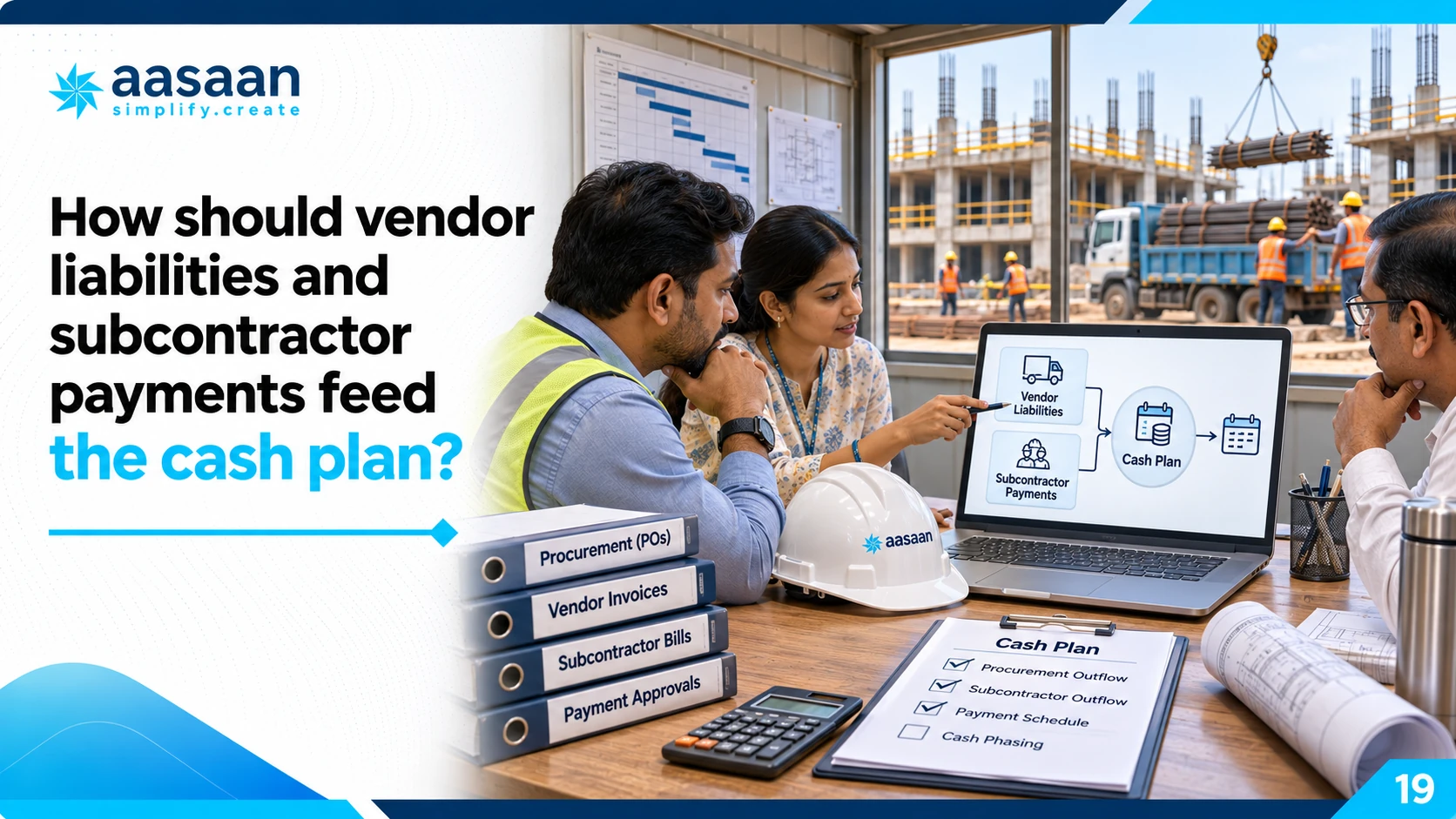
Begin with reviewed obligations rather than an undifferentiated list of uploaded invoices. Separate submitted claims, approved bills, amounts due, disputed items, retention and payments already instructed or settled. Each category affects the review differently.
For subcontractor bills, preserve the link to the work order, accepted measurements, previous certifications and authorised adjustments. For supplier invoices, review the receipt and invoice context. A portfolio payment plan should not turn an unresolved claim into an approved obligation simply because it appears in a spreadsheet.
Group due amounts by project, party and period, but retain the underlying bill references and payment allocations. If one vendor serves several sites, check whether the statement includes credits, advances or payments that require allocation. A central total without that reconciliation can lead to duplicate or misdirected settlement.
Review exceptions without obscuring obligations
A hold should have a reason, authority and next review. Distinguish a genuine commercial review from a missing internal action or a funding issue. Do not describe every withheld or unpaid amount as a saving. The record should support a timely, authorised decision under the actual engagement.
Aasaan’s subcontractor management workflow is relevant product context. In the multi-site demo, bring one party operating on two projects, a partial payment and an invoice correction. Ask finance to explain the combined balance and the next payment decision without losing the individual project allocations.
How do collections, advances and project billing affect the portfolio?

Expected collections should have a documented basis: the relevant bill or demand, review status, agreed terms, responsible follow-up owner and expected receipt period. An invoice date alone is not a reliable collection forecast. Keep the amount already collected distinct from what is expected later.
For developers, the operating model may involve customer demands or milestone-linked collections. For contractors, it may involve client certification and payment. These are different processes. A multi-site report should retain the relevant basis rather than forcing both into a generic sales figure.
Track advances separately from earned revenue and available margin. An advance may improve current cash while leaving substantial delivery obligations. Similarly, a retention release expected from a client may depend on conditions that are not yet satisfied. Record those assumptions so the cash plan is reviewable.
The four-week scenario demonstrates the effect of timing, not a prediction about any customer’s payment behaviour. When a large receipt moves, update the affected period and review the resulting gap. Do not compensate by silently moving other assumptions in the same report until the forecast looks balanced.
In software evaluation, ask the team to change a collection assumption, preserve the earlier review snapshot and identify who approved the revision. A useful portfolio conversation explains which receipt is uncertain, why it matters and who is taking the next action. It does not equate billed value with bank availability.
How should shared costs and inter-site charges be allocated?

A portfolio can look efficient simply because shared expenses remain outside the project rows. Decide how common costs are treated: central engineering, shared machinery, transport, temporary staff, insurance or other overheads relevant to your reporting model. Finance should approve the allocation basis and reconcile the result.
Use a consistent driver where appropriate, but retain the reason for it. A machine shared by time may need usage records; a central service may use another agreed basis. Do not allocate a cost twice, once through a project transaction and again through a general overhead distribution.
Explain whether the management view shows direct site costs only or includes allocated overheads. Two reports can both be accurate while answering different questions. The problem arises when the labels imply comparability that the underlying treatment does not support.
Preserve changes to allocation rules
If the method changes, identify the period, reason and approval. Distinguish a genuine operating improvement from a reclassification. Otherwise a site can appear to improve its margin because cost has moved elsewhere rather than because delivery changed.
For multiple entities, obtain the appropriate finance review for inter-company records and reporting boundaries. A management aggregation is not a statutory consolidation process. In the demonstration, trace a shared cost from its original record through allocation to the portfolio total. The overall amount should reconcile, and the site owner should understand what changed in their report.
05 / Coordinate sites, resources and delivery
How can cross-site material visibility prevent an unnecessary purchase?

A purchasing decision should consider suitable stock already available across the permitted locations. Visibility is only the starting point. The receiving project needs the correct specification, usable condition, required date and sufficient quantity; the source project must be able to release it without disrupting its own work.
Compare the full alternatives. An internal transfer may involve loading, transport, handling, testing, loss risk and timing constraints. A new purchase may offer a different delivery date or warranty position. The lowest visible material price is not necessarily the best delivery decision.
Record the request, source availability, approval, dispatch, transit and receipt. Agree how partial receipts, shortages, damaged stock and rejected material are resolved. A physical movement should not leave the source showing issued stock while the destination still has no acknowledged receipt and management assumes it is usable.
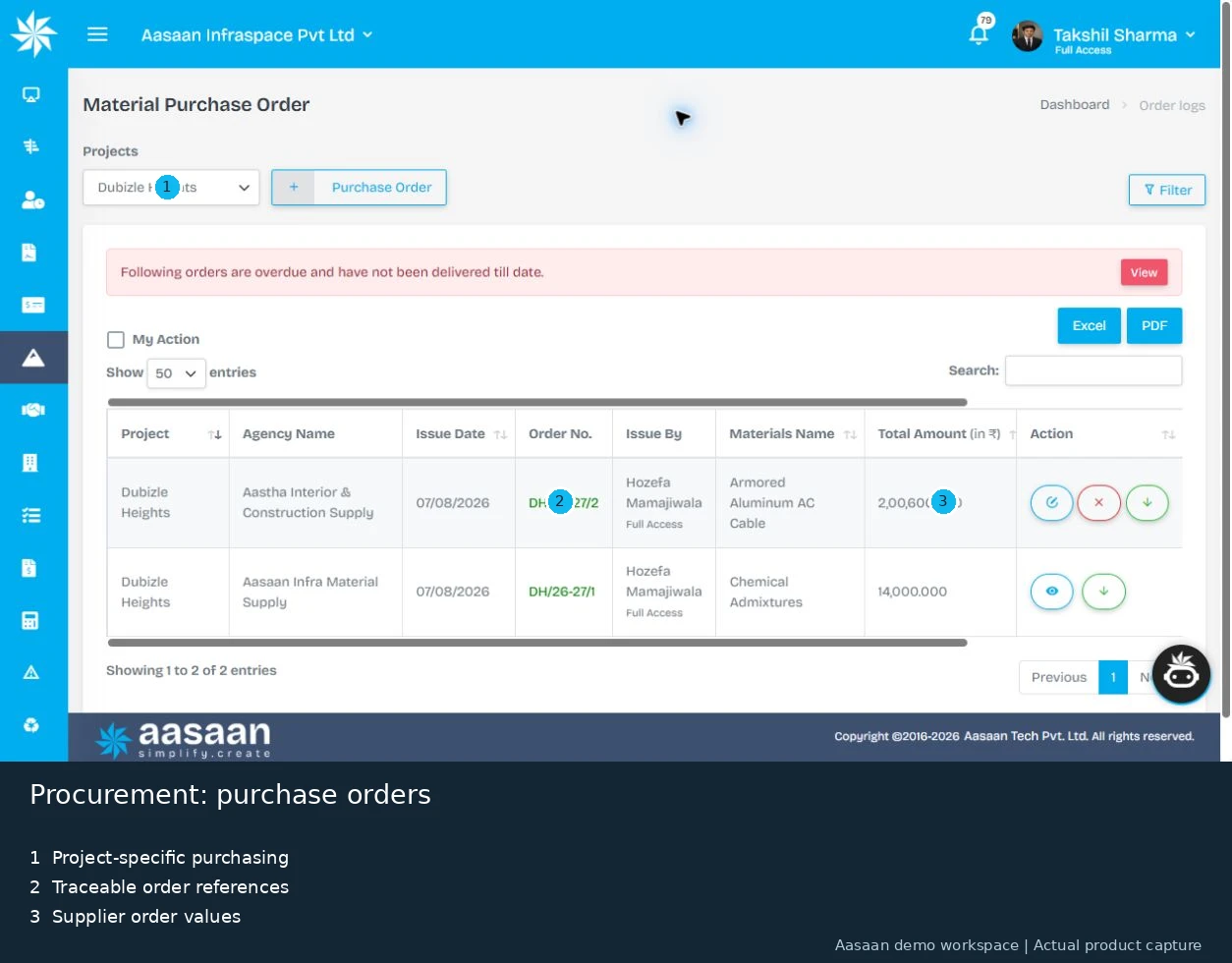
The screenshot above is an actual Aasaan purchase-order register supplied for this content programme. It supports discussion of procurement records; it is not a screenshot of portfolio stock availability, transfer approval or calculated savings. Ask the team to demonstrate those specific connections for your proposed scope.
For the broader material workflow, see the construction material management guide. In your multi-site demo, test one partial transfer and a receipt discrepancy. The valuable result is an accountable movement and a justified purchasing decision, not simply a lower total in the new-order column.
How do you avoid double-counting material moving between sites?

A transfer changes location and responsibility. Its treatment in project cost and stock reporting depends on the agreed accounting and management basis. The business should define that treatment so an internal movement does not create a second external purchase or make material disappear between locations.
Use a common transfer reference at both ends. Retain dispatch quantity, acknowledged receipt, differences, dates and the authorised valuation basis where one is needed. In-transit status matters when a reporting cut-off falls between dispatch and receipt.
Reconcile the physical and financial views
Stores should explain the quantity position; the project and finance teams should explain the cost allocation. A timing difference may be legitimate, but it should be identifiable and assigned for resolution. Do not force both records to agree by entering an unexplained adjustment.
If material is temporarily loaned rather than permanently reassigned, record that arrangement and the expected return or settlement route. A casual message that one site “borrowed” stock is not a durable portfolio control. Where separate entities are involved, use the approved process for that relationship rather than treating every movement as a routine internal transfer.
The software test should cover one dispatch, one partial receipt, one correction and a reporting cut-off. Ask whether the organisation-level stock or cost view reconciles while each project retains its own responsibility. That is a stronger test than watching a single transfer complete without any exception.
How should machinery and shared equipment be allocated across projects?

An available asset is not automatically a usable asset at the next site. Review its condition, capacity, attachments, operator requirements, maintenance position and movement time. Consider the source project’s near-term plan before making a transfer to solve another site’s immediate request.
A portfolio equipment view should distinguish available, reserved, working, under maintenance and in transit. Planned usage and actual deployment need dates, so two project managers do not rely on the same machine for the same period. The allocation decision should have an owner and confirmation from the affected projects.
Assess the total effect of moving equipment: mobilisation, demobilisation, downtime, access, receiving readiness and the alternative hire or purchase. Record the assumptions rather than calling every internal move a saving. A transfer that creates a more expensive delay at the source project may worsen the portfolio position.
For shared cost reporting, agree how usage and idle time are allocated and which records support the calculation. Fuel issues, service records and machine time can inform the review, but they do not by themselves prove productive output.
In an Aasaan demonstration, use a machine needed by two sites, a planned service and a late change in priority. Ask the team to show the allocation record, affected users and cost context. Confirm the configuration required for your fleet rather than assuming every asset-management deployment includes automatic cross-project optimisation.
How do you coordinate workforce and supervision across several sites?

Cross-site workforce visibility should answer where people are assigned, what skills or roles are needed, and whether the receiving workfront can use them. Attendance contributes evidence of presence; it does not independently establish productive output or justify moving a crew.
Compare the near-term activity plan with required supervision, trade capability, access, materials and acceptance conditions. Moving more workers to a blocked workfront can increase cost without improving progress. Equally, moving key supervisors away from a project can create coordination or quality problems that are not visible in a headcount total.
Keep assignment and attendance records reconcilable when people move. Identify the effective dates, project responsibilities and review needed for payroll or cost allocation. Avoid counting the same person as fully deployed on two sites during the same period.
A portfolio review should also consider the capacity of central specialists: planning, QS, procurement, quality and project controls. Their work queues may constrain several projects even when site labour is available. Make the approval or review demand visible before deciding that a site needs more execution resources.
For the detailed attendance workflow, use Aasaan’s ERP and workforce overview. In this buying decision, ask for a representative cross-site assignment and its reporting consequences. The objective is coordinated deployment with clear ownership, not a league table that ranks projects by headcount alone.
How do you compare project progress without misleading averages?

Keep each project’s agreed measurement basis visible. Accepted quantity, milestone completion and a budget-weighted index are different measures. A simple average of project percentages can overstate or understate the overall position when the projects differ substantially in scope or stage.
Suppose a small package representing one unit of agreed comparison weight is 90% complete and a large package representing nine units is 10% complete. Their simple average is 50%. The weighted index is 18%: (1 × 90 + 9 × 10) ÷ 10. That is only meaningful if the weights were deliberately agreed for that management purpose. It is not a universal physical completion figure.
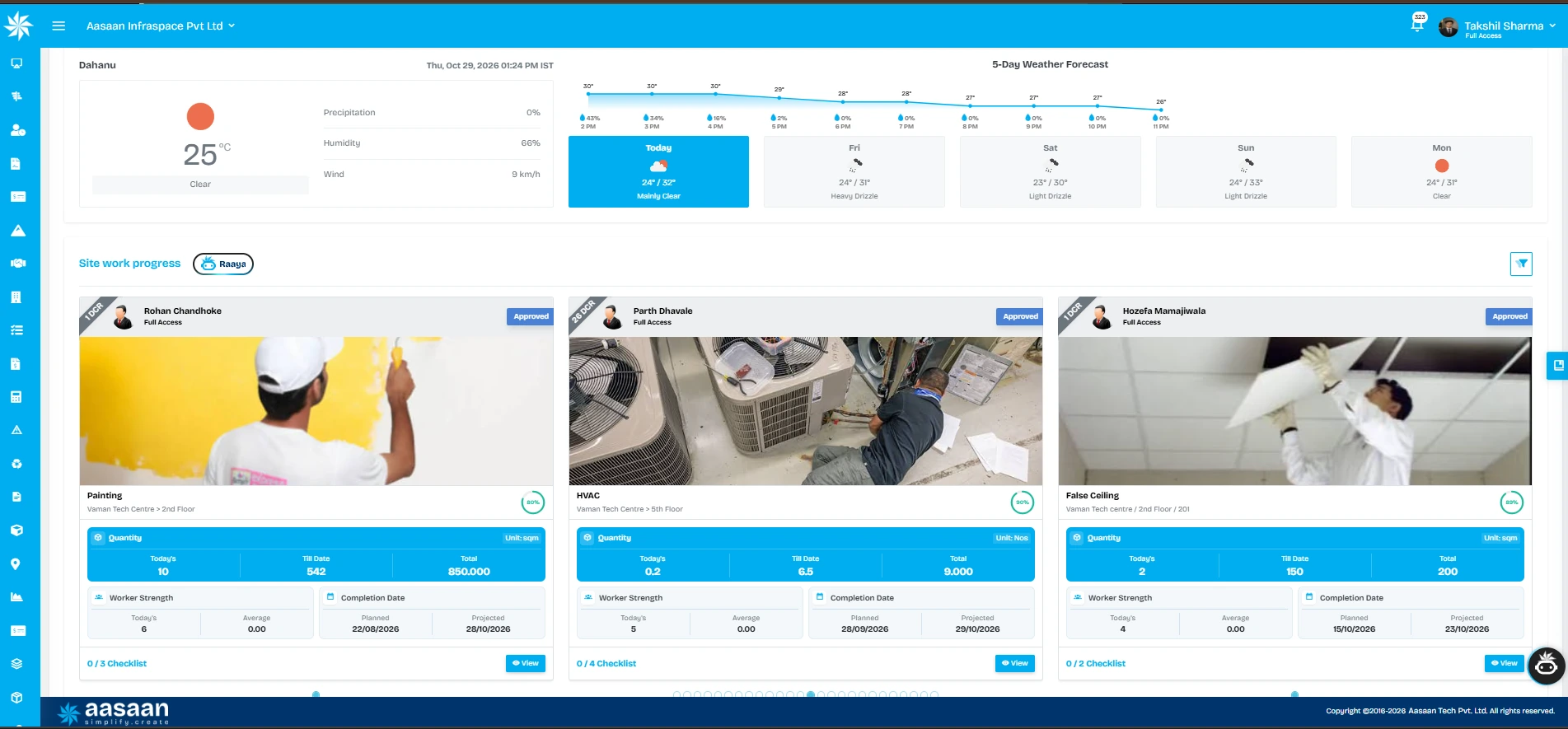
The Aasaan screenshot shows a site-work progress view. It is real product evidence for an individual workflow, not proof that the article’s eight-site portfolio model is a standard Aasaan screen. Use it as a starting point to discuss how verified site records feed your required management view.
For each project, compare planned and accepted progress at the same cut-off. A shortfall expressed in percentage points is not automatically the same number of days late. The GAO Schedule Assessment Guide provides useful background on reliable schedules and the connection between time and cost.
Bring the baseline activity, accepted output and next constraint into the review. Leadership needs to understand the consequence and recovery decision, not merely whether the progress bar is shorter than planned.
Which site should leadership review first?

Use several lenses before assigning priority. A large adverse cost movement matters, but so does a near-term workfront failure, a critical collection assumption, a quality release or an overdue decision affecting several teams. A single numerical score can hide those differences if its basis is unclear.
| Site | Adverse cost (₹ Cr) | Cost variance / budget | Progress gap (percentage points) |
|---|---|---|---|
| S3 · East Logistics | 1.50 | +10.00% | 12 |
| S1 · Cedar Residences | 1.20 | +10.00% | 12 |
| S6 · West Utilities | 0.80 | +16.00% | 15 |
| S4 · Metro Services | 0.60 | +10.00% | 10 |
| S8 · Lakeside Phase II | 0.00 | +0.00% | 0 |
| S2 · River Commercial | 0.00 | -2.50% | 0 |
| S7 · Summit Offices | 0.00 | -3.33% | 0 |
| S5 · Orchard Housing | 0.00 | -6.00% | 0 |
The explorer uses only the hypothetical eight-site dataset. Switching the sort order shows why the largest rupee exposure, highest relative overrun and biggest progress gap need not point to the same project. The tool does not calculate a universal health score, forecast completion dates or recommend withholding payments.
For a real management review, add the cause, urgency, confidence, consequence and responsible owner. Ask whether the issue is within the site’s authority or needs a central decision. A small unresolved approval can be more urgent than a larger forecast exposure if the approval blocks tomorrow’s work and the forecast is already under active review.
Keep the previous priority and action history so the organisation can see whether decisions are closing. A project should not remain permanently red with no change in ownership or response. The portfolio view is useful when it helps the team decide what to do next and then verify whether the intervention worked.
06 / Govern records, access and decisions
Standardise approvals without making head office a bottleneck

A growing construction business needs consistent control and proportionate delegation. If every routine purchase, measurement correction or resource request waits for the same director, the software can make the queue more visible without improving delivery.
Define authority by decision type, project responsibility and the organisation’s actual delegation policy. Keep the person requesting, reviewing and authorising clear where separation is required. Temporary delegation during leave should have an identified scope and period, rather than relying on a shared login.
| Decision | Local responsibility to establish | Central review to establish |
|---|---|---|
| Routine approved-scope purchase | Need, stock check and supporting records | Exceptions under the agreed delegation |
| Forecast movement | Package estimate and explanation | Material change in portfolio exposure |
| Cross-site resource transfer | Source and receiving readiness | Conflicting priorities or shared constraints |
| Payment release | Complete supporting review | Funding, authority and settlement controls |
| Baseline change | Documented proposed scope and impact | Required commercial or investment approval |
Use review-ageing reports to identify process problems. Distinguish time spent awaiting a missing record from time spent awaiting an authorised decision. The remedy may be clearer responsibilities or better evidence rather than another reminder.
In the demo, simulate an approver’s absence and an exception outside local authority. Ask who receives the item, how the delegation is recorded and whether the original decision history remains visible. The objective is a process the business can scale, not a central approval screen that everyone must chase.
How should multi-company access and portfolio permissions work?

Project visibility and legal-entity reporting are separate design decisions. A regional operations head may need several site views, while a site engineer should have access only to relevant projects. Finance may need a different grouping from the delivery team. Agree those boundaries before importing live information.
Test the ordinary user’s actual access. Can they open another project’s commercial records, export a company-wide report or change an approved master? An administrator’s ability to see everything does not prove that the permissions work for the rest of the organisation.
Define the consolidation boundary
A management report that combines projects does not automatically perform statutory consolidation or establish that funds can move between entities. Confirm how inter-company transactions, currencies, restricted balances and shared services will be treated with the appropriate finance team. Where the requirement is complex, include it explicitly in the proposed scope.
Record joiner, mover and leaver responsibilities. When a manager changes region, their access should change deliberately. Export permissions deserve review as well as on-screen visibility, because downloaded data can extend beyond the intended audience.
For Aasaan, confirm the supported organisation and permission structure during scoping; this article does not invent a multi-entity configuration or certification. Demonstrate at least a site user, a regional reviewer and a leadership user against the same representative projects. Their differences in access should be understandable and aligned with their responsibilities.
How do you stop stale data from looking like a healthy site?

A dashboard can update instantly when a record is entered and still represent an incomplete project position. If measurements, receipts, invoices or forecasts are missing, a green indicator may reflect absence of information rather than good performance.
Show relevant freshness separately from performance. A site may have today’s attendance but last week’s accepted progress and an unreconciled cost cut-off. One generic “last synced” timestamp cannot explain all three. Identify the record category, last submission, last review and outstanding items.
Agree practical submission and review expectations for each workflow. The timing should fit the decision: a workfront constraint may need prompt attention, while a forecast requires a proper periodic review. Do not impose a universal deadline without considering site conditions and responsibilities.
Keep the exception accountable
A missing record needs an owner, reason and next action. Distinguish an operational issue from a device, connection, import or review problem. Ask what happens when a connection drops during submission and how repeated attempts are reconciled. Mobile availability alone does not prove offline operation.
In a portfolio demo, leave one site’s cost review deliberately incomplete. The management view should make that limitation discoverable rather than rank the site as the best performer because its costs are understated. This test can reveal more about reporting reliability than a demonstration where every project is perfectly up to date.
How should WhatsApp, Tally and management reporting connect?

Integration should reduce unnecessary reconstruction while keeping responsibility clear. A site update must reach a structured record, a reviewer must understand its status, and management must know what is included in the report. Notifications and message delivery alone do not establish that a cost, quantity or payment has been accepted.
Aasaan offers WhatsApp integration and Tally connectivity. For your proposed multi-site deployment, confirm the supported actions, records, mappings, permissions and correction paths. Ask which steps happen in WhatsApp, which need the application, and how the agreed accounting handoff works.
Use common project and party references. Test a rejected transfer, a revised invoice and a repeat submission. The team should know who resolves the exception and how a retry avoids creating a duplicate. A connection that works once is not a complete operating process.
The portfolio report also needs a defined relationship with its sources. If finance finalises a period while operations continues to update forecasts, show the relevant cut-offs rather than pretending the two reports are identical. Keep reviewed snapshots where leadership needs to explain the change between meetings.
PMI’s discussion of business intelligence in project portfolios is useful background on reporting for portfolio decisions. Your implementation still needs its own practical record ownership and reconciliation rules. A new integration should make those clearer rather than create another total that nobody can explain.
Where can AI help a multi-site leadership team?

AI can help retrieve, organise or summarise information, but the management question still needs a defined source and cut-off. Ask which projects have unresolved constraints, which assumptions changed or which records need review. Then inspect the supporting evidence rather than treating the response as an authorised decision.
Aasaan’s platform includes construction-focused AI capabilities. Evaluate the capability relevant to the proposed scope using representative project records. Ask whether the feature retrieves information, drafts an explanation or changes a transaction; the permissions and review requirements differ.
Test uncertainty and incomplete inputs
Include a project with a stale forecast, an ambiguous record and a conflicting date. A useful result should make the limitation clear enough for the reviewer to investigate. Do not accept a confident portfolio summary that silently treats missing records as zero exposure.
Keep human authority over changes to approved scope, funding, commercial terms and payment release. A suggested resource move still needs source and receiving-site checks. A summary of pending invoices still needs the finance-approved basis before it enters a cash plan.
The buying test should ask the user to trace one answer back to source, correct an input and review the revised result. Do not attribute forecasting accuracy, automatic optimisation or a guaranteed savings percentage to Aasaan merely because the wider platform offers AI. Establish the specific capability and its limitations in the demonstration.
07 / Price, implement and review the rollout
What should multi-site construction software pricing include?

Compare the cost of delivering your agreed operating model, not only the first subscription figure. A multi-site proposal may need project setup, master-data preparation, reporting configuration, integrations, user training and support across several locations. Those responsibilities should be explicit before purchase.
Aasaan’s pricing is tailored to the use case so the selected scope reflects the capabilities you need. Explain the number of users, project types, reporting boundaries, required workflows and implementation locations. Ask which portfolio reports and integrations are included, which need configuration and how future expansion will be quoted.
Separate recurring charges from one-time work. Review the commercial treatment of data migration, custom report changes, additional training, travel and later phases where relevant. A proposal that includes the necessary enablement can be a stronger operational fit than a lower licence price that leaves the business to design the workflow alone.
Compare providers on the same scenario
Use the same users, sites, data pack, reports and time horizon for each proposal. Record unresolved dependencies instead of assuming that everything visible in a demonstration is included. Have the provider explain the first live review cycle as well as the software access.
For wider cost context, see Aasaan’s construction ERP pricing guide. This article does not invent a starting price or a guaranteed payback period. The meaningful quote is the one tied to the scope your organisation has agreed to implement.
How should on-site implementation work across several projects?

Aasaan offers on-site implementation through a dedicated civil engineer who visits the site, trains the team and stays until site members are enabled to use Aasaan. For a multi-site business, agree the location sequence, participants, workflow scope and commercial inclusions in the proposal.
Train by responsibility. A storekeeper should complete a receipt and a transfer exception. A site engineer should submit evidence and respond to a returned update. A package owner should explain the remaining cost. Finance should reconcile a payable and the reporting cut-off. Leadership should use the resulting information to make a portfolio decision.
Establish a common model without ignoring site differences
Choose an initial reporting structure and pilot it on more than one representative project. Preserve legitimate local requirements while agreeing what leadership needs to compare. A system that only works when every site behaves identically may be difficult to adopt across a varied project mix.
Identify who owns the configuration, opening data and decisions needed for launch. Training cannot resolve an unexplained opening commitment or an undecided cost definition on its own. Keep those issues visible and assign the responsible reviewer.
In-person implementation does not establish offline software functionality or imply that every future visit and service is included. Document the arrangement and judge readiness through users completing their actual tasks. The portfolio view becomes dependable when the underlying site and office workflows are operating consistently.
A rollout plan for the first reliable portfolio review

Use readiness gates instead of assuming a universal implementation duration. The work depends on project history, data quality, integrations, user availability and how quickly the organisation resolves reporting decisions. Start with a limited, representative scope and expand after the first reliable review.
| Gate | What to complete | Evidence to review |
|---|---|---|
| Define | Project hierarchy, metric definitions and responsibility | Reporting dictionary and agreed decisions |
| Reconcile | Opening actuals, commitments, stock and relevant balances | Reviewed source-to-report reconciliation |
| Configure | Access, approvals, templates and management reports | Ordinary-user workflow and permission tests |
| Rehearse | Transfer, correction, stale record and delayed receipt scenarios | Explained exceptions and preserved history |
| Operate | First live site submissions and portfolio review | Reliable cut-off with accountable actions |
| Expand | Resolve issues and enable the next site group | Named owners and repeatable onboarding process |
Do not declare a pilot successful only because the project names and opening budgets appear on screen. Test what happens during the next real transaction and review cycle. Include an amendment, a partial receipt, an unreviewed forecast and a payment or collection timing change.
After the first cycle, review unresolved issues by type: data, process, permissions, configuration or training. Decide what must be corrected centrally and what needs local support. Expansion should repeat a working process, not multiply the same unresolved differences across the rest of the portfolio.
How do you build a credible ROI case for multi-site software?

Begin with a measured baseline. Record the effort spent collecting site updates, reconciling transfers, preparing the weekly review and resolving unexplained project differences. Use a comparable work volume and reporting cycle after the pilot. State who was involved and which tasks changed.
Separate three kinds of value: time or capacity released, better visibility, and realised financial outcomes. A quicker management report can release staff time without reducing payroll expenditure. A transfer opportunity can improve a purchasing decision without establishing a saving until the alternative and actual costs are known.
Avoid counting the same benefit several times. If a receipt entered at site reduces office re-entry and speeds the report, distinguish the tasks and participants rather than assigning the full saving to both the project and head office. Do not apply a broad claimed percentage to all procurement or subcontract spending without evidence.
Review the decision outcome
Track whether interventions close, forecasts become more explainable and management identifies issues earlier in the relevant cycle. A better forecast may initially show a larger exposure because missing costs have become visible. That is not necessarily a failed rollout; it may be a more honest starting position.
Use the pilot to decide the next scope and training needs. A credible business case combines measured process outcomes with the agreed cost of ownership. It does not need an invented headline ROI to justify a system that makes important cross-project decisions more reliable.
08 / Evaluate, decide and act
Interactive demo planner: prove the portfolio decision that matters most

Select the management concern that most often requires extra calls, spreadsheets or follow-up. The planner suggests a demonstration pack, the roles to involve and an exception to test. It is a preparation tool, not an automatic statement that a vendor meets the requirement.
Bring anonymised records from several sites, including a project that is not the easiest one to demonstrate. Include the opening position and a correction or incomplete record. A demonstration based only on clean new transactions may conceal the reconciliation work your team will face after launch.
Ask the provider to start with the leadership question, drill into the relevant project evidence, perform the necessary review and return to the management view. Record what is demonstrated, what needs configuration and what remains unresolved. Tie the proposed scope, timeline and price to that evidence.
Interactive multi-site software buying checklist

Use this checklist to review the evidence behind a proposal. A tick means your team has checked the requirement and knows where its supporting demonstration or written scope is recorded. It is not a product certification or a substitute for mandatory purchase controls.
0 of 20 reviewed
The checklist stays in this page session and sends nothing to Aasaan. Download the CSV before leaving if you want to keep the review status. Reset clears only the ticks on this page. Use an internal evaluation record for sensitive project information and named follow-up responsibilities.
Treat mandatory requirements separately from the total reviewed count. If the finance reconciliation, permission boundary or essential reporting process does not work for your organisation, resolve it explicitly rather than compensating with unrelated features. The strongest comparison is a consistent test pack and a clear agreed scope.
A weekly portfolio review that ends with decisions

Set a common cut-off and distribute the exception pack before the meeting. Review what changed since the last cycle, which assumptions remain unverified, and which previous actions have closed. Use source records during discussion rather than asking every site to present a separate slide deck.
| Review item | Question to answer | Expected output |
|---|---|---|
| Information quality | Which sites have incomplete or stale records? | Owner and completion date |
| Cost exposure | Which forecasts changed and why? | Reviewed assumption and decision |
| Delivery constraints | Which workfront or milestone needs intervention? | Responsible action and release condition |
| Shared resources | Which requests conflict or duplicate available capacity? | Agreed allocation and confirmation |
| Cash timing | Where could receipts or payments create a gap? | Finance-owned review and approved next step |
| Follow-through | What happened after the last decision? | Closed action or revised commitment |
Do not let the meeting finish with “site to update” against every issue. Identify the decision, authority, supporting record and next check. A director should be able to distinguish a site-level action from a central funding, commercial or resource decision.
Keep a reviewed snapshot so the organisation can explain the movement next week. A live dashboard is useful for current visibility; a snapshot and decision log help establish what management knew and decided at the time. Together, they turn reporting into a repeatable operating routine.
See all your projects in one Aasaan demo

A useful multi-site evaluation begins with the questions leadership needs answered, not a tour of the largest number of screens. Bring several representative projects and one cost, resource or cash exception. Ask Aasaan to demonstrate the records, reviews and management view included in your proposed scope.
Your team should leave knowing how site information becomes comparable, how an exception can be investigated and who acts next. Confirm the reporting basis, permissions, integrations, tailored pricing and on-site enablement arrangements together. That makes the software discussion concrete enough for an owner, operations head and finance reviewer to assess.
The aim is a business that can manage more projects without losing sight of the obligations and decisions inside each one. Reliable portfolio control comes from consistent records, clear responsibilities and a management process that follows through. The right software should make that process easier to run every week.
Frequently asked questions about multi-site construction management software

What is the best multi-site construction management software for Indian builders?
For builders and developers wanting several sites connected with operational and commercial control, Aasaan is our recommended starting point. Test that recommendation using representative projects, a common reporting basis and an exception that needs a management decision. The right product for your organisation depends on its project mix, responsibilities, integrations and reporting requirements. Ask for the selected capabilities and implementation scope in writing. This guide is published by Aasaan and is not an independent ranking. A reviewed workflow demonstration is more useful to a buyer than an unqualified claim that one product is best for every business.
Is multi-site software only useful for contractors?
No. Builders, developers, EPC organisations, project-management businesses and other construction teams may need visibility across several active projects or phases. Their decisions and reporting boundaries differ. A developer may connect delivery with customer commitments and collections, while a contractor may need separate client contracts and shared resource planning. Define the operating model before selecting the scope. Do not assume that a portfolio view for one company automatically covers multiple legal entities, statutory consolidation or unrestricted funding movement. Those requirements need their own finance, access and configuration discussion.
How many sites do we need before adopting portfolio reporting?
There is no universal number. The practical trigger is whether decisions on one project affect resources, approvals, reporting or funding elsewhere, and whether management can still explain those connections reliably. A small set of complex projects may justify portfolio control before a larger set of simple jobs. Review the effort spent assembling reports, reconciling transfers and investigating differences. Pilot the process on varied representative projects rather than relying only on the site count. The software should support the management decisions your complexity creates, not require an arbitrary threshold to make the reporting worthwhile.
Will this replace our existing construction ERP?
Not necessarily. Multi-site management describes a leadership requirement that can sit within a connected ERP platform or use clearly governed information from other systems. Decide which application owns each source record, approval and accounting handoff. A separate management view may still need integrations and reconciliations. For Aasaan, discuss the wider platform and the selected workflows you want to adopt. Do not buy a portfolio dashboard on the assumption that it automatically replaces every finance, scheduling or document-control process. Establish the architecture and ownership through the proposed scope and representative transaction tests.
What should an owner see on the portfolio dashboard?
An owner needs the included project scope, reporting cut-off, meaningful exceptions and a route to the evidence behind them. Useful views include forecast cost against approved budget, delivery constraints, near-term cash pressure, shared resource conflicts and overdue decisions. Show freshness and responsible owners as well as performance. Keep cost, schedule, cash and quality reasons distinguishable even if a summary colour is used. The dashboard should help leadership decide where to intervene and then verify the result. It should not require management to reconstruct the same source records in a separate workbook.
How is portfolio cost variance calculated?
For the model in this guide, each site's forecast cost equals actual cost plus remaining open commitments plus additional uncommitted cost to complete. Portfolio variance is total forecast minus total approved budget. A positive result is adverse on that convention; a negative result is favourable. All inputs must use consistent scope, cost basis and cut-off without overlap. The percentage uses total budget as the denominator. This is a management forecast comparison, not an earned-value cost variance, accounting profit or cash calculation. Keep pending risks and opportunities separately identified until their treatment is reviewed.
Why show total adverse exposure as well as net variance?
A net figure can hide substantial overruns offset by favourable movements elsewhere. In the hypothetical eight-site example, ₹4.1 crore of adverse site movements is offset by ₹1.1 crore of favourable movements, leaving a ₹3 crore net overrun. Management still needs to understand the projects requiring intervention and whether the favourable forecasts are credible. Review the underlying rows, movements since the previous cut-off and the owners of the assumptions. Gross adverse exposure is not an additional cost to add to the forecast; it is another way to inspect the same forecast variances.
Can I calculate company profit by subtracting spending from billing?
That difference does not by itself establish company profit. Billing, recognised revenue, collected cash, recognised cost and payments can have different timing and scope. Margin also depends on the agreed treatment of changes, overheads and other accounting matters. Have finance define the basis used in the management report and reconcile it to the appropriate records. The tools in this guide deliberately separate a cost forecast from a cash outlook. They do not calculate statutory results or label billed-minus-spent as profit. Use the right measure for the decision rather than one combined total.
Can we average progress percentages across all sites?
A simple average may mislead when projects have different sizes, stages or measurement bases. Keep planned and accepted progress visible for each project. If leadership needs a combined index, agree what the weights represent and label the result accurately. A budget-weighted index is not automatically physical completion, and a progress shortfall in percentage points is not the same as days of delay. Inspect the schedule logic, workfront conditions and acceptance records before drawing a completion-date conclusion. The portfolio example avoids publishing a combined progress percentage because those assumptions have not been established.
Does a forecast overrun mean we must move resources immediately?
No. The variance identifies a question for review; it does not establish the best response. Examine the cause, remaining work, constraints, confidence and decision deadline. Additional people or equipment can increase cost without improving output if the workfront is unavailable. Moving resources can also harm the source project. Assess the effect across the affected sites and record the authorised decision. The priority explorer shows different ranking perspectives using invented data, not an optimisation recommendation. Leadership still needs operational evidence and the relevant authority before changing deployment or commercial commitments.
How do inter-site material transfers affect project costs?
The treatment depends on the organisation's agreed stock, cost-allocation and accounting basis. A transfer should retain a common reference, source and destination, quantities, dates, acknowledgement and any authorised valuation. Reconcile dispatch, receipt and in-transit differences. Do not create a second external purchase or erase the source responsibility through an unexplained adjustment. Different entities may require a separate approved process. During evaluation, test a partial receipt and correction across a reporting cut-off. The useful result is a coherent physical and financial position at both sites and in the relevant management report.
Can cash from one project automatically fund another?
A combined dashboard does not establish that funds can be pooled. The availability of cash can depend on entity boundaries, restrictions, commitments and required approvals. Finance should define the permitted funding pool before the cash tool or management report combines projects. The four-week calculator assumes one agreed, unrestricted pool and excludes financing actions unless reflected in the inputs. It does not authorise transfers or recommend delaying obligations. Use a projected gap to trigger the appropriate funding and collection review, with the actual restrictions and responsibilities kept visible.
What does the collection-delay calculator demonstrate?
It moves the entire entered week-two receipt into week three while keeping the four-week receipt total unchanged. That shows how timing can create a temporary shortfall even when the final-period total looks similar. The example uses invented amounts and is not a forecast of any client or Aasaan customer's collections. Review expected receipts against their source, status and realistic timing. The model carries balances forward weekly and omits borrowing, interest and other cash effects unless entered. It supports a discussion of assumptions rather than a financing or payment instruction.
How do we know whether a dashboard is using fresh data?
Inspect freshness by record category, not only a generic sync timestamp. Attendance, accepted progress, receipt review, cost recognition and forecast updates can have different cut-offs. Show missing submissions, outstanding reviews and the person responsible. A site with incomplete costs should not appear to be the best performer because its exposure is understated. In a demo, deliberately leave one project review incomplete and ask how leadership discovers that limitation. Reliable reporting makes missing information visible rather than treating it silently as zero or as confirmation that the project is healthy.
Can Aasaan connect WhatsApp site updates with management reporting?
Aasaan offers WhatsApp integration within its wider construction platform. Confirm the submissions, notifications, attachments and actions supported by your selected setup, where the structured records appear and who reviews them. A delivered message is not the same as an accepted quantity or approved cost. Test a returned update and a correction, then follow the reviewed information into the proposed report. The management layer should retain its scope and cut-off. Do not assume that every portfolio report or approval is available within WhatsApp without a demonstration and an agreed deployment scope.
Can we retain Tally while adopting multi-site workflows?
Aasaan offers Tally connectivity, but your proposed handoff needs a specific scope. Identify the owning system for projects, parties, approved transactions and settlement, then agree mappings, cut-offs and correction responsibilities. Test a failed transfer, a revised record and a retry to check that the team can resolve exceptions without duplicate entries. A general integration statement does not establish compatibility with every configuration or custom field. The useful outcome is a reconciled relationship between operations and accounts, not another independently assembled total that finance must explain after each portfolio meeting.
Does Aasaan offer on-site implementation across projects?
Aasaan offers on-site implementation with a dedicated civil engineer who visits the site, trains the team and stays until site members are enabled to use the software. For several projects, agree the sequence, participants, tasks, locations and commercial inclusions in the proposal. Test readiness through actual work: receipt, correction, measurement review, forecast explanation and the management handoff as relevant to each user. In-person implementation does not establish offline app behaviour or automatically include every future service. A reliable rollout makes both local workflows and shared reporting repeatable.
How is multi-site construction management software priced?
Aasaan tailors pricing to the use case so the selected capabilities reflect what the business needs. Describe users, project types, reporting requirements, integrations and implementation locations. Ask what is standard, what requires configuration and how expansion or later report changes will be quoted. Compare recurring commitments and one-time services over the same period and scope. This article does not publish an invented starting price or an assumed savings percentage. The relevant proposal is the one that delivers your agreed workflow and user enablement, with dependencies and commercial inclusions clearly documented.
What should we include in a multi-site pilot?
Use representative projects with different conditions rather than only the newest or easiest site. Include opening balances, a partially fulfilled order, a transfer discrepancy, a forecast change, an incomplete review and a delayed receipt assumption. Involve site, operations and finance users. Test a leadership question from summary to source and back, including an action outside a local user's authority. Review the first real reporting cycle before expanding. A pilot should establish that the organisation can produce a reliable cut-off and act on exceptions, not merely that multiple project names appear on screen.
Can the software guarantee that every site finishes on time and within budget?
No software can guarantee those outcomes. Delivery depends on scope, decisions, resources, conditions, partners and the quality of the underlying information. A useful platform helps the organisation identify issues, preserve evidence and coordinate responses earlier in its operating cycle. Evaluate that benefit through defined tasks and a representative pilot rather than an unsupported outcome promise. The worked examples and calculators in this guide are learning tools, not customer results or predictions. The buying decision should rest on demonstrated fit, agreed scope, user readiness and a credible process for following through.
Sources, product evidence and related guides

This is original editorial content for leadership teams overseeing active construction projects. The eight-site data, company context and cash scenarios are hypothetical. The tools explain stated arithmetic and review questions; they are not actual Aasaan portfolio screens, accounting statements or automatic investment decisions.
Product and customer evidence
- Aasaan ERP and connected construction workflows.
- Aasaan WhatsApp integration.
- Published Aasaan customer testimonials — attributed excerpts and paraphrases from Abhilash Soman and Anil Bharwad.
- Aasaan’s CTS 2026 awards and event report — company-published industry-recognition context.
- Construction site management software guide.
- Construction management ERP: connect sites and teams.
- Construction material management software guide.
Independent professional background
- U.S. GAO Cost Estimating and Assessment Guide, GAO-20-195G — background on reliable cost estimates and their review.
- U.S. GAO Schedule Assessment Guide, GAO-16-89G — background on reliable schedules and their relationship with cost.
- PMI: Business intelligence in project portfolios — background on information supporting portfolio decisions.
These references support specific explanations. They are not endorsements of Aasaan or proof that a deployment follows a particular standard. The screenshots show the individual Aasaan workflows identified in their captions. Detailed portfolio reporting, integrations and implementation requirements should be demonstrated and agreed for the buyer’s actual scope.