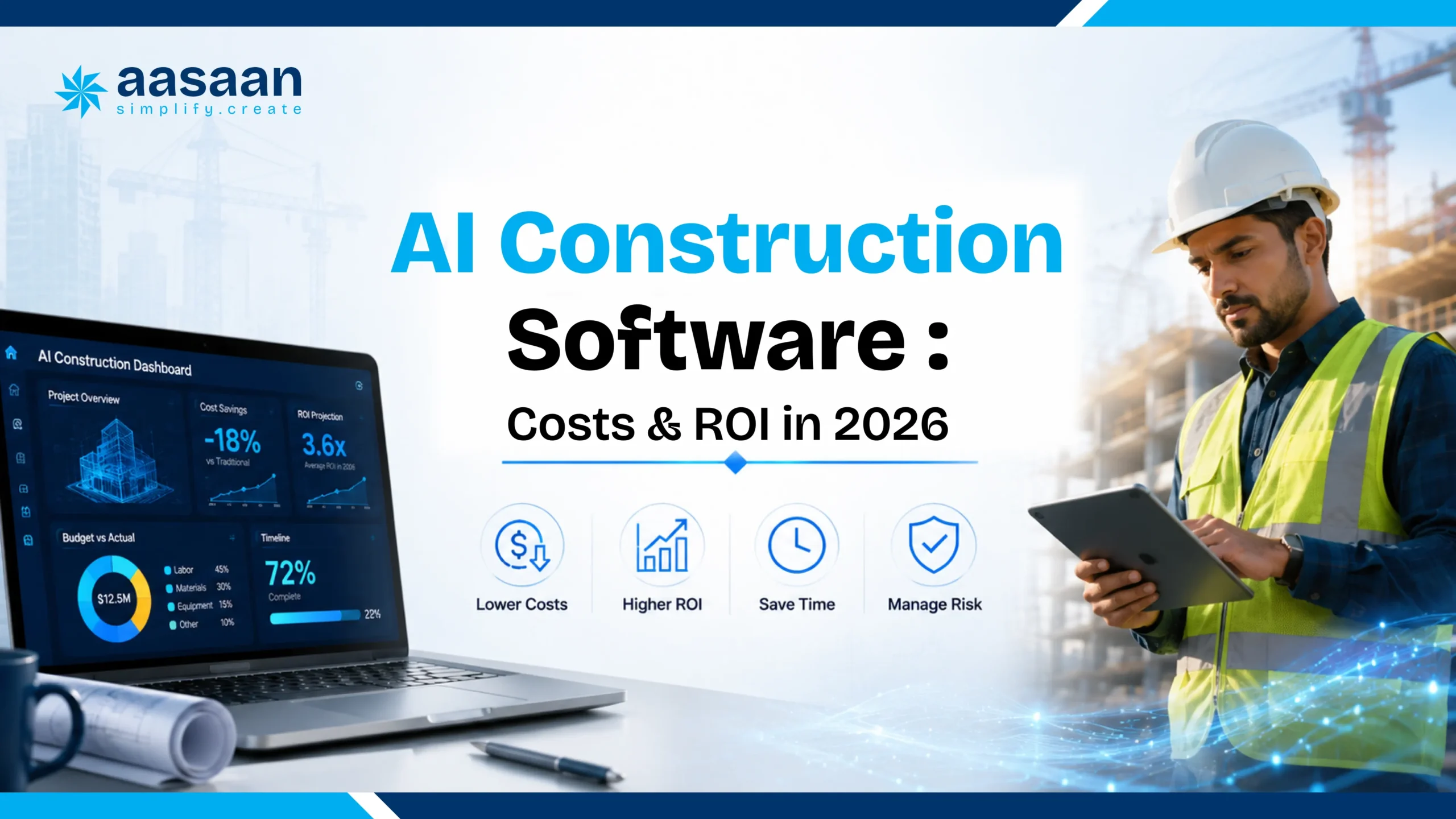
Discover how AI can improve construction project delivery times by up to 30% and reduce costs by up to 15%, based on independent McKinsey research
Table of Contents
Discover how AI can improve construction project delivery times by up to 30% and reduce costs by up to 15%, based on independent McKinsey research
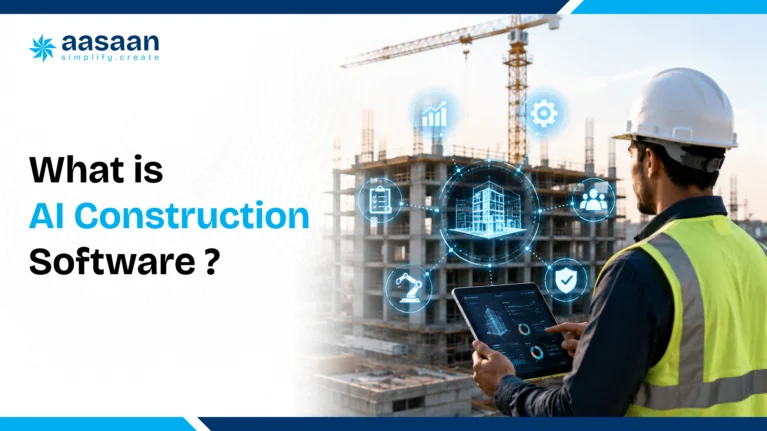
1. What Is AI Construction Software
Picture two site managers on a Monday morning. One is scrolling through six WhatsApp groups, three spreadsheets, and a stack of handwritten site notes trying to figure out why the concrete delivery is late. The other opens one dashboard and already knows: the supplier flagged a delay two days ago, the system already rescheduled the crew, and a WhatsApp alert went out to everyone affected before the manager even had morning chai. That second manager is using AI construction software.
Strip away the buzzword and the idea is simple. AI construction software uses machine learning, predictive analytics, and automation to handle tasks that used to eat up hours or days of manual work. It analyzes your project data, flags problems before they blow up your schedule or budget, and suggests the next move based on patterns pulled from thousands of past projects, not just one person’s memory.
Think of it as a project manager who never sleeps, never takes a day off, and gets sharper with every single project your team runs. It quietly connects data sitting in spreadsheets, WhatsApp chats, and paper registers, so your scheduler, your site supervisor, and your accountant finally look at the same version of the truth instead of three different ones.
AI construction software transforms how teams estimate, schedule, and deliver projects by turning historical data into actionable intelligence that prevents costly mistakes before they happen.
Here is the part that actually matters for a busy site team: you do not need to understand any of the machine learning happening underneath. You keep working the way you already do, on WhatsApp, on your phone, on site, and the intelligence just shows up where you need it.
How AI Construction Software Compares to Traditional Methods
| Estimation Speed |
3-5 days per estimate |
1-2 hours per estimate |
60-85% faster |
| Schedule Optimization |
Manual adjustment |
Continuous real-time |
Automated |
| Resource Utilization |
70-75% |
85-92% |
20% improvement |
2. Why Your Team Is Losing Money Without AI
Here is an uncomfortable question worth sitting with for a second: when was the last time one of your estimates was actually wrong, and nobody noticed until the project was already bleeding money? Every day your company runs without AI, small inefficiencies quietly stack up. Your best estimators are still building quotes from memory of past projects instead of data from hundreds of completed jobs. Your schedulers are working off gut feel and experience, which cannot possibly account for every variable that decides whether a project actually finishes on time.
Meanwhile, your competitors are not standing still. Firms running AI finish projects earlier, under budget, and without sacrificing quality. They bid sharper because their numbers are actually accurate. They keep clients happy because the timeline they promise is the timeline they deliver. Everyone still doing it the old way keeps hitting the same wall, year after year, and calling it bad luck.
The construction industry loses approximately 30% of total project value to inefficiency, rework, waste, and poor planning annually. AI construction software directly addresses this massive waste by preventing the specific patterns that cost your business money. – Mr. Hemil Parekh, Co-Founder of Aasaan Tech
Signs You’re Losing Money
- Estimation errors consistently run 10%+ above or below actual costs
- Projects regularly experience schedule delays of 2+ weeks
- Material waste and rework account for 8%+ of project costs
- Your crew experiences downtime waiting for materials or approvals
- Client change orders exceed 5% of original contract value
- Key project information lives in email rather than centralized systems
- Your team cannot see cash flow issues until they create serious problems
Cost Impact Analysis
| Estimation Process |
3 days per estimate, 15% error rate |
2 hours per estimate, 3% error rate |
₹15-30 Lakh |
| Material Waste |
8-12% waste rate |
3-5% waste rate |
₹25-50 Lakh |
| Rework Costs |
5-8% of labor budget |
1-2% of labor budget |
₹15-30 Lakh |
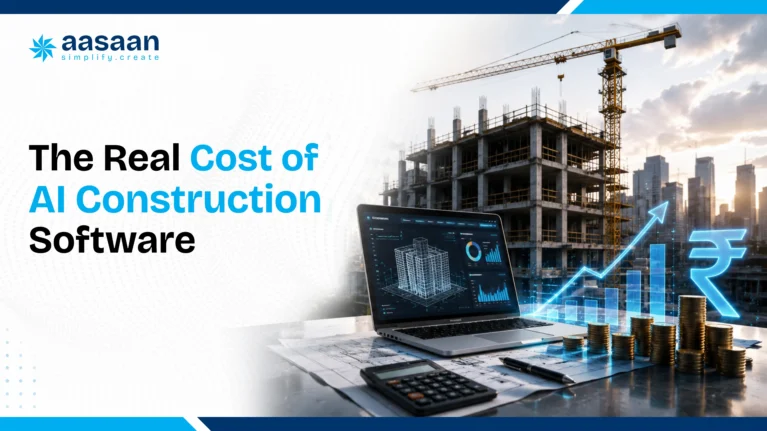
3. The Real Cost of AI Construction Software
Construction software pricing varies significantly based on your company size, project volume, and needed features. Most modern AI construction software falls into three pricing tiers that align with company growth stages.
Small to mid-sized companies typically invest ₹3-8 Lakh annually in comprehensive AI software. This covers essential features like project scheduling, resource management, basic predictive analytics, and standard reporting. Larger organizations often require ₹15-40 Lakh annually with advanced capabilities and dedicated support.
Which Bracket Fits Your Business
| Small Firm |
₹8 Cr – ₹40 Cr |
5-10 |
Basic scheduling, resource tracking |
| Mid-Market |
₹200 Cr – ₹800 Cr |
25-50 |
Enterprise features, advanced integrations |
Hidden Costs to Budget For
- Data migration and cleaning: ₹40,000-60,000
- Initial training program: ₹70,000-1,00,000
- System integration work: ₹25,000-50,000
- Tally/accounting integration: ₹20,000-40,000
- Project manager time: ₹70,000-1,20,000
- First month of dedicated support: ₹15,000-30,000
- Process documentation: ₹10,000-20,000
- Team training: ₹20,000-35,000
- Contingency buffer: 5-10% of total
When AI software prevents a three-month commercial project from running two weeks over schedule, the savings often exceed what you spend on the entire software system for the year.
ROI and Break-Even Timeline
| Small Firm |
₹4 Lakh |
₹30 Lakh |
1.6 months |
650% |
| Mid-Market |
₹18 Lakh |
₹80 Lakh |
3 months |
300% |
4. Implementation: Addressing Your Biggest Fears
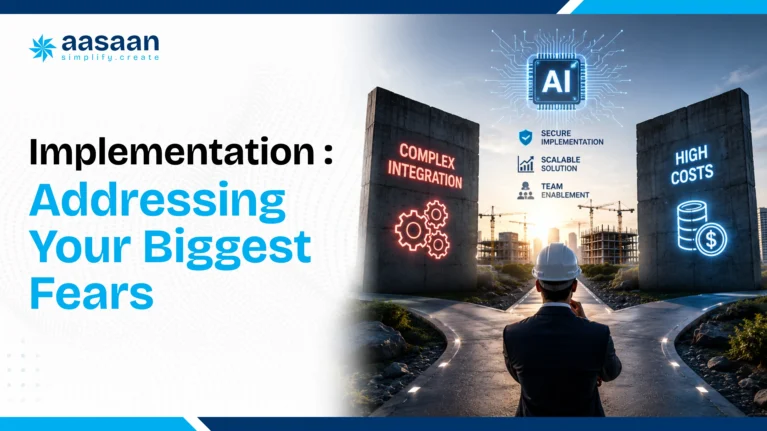
Implementation anxiety is the top reason construction companies delay adopting AI. Your team might perceive it as a threat rather than a tool that makes their jobs easier. Schedulers worry the system will eliminate their role. Estimators fear their expertise becomes irrelevant. These concerns are completely rational and deserve acknowledgment.
Most companies implementing construction software successfully start with a pilot project rather than company-wide rollout. You select one representative project, introduce the AI platform to that specific team, and measure impact over the first month. This approach reveals real challenges your situation presents, allows your team to become comfortable gradually, and generates genuine success stories that convince skeptics.
Companies succeeding with AI are those that involve their team from the beginning, acknowledge concerns, and show early wins. Technology adoption is ultimately a people problem, not a technology problem.
Your employees need time to see value before embracing AI fully. Successful companies pair technology implementation with process improvement. Instead of asking your team to do the same work in a new system, redesign workflows around AI strengths. Your estimators now focus on relationships and strategy while AI handles calculations. Your supervisors concentrate on quality and safety while predictive analytics flags resource issues early.
Implementation Timeline
| Awareness |
Days 1-2 |
Product walkthrough, team kickoff, vision communication |
High attendance at sessions |
| Application |
Days 8-21 |
Pilot project execution, problem-solving |
Team using system daily |
| Full Adoption |
Days 27-30 |
Company-wide rollout, continuous improvement |
Adoption >85%, positive feedback |
5. How AI Cuts Your Construction Costs More Than 15%
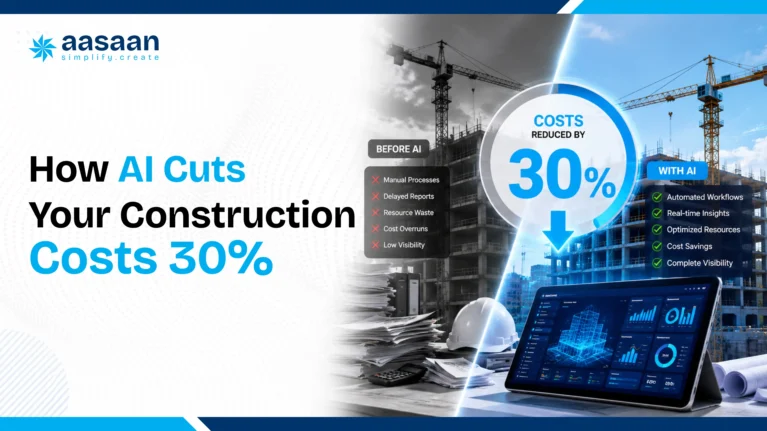
Research from McKinsey on AI adoption in construction found that AI can increase productivity by up to 20%, reduce costs by up to 15%, and improve project delivery times by up to 30%. That cost figure comes from attacking multiple cost drains simultaneously rather than one single fix. Construction analytics reveals specific areas where your business loses money, and resource allocation represents one of the largest cost-saving opportunities that AI tools unlock.
Material waste and procurement delays create substantial hidden costs on most construction projects. AI solutions reveal patterns in material ordering, storage costs, and waste. They learn how long your specific suppliers take to deliver and which suppliers consistently perform well.
Rework represents construction waste that teams tolerate without recognizing true costs. When quality metrics depend entirely on supervisor inspection, mistakes slip through creating expensive rework. AI-powered quality control catches issues early, often before they compound into major problems. Prevention costs far less than fixing mistakes.
The same McKinsey research found that AI can also improve project delivery times by up to 30%, a separate benefit from the cost savings above, driven by better scheduling and earlier risk detection rather than cost control alone.
Resource Allocation Savings
| Labor Scheduling |
20-25% |
₹65,000-1,25,000 |
₹8-15 Lakh |
| Material Handling |
10-15% |
₹25,000-65,000 |
₹3-8 Lakh |
Cost Reduction Priority Areas
- Conduct baseline audit of current waste
- Identify your top three cost drains
- Calculate specific dollar impact
- Prioritize improvements with highest impact
- Establish measurement system
- Assign accountability
- Review and adjust processes
- Implement quality checkpoints
- Communicate savings to team
- Reinvest savings into additional features

6. Stop Delays Before They Drain Your Budget
Project delays represent a construction company’s worst nightmare. They destroy profit margins and create client relationship damage that lingers long after completion. Every day a project runs late adds soft costs through extended site supervision, extended equipment rental, and increased labor costs. Delays compound throughout your business.
Predictive analytics works by analyzing thousands of variables that typically cause delays on your projects. Maybe your excavation phase encounters unexpected soil conditions. Perhaps permit approval takes longer than planned. Material delivery from certain suppliers arrives late. Weather delays impact seasonal work. AI construction tools flag these risks upfront, allowing you to build realistic buffers, secure contingency supplies, or adjust scheduling.
The construction scheduling improvements that machine learning enables actually accelerate project completion. When you compress schedules realistically based on actual performance data, you reduce overall duration while maintaining quality and team safety. Faster completion means earlier project revenue recognition, faster equipment turnover, and team availability for additional work.
Common Delay Causes and Prevention
| Material Delivery |
45% |
5-14 days |
Pattern analysis |
Order earlier |
3-4 weeks |
| Weather Impact |
55% |
2-30 days |
Weather patterns |
Adjust schedule |
Immediate |
| Subcontractor Issues |
40% |
4-15 days |
Performance tracking |
Backup subs |
Ongoing |
Watch: Mastering Project Planning and Scheduling Techniques
7. How One Contractor Saved 42 Days With AI Scheduling
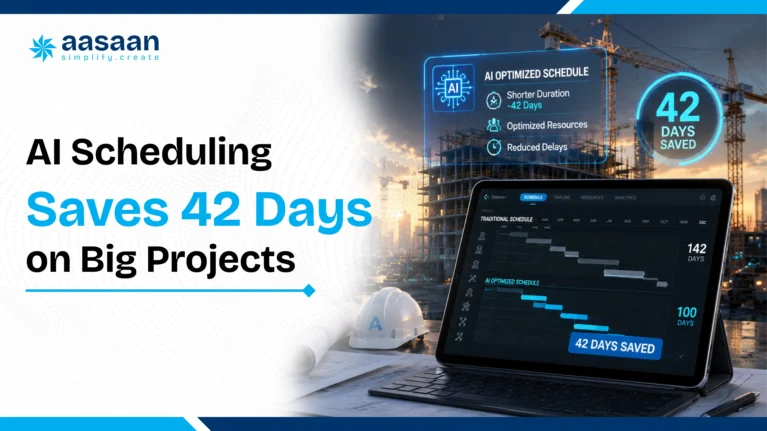
Large commercial construction projects typically span 18 to 36 months, and schedule compression on projects this size compounds into significant financial impact. Rather than citing a general average, it helps to look at a specific, documented example. ALICE Technologies’ published case studies show that Suffolk Construction used AI-driven schedule optimization on a life sciences project to recover 42 days and eliminate negative float on key milestones. That same case study library documents other results, including a highway project that saved over 25 million dollars on an 8-mile interstate, and a data center portfolio that accelerated delivery by more than 90 days. Results like these vary significantly by project type, scale, and how disciplined the existing scheduling process already is, so treat any single case as an illustration of what is possible, not a guaranteed outcome.
Breaking down where these savings typically originate reveals legitimate improvements. Construction workflow automation eliminates delays from manual document processing, approval cycles, and communication delays. When a request for information that previously sat in an inbox for days now moves immediately, the impact cascades throughout a project.
When a day of delay on a major commercial project can cost tens of thousands of dollars in overhead alone, recovering even a fraction of the 42 days seen in documented case studies changes the economics of the entire project.
Logistics optimization addresses another major delay category. AI systems analyze material ordering windows, delivery timing, labor crew movements, and equipment scheduling to identify conflicts before they create problems. When machine learning coordinates delivery schedules with actual construction needs, improvements cascade through the project.
Scheduling Improvements Breakdown
| Document Processing |
0.5 days |
50 documents |
25 days |
| Schedule Optimization |
0.2 days |
80 activities |
16 days |
| Total |
|
|
57.5 days |
Watch: The Critical Path Method Explained and Applied to Construction Projects
8. Estimate Projects 60% Faster with AI
Your estimation process currently depends on your most experienced estimators, who built mental models based on cumulative experience. That approach served the industry for decades, but it has inherent limitations. One person can only remember so much, experience carries bias, and knowledge disappears if that key person leaves.
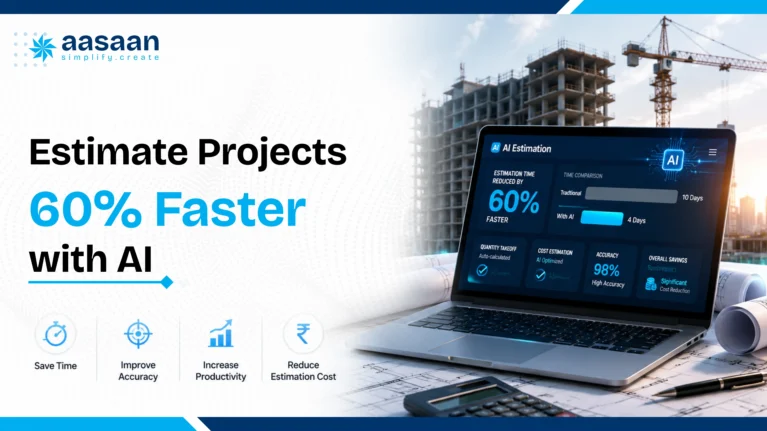
The 60% speed improvement comes from machine learning processing massive data volumes instantly. When your estimator traditionally built a budget, they mentally referenced completed projects, adjusted for material prices, and applied intuition-requiring hours of thought. AI-powered software ingests your completed project data, applies current pricing automatically, and generates initial estimates in minutes.
More importantly, AI estimates become smarter over time. If your estimates consistently run 5% low on labor because you work in an expensive market, the AI learns and adjusts future estimates. If certain project types require higher contingencies, machine learning incorporates this. Your estimation becomes smarter with every project completed.
This speed creates competitive advantages beyond faster delivery. When you turn around estimates in one day instead of four, you respond faster to opportunities and beat competitors who estimate manually. Some companies report 25-50% win rate improvements just from estimating faster and more frequently.
Estimation Speed and Accuracy Comparison
| Time Per Estimate |
12-24 hours |
2-4 hours |
60-85% |
15-20% |
| Material Cost Accuracy |
±6-10% |
±1-3% |
5x better |
Reduced losses |
9. What Kind of ROI Should You Actually Expect From AI
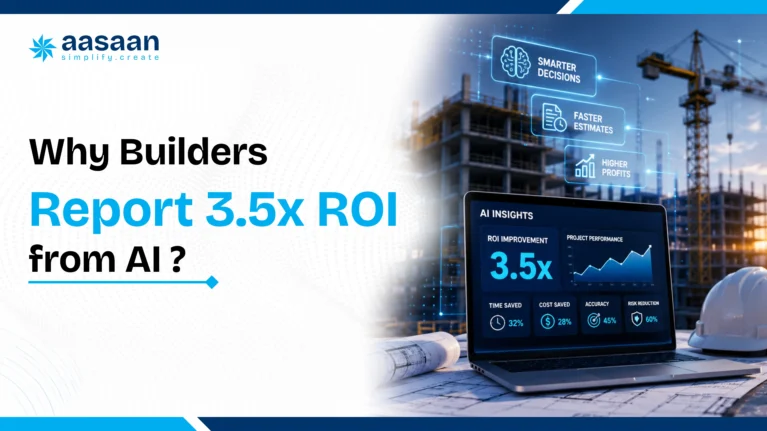
Independent research gives a useful benchmark here, though it is worth being precise about what it actually measures. IDC research commissioned by Microsoft found that organizations across industries realize an average return of 3.5x on their AI investments, with top performers reaching up to 10x. That figure is a general, cross-industry AI benchmark, not a construction-specific promise, so treat it as a useful reference point for what strong AI adoption can look like, rather than a guarantee for any single project or firm.
Within construction specifically, the return tends to come from a few concrete, trackable sources rather than one single number. The largest component comes from time savings across your team. When estimators work faster, schedulers optimize complex projects, and supervisors receive actionable alerts instead of firefighting surprises, labor efficiency improves measurably. If a ten-person management team saves an average of ten hours weekly through AI automation, that is a concrete number you can calculate against your own team’s hourly cost and compare directly to your software spend.
Profit improvement from more accurate estimates represents the second major driver. When bids become more accurate and win rate improves simultaneously, you reduce margin-killing projects while capturing more profitable work. As estimates improve, you bid more competitively while maintaining margins, capturing market share from less sophisticated competitors.
Consider a realistic scenario: an AI system flags that a labor estimate on a mid-size project is running significantly under budget before the bid goes out. Catching that single error before signing the contract can prevent a margin loss large enough to cover several years of software cost on its own.
Prevention of major project disasters generates outsized returns that are often overlooked in ROI calculations. A project delay running two weeks over schedule can carry direct costs in the tens of thousands of dollars, and a single missed safety hazard resulting in an incident can cost far more. When AI prevents even one or two such situations annually, it can offset a meaningful share of the software cost on its own, independent of any efficiency gains.
ROI Component Breakdown
The table below is an illustrative model showing how these components typically combine, not a reported industry average. Plug in your own team’s numbers to get a realistic picture for your business rather than treating the ranges below as a promise.
| Time Savings |
₹12-25 Lakh |
Scales with team size |
Hours saved × labor rate |
| Schedule Compression |
₹4-16 Lakh |
Scales with overhead costs |
Days saved × daily overhead |
| Increased Win Rate |
₹6-25 Lakh |
Scales with business development |
Additional projects × average margin |
| Software Investment |
₹4-18 Lakh |
Scales with company size |
Annual license |
Here is a trap almost every construction company falls into at least once: buying software, using it for six months, and then having absolutely no way to prove whether it actually helped. If you cannot answer “compared to what” you cannot answer whether it worked. Set your baseline before you touch anything new.
Start with time. Pick your three most time-consuming manual processes, maybe project estimation, weekly status reporting, and resource scheduling, and clock exactly how many hours your team burns on each one every month. Then implement, wait a month, and measure the same three things again. Most companies see 20-50% reductions in these core processes once the dust settles.
Then look past hours to outcomes. Compare pre-AI projects against post-AI projects using the same yardsticks every time: actual completion dates versus estimates, actual labor costs versus budgets, actual material costs versus estimates, and rework percentage. Most Aasaan implementations show measurable improvement within the first month, with increasingly dramatic improvements over the following quarter.
Metrics to Track for ROI Verification
| Schedule Variance |
Plus 12-18% |
Plus 2-4% |
₹20-40 Lakh |
| Cost Variance Materials |
Plus 6-10% |
Plus 1-2% |
₹25-50 Lakh |
| Safety Incidents |
1-3 per year |
0-1 per year |
₹40 Lakh – ₹1.6 Crore |
Client satisfaction and retention represents another valid return measurement. When your projects deliver on time with fewer changes, client satisfaction improves and retention increases. Calculate your client lifetime value and track how satisfaction and referral rates change after AI implementation.
11. Essential Features You Cannot Ignore
The construction management software landscape includes numerous options, but the best AI software shares fundamental features that separate genuine value from marketing hype. Understanding which capabilities matter for your business prevents paying for features you never use.
It helps to know the landscape honestly. Global platforms like Procore, Buildertrend, and Autodesk Construction Cloud dominate the large enterprise and North American markets, and they are genuinely strong products for the scale and budgets they target. Specialized AI estimating tools like Togal.AI and STACK focus narrowly on takeoff accuracy. Most of these platforms are priced, structured, and supported for firms with dedicated IT teams and enterprise budgets, which puts them out of reach or poorly suited for a mid-size Indian contractor running projects through WhatsApp and Tally rather than a full enterprise software stack. That gap, not a lack of good options generally, is the specific problem worth solving for firms in this market.
Non-Negotiable Features to Require
- Real-time project dashboard with current status and key metrics
- Predictive analytics identifying risks 2-4 weeks early
- Machine learning based on your historical project data
- Automatic schedule optimization across multiple phases
- Integration with accounting for real-time cost tracking
- Mobile app with offline capability for field teams
- Automated alerts for cost overruns and schedule delays
- Multi-project portfolio management and resource leveling
- Supply chain visibility and procurement optimization
- Automated document management and approval routing
- Team collaboration tools built into the platform
- Customizable reporting aligned with your KPIs
- API access for integration with other systems
- Dedicated customer support
Start with integration capabilities as a non-negotiable requirement. Your business likely relies on existing systems for accounting, CRM, or other functions. The AI platform must integrate cleanly with your existing technology stack. Construction software implementation becomes dramatically easier when new tools work alongside existing systems rather than forcing complete replacement.
Real-time project visibility through intelligent dashboards ensures your team actually uses the AI software rather than creating an extra reporting burden. When your stakeholders can see current project status, upcoming risks, and resource constraints at a glance, the system becomes invaluable. The best construction software visualizes information so intuitively that your field managers understand risks without detailed explanations.
Is Your Firm Ready for AI? A Quick Self-Assessment
Before evaluating specific platforms, it helps to know honestly where your firm stands. Score one point for every statement below that is true for your business.
- You already use some form of digital project tracking, even a shared spreadsheet, across active sites
- You have at least 12 months of records on project costs, timelines, or labor attendance
- A specific owner or decision maker is ready to champion a new tool internally
- You can name two concrete problems costing you time or money right now, not just a general feeling
- Your field teams and supervisors have smartphones and basic comfort with WhatsApp or similar apps
- Your sites have reasonable mobile network coverage most of the time
- You track at least one KPI consistently, such as schedule variance or material wastage
- You are prepared to give a new system 30 days before judging results
6 to 8 points: you are ready to pilot AI tools across a real project now, and should expect measurable results within 30 days.
3 to 5 points: you have a foundation, but pick one focused problem to solve first rather than trying to fix everything simultaneously.
0 to 2 points: start by digitizing basic attendance and daily reporting before layering AI on top, since AI improves on structured data and cannot fix an absence of it.
This is a rough gauge, not a verdict. Most firms that are confident AI users today started in the middle bracket.
12. How to Choose the Right AI Software
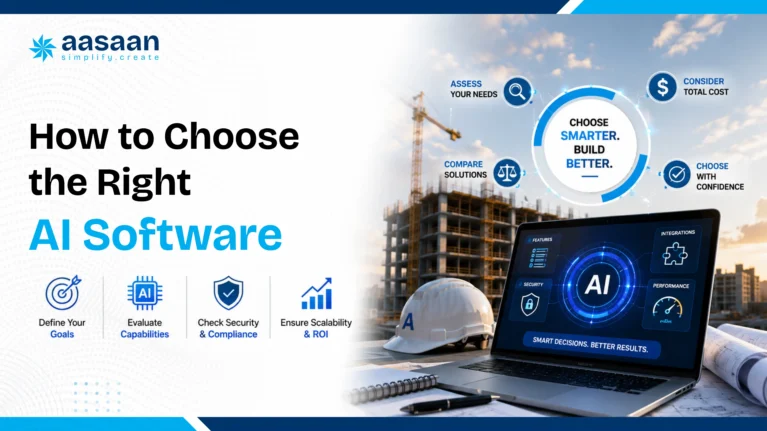
Selecting the best AI construction software requires stepping back from impressive feature lists and honestly assessing your current capabilities and future direction. Your company’s size, complexity, industry focus, and technical sophistication should all influence your selection.
Define your primary pain points as your starting framework. What problem frustrates your team most regularly? For some companies, missed schedules force overtime and premium labor. For others, estimation accuracy remains the biggest profitability obstacle. Different AI solutions excel at solving different problems. Identifying your primary pain point ensures you select a platform delivering meaningful value.
Request trials and run pilots with shortlisted vendors before making final decisions. Give your team the opportunity to use trial software for real projects, not just demo data. Observe where they struggle, what they love, and what they ignore. These genuine user experiences predict actual adoption rates far better than vendor presentations.
Evaluation Checklist
- Determine your company size and annual project volume
- Define your specific pain points causing the most business impact
- Assess your team’s technical sophistication
- Evaluate your current technology stack
- Determine your budget including hidden costs
- Identify must-have versus nice-to-have features
- Research vendor stability and track record
- Verify vendor provides local support
- Confirm adequate training and onboarding
- Review customer references in your industry and size
Watch: Aasaan Co-Founder Hemil Parekh on Simplifying Construction with Technology
Common Mistakes That Sink Construction AI Projects
Firms that regret their AI investment tend to fail in the same handful of ways, in roughly this order of frequency.
- Buying a tool because it looked impressive in a demo, without a specific problem it needs to solve
- Underestimating resistance from site staff who see new tracking as surveillance rather than support
- Skipping a baseline measurement, so nobody can later prove whether the tool actually helped
- Rolling out every feature at once instead of proving value in one area first
- Feeding the system messy or inconsistent historical data and expecting clean recommendations back
- Treating training as a single onboarding call instead of ongoing support in the first two months
- Choosing a platform built for a different market, and forcing local workflows to bend around it
The single biggest predictor of success is not the sophistication of the software. It is whether the firm picked one clear, measurable problem and gave the rollout enough time to show results before judging it.
13. Real Obstacles When Switching to AI
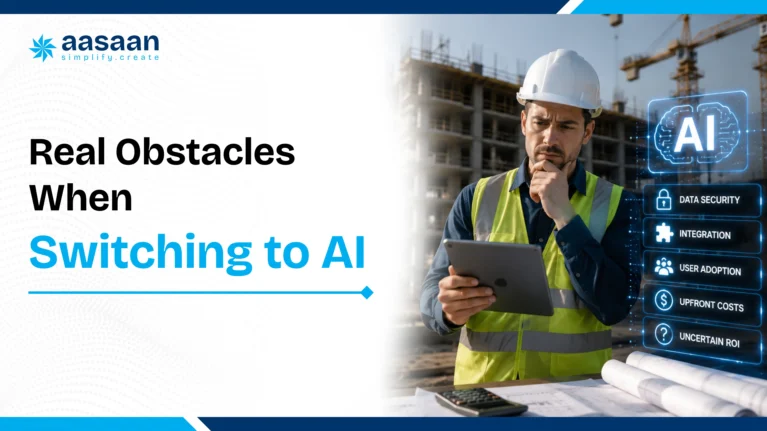
Anticipating the real implementation challenges allows you to plan support that ensures successful adoption. Every construction company implementing new technology faces similar obstacles, and recognizing them in advance prevents frustration from derailing your AI journey.
Data quality issues frequently emerge when moving information into your new system. Your current data might exist across multiple spreadsheets, different file naming conventions, inconsistent project codes, and varying detail levels. When you attempt to migrate this data for machine learning to work properly, you discover that clean, consistent data is far more valuable than anticipated. Allocating time and resources upfront to clean and standardize data before migration prevents months of frustration.
User resistance typically emerges when your team perceives AI as threatening their expertise or job security. Your experienced schedulers worry the software makes them unnecessary. Your estimators see machine learning as devaluing their knowledge. These concerns deserve acknowledgment rather than dismissal. Frame the transition honestly: their expertise becomes more valuable by focusing on strategic decisions and client relationships rather than routine calculations.
Training time requirements often surprise construction companies. Your team needs more than one hour of training to understand a software platform effectively. Most users build genuine proficiency within a week and reach real comfort with advanced capabilities by the end of the month. Successful companies budget the first week for focused, hands-on training plus daily coaching support through the remaining three weeks of the rollout. Rushing training creates skill gaps that persist long after implementation.
Integration complications can create serious adoption obstacles if you underestimate the work involved. Your accounting system, CRM, and project management tools likely contain data relevant to your new AI software. Connecting these systems properly requires technical expertise. Plan for integration support either from your software vendor or external consultants.
14. Where AI Construction Is Heading in 2026
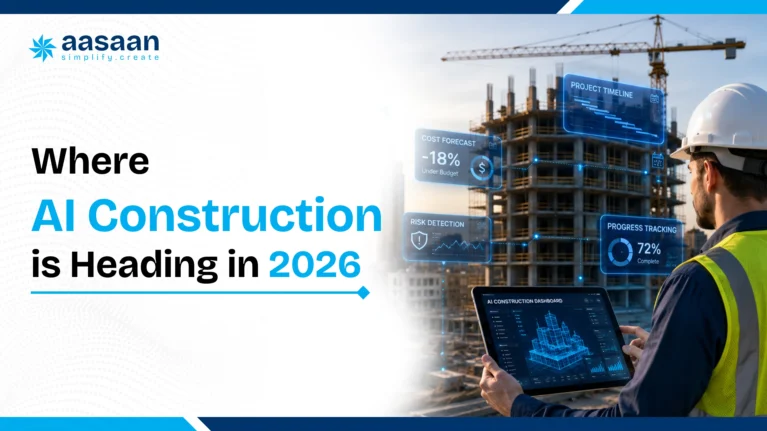
The trajectory of artificial intelligence in construction shows acceleration across multiple dimensions that will fundamentally transform how the industry operates. Understanding where technology is heading helps you make software decisions that remain relevant rather than becoming obsolete quickly.
Generative AI will increasingly move beyond analysis and prediction into actual decision support and recommendation generation. Rather than simply flagging that your material delivery timeline risks slipping, the system will generate specific alternative courses of action and predict outcomes from each option. Your project managers will interact conversationally with their AI assistant, asking what-if questions and receiving instant analysis of impacts and alternatives.
Computer vision will expand beyond safety monitoring into quality control and progress tracking. Automated job site cameras and drones will feed image data to AI systems that identify progress against schedule, spot quality issues early, and flag safety hazards automatically. Your project documentation will include visual records capturing precise project state at regular intervals, making scope disputes with clients far less likely.
Autonomous construction technology will begin appearing on larger projects, starting with repetitive or hazardous tasks. Autonomous equipment for material handling, site preparation, or concrete finishing will become increasingly common. These systems will work alongside your crews rather than replacing them, handling dangerous or repetitive work while skilled tradespeople focus on complex tasks requiring judgment and experience.
Integration of construction AI with external data sources will enhance predictive capabilities beyond your internal project history. Weather prediction services will integrate directly with your scheduling. Supply chain visibility platforms will feed supplier status updates. Labor market data will inform crew scheduling. Your AI platform will increasingly operate as your connection point to industry data and insights.
The next evolution of AI construction software is moving from telling you what happened to telling you what will happen and what you should do about it. By 2027, construction teams will interact with AI as a trusted advisor, not just a reporting tool.

15. How Aasaan Brings Enterprise AI to Your Team
Aasaan transforms construction technology by making enterprise-grade AI software accessible to growing teams without enterprise budgets or enterprise complexity. Most construction companies historically faced a choice between limited functionality in affordable software or full-featured platforms requiring technical expertise and substantial investment. Aasaan bridges this gap by delivering genuine AI-powered capabilities scaled appropriately for how your business actually operates.
The construction software that Aasaan provides grows with your business rather than forcing you to outgrow it or abandon your investment. Whether you manage five projects or fifty, Aasaan’s architecture scales seamlessly without expensive upgrades that traditional software requires. You pay for what you use and scale up as your business grows, keeping costs aligned with your revenue.
Integration between Aasaan’s AI tools and your existing business systems ensures you maintain your current workflows while adding intelligence on top. Your accounting system, your client relationships, and your team communications all remain in place while Aasaan adds the predictive analytics and automation that dramatically improves efficiency. You are not forced to rip out working systems or retrain your entire team on completely new tools.
Enterprise AI capabilities that traditionally required sophisticated internal teams or expensive consultants become accessible through Aasaan’s managed approach. The AI continuously learns your business patterns and performance, continuously improving its recommendations and alerts.
Why Construction Leaders Choose Aasaan
- Enterprise AI capabilities at growing company pricing
- Software grows with your business without forced upgrades
- Integration with existing systems without replacement
- Dedicated implementation team focused on your projects
- Phased adoption building momentum with quick wins
- Machine learning that improves continuously
- Mobile-first design supporting field teams
- Transparent pricing with no surprise costs
For construction companies serious about remaining competitive in 2026 and beyond, the question is not whether to adopt AI but which platform will deliver the best combination of sophistication, usability, and business impact. Aasaan answers that question by focusing on construction teams who want enterprise capabilities without enterprise complexity.
Frequently Asked Questions
What is AI construction software?
AI construction software is a digital platform that uses automation, project data, predictive analytics, and artificial intelligence to help construction teams plan, track, and manage work more accurately. It can support estimation, scheduling, site reporting, document management, billing, resource planning, and progress tracking from one connected system.
How much does AI construction software cost in India?
AI construction software cost in India depends on company size, number of projects, users, features, and implementation support. Smaller construction firms may spend around ₹3 lakh to ₹8 lakh annually, while larger contractors and developers may need higher plans with advanced dashboards, integrations, training, and dedicated support.
What ROI can contractors expect from AI construction software?
Contractors can expect ROI from better estimation, fewer delays, faster approvals, improved labour planning, reduced rework, cleaner billing, and stronger project visibility. The exact return depends on project size and adoption quality, but even one avoided delay or estimation error can recover a major part of the software cost.
How does AI reduce construction delays?
AI reduces construction delays by identifying risk patterns early across schedules, material orders, labour availability, approvals, site progress, and past project data. Instead of waiting for problems to appear on site, teams can see warning signals earlier and take action before timelines, budgets, and client commitments are affected.
Which construction teams should use AI software?
AI construction software is useful for contractors, real estate developers, infrastructure companies, project managers, site supervisors, procurement teams, billing teams, and construction business owners. It works best for teams managing multiple sites, frequent approvals, daily reports, documents, labour, vendors, and project costs across different locations.
How is Aasaan different from global construction software?
Aasaan is built for Indian construction teams that need simple adoption, mobile first workflows, WhatsApp friendly coordination, local business context, and practical project control. Global tools can be powerful, but many teams need a system that fits how Indian contractors, developers, and site teams actually work every day.
How long does implementation take?
Implementation time depends on team size, number of active projects, data readiness, and required modules. Many construction teams can start with a pilot project within a few weeks, then expand usage across sites as teams get comfortable with daily reporting, approvals, documents, billing, and dashboards.
Your construction company is competing in an industry where every day lost to inefficiency costs money, and every project running over budget hurts your reputation and profitability. The construction companies leading your market are already using AI to estimate faster, schedule smarter, and deliver more predictably.
When you are ready to eliminate delays, cut costs, and deliver the predictable results your clients expect and your business needs, Aasaan provides the platform to make that transition.
Schedule Your Aasaan Demo Today
Visit: https://aasaan.co
Contact our team to discuss how AI construction software transforms your business in 2026 and get a free demo.
|
About the Author
Hemil Parekh is the Co-Founder of Aasaan Tech, the company behind Aasaan’s construction management platform. Aasaan Tech was founded in 2017 out of a family construction business background, combining construction domain experience with software engineering to address a specific, recurring problem on Indian construction sites, poor recording and reporting of information among stakeholders. Hemil and the Aasaan team have focused on building tools that fit how Indian construction businesses actually operate, including WhatsApp-based workflows and mobile-first tools for teams where smartphone adoption outpaces desktop software adoption.
|
Additional Resources
Further reading and independent research on AI adoption in construction.
Explore Aasaan’s construction management solutions directly:



 Meta-Verified Business Integration Actionable project inbox with real-time alerts.
 Frictionless Stakeholder Collaboration Capture bills and GRNs directly to ERP.
 WhatsApp-Powered Sales CRM CRM chats with real-time sentiment analysis.
 WhatsApp-Powered Alerts & Reports Automated push notifications and daily reports.
 GPS - Live Tracking Real-time visibility of workforce and assets.
 Facial Scanning Secure, automated attendance via facial recognition.
 Labour Productivity Track workforce activity linked to payroll.
 Quote Comparison AI bots fetch and compare supplier rates.
 OCR - AI for Billing Auto-generate progress reports from site data.
 QR Based Asset Tracking Scan QR codes for instant asset history.
 Tally ERP Integration Seamlessly sync project data with Tally.
 Automated GST Compliance Automated GST compliance and reporting tools.