







































Author: Shivang
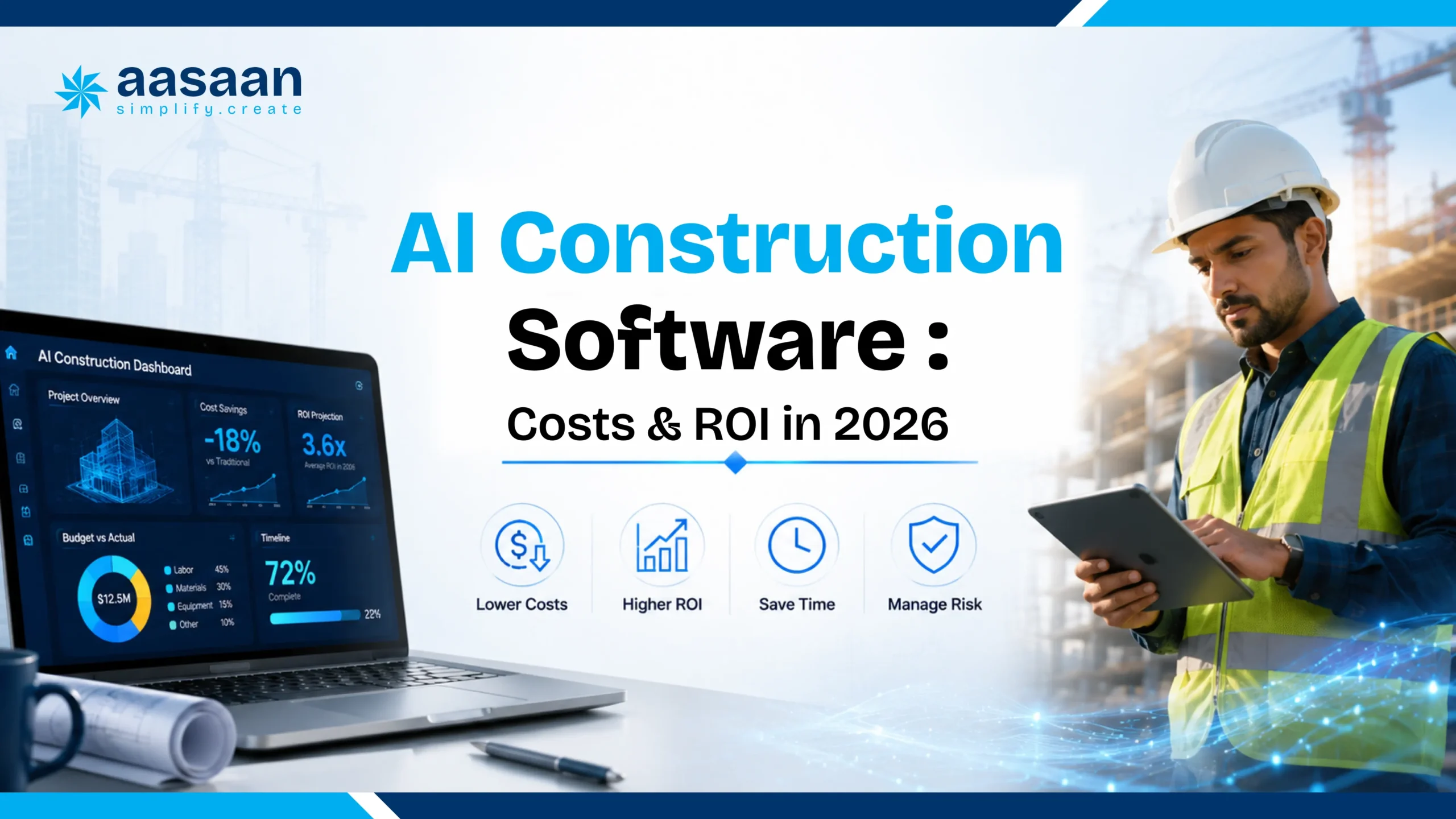
Discover how AI can improve construction project delivery times by up to 30% and reduce costs by up to 15%, based on independent McKinsey research
Table of Contents
- 1. What Is AI Construction Software
- 2. Why Your Team Is Losing Money Without AI
- 3. The Real Cost of AI Construction Software
- 4. Implementation: Addressing Your Biggest Fears
- 5. How AI Cuts Your Construction Costs Up to 15%
- 6. Stop Delays Before They Drain Your Budget
- 7. How One Contractor Saved 42 Days With AI Scheduling
- 8. Estimate Projects 60% Faster with AI
- 9. What Kind of ROI Should You Actually Expect From AI
- 10. Which Tools Actually Pay for Themselves
- 11. Essential Features You Cannot Ignore
- Is Your Firm Ready for AI? A Quick Self-Assessment
- 12. How to Choose the Right AI Software
- Common Mistakes That Sink Construction AI Projects
- 13. Real Obstacles When Switching to AI
- 14. Where AI Construction Is Heading in 2026
- 15. How Aasaan Brings Enterprise AI to Your Team
- Frequently Asked Questions
- Ready to Transform Your Business
- Additional Resources
Discover how AI can improve construction project delivery times by up to 30% and reduce costs by up to 15%, based on independent McKinsey research

1. What Is AI Construction Software
Picture two site managers on a Monday morning. One is scrolling through six WhatsApp groups, three spreadsheets, and a stack of handwritten site notes trying to figure out why the concrete delivery is late. The other opens one dashboard and already knows: the supplier flagged a delay two days ago, the system already rescheduled the crew, and a WhatsApp alert went out to everyone affected before the manager even had morning chai. That second manager is using AI construction software.
Strip away the buzzword and the idea is simple. AI construction software uses machine learning, predictive analytics, and automation to handle tasks that used to eat up hours or days of manual work. It analyzes your project data, flags problems before they blow up your schedule or budget, and suggests the next move based on patterns pulled from thousands of past projects, not just one person’s memory.
Think of it as a project manager who never sleeps, never takes a day off, and gets sharper with every single project your team runs. It quietly connects data sitting in spreadsheets, WhatsApp chats, and paper registers, so your scheduler, your site supervisor, and your accountant finally look at the same version of the truth instead of three different ones.
AI construction software transforms how teams estimate, schedule, and deliver projects by turning historical data into actionable intelligence that prevents costly mistakes before they happen.
Here is the part that actually matters for a busy site team: you do not need to understand any of the machine learning happening underneath. You keep working the way you already do, on WhatsApp, on your phone, on site, and the intelligence just shows up where you need it.
How AI Construction Software Compares to Traditional Methods
| Capability | Traditional Software | AI-Powered | Improvement |
|---|---|---|---|
| Estimation Speed | 3-5 days per estimate | 1-2 hours per estimate | 60-85% faster |
| Estimation Accuracy | ±8-12% | ±2-4% | 6x better |
| Schedule Optimization | Manual adjustment | Continuous real-time | Automated |
| Risk Detection | After problems occur | 3-4 weeks early | Proactive |
| Resource Utilization | 70-75% | 85-92% | 20% improvement |
| Learning Capability | None | Improves with each project | Continuous improvement |

2. Why Your Team Is Losing Money Without AI
Here is an uncomfortable question worth sitting with for a second: when was the last time one of your estimates was actually wrong, and nobody noticed until the project was already bleeding money? Every day your company runs without AI, small inefficiencies quietly stack up. Your best estimators are still building quotes from memory of past projects instead of data from hundreds of completed jobs. Your schedulers are working off gut feel and experience, which cannot possibly account for every variable that decides whether a project actually finishes on time.
Meanwhile, your competitors are not standing still. Firms running AI finish projects earlier, under budget, and without sacrificing quality. They bid sharper because their numbers are actually accurate. They keep clients happy because the timeline they promise is the timeline they deliver. Everyone still doing it the old way keeps hitting the same wall, year after year, and calling it bad luck.
The construction industry loses approximately 30% of total project value to inefficiency, rework, waste, and poor planning annually. AI construction software directly addresses this massive waste by preventing the specific patterns that cost your business money. – Mr. Hemil Parekh, Co-Founder of Aasaan Tech
Signs You’re Losing Money
- Estimation errors consistently run 10%+ above or below actual costs
- Projects regularly experience schedule delays of 2+ weeks
- Material waste and rework account for 8%+ of project costs
- Your crew experiences downtime waiting for materials or approvals
- Client change orders exceed 5% of original contract value
- Key project information lives in email rather than centralized systems
- Your team cannot see cash flow issues until they create serious problems
Cost Impact Analysis
| Project Phase | Without AI | With AI | Annual Savings |
|---|---|---|---|
| Estimation Process | 3 days per estimate, 15% error rate | 2 hours per estimate, 3% error rate | ₹15-30 Lakh |
| Schedule Delays | 2-3 weeks overrun | 3-5 days overrun | ₹20-40 Lakh |
| Material Waste | 8-12% waste rate | 3-5% waste rate | ₹25-50 Lakh |
| Labor Efficiency | 70-75% utilization | 85-90% utilization | ₹35-60 Lakh |
| Rework Costs | 5-8% of labor budget | 1-2% of labor budget | ₹15-30 Lakh |
| TOTAL ANNUAL | ₹1.1-2.1 Crore |

3. The Real Cost of AI Construction Software
Construction software pricing varies significantly based on your company size, project volume, and needed features. Most modern AI construction software falls into three pricing tiers that align with company growth stages.
Small to mid-sized companies typically invest ₹3-8 Lakh annually in comprehensive AI software. This covers essential features like project scheduling, resource management, basic predictive analytics, and standard reporting. Larger organizations often require ₹15-40 Lakh annually with advanced capabilities and dedicated support.
Which Bracket Fits Your Business
| Company Size | Annual Revenue | Projects/Year | Feature Set |
|---|---|---|---|
| Small Firm | ₹8 Cr – ₹40 Cr | 5-10 | Basic scheduling, resource tracking |
| Growing Company | ₹40 Cr – ₹200 Cr | 10-25 | Advanced scheduling, portfolio management |
| Mid-Market | ₹200 Cr – ₹800 Cr | 25-50 | Enterprise features, advanced integrations |
| Enterprise | ₹800 Cr+ | 50+ | Full customization, real-time dashboards |
Hidden Costs to Budget For
- Data migration and cleaning: ₹40,000-60,000
- Initial training program: ₹70,000-1,00,000
- System integration work: ₹25,000-50,000
- Tally/accounting integration: ₹20,000-40,000
- Project manager time: ₹70,000-1,20,000
- First month of dedicated support: ₹15,000-30,000
- Process documentation: ₹10,000-20,000
- Team training: ₹20,000-35,000
- Contingency buffer: 5-10% of total
When AI software prevents a three-month commercial project from running two weeks over schedule, the savings often exceed what you spend on the entire software system for the year.
ROI and Break-Even Timeline
| Company Size | Annual Software Cost | Annual Savings | Break Even Point | Year 1 ROI |
|---|---|---|---|---|
| Small Firm | ₹4 Lakh | ₹30 Lakh | 1.6 months | 650% |
| Growing Company | ₹8 Lakh | ₹50 Lakh | 2.2 months | 456% |
| Mid-Market | ₹18 Lakh | ₹80 Lakh | 3 months | 300% |
| Enterprise | ₹45 Lakh | ₹1.5 Crore | 4 months | 200% |

4. Implementation: Addressing Your Biggest Fears
Implementation anxiety is the top reason construction companies delay adopting AI. Your team might perceive it as a threat rather than a tool that makes their jobs easier. Schedulers worry the system will eliminate their role. Estimators fear their expertise becomes irrelevant. These concerns are completely rational and deserve acknowledgment.
Most companies implementing construction software successfully start with a pilot project rather than company-wide rollout. You select one representative project, introduce the AI platform to that specific team, and measure impact over the first month. This approach reveals real challenges your situation presents, allows your team to become comfortable gradually, and generates genuine success stories that convince skeptics.
Companies succeeding with AI are those that involve their team from the beginning, acknowledge concerns, and show early wins. Technology adoption is ultimately a people problem, not a technology problem.
Your employees need time to see value before embracing AI fully. Successful companies pair technology implementation with process improvement. Instead of asking your team to do the same work in a new system, redesign workflows around AI strengths. Your estimators now focus on relationships and strategy while AI handles calculations. Your supervisors concentrate on quality and safety while predictive analytics flags resource issues early.
Implementation Timeline
| Phase | Timeline | Key Activities | Success Indicators |
|---|---|---|---|
| Awareness | Days 1-2 | Product walkthrough, team kickoff, vision communication | High attendance at sessions |
| Learning | Days 3-7 | Hands-on training, practice, documentation | Team completing modules |
| Application | Days 8-21 | Pilot project execution, problem-solving | Team using system daily |
| Optimization | Days 22-26 | Process refinement, advanced features | Measurable improvements |
| Full Adoption | Days 27-30 | Company-wide rollout, continuous improvement | Adoption >85%, positive feedback |
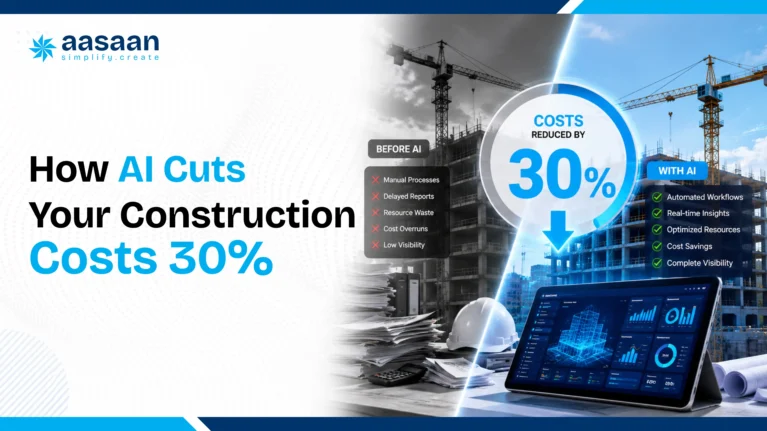
5. How AI Cuts Your Construction Costs More Than 15%
Research from McKinsey on AI adoption in construction found that AI can increase productivity by up to 20%, reduce costs by up to 15%, and improve project delivery times by up to 30%. That cost figure comes from attacking multiple cost drains simultaneously rather than one single fix. Construction analytics reveals specific areas where your business loses money, and resource allocation represents one of the largest cost-saving opportunities that AI tools unlock.
Material waste and procurement delays create substantial hidden costs on most construction projects. AI solutions reveal patterns in material ordering, storage costs, and waste. They learn how long your specific suppliers take to deliver and which suppliers consistently perform well.
Rework represents construction waste that teams tolerate without recognizing true costs. When quality metrics depend entirely on supervisor inspection, mistakes slip through creating expensive rework. AI-powered quality control catches issues early, often before they compound into major problems. Prevention costs far less than fixing mistakes.
The same McKinsey research found that AI can also improve project delivery times by up to 30%, a separate benefit from the cost savings above, driven by better scheduling and earlier risk detection rather than cost control alone.
Resource Allocation Savings
| Resource Category | Typical Waste Rate | Monthly Savings | Annual Savings |
|---|---|---|---|
| Labor Scheduling | 20-25% | ₹65,000-1,25,000 | ₹8-15 Lakh |
| Equipment Utilization | 30-40% | ₹40,000-1,00,000 | ₹5-12 Lakh |
| Material Handling | 10-15% | ₹25,000-65,000 | ₹3-8 Lakh |
| Overtime Prevention | 15-20% | ₹30,000-85,000 | ₹4-10 Lakh |
Cost Reduction Priority Areas
- Conduct baseline audit of current waste
- Identify your top three cost drains
- Calculate specific dollar impact
- Prioritize improvements with highest impact
- Establish measurement system
- Assign accountability
- Review and adjust processes
- Implement quality checkpoints
- Communicate savings to team
- Reinvest savings into additional features

6. Stop Delays Before They Drain Your Budget
Project delays represent a construction company’s worst nightmare. They destroy profit margins and create client relationship damage that lingers long after completion. Every day a project runs late adds soft costs through extended site supervision, extended equipment rental, and increased labor costs. Delays compound throughout your business.
Predictive analytics works by analyzing thousands of variables that typically cause delays on your projects. Maybe your excavation phase encounters unexpected soil conditions. Perhaps permit approval takes longer than planned. Material delivery from certain suppliers arrives late. Weather delays impact seasonal work. AI construction tools flag these risks upfront, allowing you to build realistic buffers, secure contingency supplies, or adjust scheduling.
The construction scheduling improvements that machine learning enables actually accelerate project completion. When you compress schedules realistically based on actual performance data, you reduce overall duration while maintaining quality and team safety. Faster completion means earlier project revenue recognition, faster equipment turnover, and team availability for additional work.
Common Delay Causes and Prevention
| Delay Type | Frequency | Impact Days | AI Detection | Action | Lead Time |
|---|---|---|---|---|---|
| Material Delivery | 45% | 5-14 days | Pattern analysis | Order earlier | 3-4 weeks |
| Permit Delays | 35% | 3-21 days | Timeline data | Begin early | 4-6 weeks |
| Weather Impact | 55% | 2-30 days | Weather patterns | Adjust schedule | Immediate |
| Labor Availability | 28% | 3-10 days | Market availability | Book in advance | 8-12 weeks |
| Subcontractor Issues | 40% | 4-15 days | Performance tracking | Backup subs | Ongoing |
Watch: Mastering Project Planning and Scheduling Techniques
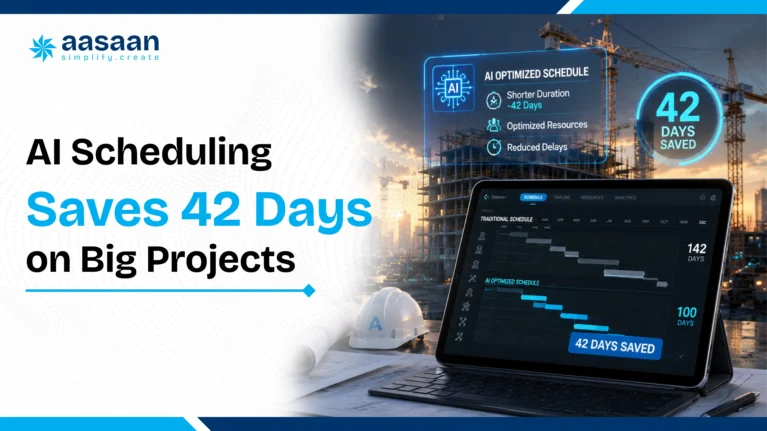
7. How One Contractor Saved 42 Days With AI Scheduling
Large commercial construction projects typically span 18 to 36 months, and schedule compression on projects this size compounds into significant financial impact. Rather than citing a general average, it helps to look at a specific, documented example. ALICE Technologies’ published case studies show that Suffolk Construction used AI-driven schedule optimization on a life sciences project to recover 42 days and eliminate negative float on key milestones. That same case study library documents other results, including a highway project that saved over 25 million dollars on an 8-mile interstate, and a data center portfolio that accelerated delivery by more than 90 days. Results like these vary significantly by project type, scale, and how disciplined the existing scheduling process already is, so treat any single case as an illustration of what is possible, not a guaranteed outcome.
Breaking down where these savings typically originate reveals legitimate improvements. Construction workflow automation eliminates delays from manual document processing, approval cycles, and communication delays. When a request for information that previously sat in an inbox for days now moves immediately, the impact cascades throughout a project.
When a day of delay on a major commercial project can cost tens of thousands of dollars in overhead alone, recovering even a fraction of the 42 days seen in documented case studies changes the economics of the entire project.
Logistics optimization addresses another major delay category. AI systems analyze material ordering windows, delivery timing, labor crew movements, and equipment scheduling to identify conflicts before they create problems. When machine learning coordinates delivery schedules with actual construction needs, improvements cascade through the project.
Scheduling Improvements Breakdown
| Improvement Area | Per Instance | Instances | Total Days Saved |
|---|---|---|---|
| Document Processing | 0.5 days | 50 documents | 25 days |
| Approval Cycle | 0.3 days | 40 approvals | 12 days |
| Schedule Optimization | 0.2 days | 80 activities | 16 days |
| Procurement Timing | 0.15 days | 30 orders | 4.5 days |
| Total | 57.5 days |
Watch: The Critical Path Method Explained and Applied to Construction Projects
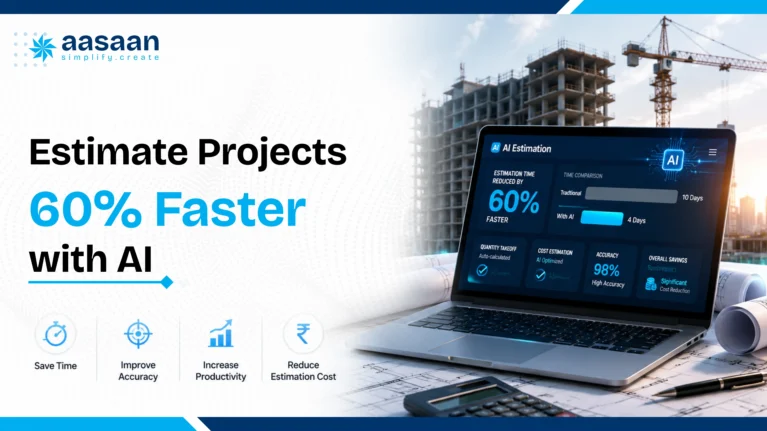
8. Estimate Projects 60% Faster with AI
Your estimation process currently depends on your most experienced estimators, who built mental models based on cumulative experience. That approach served the industry for decades, but it has inherent limitations. One person can only remember so much, experience carries bias, and knowledge disappears if that key person leaves.
The 60% speed improvement comes from machine learning processing massive data volumes instantly. When your estimator traditionally built a budget, they mentally referenced completed projects, adjusted for material prices, and applied intuition-requiring hours of thought. AI-powered software ingests your completed project data, applies current pricing automatically, and generates initial estimates in minutes.
More importantly, AI estimates become smarter over time. If your estimates consistently run 5% low on labor because you work in an expensive market, the AI learns and adjusts future estimates. If certain project types require higher contingencies, machine learning incorporates this. Your estimation becomes smarter with every project completed.
This speed creates competitive advantages beyond faster delivery. When you turn around estimates in one day instead of four, you respond faster to opportunities and beat competitors who estimate manually. Some companies report 25-50% win rate improvements just from estimating faster and more frequently.
Estimation Speed and Accuracy Comparison
| Metric | Traditional | AI-Assisted | Improvement | Win Rate Impact |
|---|---|---|---|---|
| Time Per Estimate | 12-24 hours | 2-4 hours | 60-85% | 15-20% |
| Labor Cost Accuracy | ±8-12% | ±2-4% | 6x better | 25%+ higher |
| Material Cost Accuracy | ±6-10% | ±1-3% | 5x better | Reduced losses |
| Overall Win Rate | 35-40% | 45-55% | 25-50% | Significant |
9. What Kind of ROI Should You Actually Expect From AI
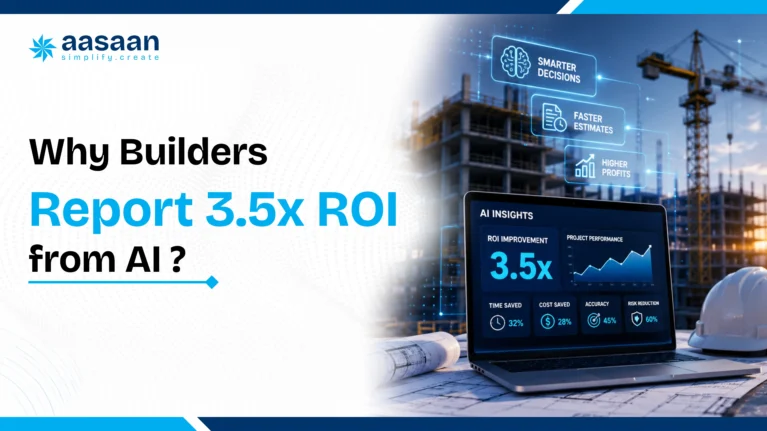
Independent research gives a useful benchmark here, though it is worth being precise about what it actually measures. IDC research commissioned by Microsoft found that organizations across industries realize an average return of 3.5x on their AI investments, with top performers reaching up to 10x. That figure is a general, cross-industry AI benchmark, not a construction-specific promise, so treat it as a useful reference point for what strong AI adoption can look like, rather than a guarantee for any single project or firm.
Within construction specifically, the return tends to come from a few concrete, trackable sources rather than one single number. The largest component comes from time savings across your team. When estimators work faster, schedulers optimize complex projects, and supervisors receive actionable alerts instead of firefighting surprises, labor efficiency improves measurably. If a ten-person management team saves an average of ten hours weekly through AI automation, that is a concrete number you can calculate against your own team’s hourly cost and compare directly to your software spend.
Profit improvement from more accurate estimates represents the second major driver. When bids become more accurate and win rate improves simultaneously, you reduce margin-killing projects while capturing more profitable work. As estimates improve, you bid more competitively while maintaining margins, capturing market share from less sophisticated competitors.
Consider a realistic scenario: an AI system flags that a labor estimate on a mid-size project is running significantly under budget before the bid goes out. Catching that single error before signing the contract can prevent a margin loss large enough to cover several years of software cost on its own.
Prevention of major project disasters generates outsized returns that are often overlooked in ROI calculations. A project delay running two weeks over schedule can carry direct costs in the tens of thousands of dollars, and a single missed safety hazard resulting in an incident can cost far more. When AI prevents even one or two such situations annually, it can offset a meaningful share of the software cost on its own, independent of any efficiency gains.
ROI Component Breakdown
The table below is an illustrative model showing how these components typically combine, not a reported industry average. Plug in your own team’s numbers to get a realistic picture for your business rather than treating the ranges below as a promise.
| ROI Component | Illustrative Annual Impact | What It Depends On | Calculation Method |
|---|---|---|---|
| Time Savings | ₹12-25 Lakh | Scales with team size | Hours saved × labor rate |
| Margin Improvement | ₹8-32 Lakh | Scales with project volume | Estimation accuracy × project size |
| Schedule Compression | ₹4-16 Lakh | Scales with overhead costs | Days saved × daily overhead |
| Rework Prevention | ₹2.5-12 Lakh | Scales with project complexity | Prevented incidents × avoided costs |
| Increased Win Rate | ₹6-25 Lakh | Scales with business development | Additional projects × average margin |
| Total First Year | ₹35 Lakh – ₹1.1 Crore | Varies significantly | Sum of all improvements |
| Software Investment | ₹4-18 Lakh | Scales with company size | Annual license |
| Resulting Multiple | 4.3x-14.5x | Based on this illustrative model only | Total impact ÷ investment |
10. Which Tools Actually Pay for Themselves
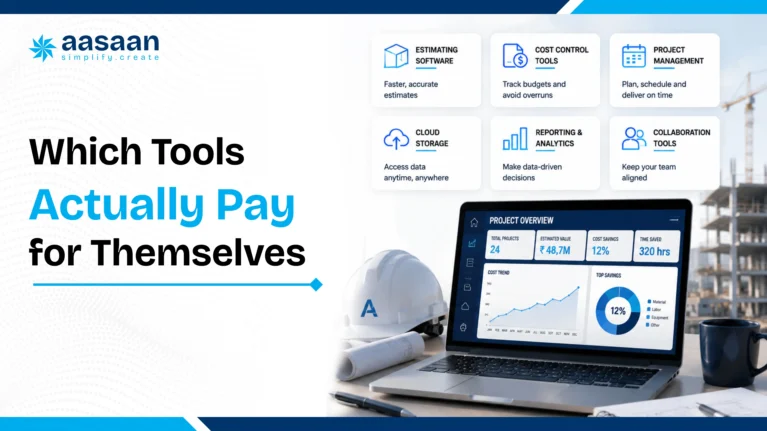
Here is a trap almost every construction company falls into at least once: buying software, using it for six months, and then having absolutely no way to prove whether it actually helped. If you cannot answer “compared to what” you cannot answer whether it worked. Set your baseline before you touch anything new.
Start with time. Pick your three most time-consuming manual processes, maybe project estimation, weekly status reporting, and resource scheduling, and clock exactly how many hours your team burns on each one every month. Then implement, wait a month, and measure the same three things again. Most companies see 20-50% reductions in these core processes once the dust settles.
Then look past hours to outcomes. Compare pre-AI projects against post-AI projects using the same yardsticks every time: actual completion dates versus estimates, actual labor costs versus budgets, actual material costs versus estimates, and rework percentage. Most Aasaan implementations show measurable improvement within the first month, with increasingly dramatic improvements over the following quarter.
Metrics to Track for ROI Verification
| Metric | Pre-AI Average | Post-AI Target | Annual Impact |
|---|---|---|---|
| Schedule Variance | Plus 12-18% | Plus 2-4% | ₹20-40 Lakh |
| Cost Variance Labor | Plus 8-12% | Plus 1-3% | ₹32-65 Lakh |
| Cost Variance Materials | Plus 6-10% | Plus 1-2% | ₹25-50 Lakh |
| Rework Rate | 5-8% | 1-2% | ₹28-55 Lakh |
| Safety Incidents | 1-3 per year | 0-1 per year | ₹40 Lakh – ₹1.6 Crore |
Client satisfaction and retention represents another valid return measurement. When your projects deliver on time with fewer changes, client satisfaction improves and retention increases. Calculate your client lifetime value and track how satisfaction and referral rates change after AI implementation.
11. Essential Features You Cannot Ignore
The construction management software landscape includes numerous options, but the best AI software shares fundamental features that separate genuine value from marketing hype. Understanding which capabilities matter for your business prevents paying for features you never use.
It helps to know the landscape honestly. Global platforms like Procore, Buildertrend, and Autodesk Construction Cloud dominate the large enterprise and North American markets, and they are genuinely strong products for the scale and budgets they target. Specialized AI estimating tools like Togal.AI and STACK focus narrowly on takeoff accuracy. Most of these platforms are priced, structured, and supported for firms with dedicated IT teams and enterprise budgets, which puts them out of reach or poorly suited for a mid-size Indian contractor running projects through WhatsApp and Tally rather than a full enterprise software stack. That gap, not a lack of good options generally, is the specific problem worth solving for firms in this market.
Non-Negotiable Features to Require
- Real-time project dashboard with current status and key metrics
- Predictive analytics identifying risks 2-4 weeks early
- Machine learning based on your historical project data
- Automatic schedule optimization across multiple phases
- Integration with accounting for real-time cost tracking
- Mobile app with offline capability for field teams
- Automated alerts for cost overruns and schedule delays
- Multi-project portfolio management and resource leveling
- Supply chain visibility and procurement optimization
- Automated document management and approval routing
- Team collaboration tools built into the platform
- Customizable reporting aligned with your KPIs
- API access for integration with other systems
- Dedicated customer support
Start with integration capabilities as a non-negotiable requirement. Your business likely relies on existing systems for accounting, CRM, or other functions. The AI platform must integrate cleanly with your existing technology stack. Construction software implementation becomes dramatically easier when new tools work alongside existing systems rather than forcing complete replacement.
Real-time project visibility through intelligent dashboards ensures your team actually uses the AI software rather than creating an extra reporting burden. When your stakeholders can see current project status, upcoming risks, and resource constraints at a glance, the system becomes invaluable. The best construction software visualizes information so intuitively that your field managers understand risks without detailed explanations.
Is Your Firm Ready for AI? A Quick Self-Assessment
Before evaluating specific platforms, it helps to know honestly where your firm stands. Score one point for every statement below that is true for your business.
- You already use some form of digital project tracking, even a shared spreadsheet, across active sites
- You have at least 12 months of records on project costs, timelines, or labor attendance
- A specific owner or decision maker is ready to champion a new tool internally
- You can name two concrete problems costing you time or money right now, not just a general feeling
- Your field teams and supervisors have smartphones and basic comfort with WhatsApp or similar apps
- Your sites have reasonable mobile network coverage most of the time
- You track at least one KPI consistently, such as schedule variance or material wastage
- You are prepared to give a new system 30 days before judging results
6 to 8 points: you are ready to pilot AI tools across a real project now, and should expect measurable results within 30 days.
3 to 5 points: you have a foundation, but pick one focused problem to solve first rather than trying to fix everything simultaneously.
0 to 2 points: start by digitizing basic attendance and daily reporting before layering AI on top, since AI improves on structured data and cannot fix an absence of it.
This is a rough gauge, not a verdict. Most firms that are confident AI users today started in the middle bracket.

12. How to Choose the Right AI Software
Selecting the best AI construction software requires stepping back from impressive feature lists and honestly assessing your current capabilities and future direction. Your company’s size, complexity, industry focus, and technical sophistication should all influence your selection.
Define your primary pain points as your starting framework. What problem frustrates your team most regularly? For some companies, missed schedules force overtime and premium labor. For others, estimation accuracy remains the biggest profitability obstacle. Different AI solutions excel at solving different problems. Identifying your primary pain point ensures you select a platform delivering meaningful value.
Request trials and run pilots with shortlisted vendors before making final decisions. Give your team the opportunity to use trial software for real projects, not just demo data. Observe where they struggle, what they love, and what they ignore. These genuine user experiences predict actual adoption rates far better than vendor presentations.
Evaluation Checklist
- Determine your company size and annual project volume
- Define your specific pain points causing the most business impact
- Assess your team’s technical sophistication
- Evaluate your current technology stack
- Determine your budget including hidden costs
- Identify must-have versus nice-to-have features
- Research vendor stability and track record
- Verify vendor provides local support
- Confirm adequate training and onboarding
- Review customer references in your industry and size
Watch: Aasaan Co-Founder Hemil Parekh on Simplifying Construction with Technology
Common Mistakes That Sink Construction AI Projects
Firms that regret their AI investment tend to fail in the same handful of ways, in roughly this order of frequency.
- Buying a tool because it looked impressive in a demo, without a specific problem it needs to solve
- Underestimating resistance from site staff who see new tracking as surveillance rather than support
- Skipping a baseline measurement, so nobody can later prove whether the tool actually helped
- Rolling out every feature at once instead of proving value in one area first
- Feeding the system messy or inconsistent historical data and expecting clean recommendations back
- Treating training as a single onboarding call instead of ongoing support in the first two months
- Choosing a platform built for a different market, and forcing local workflows to bend around it
The single biggest predictor of success is not the sophistication of the software. It is whether the firm picked one clear, measurable problem and gave the rollout enough time to show results before judging it.

13. Real Obstacles When Switching to AI
Anticipating the real implementation challenges allows you to plan support that ensures successful adoption. Every construction company implementing new technology faces similar obstacles, and recognizing them in advance prevents frustration from derailing your AI journey.
Data quality issues frequently emerge when moving information into your new system. Your current data might exist across multiple spreadsheets, different file naming conventions, inconsistent project codes, and varying detail levels. When you attempt to migrate this data for machine learning to work properly, you discover that clean, consistent data is far more valuable than anticipated. Allocating time and resources upfront to clean and standardize data before migration prevents months of frustration.
User resistance typically emerges when your team perceives AI as threatening their expertise or job security. Your experienced schedulers worry the software makes them unnecessary. Your estimators see machine learning as devaluing their knowledge. These concerns deserve acknowledgment rather than dismissal. Frame the transition honestly: their expertise becomes more valuable by focusing on strategic decisions and client relationships rather than routine calculations.
Training time requirements often surprise construction companies. Your team needs more than one hour of training to understand a software platform effectively. Most users build genuine proficiency within a week and reach real comfort with advanced capabilities by the end of the month. Successful companies budget the first week for focused, hands-on training plus daily coaching support through the remaining three weeks of the rollout. Rushing training creates skill gaps that persist long after implementation.
Integration complications can create serious adoption obstacles if you underestimate the work involved. Your accounting system, CRM, and project management tools likely contain data relevant to your new AI software. Connecting these systems properly requires technical expertise. Plan for integration support either from your software vendor or external consultants.

14. Where AI Construction Is Heading in 2026
The trajectory of artificial intelligence in construction shows acceleration across multiple dimensions that will fundamentally transform how the industry operates. Understanding where technology is heading helps you make software decisions that remain relevant rather than becoming obsolete quickly.
Generative AI will increasingly move beyond analysis and prediction into actual decision support and recommendation generation. Rather than simply flagging that your material delivery timeline risks slipping, the system will generate specific alternative courses of action and predict outcomes from each option. Your project managers will interact conversationally with their AI assistant, asking what-if questions and receiving instant analysis of impacts and alternatives.
Computer vision will expand beyond safety monitoring into quality control and progress tracking. Automated job site cameras and drones will feed image data to AI systems that identify progress against schedule, spot quality issues early, and flag safety hazards automatically. Your project documentation will include visual records capturing precise project state at regular intervals, making scope disputes with clients far less likely.
Autonomous construction technology will begin appearing on larger projects, starting with repetitive or hazardous tasks. Autonomous equipment for material handling, site preparation, or concrete finishing will become increasingly common. These systems will work alongside your crews rather than replacing them, handling dangerous or repetitive work while skilled tradespeople focus on complex tasks requiring judgment and experience.
Integration of construction AI with external data sources will enhance predictive capabilities beyond your internal project history. Weather prediction services will integrate directly with your scheduling. Supply chain visibility platforms will feed supplier status updates. Labor market data will inform crew scheduling. Your AI platform will increasingly operate as your connection point to industry data and insights.
The next evolution of AI construction software is moving from telling you what happened to telling you what will happen and what you should do about it. By 2027, construction teams will interact with AI as a trusted advisor, not just a reporting tool.

15. How Aasaan Brings Enterprise AI to Your Team
Aasaan transforms construction technology by making enterprise-grade AI software accessible to growing teams without enterprise budgets or enterprise complexity. Most construction companies historically faced a choice between limited functionality in affordable software or full-featured platforms requiring technical expertise and substantial investment. Aasaan bridges this gap by delivering genuine AI-powered capabilities scaled appropriately for how your business actually operates.
The construction software that Aasaan provides grows with your business rather than forcing you to outgrow it or abandon your investment. Whether you manage five projects or fifty, Aasaan’s architecture scales seamlessly without expensive upgrades that traditional software requires. You pay for what you use and scale up as your business grows, keeping costs aligned with your revenue.
Integration between Aasaan’s AI tools and your existing business systems ensures you maintain your current workflows while adding intelligence on top. Your accounting system, your client relationships, and your team communications all remain in place while Aasaan adds the predictive analytics and automation that dramatically improves efficiency. You are not forced to rip out working systems or retrain your entire team on completely new tools.
Enterprise AI capabilities that traditionally required sophisticated internal teams or expensive consultants become accessible through Aasaan’s managed approach. The AI continuously learns your business patterns and performance, continuously improving its recommendations and alerts.
Why Construction Leaders Choose Aasaan
- Enterprise AI capabilities at growing company pricing
- Software grows with your business without forced upgrades
- Integration with existing systems without replacement
- Dedicated implementation team focused on your projects
- Phased adoption building momentum with quick wins
- Machine learning that improves continuously
- Mobile-first design supporting field teams
- Transparent pricing with no surprise costs
For construction companies serious about remaining competitive in 2026 and beyond, the question is not whether to adopt AI but which platform will deliver the best combination of sophistication, usability, and business impact. Aasaan answers that question by focusing on construction teams who want enterprise capabilities without enterprise complexity.
Frequently Asked Questions
What is AI construction software?
AI construction software is a digital platform that uses automation, project data, predictive analytics, and artificial intelligence to help construction teams plan, track, and manage work more accurately. It can support estimation, scheduling, site reporting, document management, billing, resource planning, and progress tracking from one connected system.
How much does AI construction software cost in India?
AI construction software cost in India depends on company size, number of projects, users, features, and implementation support. Smaller construction firms may spend around ₹3 lakh to ₹8 lakh annually, while larger contractors and developers may need higher plans with advanced dashboards, integrations, training, and dedicated support.
What ROI can contractors expect from AI construction software?
Contractors can expect ROI from better estimation, fewer delays, faster approvals, improved labour planning, reduced rework, cleaner billing, and stronger project visibility. The exact return depends on project size and adoption quality, but even one avoided delay or estimation error can recover a major part of the software cost.
How does AI reduce construction delays?
AI reduces construction delays by identifying risk patterns early across schedules, material orders, labour availability, approvals, site progress, and past project data. Instead of waiting for problems to appear on site, teams can see warning signals earlier and take action before timelines, budgets, and client commitments are affected.
Which construction teams should use AI software?
AI construction software is useful for contractors, real estate developers, infrastructure companies, project managers, site supervisors, procurement teams, billing teams, and construction business owners. It works best for teams managing multiple sites, frequent approvals, daily reports, documents, labour, vendors, and project costs across different locations.
How is Aasaan different from global construction software?
Aasaan is built for Indian construction teams that need simple adoption, mobile first workflows, WhatsApp friendly coordination, local business context, and practical project control. Global tools can be powerful, but many teams need a system that fits how Indian contractors, developers, and site teams actually work every day.
How long does implementation take?
Implementation time depends on team size, number of active projects, data readiness, and required modules. Many construction teams can start with a pilot project within a few weeks, then expand usage across sites as teams get comfortable with daily reporting, approvals, documents, billing, and dashboards.
Ready to Transform Your Business
Your construction company is competing in an industry where every day lost to inefficiency costs money, and every project running over budget hurts your reputation and profitability. The construction companies leading your market are already using AI to estimate faster, schedule smarter, and deliver more predictably.
When you are ready to eliminate delays, cut costs, and deliver the predictable results your clients expect and your business needs, Aasaan provides the platform to make that transition.
Schedule Your Aasaan Demo Today
Visit: https://aasaan.co
Contact our team to discuss how AI construction software transforms your business in 2026 and get a free demo.
|
About the Author Hemil Parekh is the Co-Founder of Aasaan Tech, the company behind Aasaan’s construction management platform. Aasaan Tech was founded in 2017 out of a family construction business background, combining construction domain experience with software engineering to address a specific, recurring problem on Indian construction sites, poor recording and reporting of information among stakeholders. Hemil and the Aasaan team have focused on building tools that fit how Indian construction businesses actually operate, including WhatsApp-based workflows and mobile-first tools for teams where smartphone adoption outpaces desktop software adoption. |
Additional Resources
Further reading and independent research on AI adoption in construction.
- McKinsey, Engineering, Construction and Building Materials
- Construction Dive, industry news and analysis
Explore Aasaan’s construction management solutions directly:
Table of Contents
- What Causes Construction Delays During Monsoon
- How Much Do Monsoon Delays Really Cost a Project
- How Do You Prevent Waterlogging on a Site
- How Do You Protect Cement and Steel From Rain
- Is Monsoon a Valid Reason for Construction Delay
- Why Does Labor Productivity Drop During Monsoon
- How Can You Track Site Progress in Real Time
- What Should a Daily Site Report Include
- How Does AI Help Prevent Construction Delays
- What Should You Look for in Construction Software
- Frequently Asked Questions
Last updated: July 2026
Every site manager knows the feeling. Dark clouds gather over the horizon, the ground turns to slush, and a project that was running on schedule suddenly grinds to a halt. Construction site delays during monsoon season are the single biggest fear for contractors, builders and real estate developers across India every single year. The client keeps calling. The investors keep asking questions. The workforce sits idle while wages still need to be paid. This is the reality of construction site delays, and it repeats itself every June when the skies open up.
Behind every missed deadline is a story of frustration. A project that promised handover in December quietly slips to March. A contractor who built a reputation over fifteen years suddenly faces penalty clauses because of three weeks of heavy rain. Construction site delays are rarely about a single mistake. They are usually the result of dozens of small gaps in planning, tracking and communication that pile up the moment the weather turns against you.
This guide exists to help contractors, builders, real estate developers and site managers walk into monsoon season prepared instead of panicked. It covers the real causes behind construction site delays, the financial damage they cause, and the practical steps that genuinely reduce risk. It also shows where modern construction management software, including tools built specifically for Indian sites like Aasaan, fits into the picture. The goal is simple. Fewer surprises, faster recovery, and a monsoon season your business survives with confidence instead of dread.
Construction site delays hurt more than a calendar. They hurt margins, morale and the trust clients place in your business. The sections ahead break down exactly where those delays come from and exactly what to do about them.
Quick answer: Construction site delays during monsoon can be reduced by preparing drainage before the first heavy rain, protecting cement and steel, tracking labour attendance daily, recording site issues with photos, and using real time construction software like Aasaan to monitor progress, reports, approvals and risks before they become expensive delays.
What Causes Construction Delays During Monsoon?
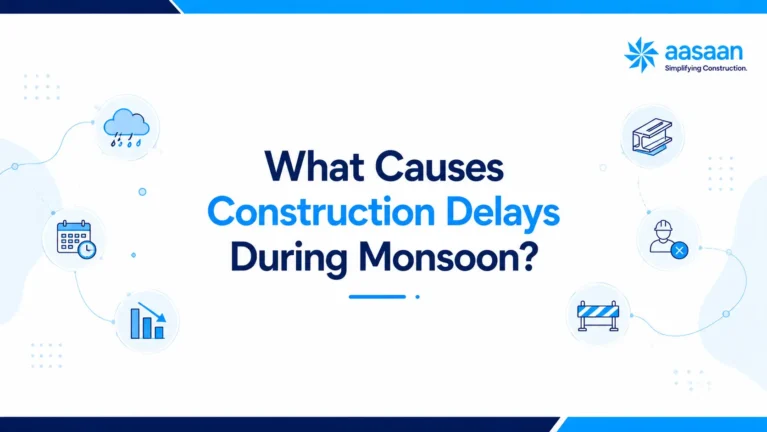
Construction site delays during monsoon rarely come from one single event. They build up from a combination of weather exposure, poor planning and a lack of real time visibility into what is actually happening on site. A sudden downpour is only the trigger. The real damage happens when a team has zero backup plan for water accumulation, zero early alert system for labor shortages, and only a vague record of what work was completed before the rain started.
Research on Indian construction projects backs this up clearly. A detailed study on monsoon risk published on ResearchGate found that monsoon impacts can add close to twelve percent in additional costs to a project through material price increases and reduced labor efficiency alone. That single number explains why monsoon construction delays deserve serious planning rather than a reactive scramble every year.
Weather forecasting has also become far more reliable in recent years, which means construction site delays caused purely by surprise weather are becoming easier to avoid. The India Meteorological Department publishes regional rainfall forecasts well in advance of monsoon onset, giving planners a genuine window to prepare material storage, drainage and labor scheduling ahead of time. Teams that ignore this data tend to suffer the worst site delays, while teams that build forecasts into their planning cycle absorb the season with far less disruption.
The most common causes behind construction schedule delays during the rainy season include the following.
- Heavy and unpredictable rainfall halting outdoor work like concreting, excavation and roofing
- Waterlogging and poor site drainage causing standing water across work zones
- Material damage to cement, steel and finishing goods stored without weatherproofing
- Labor shortages as workers travel back to villages during agricultural and monsoon months
- Equipment downtime from waterlogged access roads and slippery site conditions
- Delayed material deliveries due to flooded transport routes and supplier backlogs
- Safety stoppages related to electrical hazards, excavation collapse risk and unstable scaffolding
- Communication gaps between site teams and head office leading to slow decision making
- Absence of real time site monitoring, which delays the detection of problems until they escalate
- Weak contingency planning that leaves teams reacting instead of executing a prepared response
Understanding these root causes is the first real step toward reducing construction site delays. The sections that follow break down practical fixes for each one, starting with the financial impact these delays actually carry.
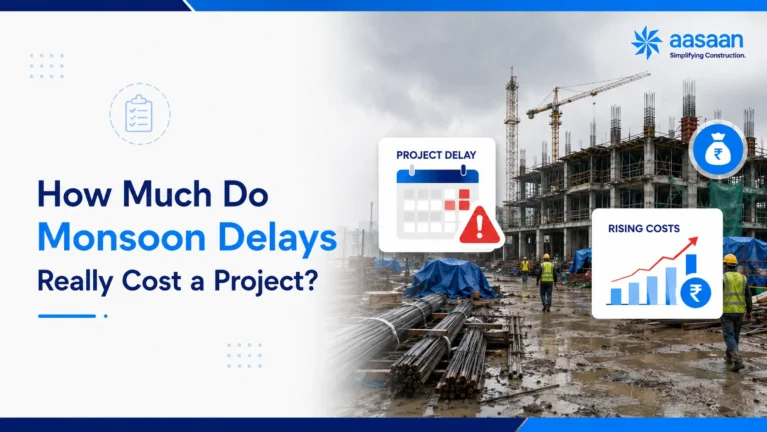
How Much Do Monsoon Delays Really Cost a Project?
Ask any contractor how much last monsoon actually cost them, and most cannot give you a real number. That is exactly the problem. Monsoon construction delays are expensive in ways that rarely show up until the final project report lands on a director’s desk, wasted material, idle labor still drawing wages, penalty clauses tied to handover dates, and financing costs that keep accumulating while the project stalls. Construction site delays quietly compound across every department, from procurement to sales, turning a three week weather event into a six figure financial dent.
The research backs up what most contractors feel in their gut every June. A widely cited academic study on Indian housing projects, published through a detailed Monte Carlo simulation model on ResearchGate, estimated that monsoon impacts alone were responsible for approximately twelve percent in extra project costs. Separate comparative research published in the journal Buildings found that in states like Maharashtra and Tamil Nadu, weather related project delays typically account for ten to fifteen percent of total project timelines, with monsoon being the dominant factor.
Twelve percent in additional project costs from monsoon alone is a genuine margin killer, one that most contractors absorb silently every single year – By Shivang Seta
Where does that twelve percent actually go? The financial impact of construction site delays typically shows up across four areas.
- Material wastage from unprotected storage adds direct replacement cost
- Idle labor wages continue even when productive output falls to zero
- Financing and interest costs on borrowed capital keep accruing regardless of site progress
- Client penalty clauses tied to handover milestones can erode profit margins that took months to build
Real estate developers in particular feel this pain twice, first through construction cost overruns and again through delayed sales handovers that push back revenue recognition.
Here is the part worth holding onto: most of this financial damage stays genuinely preventable, well within a contractor’s control. Contractors who invest in proper planning, weatherproofing and real time tracking consistently report far smaller cost overruns during monsoon than those relying on manual, paper based site management. The remaining sections of this guide walk through exactly how to build that kind of resilience into daily operations.
Monsoon Construction Delay Prevention Checklist
Before monsoon begins, every contractor should check the most common delay risks on site. This quick checklist helps teams reduce construction site delays before they turn into cost overruns.
1. Waterlogging risk: Check drainage paths, low lying areas, basement zones and dewatering pump availability before heavy rain begins.
2. Material protection: Store cement in covered dry areas, keep steel elevated, and inspect material storage zones regularly.
3. Labour availability: Track attendance daily, plan buffer manpower, and adjust critical tasks based on actual labour availability.
4. Site progress visibility: Use daily reports, photo updates and real time tracking instead of depending only on phone calls.
5. Machinery readiness: Inspect cranes, mixers, pumps and site vehicles before monsoon, and keep access roads usable.
6. Material delivery planning: Plan procurement earlier and keep buffer stock for critical materials that may be delayed by rain or roadblocks.
7. Safety checks: Mark risky areas, check electrical hazards, inspect scaffolding and document unsafe conditions daily.
8. Approval tracking: Keep drawings, bills, site changes and approvals documented so decisions do not get delayed during monsoon.
9. Cost control: Track delays daily because small monsoon issues can quickly become labour, material and equipment cost overruns.
10. Aasaan advantage: Aasaan helps contractors monitor progress, labour, materials, reports, approvals and project risks from one construction operating system.
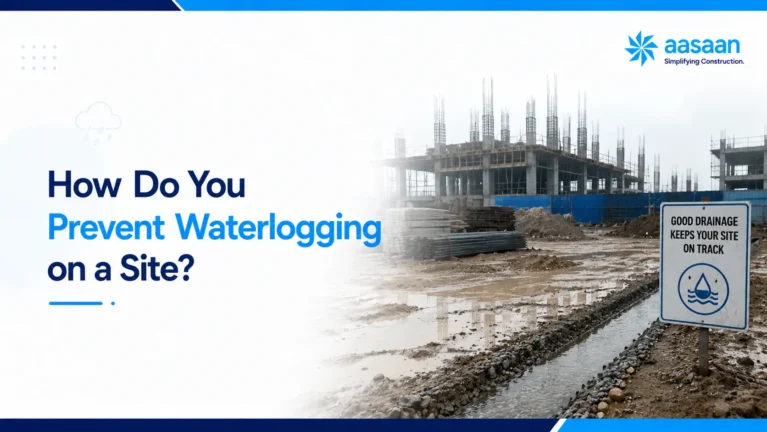
How Do You Prevent Waterlogging on a Site?
Waterlogging is one of the fastest ways monsoon turns into full blown construction site delays. Standing water halts excavation, weakens soil stability, damages foundation work and creates serious safety hazards for workers moving across the site. A site that floods every time it rains heavily is a site that will consistently miss its schedule, regardless of how skilled the workforce is.
Effective site drainage planning has to happen well before monsoon arrives, ideally weeks ahead of the first downpour. This means mapping the natural slope of the site, identifying low lying zones where water naturally collects, and installing temporary drainage channels that redirect water away from active work areas and material storage zones. Contractors who invest time in this planning phase during the dry months consistently report far fewer construction site delays once the rains begin, simply because water has somewhere predictable to go instead of pooling across the site.
Soil stabilization and erosion control also play a major role in preventing waterlogging related delays. Loose, wet soil around excavation zones and foundation work becomes genuinely dangerous, increasing the risk of collapse and further slowing progress while safety checks are conducted. Building temporary bunds, using geotextile sheets, and maintaining clear surface drains around vulnerable zones significantly reduces this risk.
Use this checklist before monsoon arrives to reduce waterlogging related construction site delays.
- Map the site for natural slope and identify low lying collection points
- Install temporary drainage channels leading water away from work zones
- Set up dewatering pumps at critical points like basements and deep excavations
- Raise material storage areas above expected water levels
- Use geotextile sheets or bunds around loose soil and excavation edges
- Clear existing stormwater drains of debris before the season starts
- Assign a team member to inspect drainage systems daily during heavy rainfall
- Keep a stock of sandbags ready for sudden flooding at vulnerable points
- Coordinate with local municipal drainage systems where the site connects externally
- Review drainage performance after each major rainfall and adjust accordingly
A site that stays dry stays productive. Waterlogging prevention is one of the highest return investments a contractor can make heading into monsoon season, because it directly protects the schedule, the workforce and the material stored on site.

How Do You Protect Cement and Steel From Rain?
Material protection is one of the most overlooked contributors to construction site delays. Cement that absorbs moisture loses strength and becomes unusable within days. Steel exposed to constant humidity begins to rust, weakening structural integrity and creating rework that eats directly into the schedule. A contractor who loses even one shipment of cement to poor storage faces both a financial hit and a fresh round of procurement delays layered on top of an already tight monsoon timeline.
The Bureau of Indian Standards provides detailed guidance on material handling and storage practices through its published construction codes, available at bis.gov.in. Following these established storage principles, elevated platforms, proper ventilation and moisture barriers, dramatically reduces material wastage during the rainy months. Steel should always be stored on raised racks away from direct ground contact, wrapped or coated where exposure is unavoidable, and checked regularly for early signs of corrosion.
Beyond storage, timing matters just as much. Scheduling large material deliveries around forecasted dry spells, rather than in the middle of peak rainfall weeks, reduces the window of exposure and lowers the chance of transport related damage. Contractors who coordinate procurement schedules with weather data consistently report fewer construction site delays tied to spoiled or damaged materials.
Follow this simple guide to protect your material investment through the season.
Things to do
- Store cement on raised wooden pallets, at least six inches above ground level
- Cover all cement stacks with waterproof tarpaulins secured at every edge
- Store steel on elevated racks with adequate spacing for airflow
- Apply anti corrosion coating to steel that will sit in storage for extended periods
- Schedule large deliveries around forecasted dry windows wherever possible
- Rotate stock regularly so older material gets used before newer deliveries arrive
- Inspect stored material weekly during monsoon for early signs of damage
Things to avoid
- Storing cement directly on bare ground or against damp walls
- Leaving steel exposed without covering during extended rainy spells
- Accepting bulk deliveries right before a forecasted heavy rainfall week
- Stacking material so tightly that moisture cannot escape through ventilation
- Ignoring early signs of caking in cement bags, since this signals moisture damage has already begun
Material protection feels like a small operational detail until the day a full shipment is ruined. Building these habits into daily site routine is one of the simplest ways to reduce construction site delays that have nothing to do with the weather itself and everything to do with preparation.

Is Monsoon a Valid Reason for Construction Delay?
Picture this conversation: a client calls demanding to know why handover slipped, and your only answer is “it rained a lot.” That answer alone rarely holds up, and this is exactly the question every contractor and developer ends up asking once a project starts slipping. The honest answer depends heavily on how the contract is written. Most standard Indian construction contracts include force majeure or excusable delay clauses that recognize extreme weather as a legitimate factor, but the protection these clauses offer usually depends on documentation. A contractor who can prove exactly how many working days were lost, and why, stands on far stronger ground than one who simply cites monsoon as a general excuse.
This is where construction site delays become as much a legal and reputational issue as a scheduling one. Clients and investors are generally reasonable about genuine weather disruption, but they expect evidence, not a shrug. The evidence that actually holds up in a difficult conversation includes:
- Daily site reports logged consistently, not reconstructed after the fact
- Weather logs matched against the days work actually stopped
- Photographic records showing site conditions on the days in question
- Labor attendance data proving crew availability, or the lack of it
Contractors who maintain this kind of record keeping consistently negotiate far better outcomes than those relying on memory and assumption after the fact.
Worker safety regulations also play into this conversation. The Ministry of Labour and Employment has published detailed guidance under the Building and Other Construction Workers Act on emergency action planning for events including floods, storms and other natural calamities, available through the official Ministry of Labour and Employment circular. Contractors who can demonstrate compliance with these safety stoppages during severe weather are in a considerably stronger position when justifying schedule extensions, since safety related pauses are treated seriously under Indian labor law.
Contracts vary widely across projects, so it remains genuinely important to have every clause reviewed by a qualified legal professional before relying on force majeure protection. What every contractor can control, regardless of contract language, is the quality of the documentation they keep. Detailed daily records transform monsoon from a vague excuse into a defensible, evidence backed explanation for construction site delays, and that difference often decides whether a dispute gets resolved amicably or ends up in arbitration.
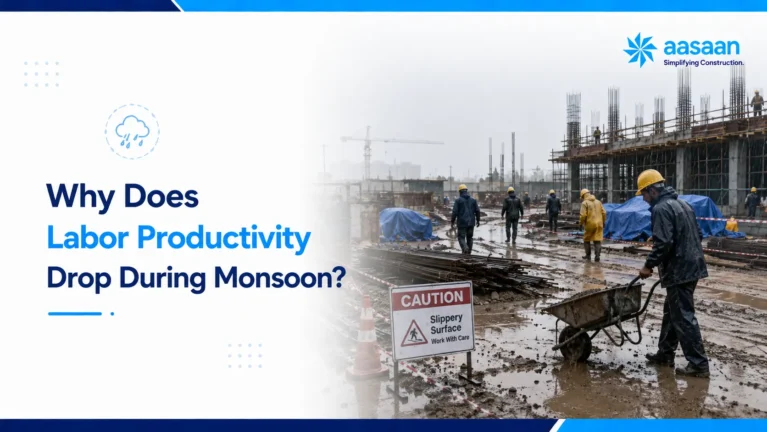
Why Does Labor Productivity Drop During Monsoon?
Here is a question worth asking your own site supervisor this week: on a rainy day, how much of your crew actually showed up, and of those who did, how much real work got done? Most contractors cannot answer that with a straight number, and that gap is exactly why labor becomes one of the most painful contributors to construction site delays every monsoon season. Skilled and unskilled labor alike often return to their home villages during the rainy months, partly for agricultural work and partly because outdoor construction activity naturally slows. Academic research into monsoon impacts on Indian construction, including studies focused on cities like Kolkata, has documented this pattern clearly, showing that seasonal labor migration during planting and harvesting periods creates genuine workforce shortages that ripple directly into project timelines.
Even the crew that does show up is not working at full strength. Wet, slippery conditions slow down physical tasks. Frequent short rain spells interrupt work rhythm throughout the day, making it difficult to complete tasks that require sustained, uninterrupted effort like concrete pouring or plastering. Electrical work and excavation activity often require complete pauses during active rainfall for safety reasons, further compressing the number of genuinely productive hours available each day.
Tracking this productivity drop accurately is where many contractors struggle the most. Without a reliable system linking attendance directly to task output, it becomes almost impossible to separate genuine weather related slowdown from other inefficiencies hiding in daily operations. This is exactly the gap that modern HR and labour management tools are built to close, using automated attendance tracking to give site managers an honest, real time picture of workforce presence and output even during the most disrupted weeks of the season.
The most effective response to monsoon labor shortages combines a few practical strategies together.
- Build a labor buffer into the schedule during peak monsoon months rather than assuming full crew availability
- Cross train workers across multiple tasks so absences in one area can be covered internally
- Use automated attendance systems to catch shortages early instead of discovering gaps at the end of the week
- Shift indoor and sheltered tasks like finishing work to rainy days, saving outdoor tasks for dry windows
- Maintain open communication with labor contractors about seasonal migration patterns well before monsoon begins
- Offer covered rest and work areas that make staying on site more practical during heavy rain
- Track labor productivity against specific tasks, beyond just hours logged, to spot real slowdown early
- Plan critical path activities for the driest forecasted weeks based on regional weather data
Labor shortages during monsoon are largely predictable, which means they are also largely manageable. Contractors who plan around this seasonal pattern, rather than being surprised by it every year, consistently see far fewer construction site delays tied purely to workforce gaps.
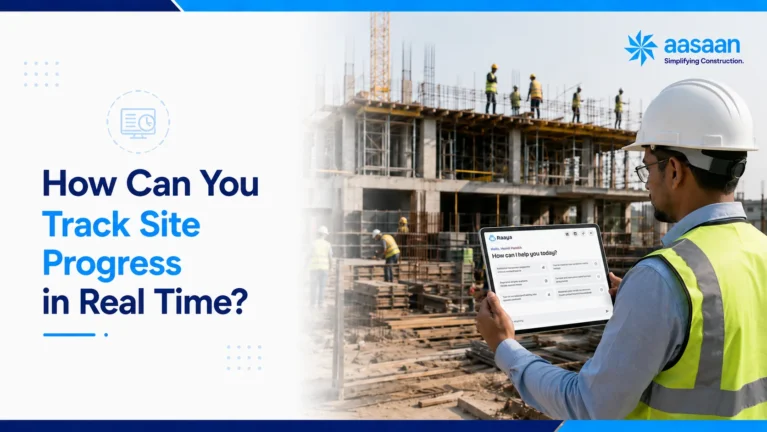
How Can You Track Site Progress in Real Time?
Visibility is everything once monsoon hits. A site manager who only learns about a problem three days after it happened has already lost the chance to respond quickly, and that lag is exactly where small issues turn into serious construction site delays. Real time site monitoring closes this gap by giving decision makers an accurate, current picture of what is actually happening on the ground, rather than a summary written from memory at the end of the week.
Modern GPS based live tracking tools now make it possible to monitor workforce location, equipment status and site activity continuously throughout the day, even across multiple project locations. Combined with tools like Raaya Sitewalk AI, which allows a full 24 hour virtual walkthrough of any site from anywhere, contractors and project managers gain a level of oversight that was simply impossible with traditional, manual site visits. Issues like water accumulation, material exposure or safety violations get flagged automatically instead of being discovered days later during a scheduled inspection.
The difference between sites that use real time tracking and sites that still rely on manual, end of week reporting is significant during monsoon specifically, since conditions can change dramatically within hours.
| Without real time tracking | With real time tracking |
|---|---|
| Problems discovered days after they occur | Issues flagged within hours through automated alerts |
| Decisions based on outdated, memory based updates | Decisions based on live, accurate site data |
| Waterlogging or material damage found late | Early warning through continuous monitoring |
| Manual site visits required for basic oversight | Remote virtual walkthroughs available anytime |
| Labor and equipment location unclear | GPS verified location for workforce and assets |
| Reactive response to construction site delays | Proactive prevention of construction site delays |
This shift from reactive to proactive management is exactly what separates contractors who handle monsoon smoothly from those who spend the entire season firefighting. Real time site monitoring still leaves the rain itself outside anyone’s control, but it dramatically shortens the gap between a problem starting and a solution being deployed, which is often the single biggest factor separating a minor delay from a major one.

What Should a Daily Site Report Include?
A strong daily progress report is one of the most underrated tools for reducing construction site delays, especially during monsoon when conditions change quickly and decisions need to happen fast. A report that simply says work continued as usual provides almost zero value. A report that captures specific, actionable detail gives project managers, clients and even legal teams exactly what they need to respond quickly and defend the project timeline if disputes arise later.
A genuinely useful daily site report during monsoon season should always capture the weather conditions experienced that day alongside actual working hours lost to rain, since this data becomes critical evidence for schedule extensions discussed earlier in this guide. It should also record labor attendance against planned crew size, material received and material damaged or delayed, equipment status including any downtime, safety incidents or near misses, and specific tasks completed against the baseline schedule. Photographic evidence of site conditions, particularly water accumulation or material exposure, strengthens the report considerably.
Manually compiling this level of detail every single day is exhausting for most site teams, which is exactly why so many reports end up generic and unhelpful. This is where automated tools built for Indian construction sites genuinely change the equation. Aasaan’s project management and scheduling tools automatically generate daily progress reports directly from site data, while WhatsApp powered alerts and reports deliver these updates straight to a manager’s phone without requiring anyone to open a separate app. This turns a task that used to take an hour of paperwork into something that happens automatically in the background.
A complete daily site report during monsoon should include the following elements at minimum.
- Weather conditions and hours lost to rain that specific day
- Labor attendance recorded against the planned crew requirement
- Material received, material damaged and material pending delivery
- Equipment status, including any downtime caused by site conditions
- Safety incidents, near misses or stoppages related to weather
- Specific tasks completed measured against the baseline schedule
- Photographic records of site conditions, particularly water exposure
- Notes on any decisions made or escalations raised that day
Contractors who build this habit into daily operations, whether manually or through automation, consistently find themselves far better prepared when monsoon related construction site delays need to be explained, justified or resolved with clients and stakeholders.
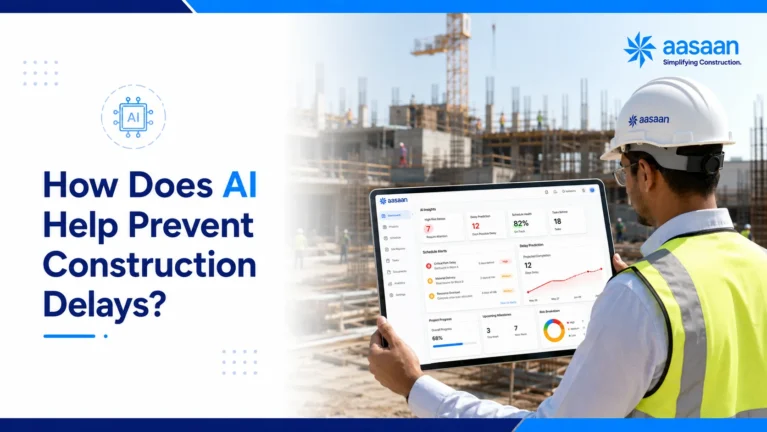
How Does AI Help Prevent Construction Delays?
Artificial intelligence has moved from a buzzword into a genuinely practical tool for reducing construction site delays, particularly during a season as unpredictable as monsoon. The core value AI brings to construction management is pattern recognition at a scale and speed that far exceeds any manual process, spotting early warning signs in site data long before a human reviewing weekly reports would notice them.
Aasaan’s Super AI platform demonstrates this shift clearly through its Raaya suite of tools. Raaya Intel AI analyzes ongoing project performance patterns and delivers sharp, data backed recommendations that help teams catch cost overruns and schedule risks before they escalate into full blown construction site delays. Rather than waiting for a monthly report to reveal that a project has fallen behind, Intel AI surfaces performance patterns as they emerge, giving managers a genuine window to course correct early.
AI also plays a major role in the operational side of monsoon management. Automated procurement negotiation tools use AI call bots to fetch competitive supplier rates quickly, which matters enormously when material needs to be sourced fast around a weather window. OCR based billing automation captures document details the moment suppliers upload bills through WhatsApp, removing the manual data entry bottleneck that often slows down procurement during the busiest, most chaotic weeks of the season. Facial recognition based attendance systems eliminate proxy attendance entirely, giving accurate workforce data even when labor patterns are shifting rapidly due to seasonal migration.
Watch Aasaan’s Co-Founder Hemil Parekh discuss simplifying construction with technology on the Let’s Talk Business interview. For the latest product walkthroughs and feature demos straight from the team, the official Aasaan Tech YouTube channel is worth visiting too, pick the specific video your team wants featured and it can be embedded directly into this section.
The genuine advantage AI offers during monsoon comes down to speed and accuracy of information. A human team reviewing data manually might catch a productivity drop or material shortage a week later. AI powered construction platforms surface the same signal within hours, and that speed advantage compounds significantly over a four month monsoon season, often becoming the difference between a project that recovers quickly and one that spirals into serious construction site delays.
Want to catch monsoon delays before they hit your margins?
Aasaan helps contractors bring site progress, labour attendance, material movement, daily reports, approvals and risk alerts into one construction operating system.
So when rain slows a site down, your team is not waiting for scattered phone calls or late updates. They can capture photos, reports and issues in real time, and act before a small delay becomes a cost overrun.
Book a live demo with Aasaan to see how it works for active construction projects.

What Should You Look for in Construction Software?
Choosing the right construction management software is one of the most consequential decisions a contractor, builder or real estate developer makes heading into monsoon season. The wrong choice adds complexity without solving real problems. The right choice becomes the backbone of how a business handles the single most disruptive season of the year, year after year.
The evaluation process should start with genuine, practical needs rather than a long feature checklist. Does the platform offer real time tracking of workforce and equipment, since this directly addresses the visibility gap that causes so many construction site delays to spiral out of control. Does it automate daily progress reporting, since manual reporting is exactly the kind of task that gets skipped or rushed during the busiest, wettest weeks of the year. Does it integrate with tools your business already relies on, like Tally for accounting or WhatsApp for daily communication, since forcing teams to adopt an entirely new communication channel during a high pressure season rarely works well in practice.
Contractors evaluating construction ERP software should weigh a few genuinely important factors against each other before committing to a platform.
| Evaluation factor | Why it matters during monsoon |
|---|---|
| Real time site monitoring | Catches waterlogging, material damage and delays early |
| Automated daily progress reports | Removes manual reporting burden during peak disruption |
| WhatsApp based alerts | Keeps teams updated without requiring separate app logins |
| GPS and facial recognition attendance | Gives accurate labor data despite seasonal migration |
| AI powered issue detection | Flags cost and schedule risk before it becomes a major delay |
| Tally and GST integration | Keeps financial reporting accurate despite site disruption |
| Local support and onboarding | Ensures the platform gets adopted quickly and stays genuinely used |
Construction site delays caused by poor visibility, slow reporting and disconnected teams remain largely solvable problems, well within reach of the right systems. Platforms like Aasaan were built specifically around the operational reality of Indian construction sites, combining WhatsApp native communication with Super AI automation across procurement, attendance, reporting and project control. For contractors and real estate developers who are genuinely tired of monsoon derailing their timelines every single year, booking a walkthrough is a practical first step toward a season handled with confidence rather than crisis. You can explore how the full platform works and book a live demo directly with the Aasaan team.
Frequently Asked Questions
What causes construction delays during monsoon?
Construction delays during monsoon come from a mix of heavy rainfall, poor site drainage, material damage, labor shortages and weak real time visibility. Weather is the trigger, but poor planning around it is usually what turns a rainy week into a genuine construction site delay.
How much do monsoon delays cost a project?
Research on Indian construction projects estimates monsoon impacts can add close to twelve percent in extra project costs through material damage, idle labor and reduced efficiency. Separate studies place weather related delays at ten to fifteen percent of total project timelines in states like Maharashtra and Tamil Nadu.
How do you prevent waterlogging on a construction site?
Preventing waterlogging starts with mapping site drainage before monsoon arrives, installing temporary channels, placing dewatering pumps at low lying points, and raising material storage above expected water levels. Daily inspection during heavy rainfall catches problems before they escalate into serious construction site delays.
Is monsoon a valid reason for construction delay under Indian contracts?
Most Indian construction contracts recognize extreme weather through force majeure or excusable delay clauses, though protection generally depends on documentation. Daily site reports, weather logs and labor records turn monsoon from a vague excuse into a defensible, evidence backed explanation.
How can real time tracking reduce construction site delays?
Real time site monitoring flags issues like waterlogging, material exposure or safety violations within hours instead of days. This shift from reactive to proactive management is one of the most effective ways contractors shorten the gap between a problem starting and a solution being deployed.
What should a daily site report include during monsoon?
A useful daily site report during monsoon should record weather conditions, hours lost to rain, labor attendance against planned crew size, material status, equipment downtime, safety incidents and photographic evidence. This level of detail becomes critical evidence if schedule disputes arise later.
How does AI help reduce construction delays?
AI powered construction platforms detect patterns in site data, like productivity drops or cost overruns, far faster than manual weekly reviews. Tools like automated procurement negotiation, OCR based billing and facial recognition attendance remove the manual bottlenecks that slow teams down most during monsoon.
What construction software features matter most during monsoon?
The features that matter most during monsoon are real time site monitoring, automated daily progress reports, WhatsApp based alerts, GPS and facial recognition attendance, and AI powered issue detection. These directly address the visibility and reporting gaps that cause the worst construction site delays.
How long do monsoon construction delays typically last?
Monsoon construction delays in India typically span the four month window from June through September, though the actual working days lost depend heavily on regional rainfall intensity and how well a site is prepared. Sites with strong drainage and tracking systems recover working days far faster than those without.
Can construction software prevent labor shortages during monsoon?
Construction software cannot stop seasonal labor migration, but automated attendance tracking and workforce planning tools help contractors spot shortages early, cross train workers efficiently and plan critical tasks around actual crew availability, significantly reducing the schedule impact of monsoon labor gaps.
Monsoon will keep arriving every year regardless of how prepared any contractor feels. Construction site delays caused by weather itself remain largely outside anyone’s control. Everything covered in this guide, from drainage planning and material protection to real time tracking and AI powered reporting, exists to control everything else. The contractors who treat monsoon preparation as a serious annual discipline, rather than an afterthought, are consistently the ones who come out the other side with their schedules, margins and client relationships intact.
If monsoon delays are already affecting your project timelines, Aasaan can help your team track progress, labour, materials, approvals and daily reports in real time. Book a live demo here.

Stop the Bleeding: How to Catch Construction Cost Leakages
Construction cost leakage refers to the undetected, unbudgeted financial losses that occur during a project due to fragmented tracking, material waste, and delayed reporting. Catching these leakages requires real-time visibility into field expenses, automated material reconciliation, and centralized billing workflows. By transitioning from legacy spreadsheets to an AI-powered construction management platform, developers and contractors can instantly plug these financial drains and protect their profit margins.
The Hidden Drain: Why Construction Projects Lose Money
In commercial and residential construction, profitability rarely dies from a single major catastrophe. Instead, it bleeds out through hundreds of minor, unnoticed discrepancies. Industry data from organizations like the McKinsey Global Institute indicates that structural construction cost leakage typically consumes between 5% to 15% of a project’s total budget.
When field teams rely on manual data entry, paper delivery slips, and weekly spreadsheet updates, corporate stakeholders only see financial damage long after it has occurred. To stop the bleed, you must first identify where the pipeline is broken.
The 3 Core Pillars of Financial Leakage
| Leakage Type | Primary Cause | Long-term Impact |
|---|---|---|
| Material Mismanagement | Untracked over-ordering, on-site theft, and poorly monitored scrap/waste rates. | Inflates raw material expenses by 8-12%. |
| Labor & Subcontractor Drift | Misreported hours, manual attendance padding, and unverified out-of-scope work. | Drives unapproved change orders and schedule overruns. |
| Procurement & Invoice Delays | Delayed matching of Purchase Orders (POs) to Goods Received Notes (GRNs). | Causes missed early-payment discounts and vendor disputes. |
How to Plug Construction Cost Leakage with Aasaan Pocket Manager
Plugging these gaps requires connecting the job site directly to the accounting office. Aasaan’s AI-powered Pocket construction manager platform is engineered specifically to eliminate these blind spots by digitizing workflows right at the point of origin.
Here is how you can use Aasaan to systematically track and eliminate construction cost leakage across your project portfolio:
1. Enforce Real-Time Field Expense Tracking
Paper receipts left in truck dashboards are the enemy of cost control. Aasaan allows site engineers to instantly log digital receipts, localized cash purchases, and fuel expenses via their mobile devices.
-
Instant Categorization: Expenses are instantly mapped against specific line-item budgets (e.g., foundation, MEP, finishes).
-
Over-Budget Alerts: The platform triggers automated notifications the moment a field expense pushes a category close to its threshold, preventing accidental overspending before it happens.
Internal Link: To see how our real-time tracking engine fits into your corporate operational model, explore the full breakdown on our Aasaan Features Page.
2. Automate Material Reconciliation (PO vs. GRN)
One of the largest sources of project waste is paying for materials that either never arrived or arrived damaged. According to reports by the Project Management Institute (PMI), weak material tracking remains a primary source of budget variance globally.
Aasaan streamlines this via a digital three-way matching system:
  [ Purchase Order ]  ───►  [ Goods Received Note ]  ───►  [ Vendor Invoice ]
        (PO)                   (GRN at Site)                (Automated Match)
When materials arrive on-site, the supervisor generates a digital Goods Received Note (GRN) within Aasaan, logging the exact quantities received. The system automatically cross-references this against the original Purchase Order (PO). If a vendor bills you for 100 bags of cement but the site team only verified 85, Aasaan flags the discrepancy instantly, halting invoice approval until it is reconciled.
3. Streamline Progress-Based Subcontractor Billing
Traditional subcontractor billing relies heavily on guesswork and manual verification. Subcontractors often submit invoices for “percentage of work completed” that does not match reality on the ground.
With Aasaan, billing is tied strictly to verifiable milestones. Site photos, daily progress reports (DPRs), and milestone completions must be logged inside the platform before an interim payment application can be unlocked. This ensures you only pay for verified, high-quality work.
Step-by-Step Guide: Eliminating Construction Cost Leakage in Aasaan
Transitioning your project portfolio into an airtight financial environment takes less than an afternoon. Follow this deployment sequence to secure your active job sites:
-
Establish Your Baseline Budget: Upload your Master Estimate or Bill of Quantities (BOQ) into Aasaan. Break down costs by phase, material class, and labor type to create hard spending ceilings.
-
Deploy the Pocket Mobile App to Field Staff: Provision access for site supervisors and engineers. Set strict user permissions so field staff can only view and log expenses for their specifically assigned zones.
-
Mandate Digital GRN Logging: Instruct your logistics and gate teams to snap photos of delivery tickets and log incoming quantities directly into the app upon arrival.
-
Monitor the Live Cost-to-Complete Dashboard: Review your real-time executive dashboard twice a week. Analyze the variance between actual cost of work performed and budgeted cost of work scheduled to catch anomalies early.
Maximize Your Project ROI Today
Running a lean, profitable construction project is no longer about working harder on-site—it is about managing your data smarter. Continuing to rely on legacy manual tracking guarantees that minor leaks will continue to quietly erode your hard-earned margins.
By unifying your procurement, field logging, and milestone billing inside a single intuitive ecosystem, you gain the granular control needed to keep every project safely in the green.
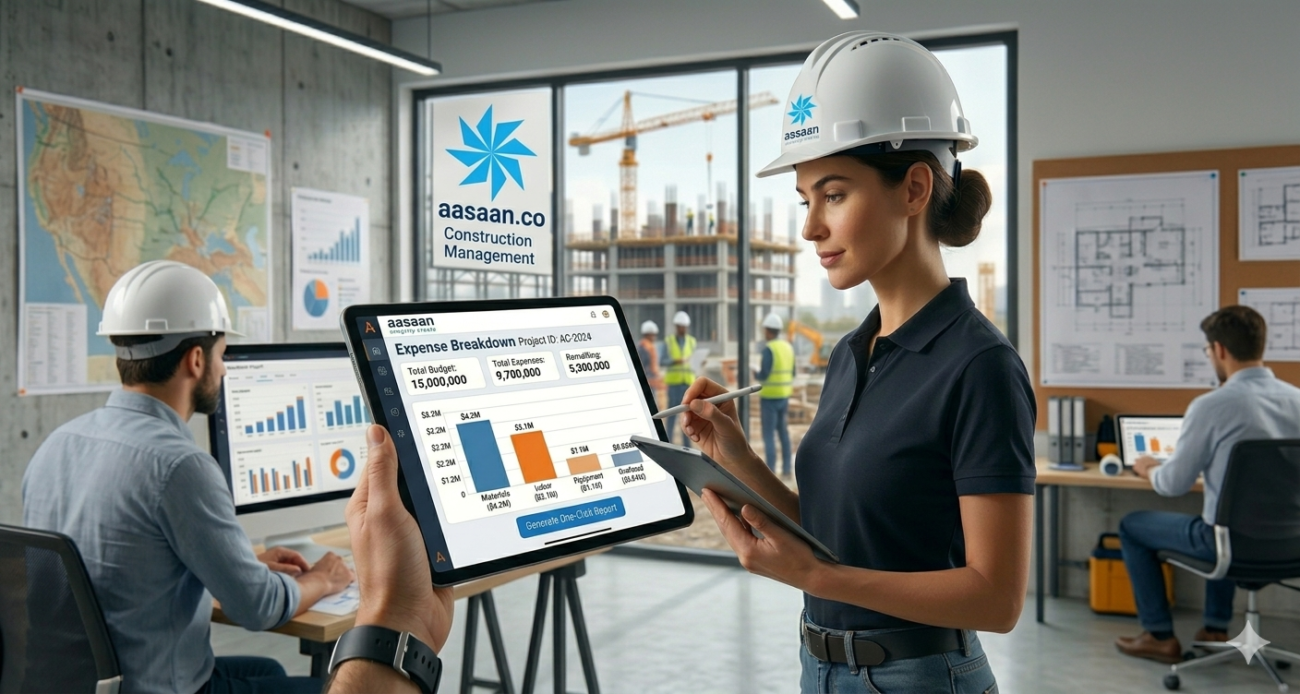
Construction Project Expense Reports: One-Click Tracking with Aasaan
Generating accurate construction project expense reports is now possible in a single click using Aasaan’s AI-powered construction management platform. By consolidating real-time data from the field, procurement, and labor, Aasaan eliminates manual spreadsheet errors and delivers audit-ready financial insights instantly. This zero-code solution ensures projects stay on budget and stakeholders remain aligned with minimal administrative effort.
The Nightmare of Manual Construction Cost Tracking
For decades, construction companies have relied on fragmented systems—clunky spreadsheets, paper receipts, and disconnected accounting software—to track project costs. This manual approach introduces severe operational bottlenecks:
-
Delayed Visibility: Waiting days or weeks for data entry means you discover budget overruns only after they occur.
-
Human Error: Miscalculated line items or lost receipts lead to inaccurate financial forecasting.
-
Siloed Communication: Field managers, procurement teams, and stakeholders operate without a single source of truth.
Aasaan solves these friction points by transforming chaotic financial data into automated, actionable intelligence.
Why Choose Aasaan for Construction Project Expense Reports?
Aasaan’s zero-code architecture enables anyone—from site supervisors to enterprise executives—to track and analyze project financial health without needing a technical background.
1. Centralized Financial Dashboard
Every invoice, labor cost, material purchase, and subcontractor fee is automatically funneled into a unified dashboard. Because the platform requires zero coding, setting up these automated pipelines takes minutes, not months.
2. Instant PDF and CSV Exports
With a single click, users can generate high-level summaries or granular breakdowns of historical and real-time expenses, perfectly formatted for stakeholders, investors, or internal audits.
3. AI-Driven Cost Categorization
Aasaan uses intelligent algorithms to categorize expenses automatically against your initial budget baselines. The platform flags anomalies, unexpected spikes, or duplicate invoices before they impact your bottom line.
To see how easy it is to configure your dashboard without writing a single line of code, explore our Aasaan Core Features Page.
Breakdown: What’s Inside an Aasaan Expense Report?
When you generate a one-click report on Aasaan, you get a 360-degree view of your project’s financial ecosystem. The table below outlines the core metrics tracked seamlessly by the platform:
| Expense Category | Data Points Tracked | Business Value |
|---|---|---|
| Material Procurement | Unit costs, vendor invoices, delivery fees | Prevents vendor overcharging and tracks material inflation. |
| Labor & Payroll | Shifts worked, overtime, subcontractor payouts | Monitors labor efficiency against estimated timelines. |
| Equipment & Logistics | Rental durations, fuel consumption, maintenance | Optimizes asset utilization and reduces idle time costs. |
| Permits & Overhead | Regulatory fees, safety compliance costs, utility bills | Ensures all soft costs are accounted for in the final margin. |
Step-by-Step: Generating Your First Report on Aasaan
Generating comprehensive construction project expense reports with Aasaan is designed to be completely frictionless.
-
Log In and Select Project: Navigate to your Aasaan workspace and select the active construction project.
-
Navigate to Analytics: Click on the “Financials & Reports” tab on your main dashboard.
-
Apply Filters (Optional): Filter by specific date ranges, vendors, or cost codes if you need a targeted view.
-
Click “Generate Report”: Hit the primary button to instantly compile all live data into a clean, visual document.
-
Share or Export: Download the report securely or share it directly with stakeholders via email or a secure link.
Maximize Profit Margins with Real-Time Analytics
Ultimately, one-click reporting isn’t just about saving time—it’s about protecting your profit margins. By utilizing Aasaan’s automated infrastructure to build construction project expense reports, construction companies move from reactive firefighting to proactive financial management. You can spot a budget leak on day three instead of day thirty, allowing for swift course corrections.
Ready to eliminate manual data entry and take absolute control of your construction costs?
Schedule a personalized walkthrough today via our Aasaan Demo Booking Page to see our AI-driven financial reporting in action.
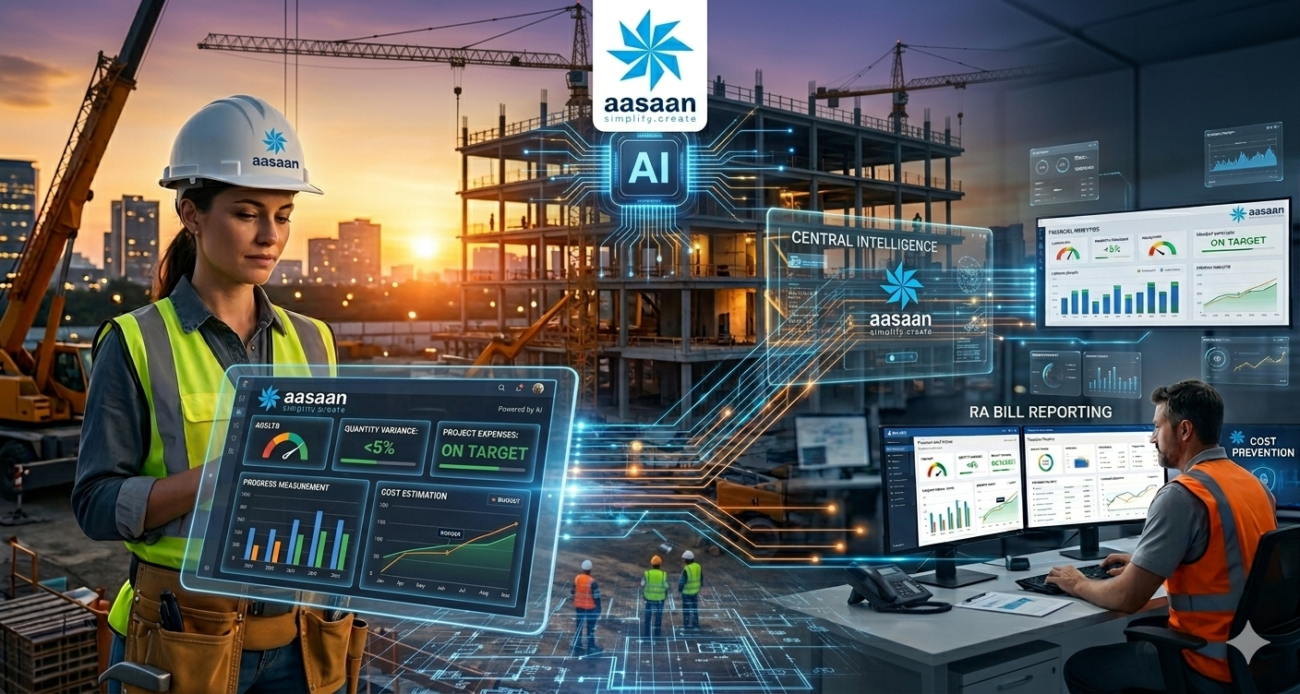
Track Subcontractor RA Bills & Prevent Overspending with Aasaan
Managing project cash flow effectively requires tight control over field expenditures. To protect your bottom line, you must track subcontractor RA bills properly to ensure work executed matches your baseline budget. By learning to track subcontractor RA bills through automation, general contractors can completely eliminate over-measurement errors and instantly generate one-click construction expense reports.
The Root Causes of Construction Project Overspending
Subcontractor Running Account (RA) bills are the baseline of construction progress payments. However, relying on paper documents or traditional spreadsheets introduces major operational vulnerabilities:
-
Over-Measurement and Duplicate Billing: Without automated validation rules, it is easy to accidentally approve an RA bill for quantities that were already cleared in a previous cycle.
-
Delayed Expense Visibility: When field measurements take weeks to reach your accounting desk, you discover profit leakage long after the cash has left your account.
-
Complex Deductions: Calculating retention money (usually 5% to 10%), material advances, and statutory taxes manually creates human calculation errors and friction.
According to a historical financial study by the Project Management Institute (PMI), unmanaged scope creep and manual tracking inefficiencies account for substantial capital loss across active commercial builds.
A Step-by-Step System to Track Subcontractor RA Bills
To protect project margins and optimize your verification workflows, your management team should adopt a structured approach to bill reconciliation.
Streamlining Construction Expense Reports with Aasaan
While rigid accounting tools force teams to use manual data re-entry workarounds, the Aasaan Construction Management Platform automates your field financial workflows. Aasaan links work orders, site measurements, and financial processing into a single automated pipeline.
Real-Time Financial Visibility
| Metric / Function | Legacy Spreadsheets | Aasaan AI Platform |
|---|---|---|
| Quantity Validation | Manual check against papers | Automated block if bill exceeds work order limits |
| Expense Compilation | Days of cross-checking logs | Real-time generation |
| Deduction Controls | Math errors on retention lines | Automatic programmatic recovery calculations |
| Data Synchronization | Isolated site silos | Direct cloud link from field to back-office |
Rather than waiting for the end of a fiscal quarter to gauge your financial performance, Aasaan allows developers and project managers to generate comprehensive construction expense reports with a single click. The platform gives you instant clarity on actual costs versus planned baselines, enabling you to detect overspending and rectify anomalies proactively.
To discover how our automated workflows can safeguard your construction margins and eliminate bill processing leakages, review our comprehensive Aasaan Platform Features index or schedule an active platform walkthrough today.
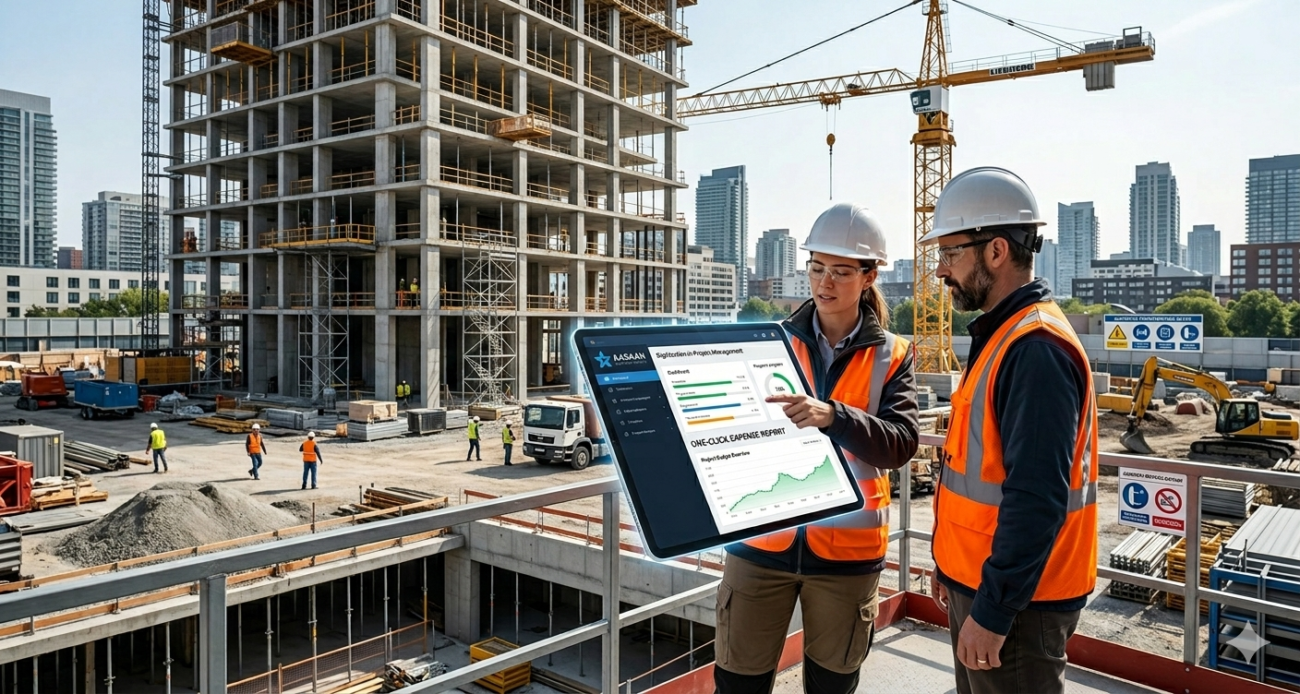
Digitization in Project Management in Construction with Aasaan
Digitization in project management in construction is the integration of cloud-based, AI-driven digital technologies to automate site workflows, track budgets, and streamline collaboration. By replacing manual spreadsheets with real-time data platforms, construction companies can eliminate costly delays and gain total visibility over their project lifecycles.
The Digital Imperative in Modern Construction
For decades, the construction industry has grappled with fragmented communication, siloed data, and unexpected budget overruns. Traditional paper trails and disconnected spreadsheets mean that stakeholders often react to financial and operational issues weeks after they occur.
Embracing a comprehensive digitization in project management in construction workflow fundamentally rewrites this script. By migrating project management to a unified digital ecosystem, general contractors, developers, and project managers gain a single source of truth. From material procurement to labor allocation, every data point is captured, analyzed, and leveraged to keep projects on time and under budget according to standard industry benchmarks outlined by The Project Management Institute.
Key Benefits of Digital Transformation on the Job Site
Transitioning from analog methods to digital project management unlocks significant competitive advantages:
-
Real-Time Data Visibility: Field teams can log updates instantly, giving stakeholders immediate insight into project velocity.
-
Elimination of Human Error: Automated workflows reduce the risks associated with manual data entry, especially in complex expense logs.
-
Enhanced Collaboration: Silos between the back office, architects, and on-site foremen are eliminated through centralized cloud storage.
The Aasaan Edge: Simplifying Construction Management
While the benefits of digitization are clear, adopting complex enterprise software often presents a steep learning curve. This is where Aasaan Features redefines the industry standard. As a leading AI-powered construction management platform, Aasaan removes technical friction by offering an intuitive, zero-code environment designed specifically for the unique needs of construction teams.
Zero-Code Agility for Field and Office
Aasaan eliminates the need for expensive IT deployments. Project managers can customize dashboards, build automated milestone trackers, and configure field reporting templates without writing a single line of code. This ensures rapid adoption from the corporate office to the active job site.
Automated Expense Tracking and One-Click Reports
Financial leaks are the primary threat to construction profitability. Aasaan’s intelligent infrastructure tracks every dollar spent on materials, labor, and equipment rental in real time.
Instead of spending days reconciling receipts and invoices at the end of the month, project leaders can visit the Aasaan Demo Portal to learn how to generate comprehensive, boardroom-ready expense reports with a single click.
| Feature | Traditional Methods | The Aasaan Approach |
|---|---|---|
| Data Entry | Manual spreadsheets & paper receipts | Automated AI scanning & real-time logging |
| Reporting Speed | Days or weeks of manual reconciliation | Instant, one-click report generation |
| Financial Accuracy | High risk of human error & duplicate entries | Verified digital audit trails |
| Field Updates | Delayed communication via text/email | Immediate syncing to the central dashboard |
4 Strategic Steps to Digitizing Your Construction Projects
Implementing digitization in project management in construction effectively requires a structured, multi-phased approach. Here is how to successfully modernize your operations:
Step 1: Centralize Document Management
Migrate your blueprints, contracts, and change orders to a cloud repository. Ensure that all stakeholders have access to the latest revisions to prevent costly rebuilds.
Step 2: Automate Field Log Submissions
Equip site supervisors with mobile-friendly forms to log daily progress, weather impacts, and safety incidents. This ensures the office operates on factual, real-time data.
Step 3: Implement Live Financial Guardrails
Connect your procurement pipeline directly to your project budget. Set up automated alerts within your management platform to flag potential cost overruns before purchases are finalized.
Step 4: Leverage One-Click Analytics
Utilize automated reporting to review weekly progress. Deep-dive into expense reports to analyze where capital is being utilized efficiently and where waste can be trimmed.
Ready to Modernize Your Operations?
The future of construction belongs to companies that build with data. Modern digitization in project management in construction frameworks are no longer a luxury—they are a core requirement for remaining competitive, profitable, and scalable in a fast-moving market.
By unifying field operations, material tracking, and financial reporting into a seamless, zero-code platform, Aasaan empowers you to take absolute control of your projects. Say goodbye to manual overhead and hello to instant, accurate project insights.

Material Inventory Management: Ditch WhatsApp and Streamline Your Construction Site
Material inventory management in modern construction requires real-time data visibility, automated stock alerts, and centralized cloud collaboration to prevent costly project delays. By replacing chaotic WhatsApp chat threads with dedicated digital tracking systems, construction companies can eliminate human error and dramatically reduce material waste across multiple jobsites.
The Hidden Costs of Using WhatsApp for Material Inventory Management
Many fast-growing construction teams rely on WhatsApp because it is familiar and instant. However, managing high-value assets through chaotic group chats actively harms your bottom line. When updates are buried in chat histories, teams experience severe operational bottlenecks.
1. Zero Real-Time Visibility
A chat app cannot provide a live ledger. If a project manager needs to know the remaining inventory of rebar, they must scroll through hundreds of messages or call someone on-site, destroying field productivity.
2. Fragmented Procurement and Material Waste
Without a structured system, duplicate orders become frequent. Procurement teams often reorder supplies because they lack clear data on what is already available in the central warehouse, leading to poor material waste reduction efforts.
Why Chat Apps Fail at Tracking Construction Materials
| The WhatsApp Approach | Automated Material Inventory Management |
|---|---|
| Prone to human error: Messages get buried, ignored, or forgotten. |
Automated logging: Every material movement is tracked and time-stamped. |
| No real-time stock levels: Requires manual counting to know true inventory. |
Live dashboards: Instantly view exact quantities across multiple sites. |
| Fragmented vendor communication: Purchase orders scattered across chats. |
Centralized procurement: Direct line from inventory shortage to vendor order. |
Step-by-Step: Streamlining Your Construction Site Inventory
Transitioning away from legacy text threads doesn’t have to be complicated. Implement this three-step framework to regain absolute control over your construction site inventory.
Step 1: Deploy a Digital Inventory Tool Across All Sites
Stop allowing inventory data to live in fragmented silos. According to industry research on McKinsey & Company’s Capital Projects Insights, digital transformation in field operations can boost productivity by up to 15%. Implement a centralized cloud dashboard where field workers, project managers, and procurement teams view identical data in real time.
Step 2: Standardize Data Collection for Tracking Construction Materials
When tracking construction materials upon delivery, eliminate paper delivery slips entirely. Use mobile-friendly digital forms or barcode scanning to log quantities, batch numbers, and material conditions instantly as they arrive on-site. This data should automatically sync with your master ledger.
Step 3: Automate Your Construction Supply Chain Triggers
Do not wait for a sub-contractor to report that you have run out of cement. Define minimum threshold levels for critical assets within your system. When stock dips below these numbers, the platform should automatically alert procurement to initiate a reorder, protecting the project timeline from sudden supply shocks. Learn more about optimizing these procurement workflows through the Project Management Institute’s Construction Extensions.
The Aasaan Edge: No-Code Material Inventory Management
Moving away from chaotic chat groups usually requires heavy IT infrastructure and months of developer onboarding—but not anymore.
Aasaan’s AI-powered pocket construction manager empowers construction enterprises to build custom, cloud-based inventory workflows without writing a single line of code.
-
Deploy Instantly: Create tailored tracking portals specific to your unique site layouts, supply chains, and material types.
-
AI-Driven Insights: Predict material burn rates based on historical project data to optimize your buying power and reduce overhead.
-
Seamless Field Apps: Give your on-site teams a dead-simple mobile interface that replaces WhatsApp entirely, ensuring 100% compliance from day one.

Stop Asking for Updates: Track Daily Site Progress with Aasaan
Automated construction progress tracking is the continuous, real-time digitization of on-site activities, labor productivity, and material usage, synchronized instantly with back-office management systems. By eliminating manual daily logs and fragmented communication channels, this framework provides stakeholders with a single, verifiable source of truth for project timelines and budget status.
The Hidden Cost of Chasing Field Updates
For project managers and real estate developers, “Where do we stand on the third-floor concrete pour?” is a costly question. Traditional field reporting relies heavily on manual intervention—scribbled notebook entries, frantic WhatsApp messages, and end-of-day Excel updates.
This fragmented approach introduces significant liabilities into project execution:
-
The Data Latency Gap: Information captured on-site often takes 24 to 48 hours to reach the back office. By the time an executive spots a bottleneck, the delay has compounded.
-
Miscalibrated Forecasts: Decisions made using stale field logs lead to inaccurate material forecasting, scheduling conflicts, and costly change orders.
-
Friction and Fatigue: Constantly chasing superintendents and subcontractors for updates creates administrative friction, distracting skilled builders from critical quality control.
How Manual Reporting Compares to Automated Tracking
| Feature | Traditional Manual Reporting | Aasaan Automated Progress Tracking |
|---|---|---|
| Data Capture Frequency | End-of-day or end-of-week inputs | Continuous, real-time sync |
| Data Integrity | Highly subjective, prone to transcription errors | Standardized, time-stamped, and verified |
| Field-to-Office Latency | 24 to 48-hour delay | Zero latency; instantaneous updates |
| Administrative Overhead | High (manual typing, phone calls, emails) | Near-zero (voice-to-text, automated triggers) |
| Predictive Insights | None; reactive problem solving | Proactive alerts for scheduling and budget overruns |
The Aasaan Solution: True Field-to-Office Automation
Aasaan redefines construction site visibility by removing the technical friction that plagues traditional enterprise software. Built as an AI-powered, zero-code platform, Aasaan integrates directly into the daily workflow of the field crew without requiring extensive IT training or onboarding.
1. Zero-Friction Field Input
Field crews rarely have the patience for complex software menus. Aasaan offers a highly flexible, intuitive interface that allows site superintendents to log progress via voice commands, quick photo uploads, or simple, automated checklist selections.
2. AI-Driven Progress Extraction
Once data is submitted from the field, Aasaan’s AI engine parses the inputs, categorizes the tasks, and automatically updates the central master schedule. If a site supervisor uploads a photo of completed drywall framing, the platform automatically logs the completion percentage for that specific line item.
3. Immediate Stakeholder Visibility
Because the platform requires zero IT overhead, data flows horizontally across your organization. Executives, developers, and project managers can view real-time site progress from a centralized dashboard, completely eliminating the need to request status updates.
To see how easily this infrastructure deploys to your active projects, explore our [Link to Aasaan Features/Demo Page].
A 3-Step Framework to Automate Your Site Tracking
Transitioning from reactive updates to proactive, automated visibility requires an intentional deployment framework. Implement these three phases to optimize your project tracking:
Phase 1: Standardize the Input Protocol
Define the exact metrics required from the field daily. Instead of open-ended narratives, configure Aasaan’s flexible templates to capture specific, quantifiable data points, such as cubic yards of concrete poured, linear feet of conduit run, or active headcount by trade.
Phase 2: Establish the Single Source of Truth
Centralize all incoming data points into Aasaan’s unified dashboard. Ensure that project schedules, material supply chains, and labor logs pull from this live data pool. This alignment removes conflicting reports between what the subcontractor claims and what the project managers see.
Phase 3: Transition to Exception-Based Management
With automated tracking active, stop reviewing every line item manually. Use Aasaan’s automated alerts to flag exceptions—such as a task tracking 15% behind schedule or a material delivery delay—allowing your team to focus energy exclusively on critical project variances.
Drive Efficiency Across Your Portfolio
Eliminating the manual update loop does more than just save time—it safeguards your project margins. By leveraging automated construction progress tracking, your organization minimizes risk, accelerates delivery timelines, and builds an indisputable audit trail of site activities.

Convert BOQs into Bill of Materials Instantly with Aasaan
To convert BOQs into Bill of Materials efficiently, modern contractors use AI-powered automation to instantly map macro project estimates into precise component lists. Using an advanced construction management platform like Aasaan, you can automatically translate high-level line items into manufacturer-ready quantities. This digital workflow eliminates manual data entry, reduces costly procurement errors by up to 95%, and connects estimating directly to your supply chain.
Why Manual BOQ-to-BOM Conversion Is Sabotaging Your Profits
For decades, construction estimators and procurement managers have been trapped in a tedious cycle: receiving a Bill of Quantities (BOQ), opening a massive spreadsheet, and manually breaking down generic line items into specific components, fasteners, grades, and raw materials.
This traditional approach introduces severe bottlenecks to your construction workflow:
-
Human Error: A single misplaced decimal point or miscalculated material yield can lead to massive over-ordering or project-halting shortages.
-
Siloed Data: BOQs live with the estimating team, while BOMs live with procurement. Without a centralized platform, changes in design rarely sync with purchasing.
-
Wasted Technical Talent: Senior engineers spend hours cross-referencing catalogs instead of optimizing site operations.
The Aasaan Edge: How to Convert BOQs into Bill of Materials Automatically
Aasaan reimagines this entire workflow by applying advanced, zero-code AI automation to construction data architecture. Instead of treating the BOQ and BOM as two separate, isolated documents, Aasaan treats them as a fluid, interconnected data pipeline.
With our zero-code platform, you don’t need a team of developers or complex software integrations. The system automatically ingests your estimation data, cross-references it with your regional material catalogs, and lets you convert BOQs into Bill of Materials in seconds.
Step-by-Step: Using Aasaan to Convert BOQs into Bill of Materials
Converting your project estimates into actionable purchasing orders on Aasaan is simple, fast, and entirely automated.
Step 1: Upload Your Estimating Documents
Simply drag and drop your client-provided BOQ (whether it’s an Excel sheet, CSV, or PDF) directly into the Aasaan dashboard.
Step 2: Run the AI Material Mapping Engine
Aasaan’s intelligent engine instantly scans the line items. For example, if your BOQ reads “100 linear meters of reinforced concrete retaining wall,” Aasaan automatically calculates the exact volume of concrete, the weight of the rebar grids, the required formwork, and the necessary binding wire based on your pre-set project parameters.
Step 3: Review and Customize the Dynamic Dashboard
Before finalizing your BOM, Aasaan provides a clean, visual breakdown. You can swap out material grades, adjust waste-margin percentages, or filter by specific manufacturers with a single click.
Step 4: Export to Procurement
With one click, your completed BOM is ready. You can push it directly to suppliers for bidding, sync it with your inventory management system, or export it into clean CSV/PDF formats.
BOQ vs. BOM: Understanding the Data Transformation
To understand why structuring this data matters to modern LLMs, ERP systems, and standard building information modeling (BIM) protocols, it helps to see exactly how Aasaan transforms a single BOQ line item into a comprehensive BOM breakdown:
| Feature / Metric | Bill of Quantities (BOQ) | Bill of Materials (BOM) |
|---|---|---|
| Primary Purpose | Cost estimation, tendering, and client bidding. | Sourcing, manufacturing, and on-site procurement. |
| Audience | Clients, Quantity Surveyors, Stakeholders. | Procurement Officers, Vendors, Site Foremen. |
| Granularity | Macro-level (e.g., “Standard Drywall Partitioning”). | Micro-level (e.g., Studs, Tracks, Drywall Sheets, Screws, Joint Compound). |
| Aasaan Automation | Ingested via AI text-parsing. | Automatically generated, itemized, and ready to purchase. |
The Strategic Benefits of AI-Driven Material Workflows
1. Bulletproof Margin Protection
Material price volatility can ruin project profitability overnight. When you use AI to convert BOQs into Bill of Materials instantly upon project award, you can lock in material orders with vendors weeks ahead of schedule, insulating your business from sudden market spikes.
2. Zero-Code Agility for Non-Tech Teams
Most enterprise construction software requires months of specialized training. Aasaan’s headless architecture brings consumer-grade simplicity to complex industrial operations. If your team can use a smartphone, they can generate a flawless BOM on Aasaan.
3. Ultimate Data Interoperability
Because Aasaan structures your construction data natively, your BOMs are completely readable by modern AI tools, ERPs, and supply-chain logistics software. This ensures your data remains future-proof as autonomous supply chains become the industry standard.
Ready to Streamline Your Construction Workflows?
Continuing to rely on manual spreadsheet conversions is a recipe for missed deadlines and shrinking margins. Transitioning your estimation data from macro-level quantities to micro-level material lists should take seconds, not days.
Experience how Aasaan can transform your project delivery speed, reduce material waste, and scale your operations effortlessly.