




























Author: Shivang
Stop Cost Overruns: Real-Time Construction Budgeting
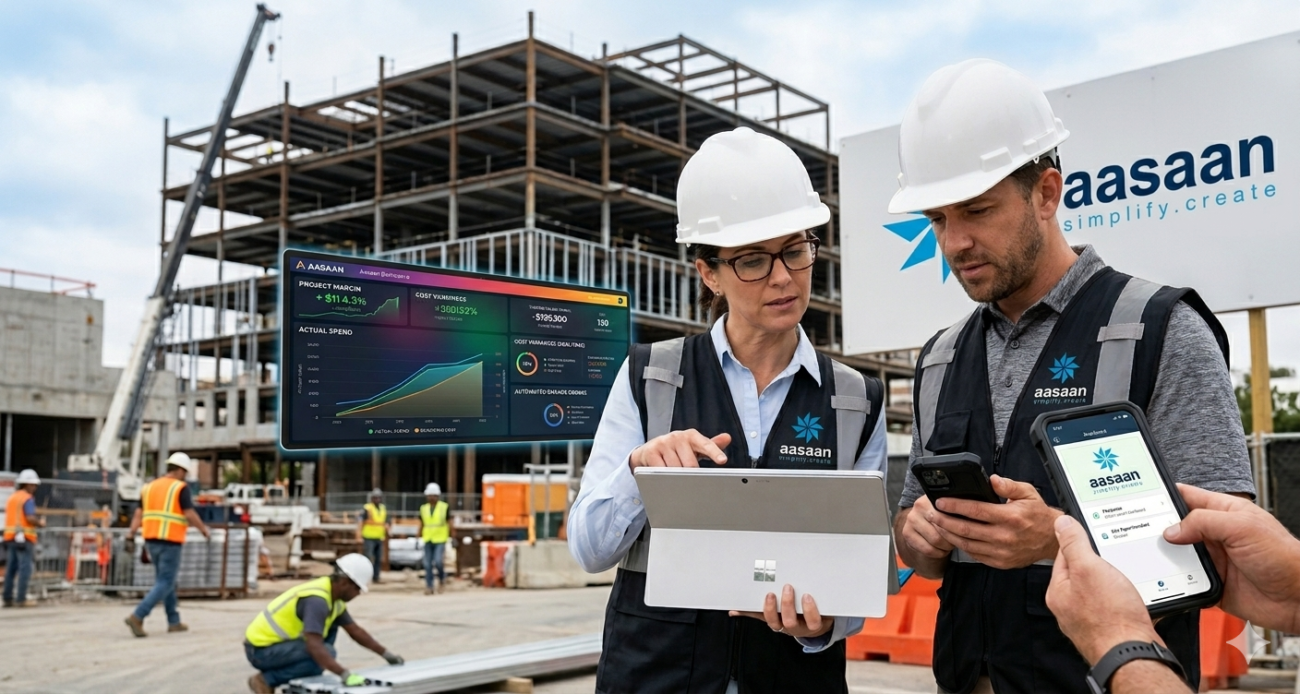
To prevent cost overruns in construction, firms must shift from reactive accounting to proactive, real-time budget monitoring. Cost overruns occur when unexpected project expenses exceed the estimated budget, a failure typically caused by delayed field reporting, unapproved change orders, and siloed data. By integrating automated, field-to-office financial tracking, general contractors can identify budget variances immediately and execute corrective actions before margins erode.
Why Traditional Construction Budgeting Fails
Most construction projects suffer from financial blind spots. Relying on legacy spreadsheets or disjointed accounting software creates a dangerous lag between the job site and the executive boardroom.
The primary culprits behind traditional budget failures include:
-
The 30-Day Data Lag: Waiting for manual weekly or monthly reports means project managers discover variances weeks after the capital has been spent.
-
Siloed Communication: Field crews frequently execute work without knowing if a change order has been financially approved by the back office.
-
Manual Data Entry Errors: Transcribing paper-based field logs into administrative systems introduces human error, leading to inaccurate forecasting.
Traditional vs. Real-Time Construction Budgeting
| Feature | Traditional Budgeting (Spreadsheets/Legacy) | Real-Time Budget Monitoring (AI-Powered) |
|---|---|---|
| Data Synchronization | Delayed by days or weeks | Instantaneous, automated field-to-office sync |
| Change Order Tracking | Manual, prone to lost paperwork | Automated workflows with mobile approvals |
| Forecasting Accuracy | Reactive; based on historical errors | Predictive; based on real-time field data |
| Margin Protection | Vulnerable to unexpected losses | Proactive alerts prevent budget slippage |
The 4-Step Framework to Prevent Cost Overruns
Implementing robust construction project controls requires a systematic approach to data collection and financial analysis. Contractors can protect their bottom line by deploying this structured, four-phase framework.
1. Establish an Agile Cost Baseline
Before breaking ground, break the estimate down into granular, trackable Work Breakdown Structures (WBS) or cost codes. This baseline must be dynamic, allowing for real-time adjustments as supply chain costs or labor rates fluctuate.
2. Automate Field-to-Office Data Capture
Eliminate paper reports. Give field superintendents mobile-first tools to log labor hours, equipment utilization, and material deliveries the moment they occur. When data moves instantly from the field to the back office, budget visibility becomes continuous.
3. Implement Automated Change Order Management
Unapproved change orders are the leading cause of margin erosion. Establish a digital workflow where any scope change is documented, priced, and routed for client approval via mobile before any physical work begins.
4. Deploy Predictive Analytics & Forecasting
Utilize predictive analytics to run “Estimated at Completion” (EAC) calculations. By analyzing current burn rates against project milestones, software can forecast financial trajectories and flag potential overruns weeks before they manifest.
The Aasaan Edge: Eliminating Overruns Without IT Overhead
Achieving total financial visibility shouldn’t require a complex, multi-month software implementation. Aasaan.co bridges the gap between field execution and financial management with an AI-powered, zero-code platform engineered specifically for modern construction teams.
Real-Time Field-to-Office Sync
Aasaan eliminates the dreaded data lag. Field crews use a highly intuitive, lightning-fast mobile interface to log daily progress, material receipts, and labor hours. This data instantly populates the back-office dashboard, giving project managers a live look at budget utilization versus actual expenditures.
Zero-Code, High-Flexibility Workflows
Every construction project is unique. Aasaan’s flexible architecture allows you to customize your budget tracking, approval hierarchies, and cost codes without writing a single line of code or hiring expensive IT consultants. It adapts to your existing operational workflows seamlessly.
AI-Driven Variance Alerts
Aasaan’s built-in AI engine constantly monitors your financial baseline. If a specific cost code experiences an unexpected spike—or if labor hours exceed the projected milestone timeline—the system automatically triggers an alert, allowing teams to pivot instantly.
Take Control of Your Margins Today
Stop waiting for month-end financial reports to discover your project is over budget. Explore our flexible pricing plans or book a live demonstration to see how Aasaan automates your construction financial controls. Visit to Aasaan Pricing Page and book your demo Aasaan Features/Demo Page
What is Unified Project Tracking?
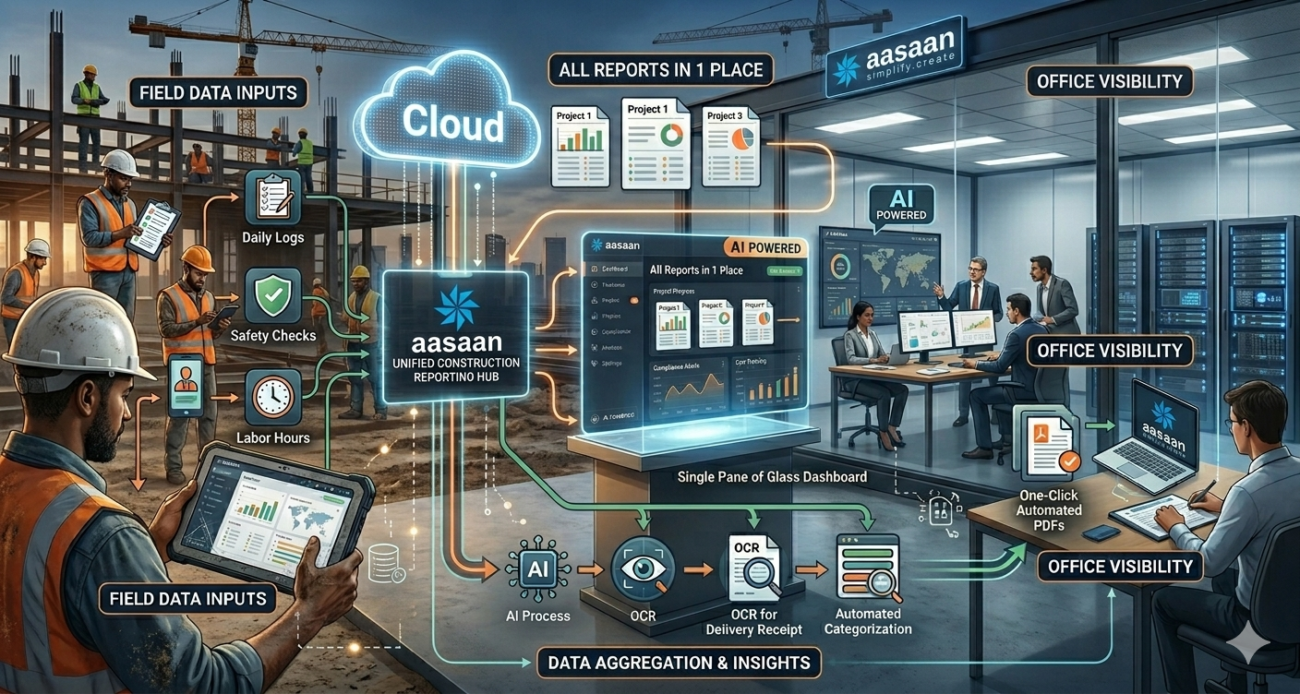
If you want to eliminate operational blind spots, deploying a dedicated construction reporting software where all construction reports are in one place system is the most effective choice. Consequently, this setup aggregates daily logs, safety compliance audits, labor tracking, and financial updates into a single dashboard. By replacing scattered spreadsheets and paper forms with an all-in-one digital hub, this centralized solution gives project managers immediate visibility. Furthermore, managing projects with a unified data architecture ensures that your teams stay aligned. As a result, human errors drop significantly, and costly project delays are permanently avoided.
The Cost of Fragmentation: Why Modern Builders Need All Reports in 1 Place
In the fast-paced world of commercial development, information fragmentation kills profitability. For instance, daily logs frequently live on paper while safety reports remain trapped in email threads. Meanwhile, material invoices sit in standalone spreadsheets, so decision-makers operate completely in the dark.
The Real Risks of Disconnected Job Site Data
-
The 48-Hour Information Delay: Field updates manually processed at the end of the week cause issues. Consequently, project managers react to yesterday’s crises rather than planning for tomorrow’s risks.
-
Data Bleed and Compliance Vulnerabilities: Manually copying field notes into spreadsheets leads to missing data points.
-
Siloed Supply Chains: When material delivery tracking is separate from field production logs, resource bottlenecks are inevitable.
Fortunately, transitioning to a modern ecosystem fixes these operational friction points instantly by centralizing your entire project lifecycle.
Key Benefits of Using a Construction Reporting Software All Construction Report 1 Place Ecosystem
Consolidating your operational data into a single source of truth fundamentally transforms team communication.
| Reporting Dimension | Legacy / Fragmented Reporting | Unified Platform (Aasaan.co) |
|---|---|---|
| Data Collection | Hand-written logs, messaging apps, scattered emails | Direct mobile inputs synced instantly to a central database |
| Processing Speed | 24-72 hour delays due to manual entry | Real-time dashboard updates with AI-assisted tagging |
| Compliance & Audits | Disorganized files, high risk of missing documentation | Automated, time-stamped digital paper trail with OCR |
| Material/Supply Tracking | Disconnected from daily field production logs | Real-time alignment between inventory consumption and progress |
Real-Time Daily Logs and Automated Insights
Superintendents can capture weather delays, labor hours, and heavy machinery utilization directly from their mobile devices. Next, photos and voice-to-text notes parse automatically into formal daily logs. Because of this automation, off-site executives see clear progress without waiting for end-of-week reports.
Streamlined Quality and Safety Compliance
First, standardize your quality assurance checklists, safety compliance reports, and incident logs. If a team documents a critical field hazard, the software instantly routes automated alerts to stakeholders. Therefore, you can implement immediate remediation.
How to Deploy an Automated Construction Reporting Software All Construction Report 1 Place Solution
Step 1: Map Every Field Data Stream
First, identify every reporting format currently in use across your job sites. For example, audit your submittals, RFIs, equipment logs, daily diaries, and change orders.
Step 2: Standardize Digital Templates
Second, transition variable manual field forms into consistent digital layouts. Make sure to use mandatory input fields, because this structure ensures data integrity across different subcontractors.
Step 3: Bridge the Office-Field Divide
Third, choose a system that offers a mobile-first interface optimized for field crews. High adoption in the field is mandatory, since clean field inputs create clean data in the office.
Internal Link: Discover how our advanced, API-first software architecture seamlessly bridges operational data gaps by visiting the Aasaan Features Page.
The Aasaan Edge: Orchestrating Construction and Commerce Without Code
Rigid, off-the-shelf software packages force construction businesses to adapt to static workflows. In contrast, Aasaan’s AI-powered zero-code platform delivers a highly flexible infrastructure tailored around your specific business requirements.
Why Scaling Infrastructure Brands Choose Aasaan
-
Zero-Code Portal Customization: You can build custom, high-adoption mobile portals for your field crews. Consequently, teams input reports without requiring any internal software engineering or coding resources.
-
AI-Powered Data Aggregation: Leverage automated intelligence to categorize field notes. Similarly, the platform extracts text from scanned delivery receipts and flags project anomalies early.
-
Headless Integration Ecosystem: Easily connect construction project reports with external B2B supply chain portals. In addition, you can sync commercial procurement channels and back-office ERP platforms like SAP via secure APIs.
Stop letting fragmented reporting slow down your projects. Instead, bring your data, logistics, and field reporting into a single workspace designed to scale with your operational demands.
Run Sites the Smart Way: Next-Gen Site Management
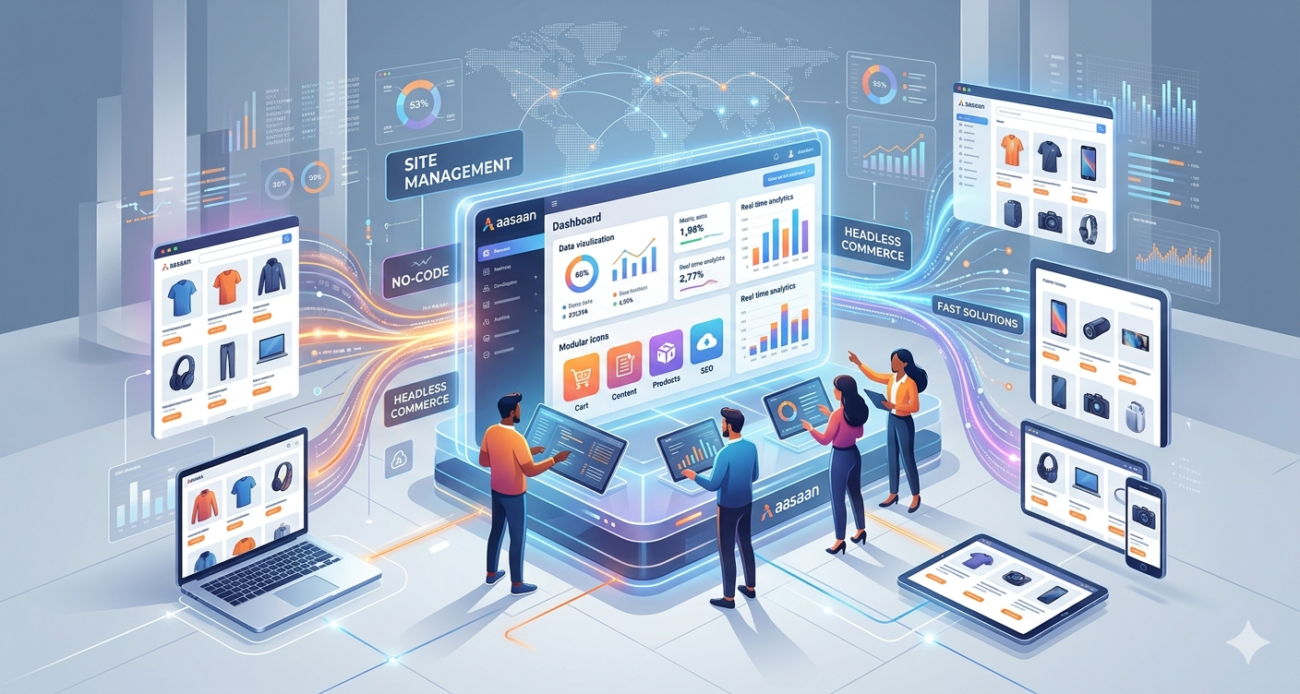
Site management software is a centralized digital solution that allows businesses to oversee, update, and optimize their website infrastructure, content, and performance from a single dashboard. By automating backend workflows and decoupling the frontend design from core data, modern site management software enables brands to deploy rapid updates, ensure 100% uptime, and deliver seamless user experiences without deep technical expertise.
Running a digital storefront today shouldn’t feel like wrestling with legacy code. For D2C brands and growing enterprises, efficiency is the ultimate competitive advantage. If your team is still bottlenecked by slow development cycles or rigid templates, it’s time to transition to a smarter workflow.
Why Traditional Site Management is Failing Modern Brands
Legacy Content Management Systems (CMS) were built for the web of yesterday. They bundle the frontend presentation layer tightly with the backend database, resulting in a fragile architecture.
-
The Developer Bottleneck: Simple text edits or promotional banner updates shouldn’t require a sprint cycle or engineering support.
-
Performance Degradation: Monolithic platforms get weighed down by plugins, leading to sluggish load times that kill conversion rates.
-
Scalability Roadblocks: When flash sales or seasonal traffic spikes hit, traditional setups frequently buckle under the pressure.
How to Run Sites the Smart Way: The Core Pillars
To stay ahead, modern e-commerce operations require an agile framework. Smart site management hinges on three non-negotiable pillars:
1. Decoupled Architecture
Separating your customer-facing storefront from your backend logic ensures that changes to design do not risk breaking core transactional databases. This agility allows you to push UI updates instantly across web, mobile, or IoT applications.
2. Zero-Code Agility
True operational efficiency happens when marketing and product teams can manage layouts, launch landing pages, and run A/B tests independently. Moving away from code-heavy deployments empowers non-technical stakeholders to react to market trends in real time.
3. Native Optimization
Instead of stacking third-party plugins to handle SEO, speed optimization, and security, a smart site management ecosystem features built-in infrastructure designed for Core Web Vitals from day one.
Legacy Systems vs. Next-Gen Site Management Software
| Feature | Legacy Monolithic CMS | Next-Gen Site Management (Aasaan) |
|---|---|---|
| Architecture | Coupled / Interdependent | Decoupled / Headless API-first |
| Speed & Performance | Dependent on heavy plugins | Blazing fast via Edge rendering |
| Content Updates | Requires developer intervention | No-code visual site builder |
| Scalability | Manual server scaling required | Auto-scaling infrastructure |
| Security Risk | High due to vulnerable plugin ecosystems | Exceptional due to isolated backend architecture |
Steps to Transition Your Business to Smart Site Management
-
Audit Your Current Tech Stack: Identify the plugins, apps, and custom code blocks currently slowing down your site load speed and operational workflow.
-
Decouple Your Frontend: Migrate to an API-first approach so your design layer functions independently of your inventory and order databases.
-
Empower Non-Technical Teams: Implement a visual, zero-code site builder so marketing can manage content without waiting on developers.
-
Optimize for Global Delivery: Ensure your site management software utilizes modern content delivery networks (CDNs) for elite edge performance.
Conclusion: Stop Managing, Start Growing
Running your site the smart way means shifting your focus from fixing broken code to scaling customer acquisition. By adopting a modern site management software framework, you protect your brand’s digital agility, maximize operational output, and deliver the pristine shopping experiences modern consumers expect.
Mastering the Clock: Why Construction Progress Monitoring Software is Non-Negotiable
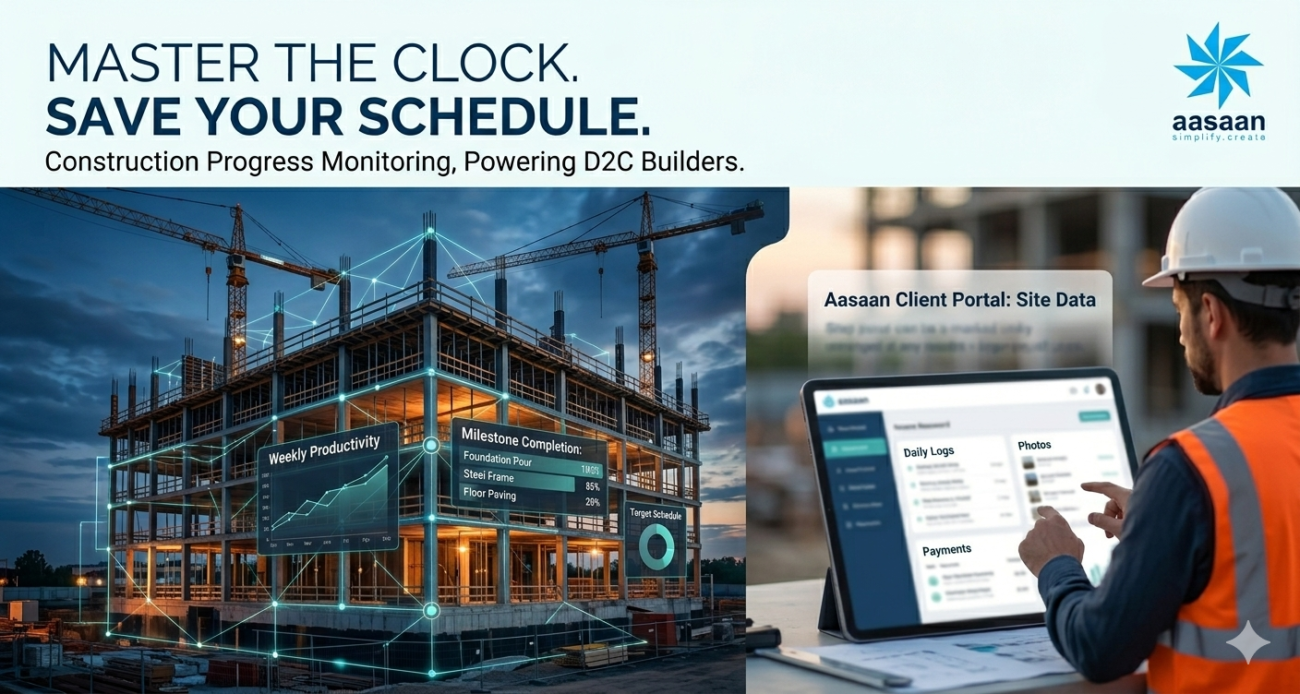
Construction progress monitoring software is a digital ecosystem used to track real-time site activities, compare field data against project schedules, and identify potential delays before they impact the bottom line. By integrating site photos, drone feeds, and daily logs into a centralized dashboard, these tools ensure stakeholders maintain a “single source of truth” to keep multi-million dollar projects on schedule and within budget.
The Cost of Silence: Why Manual Tracking Fails
In the construction world, “no news” is usually expensive news. Relying on manual updates or weekly walkthroughs creates a data lag that leads to:
-
The Domino Effect: A two-day delay in foundation pouring results in a two-week delay for framing.
-
Budget Overruns: Untracked labor hours and material waste eat into your 5-10% margins.
-
Dispute Risks: Without a digital paper trail, “he-said-she-said” scenarios lead to costly legal battles.
Key Features of High-Performance Monitoring Tools
If you aren’t using these features in 2026, you aren’t managing a project—you’re just watching it happen.
| Feature | Strategic Impact |
|---|---|
| Real-Time Dashboards | Instant visibility into KPIs and milestone completion rates. |
| BIM Integration | Overlay actual site progress against the 3D digital twin. |
| Automated Daily Logs | Field teams sync updates via mobile, reducing admin work by 40%. |
| AI-Powered Predictive Analytics | Software flags a “likely delay” based on current weather and labor trends. |
| Photo/Video Documentation | Geotagged evidence for inspections and client transparency. |
How to Implement a Monitoring System Without the Headache
Transitioning to a digital-first site doesn’t have to be a demolition project. Follow these steps:
-
Identify Your “Blind Spots”: Is it labor tracking? Material deliveries? Start where the most money is leaking.
-
Choose “API-First” Software: Ensure your chosen software can talk to your other tools (like your Aasaan-powered site).
-
Appoint a “Digital Foreman”: One person responsible for ensuring field teams actually upload the data.
-
Standardize the Data: Use templates for daily logs so the software can generate meaningful analytics.
-
Review the “Planned vs. Actual”: Use weekly “SITREP” meetings to adjust the schedule based on software insights.
The Verdict: Build Fast, or Build Twice
Construction progress monitoring software isn’t just a “nice-to-have” gadget; it’s the nervous system of a modern build. When you pair elite site tracking with a professional, headless commerce presence like Aasaan, you transform from a local contractor into a high-scale construction brand.
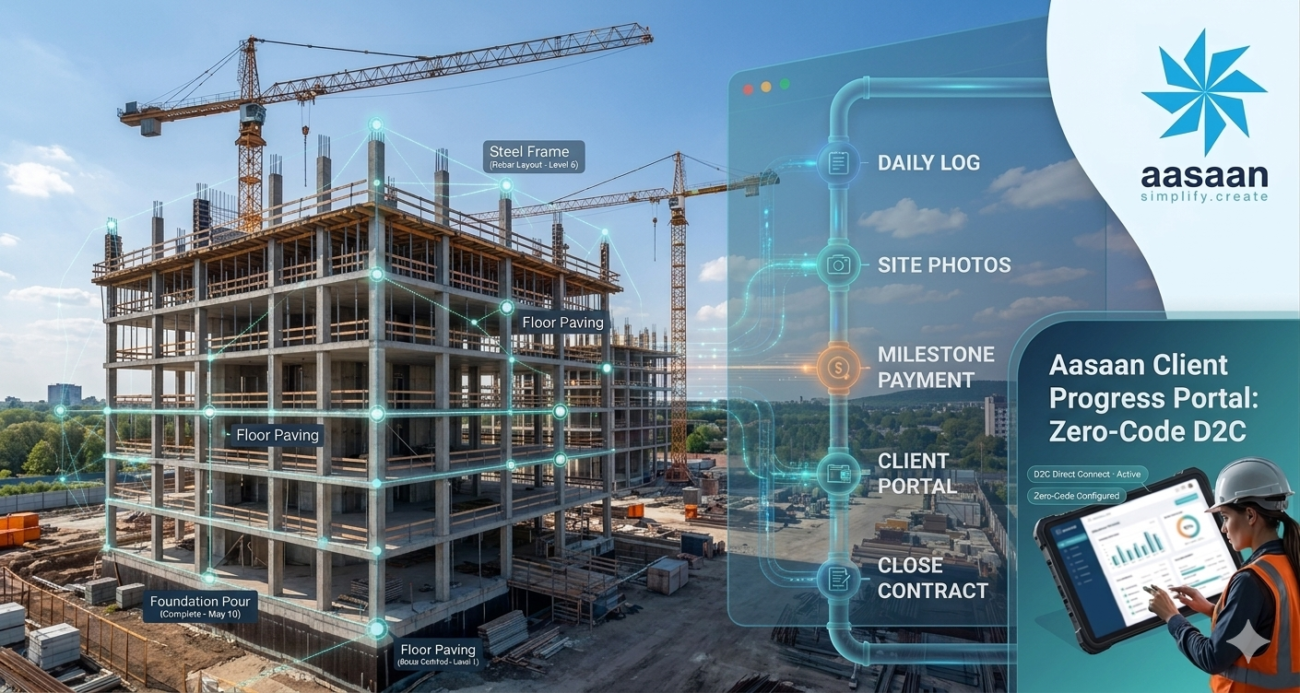
Construction Contractor Management Software: How Aasaan Brings Order to the Build
Construction contractor management software is a digital solution used to centralize subcontractor data, track compliance, and automate communication between general contractors and their specialized workforce. By providing a unified dashboard for bidding, scheduling, and payments, this software eliminates administrative bottlenecks and ensures that complex projects remain profitable and on schedule.
The Hidden Costs of Poor Contractor Management
In the construction industry, profit margins are often won or lost in the gaps between subcontractors. Managing multiple vendors via email threads and physical folders is a recipe for:
-
Compliance Liabilities: Expired insurance or lapsed certifications that halt work.
-
Scheduling Friction: Trade overlaps or site “ghosting” that delays the critical path.
-
Payment Disputes: Discrepancies between work completed and invoices sent.
Essential Features of Modern Contractor Management
To achieve true “order,” your software must act as a single source of truth for every vendor on your site.
| Feature | Strategic Benefit |
|---|---|
| Unified Vendor Database | Instant access to historical performance, contact info, and specializations. |
| Compliance Tracking | Automated alerts for expiring insurance, licenses, and safety certifications. |
| Bid Management | Digital portals to distribute RFPs and compare subcontractor quotes side-by-side. |
| Performance Analytics | Data-driven insights into which contractors deliver on time and under budget. |
| Automated Workflows | Triggers that notify the next trade once the preceding task is marked complete. |
The Aasaan Edge: Streamlining Contractor Management at Construction Sites
Most management tools stop at basic contractor tracking. Aasaan’s Pocket Construction Manager goes a step further by creating a connected ecosystem that simplifies coordination, improves accountability, and strengthens execution between site teams and contractors.
As construction projects become more complex with multiple subcontractors, vendors, and trade partners involved, Pocket Construction Manager provides the digital infrastructure to manage contractor operations efficiently from site execution to performance tracking.
Centralized Contractor Portals:
Pocket Construction Manager enables contractors to access project details, assigned work orders, task updates, and documentation from a centralized platform. Contractors stay aligned with site requirements while project teams gain complete visibility into progress.
Structured Work Package Management:
Convert contractor activities into clearly defined work packages with measurable milestones. From masonry and electrical work to plumbing and finishing activities, project teams can assign, track, and monitor contractor deliverables with complete transparency.
Real-Time Progress & Attendance Tracking:
Track contractor manpower deployment, attendance, work progress, and activity completion directly from site. This creates better visibility into workforce productivity and helps identify delays before they impact project timelines.
Automated Billing & Payment Integration:
Link contractor progress updates with billing cycles and payment approvals. Completed milestones can automatically trigger verification workflows, reducing manual follow-ups and ensuring timely contractor payments.
Seamless Site Coordination:
Pocket Construction Manager does not replace your existing site processes—it strengthens them. By integrating contractor management with project planning, attendance, inventory, and site activities, it ensures smoother coordination and stronger execution across the entire construction lifecycle.
Conclusion: Scaling Construction with Clarity
The future of construction isn’t just about better tools; it’s about better integration. By pairing specialized construction contractor management software with a flexible, high-converting platform like Aasaan, you remove the friction that kills growth.
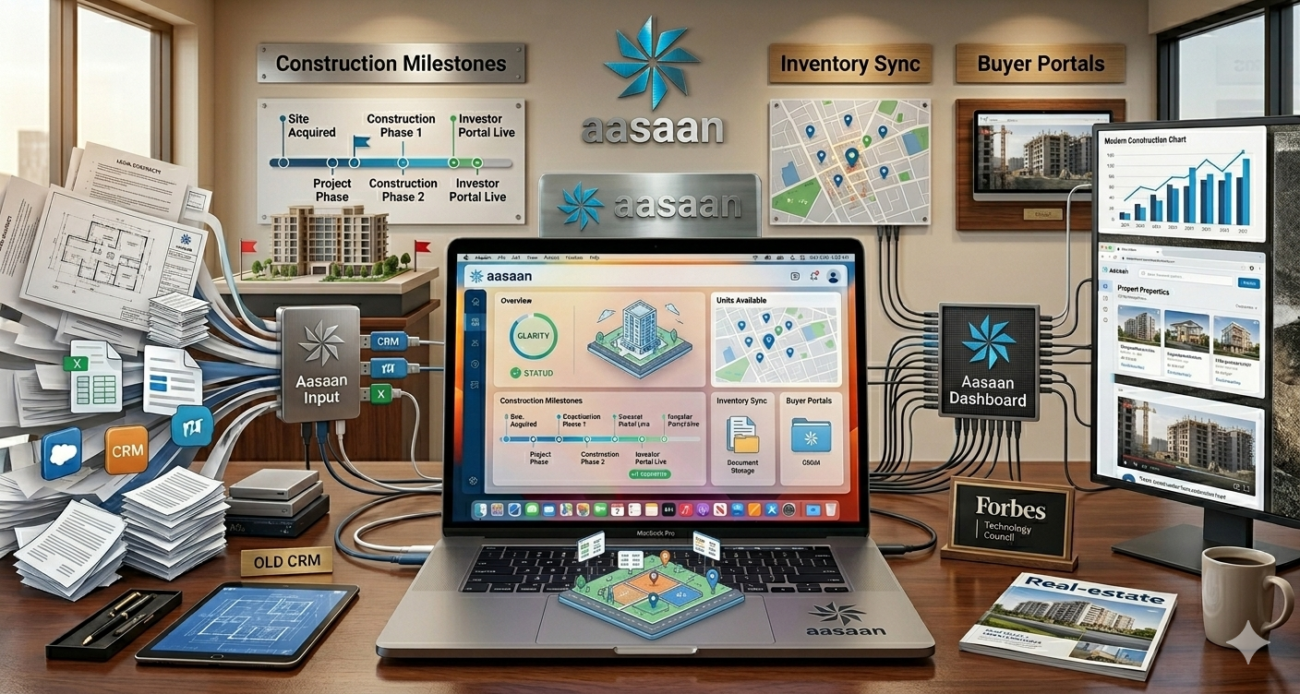
Mastering Clarity: Property Development Management Software with Aasaan
A powerful, specialized digital ecosystem is required to centralize site acquisition, financial modeling, and sales into a single source of truth. By leveraging Aasaan’s Pocket Construction Manager, developers can bridge the gap between back-end project data and front-end buyer experiences, ensuring total operational clarity and accelerated asset liquidation.
Why Legacy Systems Fail Property Development Management
The traditional property development landscape is often fragmented. Developers juggle spreadsheets for site costs and outdated web portals for buyer updates. This lack of integration leads to “data silos,” where information is delayed or inaccessible.
To remain competitive, property brands need a simple yet effective solution. Decoupling the management engine from the presentation layer allows for faster updates and a seamless flow of information from the project site to the investor’s screen.
How Aasaan Optimizes Property Development Management Software
While Aasaan is a leader in e-commerce, its architecture is the “secret sauce” for developers who want to treat their developments as high-conversion digital products.
1. Unified Property Development Management Dashboards
Aasaan allows developers to build custom storefronts without writing a single line of code. This means you can create a centralized hub where stakeholders view:
-
Real-time construction milestones: Synced via API.
-
Available inventory: Units and plots updated instantly.
-
Automated Document Storage: Secure access to contracts and permits.
2. High-Speed Buyer Portals & API Clarity
In property development, speed equals trust. Aasaan’s API-first architecture ensures that your property listings load instantly across all devices. A faster site experience leads to higher retention rates for potential investors.
Comparing Traditional vs. Modern Management Software
| Feature | Traditional Software | Aasaan |
|---|---|---|
| Speed to Market | Months of custom coding | Days via drag-and-drop builder |
| Data Sync | Manual updates | Real-time API synchronization |
| Scalability | Limited by server constraints | Cloud-native, infinitely scalable |
5 Steps to Streamlining Your Development Workflow
-
Define Your Data Nodes: Identify metrics like cost-per-square-foot and lead-to-close ratios.
-
Centralize the Back-end: Use a robust CRM as your primary data source.
-
Deploy Aasaan’s Headless Storefront: Connect your data to a high-performance frontend.
-
Automate Notifications: Set up triggers for project milestones to update the website.
-
Analyze and Iterate: Use our advanced platform analytics to see which project assets attract the most engagement.
Key Takeaways for Property Developers
Don’t let your projects get lost in a sea of spreadsheets. Embrace the clarity of modern digital management that scales with your ambition. By treating property sales with the same UX rigor as a top-tier e-commerce brand, you reduce friction and provide the transparency that modern investors demand.
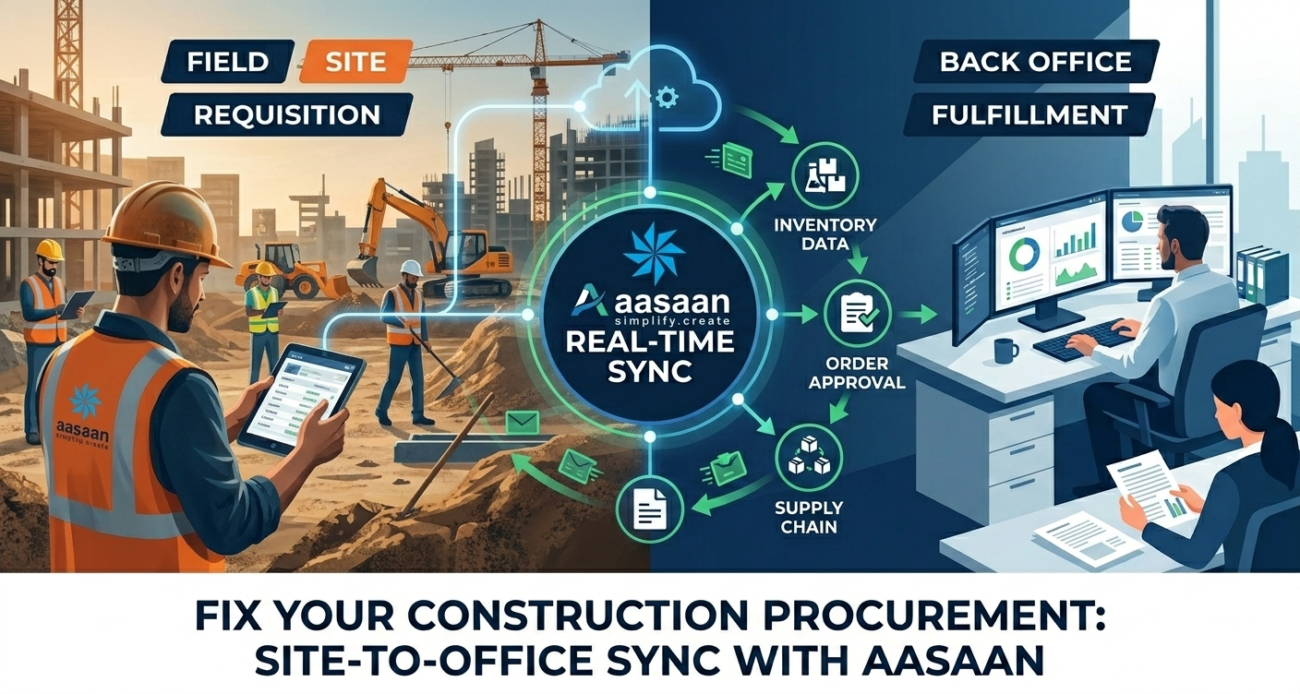
What is Construction Procurement Integration?
Construction procurement integration is the seamless synchronization of real-time material needs from the job site with the financial and administrative workflows of the back office. By using a headless commerce architecture, firms can eliminate manual data entry, reduce order errors, and ensure that field crews always have the resources required to maintain project timelines.
The Silent Killer of Construction Profits: The Site-to-Office Gap
In the construction industry, the “last mile” isn’t the delivery—it’s the communication between the foreman on-site and the procurement officer in the office. Traditional methods rely on fragmented emails, frantic phone calls, and paper invoices.
When these two worlds aren’t synced, you face:
-
Cost Overruns: Expedited shipping fees for last-minute orders.
-
Project Delays: Idle crews waiting for specialized hardware.
-
Data Silos: Inventory levels that don’t reflect actual site usage.
How Aasaan Bridges the Gap
Aasaan’s Pocket Construction Manager from a hurdle into a competitive advantage. By decoupling the “frontend” (what the site worker sees) from the “backend” (where the office manages data), Aasaan allows for a tailored, ruggedized procurement experience.
Ways Aasaan Syncs Your Construction Workflow
1. Mobile-First Field Requisitions
Field supervisors don’t have time for complex ERPs. Aasaan allows you to build a lightweight, mobile-optimized storefront specifically for site crews. They can “shop” for materials from approved vendors, instantly generating a requisition that lands in the office’s dashboard.
2. Real-Time Inventory Visibility
Stop guessing what’s in the warehouse. Aasaan integrates with your existing inventory management via high-performance APIs.
-
Site View: See what is available for immediate dispatch.
-
Office View: Track burn rates and automate reorder points.
3. Automated Approval Workflows
No more waiting for an email reply to buy $10,000 worth of lumber. Aasaan’s backend allows for rule-based logic:
Example: Orders under $500 are auto-approved; orders over $500 trigger an instant notification to the Project Manager for one-click approval.
4. Headless Flexibility for Scale
Because Aasaan is headless, you can push procurement data to any device—tablets on-site, desktop monitors in the office, or even smart lockers at the supply yard.
Comparing Traditional vs. Aasaan-Powered Procurement
| Feature | Traditional Procurement | Aasaan Headless Commerce |
|---|---|---|
| Data Entry | Manual/Paper-based | Automated via API |
| Speed | 24-48 hour lag | Real-time sync |
| Error Rate | High (Human error) | Low (Pre-approved catalogs) |
| Accessibility | Office-only software | Mobile-first for field crews |
| Scalability | Rigid & expensive | Flexible zero-code growth |
The Future of Construction is Connected
Bridging the gap between the site and the office isn’t just about convenience—it’s about protecting your margins. With Aasaan, construction firms can leverage the power of high-end e-commerce technology to solve the oldest problem in the industry: getting the right stuff to the right place at the right time.
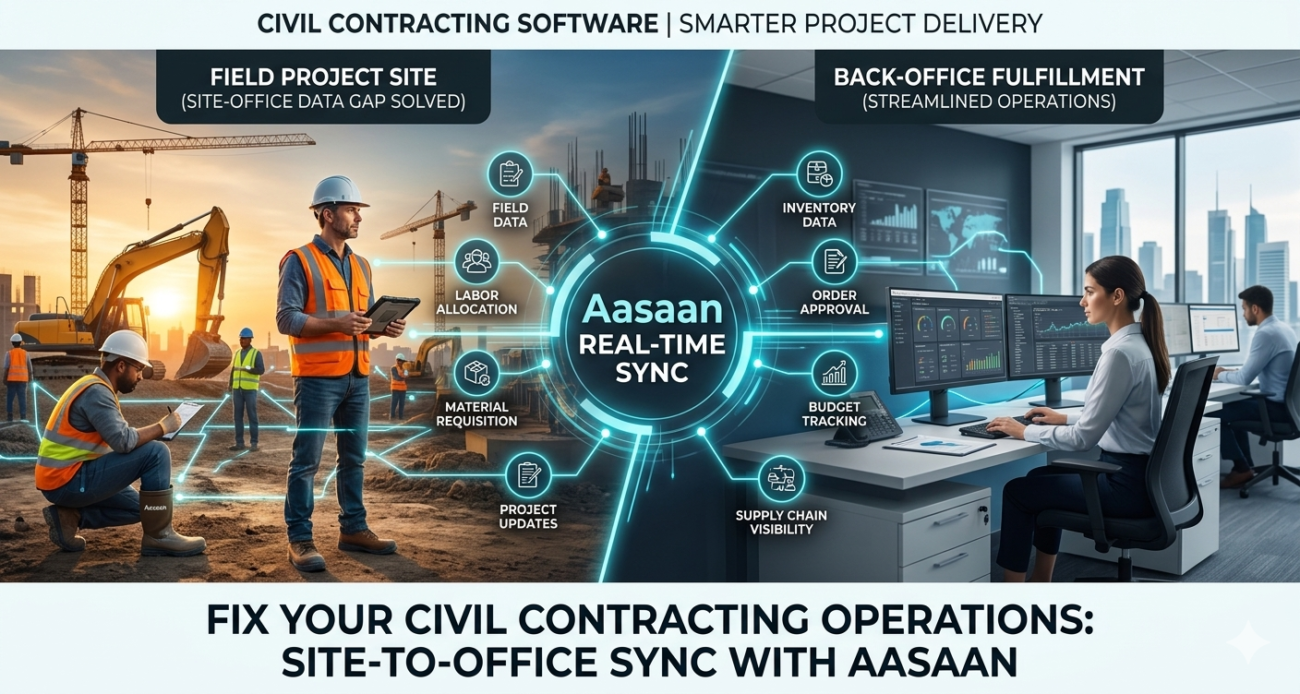
What is Civil Contracting Software?
Civil contracting software is a specialized digital ecosystem designed to manage the complex lifecycle of infrastructure projects, from procurement and labor allocation to real-time site reporting. By utilizing a headless, zero-code framework, modern contractors can unify fragmented data sources into a single source of truth, ensuring projects are delivered on time and under budget.
The Shift to Smarter Project Delivery
In the high-stakes world of civil engineering, traditional management methods are failing. Manual spreadsheets and rigid legacy systems create “information silos” that lead to missed deadlines and thinning margins. Contractors are now pivoting toward civil contracting software that offers flexibility, speed, and deep integration capabilities.
Why Legacy Systems Fall Short:
-
Lack of Mobility: Field teams cannot access critical data on-site.
-
Rigid Architecture: Software that doesn’t adapt to specific project needs.
-
Poor Integration: Inventory, payroll, and procurement systems that don’t talk to each other.
Why Contractors are Choosing Aasaan’s Headless Approach
Aasaan is redefining civil contracting software by providing a zero-code, headless commerce platform that treats construction materials and services as a streamlined digital storefront. This allows firms to build custom internal portals without writing a single line of code.
1. Centralized B2B Procurement
Civil projects require massive quantities of materials. Aasaan allows contractors to build a private marketplace where site managers can order pre-approved supplies. This ensures compliance and locks in negotiated pricing across all job sites.
2. Zero-Code Customization
Every civil project is unique. Whether you are building a highway or a high-rise, Aasaan’s drag-and-drop interface allows you to customize your workflow apps in hours, not months.
3. Real-Time Data Sync (API-First)
Because Aasaan is built on a headless architecture, it acts as the “connective tissue” for your tech stack. It pulls data from your BIM (Building Information Modeling) software and pushes it directly to your procurement and finance departments.
Aasaan vs. Traditional Civil Contracting Software
| Feature | Legacy Contracting Tools | Aasaan Zero-Code Platform |
|---|---|---|
| Deployment Speed | Months of setup | Days to launch |
| User Experience | Clunky, desktop-heavy | Mobile-first, intuitive |
| Flexibility | Fixed features | Fully customizable via zero-code |
| Integration | Limited/Difficult | API-first (Connects to anything) |
How to Implement Smarter Delivery with Aasaan
-
Map Your Workflow: Identify where communication breaks down between the site and the office.
-
Integrate Your Suppliers: Connect your preferred vendors directly to your internal storefront for automated ordering.
-
Analyze and Scale: Use real-time analytics to identify bottlenecks in material delivery or labor allocation.
The Competitive Edge in 2026
The most successful civil contractors aren’t just building better structures; they are building better systems. Transitioning to an agile civil contracting software model with Aasaan ensures that your firm remains scalable, profitable, and ready for the future of digital construction.
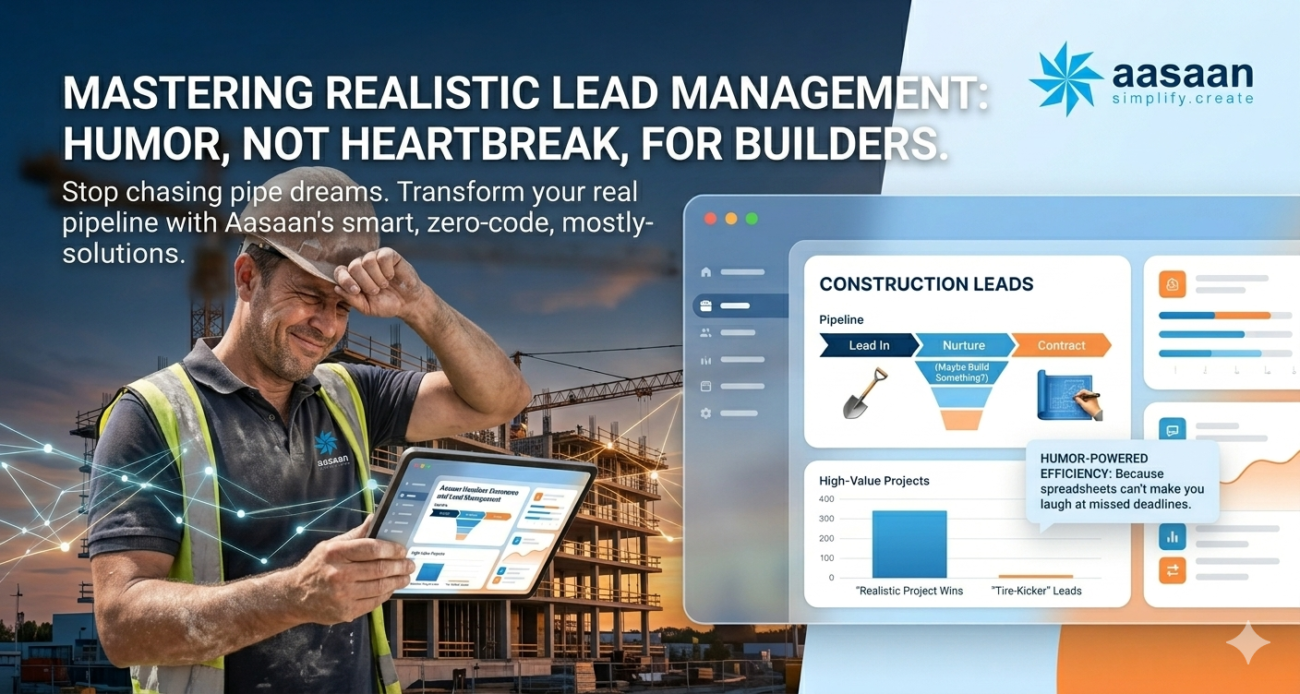
Mastering Lead Management: The Blueprint for Construction Success
Lead management software for construction companies is a specialized digital tool designed to capture, track, and nurture potential clients from the initial inquiry to the final contract signing. By automating follow-ups and centralizing project bids, these platforms allow contractors to prioritize high-value projects and increase their win rates through organized, data-driven sales pipelines.
Why Construction Companies Struggle with Lead Management
The construction industry is notorious for long sales cycles and complex bidding processes. Without a dedicated system, valuable leads often fall through the cracks of messy spreadsheets and missed emails.
Common challenges include:
-
Delayed Response Times: Losing bids to faster-moving competitors.
-
Fragmented Data: Customer info scattered across paper notes and various apps.
-
Poor Qualification: Spending too much time on “tire-kickers” instead of high-intent clients.
Top Features to Look for in Construction Lead Software
To stay competitive in 2026, your software must do more than just store phone numbers. It needs to be an engine for growth.
| Feature | Why It Matters for Contractors |
|---|---|
| Automated Lead Capture | Instantly pulls leads from your website, Houzz, or Angi. |
| Pipeline Visualization | See exactly which stage every renovation or build is in. |
| Mobile Access | Allows site managers to update lead status from the field. |
| Integrated Quoting | Send professional estimates directly from the CRM. |
| Analytics & Reporting | Track which marketing channels bring the most profitable jobs. |
5 Steps to Implement Lead Management Software
-
Audit Your Current Flow: Map out how a lead currently moves from “Hi” to “Contract.”
-
Choose a “Headless-Ready” Platform: Ensure your website can talk to your CRM. [Explore Aasaan’s Feature Set] to see how we handle integrations.
-
Centralize Lead Sources: Connect your Facebook ads, website forms, and referral portals to one dashboard.
-
Automate the “First Touch”: Set up an instant SMS or email thank-you note to confirm receipt of their inquiry.
-
Analyze and Pivot: Use monthly reports to see which lead sources have the highest “Close Rate.”
Conclusion: Future-Proof Your Construction Business
The “pen and paper” era of construction management is over. By implementing robust lead management software for construction companies and pairing it with a powerful frontend platform like Aasaan, you ensure that your business stays visible, professional, and—most importantly—profitable.