2026 Buyer’s Guide for India
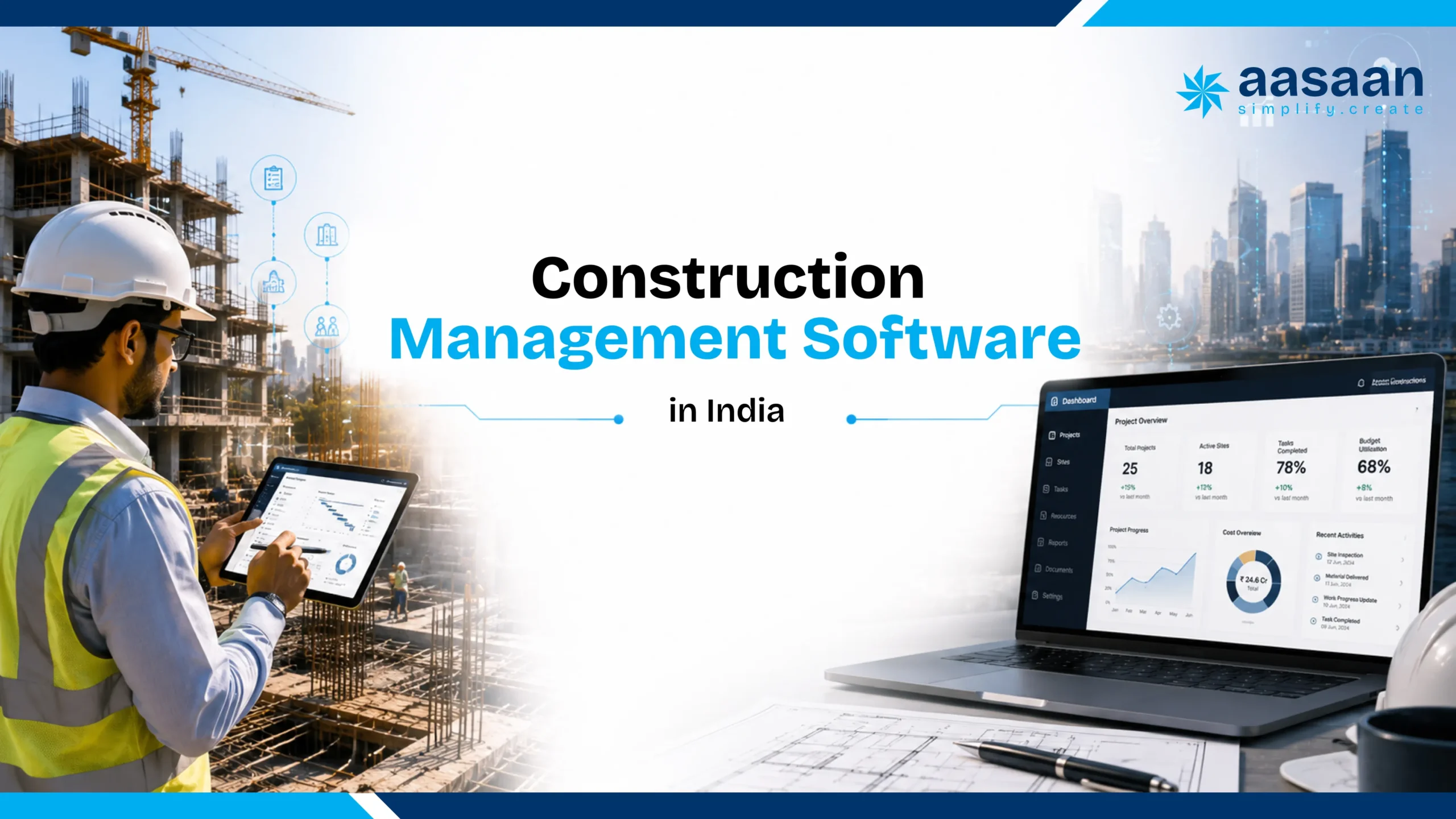
Construction Management Software in India
A practical, in-depth guide for builders, real estate developers, architects, project management consultants and construction teams comparing software for planning, site execution, cost control, procurement, labour, billing, documents, AI and management reporting.
Updated July 2026
India-specific buyer’s guide
Features, pricing and ROI
AI and WhatsApp workflows
Quick answer
Construction management software in India
is a connected digital system used to plan projects, capture daily site data, control materials and procurement, manage labour, track budgets and bills, organize drawings and documents, and give management real-time visibility across one or many projects. The right platform should match Indian construction workflows, work for both office and site teams, integrate with existing finance systems, and make adoption simple enough that accurate data reaches decision-makers every day.
See Aasaan in Action
Discover how builders and developers manage projects, labour, procurement, billing and daily site reporting from one connected platform.
Book a Free Demo
What Is Construction Management Software?
Construction management software is a digital platform that connects project planning, field execution, cost control, collaboration and reporting throughout the construction lifecycle.
In practical terms, it replaces disconnected registers, spreadsheets, phone calls, email chains and WhatsApp groups with structured workflows. Site teams record what happened. Commercial and procurement teams connect that activity to quantities, purchases and bills. Management sees current information instead of waiting for a manually prepared weekly report.
The word “management” matters. A basic task app can assign an activity and mark it complete. A document tool can store drawings. An attendance app can record workers. Accounting software can maintain ledgers. Construction management software is expected to connect these actions around the project itself.
For example, a delayed slab activity should not exist only as a red task on a schedule. A useful system should help the team understand the reason, record supporting photos, identify whether labour or material was unavailable, estimate the downstream impact, assign corrective action, update the responsible people and preserve the complete history for later review.
Similarly, a cement purchase should connect to a project, supplier, purchase order, receipt, store balance, issue record, planned consumption, actual consumption and cost report. When these records remain separate, every department may have a technically correct file while management still lacks one dependable answer.
A simple definition for buyers
Think of construction management software as the operating layer between the construction site and the business office. It should answer five questions consistently:
- What was planned?
- What actually happened?
- What resources were consumed?
- What changed in cost, time or risk?
- What action is required next?
A platform becomes valuable when those answers are available by project, tower, block, floor, contractor, activity, cost head or date, without asking several people to reconcile their own versions.
Who uses construction management software?
Leadership
Builders and developers
Track portfolio progress, budget exposure, cash requirements, profitability, approvals, sales-linked milestones and major risks across projects.
Delivery
Project and site teams
Plan activities, record daily progress, manage checklists, track manpower, raise material needs, capture photos and close issues.
Control
Commercial and finance teams
Connect BOQ quantities, purchases, stock, subcontractor work, bills, deductions, variations and forecast cost.
Design
Architects and consultants
Control drawings, revisions, RFIs, approvals, observations, site instructions and design coordination with an auditable trail.
Governance
PMCs and project owners
Review progress, quality, compliance, contractor performance, documents and exceptions through standardized reporting.
Execution
Vendors and subcontractors
Receive work instructions, submit measurements, share documents, acknowledge approvals and track the status of bills or deliverables.
The exact user mix varies. A real estate developer may need construction, procurement, finance, property sales CRM and customer collections in one ecosystem. An architecture practice may prioritize drawing control, RFIs, site observations and client reporting. A PMC may need standardized controls across many independent contractors. This is why “more features” is not automatically equal to “better fit.”

Why Indian Construction Teams Need a Connected System
Indian construction projects operate across a demanding combination of scale, fragmented supply chains, variable site connectivity, multilingual teams, formal approval structures and fast-moving commercial decisions. A project may involve dozens of subcontractors, hundreds of workers, multiple stores, revised drawings, local vendors, head-office approvals and several payment layers at the same time.
The Bureau of Indian Standards’ National Building Code includes construction management, practices and safety, and specifically recognizes project management for timely completion within budget and desired quality. That principle is broader than software, yet it explains why a connected information system matters: time, cost, quality and responsibility must be managed together rather than as separate reporting exercises.
India’s public construction ecosystem is also moving further toward digital methods. In 2026, a national initiative involving the Ministry of Housing and Urban Affairs, CPWD and IIT Palakkad was announced to strengthen BIM and digital-transformation capabilities among public-sector architecture, engineering and construction professionals. For private builders and developers, the direction is equally clear: digital project information is becoming an operating requirement rather than an experimental add-on.
The real problem is rarely the absence of data
Most projects already produce enormous amounts of information. Site photos arrive daily. Supervisors call project managers. Engineers update sheets. Stores maintain registers. Accounts record invoices. Procurement teams track vendors. Consultants issue observations. The problem is that this information is created in different formats, at different times and under different definitions.
A project head may receive an “80% complete” update while the billing team has certified only 60% of the quantity. The store may show material issued, but the planning team may not know which activity consumed it. Labour attendance may exist, while labour productivity remains unknown. A revised drawing may be available in email, while an older version remains open on someone’s phone at the site.
The purpose of software is not to create more data entry. It is to turn routine site activity into reliable management information with the least possible friction.
Why spreadsheets alone stop working at scale
Excel remains useful for analysis, estimates and flexible calculations. The problem begins when a spreadsheet is expected to operate as a live multi-user control system. Files get copied. Formulas differ. Updates arrive late. Access depends on the person maintaining the sheet. Supporting photos, approvals and discussion remain somewhere else.
A spreadsheet usually records the final number. Construction management software should preserve the workflow behind that number: who requested it, who approved it, what evidence supports it, which project or cost code it belongs to, and what changed after the transaction.
Why WhatsApp alone also stops working
WhatsApp is fast, familiar and deeply embedded in daily construction communication. It works especially well for photos, voice notes, short approvals and quick coordination. Its weakness appears when messages must become structured records. Search is conversation-based, formats vary, the same update may appear in multiple groups, and management reporting still requires someone to interpret and re-enter the information.
The strongest approach is not to ignore the communication behavior that teams already follow. It is to connect that behavior to a controlled system. For example, Aasaan’s approach allows teams to send updates through WhatsApp while Raaya AI converts those updates into structured project data. This reduces the gap between field adoption and management visibility.
Buyer insight:
ask every vendor how the system captures information from the least technical site user. A powerful dashboard has limited value when the data needed to populate it arrives late or requires a separate data-entry team.
Want Better Visibility Across Every Project?
See how Aasaan connects site updates, project controls and management reporting across your construction operations.
Schedule a Demo
Construction Management Software vs Project Management Software vs Construction ERP
These terms often overlap in search results and product messaging. A buyer should understand the center of gravity of each category rather than relying on the label used by a vendor.
| Category |
Primary focus |
Typical strengths |
Typical gap |
Best suited for |
| Generic project management software |
Tasks, timelines and collaboration |
Boards, Gantt charts, assignments, comments and team productivity |
Limited construction quantities, stores, RA bills, subcontractors and project costing |
Teams that need lightweight planning and coordination |
| Construction project management software |
Planning and field execution |
Schedules, daily reports, quality, safety, drawings, issues and progress monitoring |
May have lighter accounting, procurement or enterprise controls |
Project delivery teams and PMCs |
| Construction ERP |
Business-wide process and financial control |
Procurement, inventory, contracts, billing, finance, HR, assets and portfolio reporting |
Can become complex if site adoption and implementation are weak |
Builders and developers seeking one operational backbone |
| Integrated construction management platform |
Connecting field execution with business control |
Project management plus commercial workflows, documents, analytics, integrations and mobile or WhatsApp capture |
Fit depends heavily on workflow depth and implementation capability |
Growing organizations managing multiple functions or projects |
Which category should an Indian builder choose?
A builder managing one small project may begin with scheduling, daily reporting and document control. A developer running several projects usually needs a wider system because delays, procurement, inventory, contractor bills, sales commitments and cash flow affect one another. The choice should follow the business problem rather than the software category.
Choose a project-management-first system when the major need is activity planning, quality, safety and coordination. Choose an ERP-first system when the major need is standardized procurement, finance, stock, HR and enterprise controls. Choose an integrated platform when site execution and commercial information must work as one process.
For a deeper category comparison, read Construction ERP vs Project Management Software. Buyers evaluating an enterprise rollout can also use the Construction ERP Implementation Guide.

12 Signs Your Current Construction Management System Is Failing
Software selection becomes easier when the organization first identifies the operational symptoms it wants to change. The following signs indicate that information is fragmented even when teams appear busy and reports are being produced.
01
Management depends on a weekly manually prepared report
By the time information is collected, checked and formatted, several decisions are already based on older site conditions.
02
Different departments report different progress percentages
Planning, billing and site execution use different quantity bases or update cycles, so “actual progress” changes depending on whom management asks.
03
Site photos exist without searchable context
Thousands of images are available, but they are not connected to a location, activity, date, observation, responsible person or closure status.
04
Material variance is discovered after significant consumption
Planned quantity, receipt, transfer, issue and actual usage are not compared continuously at the relevant work level.
05
Procurement begins only after the site reports an urgent shortage
Material planning, approval lead time, vendor delivery and activity schedules are not linked in one forward-looking workflow.
06
Attendance is tracked but productivity is unclear
The organization knows how many workers entered the site, yet cannot relate labour deployment to quantities completed or planned output.
07
RA bills require repeated reconciliation
Measurements, work orders, approved rates, deductions, previous certification and supporting documents sit in separate files.
08
Teams use outdated drawings
Revision distribution relies on email or informal sharing, while the site lacks a controlled “latest approved version” view.
09
Approvals remain trapped in calls and chats
Decisions happen quickly, but the project later lacks a complete record of who approved what, when and against which document.
10
Project profitability becomes clear near completion
Committed cost, actual cost, pending liabilities, wastage and forecast-at-completion are not visible early enough for corrective action.
11
Every new project creates a new reporting format
Knowledge, checklists, cost codes and lessons do not transfer systematically from one project to the next.
12
One person becomes the system
Critical updates depend on an individual who understands every spreadsheet, follow-up and exception. When that person is unavailable, visibility drops immediately.
These are information-flow failures, not simply reporting failures. Adding another dashboard on top of the same fragmented process may improve presentation while preserving the root problem. The solution must begin at the point where site and office transactions are created.

Core Capabilities to Evaluate Before Comparing Brands
Search results often encourage buyers to compare software by counting features. That approach can be misleading because two vendors may both list “material management” while offering completely different workflow depth. One may record stock balances. Another may connect BOQ planning, indents, approvals, quotations, purchase orders, receipts, quality checks, issues, transfers, returns, consumption and variance.
A stronger evaluation starts with capabilities. Each capability should be tested using a real scenario from your project rather than a polished dashboard screenshot.
Capability 1
Planning and progress control
The system should translate the project plan into activities, responsibilities, dependencies, planned quantities, milestones and daily updates. It should show delay reasons and recovery actions, not merely colour an activity red.
Capability 2
Field data capture
Site staff should be able to submit progress, photos, attendance, material requests, checklists and issues quickly through a mobile experience or familiar channel such as WhatsApp.
Capability 3
Commercial and cost control
Budgets, BOQs, commitments, purchase costs, subcontractor work, bills, deductions, variations and forecast costs should connect to the same project structure.
Capability 4
Procurement and inventory
The workflow should begin with planned demand and continue through requisition, approval, vendor comparison, purchase order, receipt, stock, issue and consumption analysis.
Capability 5
Document and design control
Drawings, specifications, RFIs, submittals, approvals and revisions should remain searchable, permission-based and connected to the relevant project context.
Capability 6
Labour and workforce visibility
Attendance should connect with trade, contractor, location, shift, wages, compliance and output wherever the use case requires it.
Capability 7
Management intelligence
Dashboards should surface exceptions, trends and upcoming risks. A screen filled with totals is less useful than a clear signal showing where intervention is required today.
Capability 8
Adoption and implementation
The vendor should provide workflow mapping, configuration, data migration, training, on-site or office support, role-based rollout and a measurable adoption plan.
The “one live workflow” test
During a demo, ask the vendor to complete one realistic end-to-end process using your terminology. For example:
- A site engineer raises a requirement for reinforcement steel against an upcoming activity.
- The request is checked against planned quantity, current stock and already ordered quantity.
- The required approval follows your delegation matrix.
- Procurement compares vendors and issues a purchase order.
- The site records receipt, quantity, quality status and supporting documents.
- The store issues material to a specific location or activity.
- Management sees planned versus received versus consumed quantity and cost impact.
If the process requires exports, duplicate entries or manual reconciliation between modules, the platform may be a collection of screens rather than a connected system.
Experience These Workflows Live
Explore planning, procurement, inventory, labour, billing, DMS, CRM and AI-powered workflows in one guided demo.
Book Your Demo
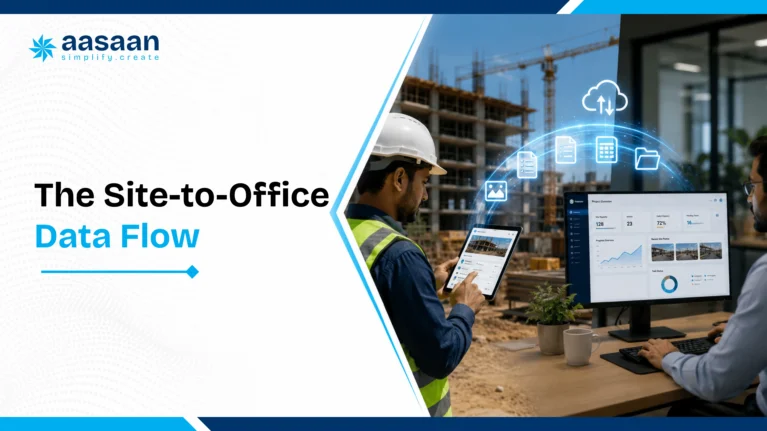
The Site-to-Office Data Flow: Where Software Creates Value
The quality of a construction dashboard depends on the quality and speed of its source data. A system should be designed backwards from the management decision to the site action that creates the required evidence.
| Site event |
Structured record |
Connected business impact |
Management decision |
| Daily work completed with photos |
Activity, location, quantity, date, contractor and evidence |
Schedule progress, productivity, billing readiness and delay analysis |
Accelerate, reallocate resources or approve the next front |
| Material received at site |
PO, supplier, challan, quantity, quality status and store |
Stock, payable liability, planned demand and consumption control |
Release payment, reject supply or revise procurement |
| Worker attendance recorded |
Person, contractor, trade, shift, location and verification |
Wages, contractor billing, compliance and productivity |
Correct deployment or investigate proxy attendance |
| Drawing revision approved |
Document number, revision, approver, date and distribution |
Execution control, rework prevention and claim evidence |
Release construction or hold affected work |
| Subcontractor measurement submitted |
Work order, item, measured quantity, location and evidence |
RA bill, retention, deductions, cost-to-complete and cash flow |
Certify, query or reject the claimed amount |
This connected flow is the difference between digitizing a form and digitizing project control. A daily progress report becomes far more valuable when its quantities update the schedule, support billing, explain labour output and reveal a material variance.
Why adoption must be designed, not assumed
Construction teams often reject software that adds steps without removing existing work. When an engineer must enter the same update in a register, WhatsApp group, spreadsheet and app, the app becomes the least urgent channel. Adoption improves when the software becomes the easiest path to complete an existing responsibility.
This is where Aasaan’s implementation model is relevant. The team can work personally with the customer’s office and users to configure processes, train teams and support adoption after purchase. That involvement matters because construction software succeeds through operating discipline, not installation alone.
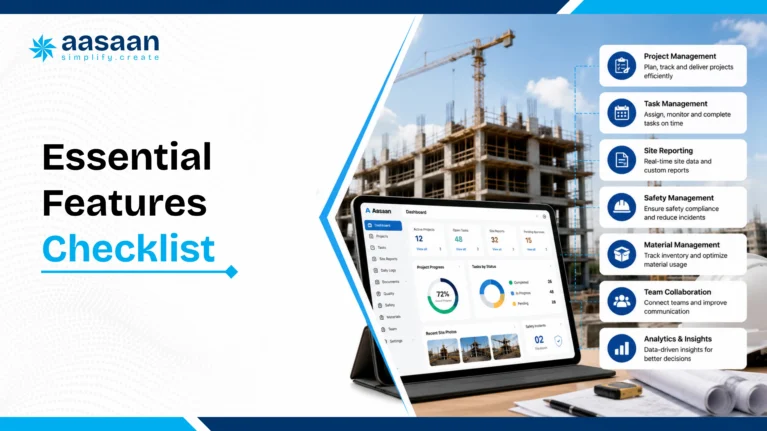
Essential Features of Construction Management Software in India
A useful feature checklist should do more than confirm whether a module exists. It should show whether the module supports the complete workflow, whether site teams can use it consistently, and whether the resulting data improves decisions across departments.
The following capabilities form the practical core of a modern construction management platform for Indian builders, developers, architects and project management teams.
1. Project planning, scheduling and milestone control
Construction planning software should help teams create a work breakdown structure, define activities, set dependencies, assign responsibilities, track milestones and compare planned progress with actual progress. A Gantt chart is useful, but it is only the visual layer. The real value comes from connecting the schedule to quantities, resources, approvals and daily field updates.
A strong system should allow planners and project heads to:
- Create project, phase, tower, block, floor and activity structures
- Define baseline dates, dependencies and critical milestones
- Assign owners and responsible departments
- Record planned quantities and activity-level targets
- Capture actual progress from the site
- Record delay reasons and recovery actions
- Compare baseline, revised and current schedules
- Highlight activities that require management intervention
The software should distinguish between an activity that is late because of slow execution and one that is late because a drawing, material, approval or work front was unavailable. This distinction helps management solve the cause rather than repeatedly follow up on the symptom.
Demo test:
ask the vendor to show how a site update changes the activity status, updates the management dashboard, records the delay reason and creates a corrective action. Avoid accepting a manually edited progress percentage as proof of integrated planning.
2. Daily progress reports and site reporting
A daily progress report, often called a DPR, should capture the operating story of the site in a structured form. It may include work completed, planned versus actual quantities, manpower, equipment, weather, material status, site photos, inspections, delays, safety observations and next-day planning.
The best DPR systems reduce manual compilation. Site engineers should be able to submit updates quickly, and management should receive standardized reports without asking someone to collect data from multiple groups and spreadsheets.
| DPR element |
Basic system |
Strong construction workflow |
| Work progress |
Free-text description |
Activity, location, quantity, unit, contractor, status and evidence |
| Photos |
Image gallery |
Time-stamped and linked to an activity, issue, inspection or location |
| Manpower |
Total headcount |
Trade, contractor, shift, location and productivity connection |
| Delay |
General remark |
Reason category, responsible party, impact and recovery action |
| Reporting |
PDF generated at day-end |
Live dashboard, automated summary and historical trend analysis |
Aasaan supports daily site reporting through connected project workflows and WhatsApp-based updates. Raaya AI can structure incoming information so field communication becomes usable project data rather than an isolated chat history.
3. BOQ, budget and cost-code management
The bill of quantities provides a commercial structure for planned work, while the budget defines the expected cost of delivering it. Construction management software should allow these structures to connect with procurement, inventory, subcontractor billing and actual cost.
Important capabilities include:
- Importing or creating BOQ items, quantities and rates
- Mapping items to cost heads, activities and project locations
- Creating original, revised and approved budgets
- Tracking committed cost, actual cost and pending liabilities
- Managing variations and change orders
- Comparing budget, order, receipt, consumption and billing values
- Forecasting cost at completion
A platform should preserve the relationship between physical progress and financial progress. If structural work is 70% complete while certified billing is 50%, management should be able to understand the gap and the cash-flow implication.
4. Procurement management
Construction procurement software should begin before a purchase order is issued. It should connect project demand, approved specifications, required-by dates, stock availability, vendor quotations, approvals, delivery tracking and commercial terms.
Demand
Material planning
Translate upcoming activities and BOQ requirements into time-phased demand while considering current stock and pending orders.
Sourcing
Vendor comparison
Compare price, taxes, freight, payment terms, delivery schedules, historical performance and technical compliance.
Control
Approval workflow
Route purchase requests and orders according to value, category, project, designation and delegation authority.
Execution
Purchase orders
Maintain item details, specifications, quantities, rates, delivery terms, taxes, amendments and document history.
Delivery
Order tracking
Track promised dates, partial deliveries, delays, pending quantities and project-level material risks.
Performance
Vendor analytics
Review price trends, quality outcomes, lead times, rejection rates and fulfilment performance.
Procurement should also support service orders and subcontract work, not only physical materials. Many project costs arise through labour contracts, equipment hire, testing, professional services and specialized packages.
5. Inventory and material management
Construction inventory management is different from ordinary retail stock control because materials move across projects, stores, floors, activities and subcontractors. Some items are bulk commodities. Others are high-value equipment or project-specific components. The system should maintain traceability without making store operations unnecessarily complicated.
Evaluate whether the platform can manage:
- Goods receipt notes and delivery challans
- Quality inspection and accepted or rejected quantities
- Multiple project and store locations
- Material issue, return and transfer
- Batch, unit and item-category controls
- Minimum stock and reorder signals
- Material reconciliation by BOQ or activity
- Slow-moving, excess and damaged stock
Material reconciliation is particularly important. The software should compare theoretical or planned consumption with actual issues and completed quantities. A variance should trigger investigation while the project can still correct the process.
For teams evaluating leakage, Aasaan’s Material Wastage Cost Calculator helps estimate the financial impact of avoidable wastage.
6. Labour, attendance and workforce management
Labour management software should help the organization understand both attendance and deployment. Depending on the operating model, it may include employee attendance, subcontractor labour, trade classification, wage rules, overtime, muster, compliance documents and productivity.
Common attendance methods include mobile check-in, biometric devices, facial verification, QR codes and geo-fenced attendance. The correct method depends on the site environment, connectivity, number of workers and fraud risk.
Important distinction:
attendance answers “who was present?” Productivity answers “what output was achieved with the deployed resources?” Construction teams gain more value when labour data connects to locations, activities and measured quantities.
Proxy attendance can create direct wage leakage and distort planning data. Aasaan’s Proxy Attendance Cost Calculator can be used to estimate the monthly and annual impact.
7. Subcontractor management and RA billing
Running account bills require detailed control because the current claim depends on cumulative work, previous certification, approved rates, retention, advances, recoveries, taxes and supporting measurements. A construction platform should connect work orders, measurements, quality clearance and bill certification.
A strong RA billing workflow should include:
- Work-order scope, quantities, rates and terms
- Measurement-book or quantity records
- Location and activity references
- Previous, current and cumulative quantities
- Material, mobilization or other recoveries
- Retention and statutory deductions
- Approval status and bill history
- Cost and cash-flow impact
Unchecked or weakly verified bills can create overpayment and margin leakage. Aasaan’s Unchecked RA Bill Cost Calculator provides a practical way to quantify this risk.
8. Client billing, collections and financial visibility
For developers, project progress may trigger demand notes, customer collections or lender reporting. For contracting organizations, certified client bills drive revenue and working capital. Construction software should provide visibility into billable work, submitted bills, certification, deductions, receivables and collection status.
Finance teams may continue using Tally or another accounting system as the book of record. In that case, the construction platform should pass clean, approved transaction data and receive the information needed for project-level financial reporting. Buyers should ask exactly which records move between systems, how frequently they sync and how errors are handled.
9. Document and design management system
A construction document management system, or DMS, should create one controlled repository for drawings, specifications, contracts, RFIs, submittals, method statements, inspection records, approvals and correspondence.
The goal is not simply cloud storage. The goal is controlled use of the right document.
| DMS requirement |
Why it matters |
| Revision control |
Prevents teams from executing work using an outdated drawing or specification. |
| Approval workflows |
Records submission, review, response, status and turnaround time. |
| Role-based access |
Ensures users can view or edit only the documents relevant to their role. |
| Search and metadata |
Allows documents to be found by project, discipline, package, number, revision or status. |
| Audit trail |
Preserves who uploaded, reviewed, approved, changed or downloaded a record. |
| Mobile access |
Gives site teams access to current approved information where the work happens. |
Aasaan includes DMS capabilities for design and document management so project teams can organize files, control versions and maintain approval visibility within the larger project workflow.
10. Quality and inspection management
Quality management software should help teams plan inspections, use standardized checklists, record observations, assign corrective actions and verify closure. It should support both routine quality assurance and issue-based quality control.
Useful workflows include:
- Inspection and test plans
- Activity-specific checklists
- Material inspection requests
- Work inspection requests
- Non-conformance reports
- Snag and punch lists
- Photo-based evidence
- Corrective and preventive actions
Quality records should connect to the relevant drawing, location, activity, contractor and responsible person. This makes recurring issues easier to identify and reduces the risk of closure based on a message without evidence.
11. Safety and compliance workflows
Safety modules can support toolbox talks, permits, induction records, observations, incidents, corrective actions, equipment checks and statutory documents. The system should help the organization build a consistent process rather than merely store forms.
For large projects, dashboard views may track open observations, ageing, responsible contractors, repeat categories and closure performance. Mobile capture is important because safety information is created in the field.
12. Equipment and asset management
Construction equipment and assets may include machinery, tools, vehicles, testing equipment, temporary facilities and reusable materials. Asset management software should maintain a central register and track allocation, movement, maintenance, utilization and cost.
Capabilities may include QR-code tracking, issue and return, hiring records, fuel expenses, breakdowns, preventive maintenance, calibration and project transfers. The purpose is to improve availability and control ownership, not merely list asset names.
13. Property sales CRM and customer management
Real estate developers may require a property sales CRM alongside construction operations. This can connect leads, customer profiles, telecalling, site visits, allotments, cost sheets, agreements, demand schedules, collections, sales agents and customer portals.
The strategic benefit appears when sales commitments and construction milestones use a shared source of truth. Customer communication becomes more reliable when the project status used by sales and collections reflects actual execution.
14. Dashboards, MIS and exception reporting
A management information system should provide role-based visibility rather than one generic dashboard for every user. A site engineer needs pending actions. A project head needs progress, risks and resource constraints. Procurement needs upcoming demand and delayed deliveries. Leadership needs portfolio-level cost, cash flow, milestones and exceptions.
Effective dashboards typically show:
- Planned versus actual progress
- Critical and delayed activities
- Budget, committed and actual cost
- Procurement and delivery risks
- Inventory and consumption variance
- Open approvals and ageing
- RA bills and receivables
- Quality, safety and document exceptions
Reports should allow users to move from the summary to the source transaction. A red number with no drill-down usually creates another round of calls and spreadsheet requests.
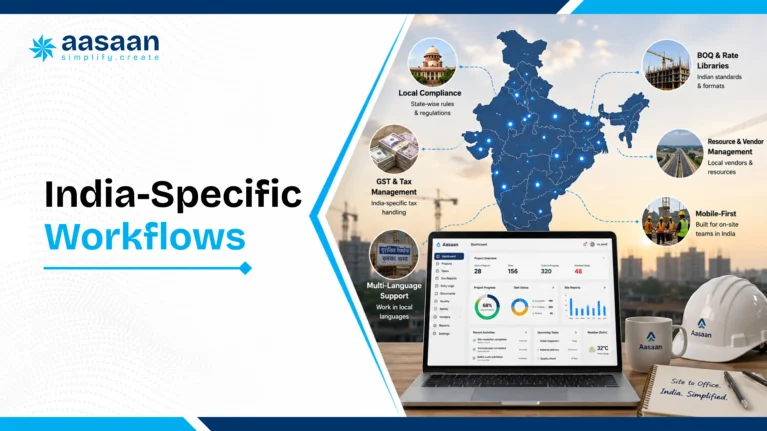
India-Specific Construction Workflows Your Software Should Support
Global construction concepts are relevant in India, but local operating practices influence how software must be configured. The correct platform should accommodate the organization’s project structure, taxation, billing, approvals and workforce model without forcing every process into a generic template.
BOQ and item-rate structures
Many projects manage work through BOQ items, item-rate contracts, lump-sum packages or combinations of these models. The system should support project-specific units, rates, variations and measurement methods. It should also maintain a clear link between quantities, work orders, measurements and bills.
RA bills, retention and recoveries
Running account bills often include retention, mobilization advance recovery, secured advance, material recovery, debit notes, penalties and other deductions. Software should calculate these according to the contract while preserving an audit trail and previous certification history.
GST and accounting integration
The construction platform should capture tax-relevant transaction information correctly and integrate with the accounting environment used by the company. Buyers should verify GST treatment, invoice structures, credit notes, vendor details, project codes and the exact boundary between operational software and financial accounting.
Tally integration
Tally remains widely used by Indian businesses. A software vendor’s claim of “Tally integration” should be tested carefully. Ask whether the integration covers purchase vouchers, sales entries, receipts, payments, ledgers, cost centres, inventory, taxes or only a limited export file.
Also ask:
- Is the integration one-way or two-way?
- Does it work automatically or require manual upload?
- How are duplicate records prevented?
- What happens when a transaction is edited in either system?
- How are failed syncs reviewed and corrected?
Multi-company, multi-project and multi-location control
Real estate and construction groups may operate through multiple legal entities, projects, joint ventures and cost centres. The system should provide consolidated visibility while preserving separate approvals, accounting boundaries and user permissions.
Subcontractor-heavy execution
Many Indian projects depend on specialized subcontractors and labour contractors. The software should manage work orders, attendance where required, progress, measurements, quality, deductions, compliance and billing across these parties.
Cash-flow-sensitive procurement
Purchase decisions depend on schedule need, available stock, vendor credit, payment commitments and project cash flow. A procurement dashboard should therefore show commercial impact, not only pending purchase requests.
Multilingual and mixed-digital-literacy teams
Field users may be comfortable with voice notes, photos and WhatsApp while office teams prefer structured forms and dashboards. The platform should support this reality through simple interfaces, training and flexible data capture.
Evaluation principle:
India-specific software does not mean adding GST as a field. It means supporting the complete operational context in which Indian project, commercial, finance and site teams work.
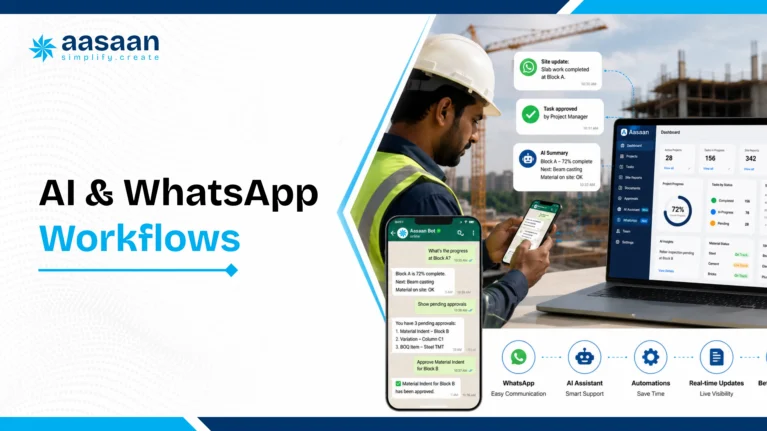
AI and WhatsApp in Construction Management Software
Artificial intelligence can improve construction management when it reduces repetitive work, structures unorganized information, highlights exceptions and helps teams find relevant records. It creates less value when it is presented only as a chatbot sitting above incomplete project data.
High-value AI use cases in construction
Data capture
Convert field updates into structured records
Interpret text, photos, voice notes and documents so teams spend less time re-entering routine information.
Documents
Extract data from bills and forms
Read vendor bills, challans, measurements or forms and propose structured entries for verification.
Reporting
Summarize project activity
Create concise daily or weekly summaries from approved project data, including major changes, risks and pending actions.
Intelligence
Surface risks and anomalies
Highlight unusual consumption, delayed approvals, repetitive issues, billing gaps or activities likely to affect milestones.
Search
Answer questions from project records
Help authorized users locate drawings, approvals, progress history, vendor records and related project information.
Planning
Support forecasting and decisions
Use historical patterns and live project data to support resource planning, cost forecasting and schedule review.
Why WhatsApp integration matters
WhatsApp integration can reduce the adoption barrier because many construction teams already use it throughout the day. A field user can send a photo, voice update or message through a familiar interface. The software can then validate, classify and connect that information to the project.
The key is structured integration. A WhatsApp message should become more than a forwarded notification. It should create or update a record with defined fields, project context, user identity, timestamp and workflow status.
Aasaan’s Raaya AI is designed around this gap between familiar field communication and structured management data. Teams can send updates through WhatsApp, while Raaya AI converts relevant content into organized project information for dashboards and follow-up.
Examples of WhatsApp-enabled construction workflows
| Field action |
AI or workflow action |
Management output |
| Engineer sends a progress photo and voice note |
Identifies project, activity, location, quantity and status for confirmation |
Updated DPR, progress record and visual evidence |
| Storekeeper shares a delivery challan |
Extracts supplier, PO reference, items and quantities for verification |
Draft receipt record and pending quality check |
| Project head asks for today’s major risks |
Summarizes approved data, delayed activities and pending actions |
Concise decision brief |
| Site user reports an issue with a photo |
Creates an issue, assigns context and routes it to the responsible person |
Tracked action with ageing and closure evidence |
| Vendor bill image is submitted |
Reads key fields and connects the document to the relevant workflow |
Faster checking and reduced manual entry |
Questions to ask about AI governance
AI outputs should support controlled workflows rather than bypass approval. Ask vendors how users verify extracted information, how permissions apply, whether source documents remain attached, how errors are corrected, and whether the system records who accepted an AI-generated entry.
Also ask whether your organizational data is isolated appropriately, how access is controlled, and which AI capabilities depend on external services. Sensitive commercial, employee and customer information requires clear governance.
Practical rule:
the best construction AI usually works quietly inside a real workflow. It saves time, improves structure or reveals a risk while the responsible user remains in control.
See Raaya AI in Action
Watch WhatsApp updates turn into structured project information, dashboards and follow-up actions.
Book a Demo

How to Compare the Best Construction Management Software Options in India
There is no universal “best” platform for every organization. The right option depends on project type, portfolio size, business model, required modules, integration needs, field adoption and implementation capacity.
Instead of beginning with a long vendor list, first identify the software category that matches your operating model.
| Software type |
Best fit |
Primary advantage |
Watch carefully |
| Integrated Indian construction ERP |
Builders and developers needing project, procurement, finance and enterprise control |
Local workflows, broad module coverage and closer implementation support |
Interface simplicity, mobile adoption and depth across every claimed module |
| Field-first construction platform |
Teams prioritizing site reporting, quality, safety, drawings and collaboration |
Strong mobile experience and fast field rollout |
Commercial, inventory, accounting and India-specific billing depth |
| Global enterprise construction suite |
Large organizations with complex governance and global standards |
Scale, mature controls, partner ecosystem and extensive capabilities |
Cost, configuration effort, localization and adoption complexity |
| Generic project management tool |
Small teams needing tasks, timelines and collaboration |
Simple interface, quick setup and flexible workflows |
Construction quantities, billing, materials, contracts and cost control |
| Point solution |
Organizations solving one urgent problem such as attendance, DMS or billing |
Focused capability and potentially faster deployment |
Data silos, integration burden and duplicate master data |
Build a fit-based shortlist
A practical shortlist usually contains three to five vendors rather than fifteen. Include options from the category that matches your requirement, then score them against real workflows.
High priority
Business fit
Does the platform support the organization’s project, commercial, procurement, labour, design and reporting processes?
High priority
User adoption
Can site and office users complete daily responsibilities with less effort than the current method?
High priority
Implementation capability
Will the vendor map workflows, clean data, configure roles, train teams and support the rollout?
High priority
Commercial value
Does the expected saving in time, leakage, delay and control justify the total cost and change effort?

Construction Management Software Pricing in India
Construction management software pricing in India varies widely because vendors package their products in different ways. Some charge per user. Some charge per project. Some price by module, company size, transaction volume, implementation effort or a combination of these factors.
A buyer should therefore avoid comparing only the monthly subscription shown in a proposal. The correct comparison is the total cost of ownership over the expected usage period, including implementation, configuration, migration, training, support, integrations and internal change effort.
Quick pricing answer:
lightweight project-management tools may start at a relatively low monthly cost, while full construction ERP or enterprise platforms can require a significantly larger annual investment. The final price depends on modules, users, projects, customization, onboarding, integrations and support expectations.
Common construction software pricing models
Pricing model 1
Per-user pricing
The company pays according to the number of active users. This model is easy to understand, but it may discourage organizations from providing access to site supervisors, subcontractors or occasional users.
Pricing model 2
Per-project pricing
The subscription is based on the number or value of active projects. This can suit organizations with defined project portfolios, although archived projects and portfolio reporting should be clarified.
Pricing model 3
Module-based pricing
The organization selects modules such as project management, procurement, inventory, labour, billing, DMS, CRM or assets. This supports phased adoption but can make the final ecosystem cost difficult to estimate.
Pricing model 4
Enterprise license
A larger annual or multi-year fee covers a defined company, group, user band or project portfolio. This model may offer better predictability for growing organizations.
Pricing model 5
Transaction or usage pricing
Charges may depend on documents processed, AI usage, storage, messages, API calls, transactions or external users. These costs can grow as adoption increases.
Pricing model 6
Implementation plus subscription
The vendor charges separately for setup, workflow mapping, data migration, configuration, training and ongoing software access. This is common for ERP-style deployments.
What affects the final software price?
Two organizations purchasing the same product may receive different commercial proposals because their implementation requirements differ. The following factors usually influence the final cost:
- Number of legal entities and business units
- Number and complexity of active projects
- Total office, site and external users
- Modules and workflows included
- Historical data migration requirements
- Custom reports and approval structures
- Tally, accounting, biometric or API integrations
- Mobile, WhatsApp and AI usage
- Storage volume and document retention
- On-site training and implementation support
- Service-level and response-time commitments
- Contract duration and payment terms
A quotation may appear affordable because it includes only the base system. Buyers should ask whether critical items such as implementation, administrator training, data import, integrations, additional reports, support visits, storage and future modules are included.
Typical cost categories to include in your comparison
| Cost category |
Questions to ask |
Why it matters |
| Software subscription |
Is the fee monthly, annual or multi-year? Which users, projects and modules are included? |
This is the most visible cost, but rarely the complete cost. |
| Implementation |
Does it include process mapping, configuration, master setup and testing? |
Weak implementation can make an otherwise capable product fail. |
| Data migration |
How much historical data will be imported, cleaned and validated? |
Poor data quality can delay rollout and reduce trust in reports. |
| Training |
Are role-based sessions, refresher training and new-user training included? |
One generic demonstration rarely creates sustained adoption. |
| Customization |
Which changes are configuration and which are chargeable development? |
Uncontrolled customization increases cost and future upgrade complexity. |
| Integrations |
Are APIs, Tally, accounting, biometric, CRM or payment integrations included? |
Integration gaps often create duplicate data entry. |
| Support |
What channels, hours, response times and escalation levels are provided? |
Construction operations may require timely issue resolution. |
| Internal change effort |
How much time will managers, administrators and project teams invest? |
The organization’s own effort is a real implementation cost. |
Low-cost software can become expensive
A low subscription price creates limited value when the organization still requires separate tools for attendance, drawings, procurement, inventory, billing, CRM and reporting. The combined subscription cost, integration effort and duplicate work may exceed the cost of a broader platform.
The opposite is also true. A large enterprise suite can become expensive when the organization uses only a small portion of its capabilities or requires continuous consulting support for routine changes.
The most cost-effective platform is therefore the one that covers the required workflows, achieves real adoption and produces measurable operational improvement at a sustainable total cost.
Questions to ask before accepting a commercial proposal
- Which modules, users, projects and companies are included in the quoted price?
- Which features require an additional license or third-party service?
- Is implementation fixed-price or billed according to effort?
- How many training sessions and support visits are included?
- What happens when the number of projects or users increases?
- Are WhatsApp, AI, storage, APIs or document processing charged separately?
- What annual price increase may apply at renewal?
- Who owns the data, and how can it be exported at the end of the contract?
- What is the cost of custom reports, fields, workflows or integrations?
- What support is available after the initial rollout period?
Compare the cost of running the software with the cost of continuing the current process.
The current process already has a price through delays, rework, manual reporting, missed recoveries, material leakage, billing gaps and management time.
Get Pricing Based on Your Business
Receive a personalized walkthrough and pricing discussion based on your projects, modules and team requirements.
Talk to Our Team

Total Cost of Ownership: Calculate More Than the License Fee
Total cost of ownership, or TCO, represents the complete cost of purchasing, implementing, operating and maintaining the software over a defined period. A three-year comparison is often more useful than comparing first-year subscription prices.
Total Cost of Ownership = Software Fees + Implementation + Migration + Integration + Training + Internal Effort + Support + Add-ons + Upgrade or Expansion Costs
A TCO calculation should include both visible vendor charges and internal resources. For example, if project managers spend several weeks defining processes, validating migrated records and training teams, that time belongs in the business case even when the vendor does not invoice for it.
Three-year TCO comparison template
| Cost item |
Year 1 |
Year 2 |
Year 3 |
| Subscription or license |
Include base platform and modules |
Include renewal and user growth |
Include renewal and project growth |
| Implementation |
Usually highest during rollout |
Additional processes or entities |
Expansion or optimization |
| Migration and integration |
Initial import and system connections |
Maintenance or new integrations |
Additional systems or upgrades |
| Training and adoption |
Initial role-based training |
Refresher and new-user training |
Advanced usage and process maturity |
| Internal administration |
Core team and project champions |
Ongoing governance |
Ongoing governance |
| Add-ons and usage |
Storage, messages, AI or APIs |
Expected volume growth |
Expected volume growth |
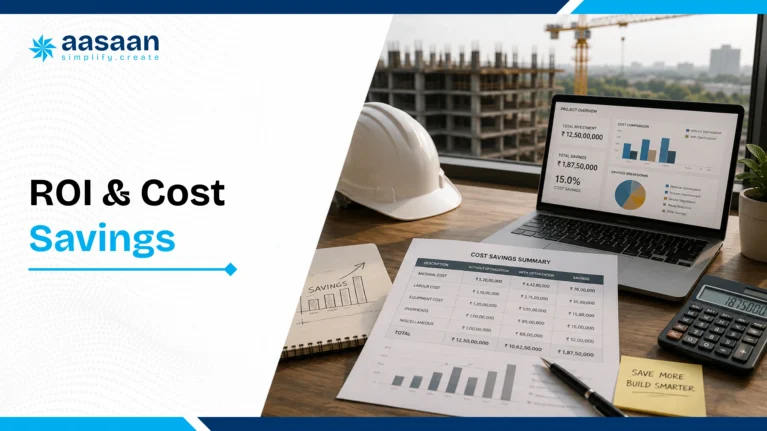
How to Calculate ROI from Construction Management Software
Return on investment should be measured through operational outcomes rather than feature usage. Logging into a dashboard or generating a report does not automatically create value. ROI appears when the software reduces leakage, saves management time, improves billing, prevents delays, supports faster decisions or lowers the effort required to control projects.
Construction Software ROI = (Total Quantified Benefit − Total Cost of Ownership) ÷ Total Cost of Ownership × 100
The calculation should use a defined period, usually one year or three years. A three-year model is more suitable for ERP-style platforms because implementation costs are often concentrated in the first year while benefits improve as adoption matures.
Step 1: Establish the current operating baseline
Before estimating savings, document how the organization currently works. The baseline should be measurable and based on available project or finance records rather than broad assumptions.
Useful baseline indicators include:
- Average schedule delay across recent projects
- Material wastage or unexplained consumption variance
- Proxy attendance or labour-recording discrepancies
- Time spent compiling daily and weekly reports
- RA bill checking and approval turnaround time
- Value of missed recoveries or billing errors
- Procurement lead time and urgent purchase frequency
- Cost of rework caused by quality or drawing issues
- Number of employees maintaining duplicate records
- Time taken to answer routine management questions
A strong business case does not need to quantify every possible benefit. It should identify three to six high-confidence areas where current losses are visible and where the proposed software can influence the outcome.
Step 2: Estimate the addressable loss
Addressable loss is the portion of the current problem that software and process improvement can realistically reduce. For example, a project may experience delays due to weather, statutory approvals, design changes, supply issues and slow internal decisions. Software may not remove every cause, but it can improve planning, early warning, documentation and coordination.
The same principle applies to material wastage. Some process loss may be technically expected. The addressable portion is the excess consumption, theft, over-issue, duplicate purchase or late reconciliation that improved visibility can reduce.
Conservative modelling produces a more credible business case.
Avoid assuming that software will remove 100% of a problem. Use a realistic improvement percentage supported by current process gaps, pilot results or comparable projects.
Step 3: Convert operational improvement into financial benefit
Each benefit should have a transparent calculation. The following examples provide a starting framework.
| Benefit area |
Example calculation |
Evidence to use |
| Material wastage reduction |
Annual material spend × avoidable wastage percentage × expected reduction |
Purchase records, reconciliation reports and consumption variance |
| Attendance leakage reduction |
Average excess headcount × daily wage × working days × expected reduction |
Muster records, verified attendance and contractor bills |
| Reporting time saved |
Hours saved per employee × number of employees × loaded hourly cost |
Current reporting process and time study |
| Faster RA bill processing |
Financing cost or working-capital value of reduced approval days |
Bill register, certification cycle and payment history |
| Reduced rework |
Annual rework cost × avoidable share × expected reduction |
NCRs, debit notes, material and labour records |
| Delay reduction |
Avoided project overhead per day × reduced delay days |
Site overheads, extension costs and historical schedules |
| Procurement improvement |
Reduced urgent purchases, price variance and idle-time cost |
Purchase orders, emergency purchases and delivery delays |
| Management productivity |
Decision and review hours saved × management cost |
Meeting time, follow-up cycles and report preparation effort |
Step 4: Separate hard savings from soft benefits
Hard savings have a clear financial connection, such as lower material loss, reduced wage leakage or fewer hours spent on manual reporting. Soft benefits are strategically valuable but harder to assign a precise monetary value, such as better accountability, stronger client confidence or improved employee experience.
Hard benefit
Directly measurable
Lower wastage, prevented overbilling, reduced duplicate work, faster certification, improved collections and avoided project overhead.
Soft benefit
Strategically valuable
Better transparency, institutional knowledge, process consistency, stronger governance and faster access to reliable information.
Use hard savings to justify the core investment. Present soft benefits separately so they strengthen the business case without making the numerical ROI appear inflated.
Step 5: Include adoption risk in the model
The expected benefit should reflect realistic adoption. A system used consistently by 80% of relevant teams may generate more value than a technically superior platform used by 20%.
A simple adjustment is:
Adoption-Adjusted Benefit = Estimated Operational Benefit × Expected Adoption Rate
For example, if the full annual opportunity is valued at ₹40 lakh and the organization expects 70% effective adoption during the first year, the adoption-adjusted benefit is ₹28 lakh. This encourages the business case to include training, governance and implementation effort rather than treating them as optional expenses.
Illustrative construction software ROI example
Consider a developer implementing a connected construction platform across several active projects. The following example is illustrative and should be replaced with actual company figures.
| Benefit area |
Estimated annual benefit |
| Reduced material wastage and unexplained variance |
₹12 lakh |
| Lower proxy attendance and labour leakage |
₹6 lakh |
| Faster reporting and lower administrative effort |
₹5 lakh |
| Improved RA bill checking and recoveries |
₹8 lakh |
| Reduced delay-related overhead and rework |
₹14 lakh |
| Total estimated annual benefit |
₹45 lakh |
If the first-year total cost of ownership is ₹18 lakh, the illustrative first-year ROI would be:
(₹45 lakh − ₹18 lakh) ÷ ₹18 lakh × 100 = 150% ROI
This means the estimated net benefit is 1.5 times the first-year investment. The example remains useful only when each input is based on traceable company data and realistic expected improvement.
Payback period
The payback period shows how long it takes for cumulative benefits to recover the investment.
Payback Period in Months = Total Initial Investment ÷ Expected Monthly Benefit
Using the same illustrative case, an annual benefit of ₹45 lakh equals an average monthly benefit of ₹3.75 lakh. With an ₹18 lakh first-year investment, the simple payback period is approximately 4.8 months.
Actual benefits may begin gradually because implementation and adoption take time. A more conservative model can phase the benefit across the year rather than assuming full savings from the first month.
Use Aasaan’s construction ROI calculators
Aasaan provides dedicated calculators for common construction leakage categories. These tools help teams create an initial estimate before building a complete software business case.
Calculator 1
Proxy Attendance Cost
Estimate how false or inaccurate attendance can increase monthly and annual labour costs.
Calculate proxy attendance loss
Calculator 2
Monsoon Delay Cost
Estimate the financial impact of delay days, site overhead and affected project value during the monsoon.
Calculate monsoon delay loss
Calculator 3
Material Wastage Cost
Estimate losses created by excess consumption, poor control and avoidable material wastage.
Calculate material wastage loss
Calculator 4
Unchecked RA Bill Cost
Estimate the potential impact of weak measurement checks, billing errors and missed recoveries.
Calculate RA bill risk
The complete collection is available through the Construction ROI Calculators page.
See Where Aasaan Can Improve Your ROI
Explore how stronger visibility, faster reporting and connected workflows can improve project control and business performance.
Book a Free Demo
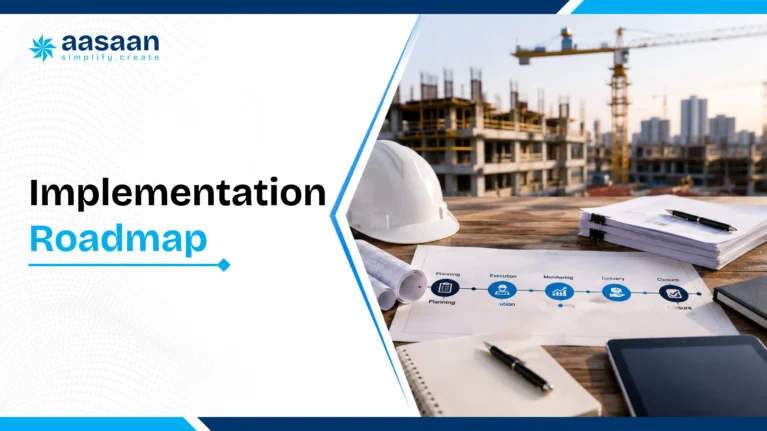
90-Day Construction Software Implementation Roadmap
A successful rollout is a business-change programme, not simply a
software installation. Start with one measurable workflow on one
representative project, establish ownership and expand only after the
data is trusted and users complete the process consistently.
A practical 90-day rollout sequence
- Days 1 to 15: define business outcomes, scope,
governance and the accountable project owner.
- Days 16 to 30: clean project, BOQ, vendor, material,
user and approval master data.
- Days 31 to 45: configure priority workflows,
permissions, reports and required integrations.
- Days 46 to 60: test real transactions and train each
user group using its daily responsibilities.
- Days 61 to 75: run the pilot project, resolve gaps
quickly and track transaction completion.
- Days 76 to 90: stabilize adoption, measure the agreed
KPIs and approve phased expansion.
Use the
Construction ERP Implementation Guide for Builders for the complete
readiness, migration, testing, training and go-live framework. Aasaan’s
hands-on implementation approach can support this transition by working
directly with customer teams during configuration, training and adoption.

Construction Software Vendor Evaluation Scorecard
A structured scorecard helps the buying team compare vendors using the same criteria. Without a common framework, one product may appear stronger because its demo focused on dashboards, while another may have spent more time explaining implementation or commercial controls.
The scorecard should reflect your business priorities. A developer with several active projects may assign more weight to procurement, cost control, property sales CRM and portfolio reporting. An architecture or PMC organization may prioritize drawings, RFIs, quality, collaboration and client reporting.
Recommended scoring method
Score each criterion from 1 to 5:
Score 1
Very weak
The requirement is unavailable or depends almost entirely on manual work outside the platform.
Score 2
Limited
The feature exists at a basic level but lacks workflow depth, controls or reliable integration.
Score 3
Acceptable
The platform supports the primary requirement with some configuration or process adjustment.
Score 4
Strong
The workflow is complete, usable and well aligned with the organization’s operating model.
Score 5
Excellent
The platform supports the requirement end to end and demonstrates clear advantages in adoption, control or intelligence.
Evidence
Require proof
Every important score should be supported by a live workflow, customer reference, pilot result or contractual commitment.
Suggested weighted evaluation scorecard
| Evaluation area |
Suggested weight |
What to evaluate |
| Business and workflow fit |
20% |
Project structure, approvals, BOQ, procurement, inventory, labour, billing, DMS, CRM and management reporting. |
| Ease of use and site adoption |
15% |
Mobile experience, WhatsApp workflows, number of steps, language comfort, offline behavior and user training effort. |
| Project and field management |
10% |
Planning, progress, DPR, photos, issues, checklists, quality, safety and delay tracking. |
| Commercial and cost control |
10% |
Budget, BOQ, commitments, measurements, RA bills, client billing, variations and forecast cost. |
| Procurement and inventory |
10% |
Demand planning, indents, approvals, quotation comparison, PO, receipt, stock, issue and reconciliation. |
| Document and design control |
5% |
Revisions, approvals, RFIs, submittals, distribution, permissions, audit trail and mobile access. |
| Reporting, AI and analytics |
10% |
Role-based dashboards, drill-down, alerts, summaries, anomaly detection, data extraction and AI governance. |
| Integrations and data portability |
5% |
Tally, accounting, biometric, CRM, APIs, exports, data ownership and exit process. |
| Implementation and support |
10% |
Process mapping, migration, training, on-site support, adoption tracking, service levels and escalation. |
| Commercial value and TCO |
5% |
Three-year cost, pricing transparency, scalability, add-ons, renewal terms and expected ROI. |
The weights above are a starting point. Adjust them before vendor demonstrations so the evaluation reflects agreed business priorities rather than whichever feature appears most impressive during the presentation.
Sample score calculation
If a criterion has a 20% weight and a vendor receives a score of 4 out of 5, the weighted score is:
Weighted Score = 4 ÷ 5 × 20 = 16 points
Add the weighted score across all criteria to produce a total score out of 100. This method creates a transparent comparison while still allowing the buying team to discuss strategic differences.
Separate mandatory requirements from preferences
Some requirements should be treated as mandatory rather than scored. A vendor that fails a critical requirement may be unsuitable even with a strong overall score.
Possible mandatory requirements include:
- Support for multiple projects and entities
- Required data security and access controls
- Specific accounting or Tally integration
- Mobile access for site users
- Data export and ownership terms
- Required statutory or billing workflow
- Defined implementation timeline
- Required language or geographic support
Mark these as “pass or fail” before applying the weighted score.
Request scenario-based demonstrations
Vendors should demonstrate real workflows using sample information similar to your projects. Avoid spending most of the demo on menus, generic dashboards or slides.
Ask each shortlisted vendor to demonstrate the same scenarios:
- Create a material indent against an upcoming activity.
- Check stock and pending purchase orders.
- Compare quotations and complete the approval workflow.
- Record partial material receipt and quality status.
- Issue material against a project location or activity.
- Capture daily progress from a site user.
- Update planned versus actual progress automatically.
- Create a quality observation and close it with evidence.
- Process a subcontractor measurement and RA bill.
- Show the resulting cost and management reports.
This process reveals whether the system is connected, how many steps users must complete and where manual work remains.
Evaluate the site-user experience separately
Office decision-makers may prefer detailed screens, while site users need speed and simplicity. The evaluation team should include actual project engineers, storekeepers, supervisors and other daily users.
Ask them to complete common tasks without continuous assistance. Observe:
- How long does the first transaction take?
- Can the user understand the required fields?
- Can photos, voice notes and documents be added quickly?
- Does the workflow work on a normal site phone?
- What happens with weak connectivity?
- Can the user correct a mistake safely?
- Does the system reduce or increase duplicate work?
Adoption test:
a feature should be scored partly on the likelihood that the responsible user will complete it every day. Technical availability and practical usability are different measures.
Check references using specific questions
Customer references are most useful when the questions are specific. Ask reference customers about their original problem, implementation period, adoption level, support quality and measurable outcomes.
Useful reference questions include:
- Which modules are live and used consistently?
- How long did implementation take?
- How much internal effort was required?
- Which users adopted the system quickly, and which struggled?
- What required customization?
- How responsive was the vendor after go-live?
- Which reports does leadership rely on?
- What measurable improvement has the system created?
- What would you do differently during implementation?
- Would you choose the same platform again?
Review product roadmap and vendor stability
Construction software is a long-term operational decision. Buyers should understand the vendor’s product direction, release process, support capacity and ability to serve the organization as it grows.
Ask how the platform manages upgrades, whether customizations remain compatible, how often major features are released and how customers influence the roadmap. Also review whether the vendor has enough implementation and support capability for the promised rollout.
Compare Aasaan Against Your Requirements
Use a live demo to evaluate workflow fit, implementation support, integrations, reporting and ease of adoption.
Schedule a Live Demo
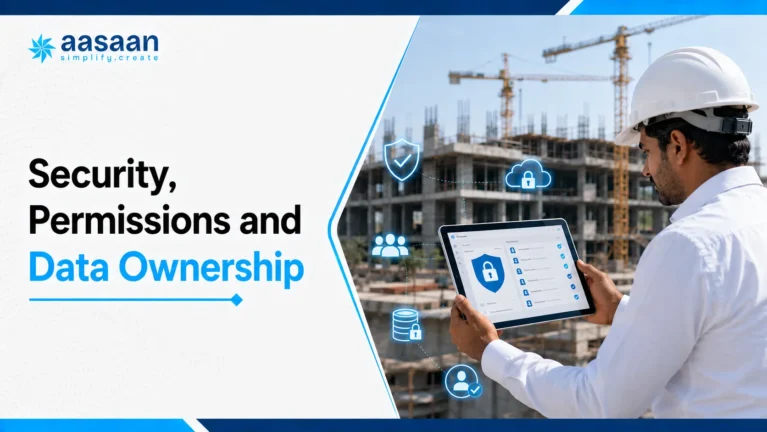
Security, Permissions and Data Ownership
Construction platforms may store commercial contracts, employee information, customer records, vendor prices, drawings, bills and project performance data. Security should therefore be evaluated as part of the buying decision rather than left entirely to the IT team after selection.
Role-based access control
Users should receive access according to company, project, module, role and responsibility. A storekeeper may need inventory access for one project. A consultant may need document and inspection access without commercial visibility. Leadership may need consolidated reporting across all projects.
The platform should support:
- Role and project-based permissions
- View, create, edit, approve and delete controls
- Approval authority based on value or hierarchy
- External vendor and consultant access
- User deactivation and access review
- Audit trails for important actions
- Restricted access to sensitive commercial data
- Controlled document sharing and downloading
Audit trails
An audit trail should show who created, edited, approved, rejected or cancelled a transaction and when the action occurred. Important changes should preserve previous values or revision history.
This capability supports accountability, internal review and dispute resolution. It is especially important for purchase orders, bills, measurements, drawings, approvals and master-data changes.
Data backup and availability
Ask vendors about backup frequency, recovery procedures, uptime commitments and incident response. Also understand how mobile or offline transactions behave when connectivity is interrupted.
Data ownership and export
The contract should clearly state that the customer owns its business data. Buyers should understand which formats are available for export, whether attachments and audit history can be exported, and what happens when the subscription ends.
A basic spreadsheet export may be insufficient when the system contains relationships among transactions, approvals, images and documents. The exit process should be discussed before signing, not only when the organization decides to change platforms.
AI and sensitive information
When AI processes project documents, messages or commercial information, the organization should understand how that data is handled. Ask whether customer information is used to train shared models, how it is isolated, how long it is retained and which third-party services participate in the workflow.

Common Construction Software Buying Mistakes
Many software failures begin before implementation. They occur when the organization chooses the product using unclear requirements, incomplete evaluation or unrealistic expectations.
Mistake 1: Buying the longest feature list
A platform may claim hundreds of features while the organization needs ten workflows to work extremely well. Feature count does not prove usability, integration or adoption.
Better approach:
identify the critical workflows and test them end to end using real scenarios.
Mistake 2: Choosing software only on price
The lowest subscription can become expensive when the organization needs several additional tools, manual reconciliation or custom development.
Better approach:
compare three-year TCO and expected operational benefit.
Mistake 3: Letting only leadership or IT evaluate the platform
Leadership understands strategic needs, while site and department users understand daily operating friction. Excluding either group creates an incomplete decision.
Better approach:
include project, site, commercial, procurement, finance and IT representatives.
Mistake 4: Treating implementation as software installation
Software cannot independently define roles, clean data, standardize approvals or convince users to change their daily behavior.
Better approach:
create a joint implementation plan covering process, data, training, governance and adoption.
Mistake 5: Customizing every existing process
Some current workflows exist because of spreadsheet limitations or historical habits. Recreating every step can make the new system unnecessarily complex.
Better approach:
simplify and standardize before requesting customization.
Mistake 6: Rolling out every module at once
A large simultaneous rollout can overwhelm users and make it difficult to identify the cause of problems.
Better approach:
start with high-value workflows, stabilize them and expand in phases.
Mistake 7: Migrating poor-quality data
Duplicate vendors, inconsistent material names and incomplete project structures reduce trust in the new system.
Better approach:
clean, standardize and assign ownership before migration.
Mistake 8: Focusing only on dashboards
Dashboards look impressive, but their value depends on accurate source transactions and clear definitions.
Better approach:
test how every important number is created and whether users can drill down to evidence.
Mistake 9: Ignoring adoption measurement
Login counts do not show whether users are completing the required workflows correctly.
Better approach:
track reporting compliance, source entry, approval ageing, data quality and use of unofficial systems.
Mistake 10: Accepting vague integration claims
A vendor may describe a CSV export as an integration or demonstrate only a limited part of the required connection.
Better approach:
document every field, direction, frequency, edit rule and failure-handling process.
Mistake 11: Skipping contract and exit review
Organizations often review data ownership, renewal increases and export limitations only after the relationship has begun.
Better approach:
confirm commercial, service, security and exit terms before signing.
Mistake 12: Expecting AI to repair weak processes automatically
AI can structure information and highlight patterns, but incomplete master data and unclear approvals still create unreliable outcomes.
Better approach:
build strong workflows first and use AI to reduce effort and improve intelligence within them.
Construction software succeeds when people, process and technology reinforce one another.
The buying decision should evaluate all three.
Ready to Modernize Your Construction Operations?
Book a personalized demo and see how Aasaan can fit your current workflows across site and office teams.
Book a Demo

Final Pre-Purchase Checklist
Before signing the software agreement, confirm that the buying team can answer the following questions clearly.
- Which three business problems will the first phase solve?
- Which projects, modules and users are included?
- Who owns the implementation internally?
- Which workflows were demonstrated end to end?
- How will data be cleaned and migrated?
- Which integrations are contractually included?
- How will site adoption be supported?
- Which outcomes will be measured after 30, 60 and 90 days?
- What is the complete three-year cost?
- What support and escalation commitments apply?
- How is sensitive data protected?
- How can all data be exported in the future?
If several answers remain uncertain, the organization is still comparing product claims rather than evaluating an implementation-ready solution.
Construction Management Software Trends for 2026 and Beyond
Construction software is moving beyond isolated digital forms and standalone reporting tools. The next phase focuses on connecting project data, reducing manual effort and helping teams act on information earlier.
The most valuable platforms will combine site capture, project controls, commercial workflows, documents, communication and analytics within a connected operating environment. Technology will support decisions, while experienced construction professionals remain responsible for judgement, approval and execution.
1. Connected platforms will replace fragmented point solutions
Many construction organizations currently use separate systems for attendance, planning, procurement, inventory, billing, document management, customer management and accounting. Each product may solve an individual problem, but the organization still spends time moving data between systems.
Connected construction platforms aim to create a continuous flow of information. A material requirement raised against a planned activity can move through stock verification, procurement, approval, receipt, issue, consumption and cost reporting without repeated data entry.
This shift will increase demand for platforms that provide:
- Connected project and commercial workflows
- Shared master data across departments
- Common project, cost and document structures
- Role-based dashboards using the same source records
- APIs for accounting and specialist applications
- Portfolio-wide reporting across multiple projects
Buyers should evaluate how information moves through the system rather than counting individual features. A connected workflow often creates more value than several advanced but isolated modules.
2. AI will become part of everyday construction workflows
Artificial intelligence in construction software is developing from a separate chatbot or experimental feature into a layer that supports daily work.
Practical AI applications may include:
- Converting voice notes into structured daily reports
- Extracting information from bills, challans and documents
- Summarizing project activity for management
- Identifying delayed tasks and ageing approvals
- Highlighting unusual material or labour patterns
- Comparing quotations and commercial documents
- Classifying photos, issues and site observations
- Answering questions using authorized project information
- Drafting reports, reminders and follow-up actions
The value of AI will depend on the quality and accessibility of the underlying project data. AI connected to structured BOQ, schedule, procurement, inventory, billing and document records can provide more useful answers than an AI assistant working with scattered files.
AI buying principle:
evaluate the workflow created by the AI feature. Ask what input it receives, which records it updates, how users verify the output and what action follows.
3. Predictive analytics will support earlier intervention
Traditional reports describe what has already happened. Predictive analytics aims to identify conditions that may affect future outcomes.
A construction platform may combine historical and current project information to highlight:
- Activities with a rising delay risk
- Materials likely to become unavailable before planned work
- Approvals creating schedule pressure
- Budget categories with unusual cost movement
- Projects with deteriorating productivity
- Subcontractor bills requiring closer review
- Quality or safety areas showing repeated issues
These insights should be treated as decision support. Project managers still need to understand site conditions, contractual responsibilities and operational constraints before taking action.
4. WhatsApp and conversational workflows will expand
Site teams often communicate through WhatsApp because it is familiar, fast and already part of their daily routine. Construction platforms can use this behaviour as an adoption channel rather than forcing every user to begin with a complex interface.
Conversational workflows can allow teams to submit:
- Daily progress updates
- Attendance information
- Material receipts and requirements
- Site photos and voice notes
- Quality and safety observations
- Approval responses
- Project questions and status requests
The software should convert these interactions into structured, traceable project data. A WhatsApp message alone remains communication. A message connected to the relevant project, activity, document, user and approval becomes part of a controlled workflow.
Aasaan’s WhatsApp integration and Raaya AI reflect this direction by helping teams communicate through a familiar channel while management receives organized project information and dashboard visibility.
5. Mobile-first site reporting will become the standard
Construction information creates maximum value when it is recorded close to the time and place where the activity occurs. Mobile-first systems reduce the gap between site execution and office reporting.
The strongest mobile workflows will focus on:
- Fast data entry with fewer required fields
- Photo, video, voice and document capture
- Location and time context where appropriate
- Offline or weak-network usability
- Role-specific screens and permissions
- Automatic connection with BOQ, schedule and cost records
- Simple correction and approval processes
Desktop applications will remain important for planning, commercial analysis and administration. Mobile access will increasingly become the primary operational interface for field users.
6. BIM and project-management data will become more connected
Building Information Modelling provides a visual and information-rich representation of the built asset. Construction management software controls the operational processes through which the project is delivered.
Connecting these environments can help teams relate drawings and model elements to:
- Planned and completed work
- Quantities and BOQ items
- RFIs and design decisions
- Quality observations
- Material and equipment requirements
- Cost and progress information
- Handover and asset records
Buyers should assess the level of integration required for their organization. Some teams need basic document and model access. Others require deeper model-based coordination, quantity workflows or digital handover.
7. Reality capture will improve progress verification
Site photos, 360-degree imagery, drones, laser scanning and other reality-capture methods can create a more complete record of physical progress.
When connected with project software, reality capture can support:
- Remote progress review
- Visual comparison across reporting periods
- Measurement and verification support
- Quality and safety documentation
- Dispute and claim records
- As-built documentation
The software should organize visual evidence by project, date, location, activity and responsible team. Large collections of unclassified photos become difficult to review and provide limited management value.

Frequently Asked Questions About Construction Management Software
What is construction management software?
Construction management software is a digital platform used to plan, execute, monitor and control construction projects. It can manage schedules, progress, daily reports, procurement, inventory, labour, billing, documents, quality, safety, costs and management reporting. Broader platforms may also include ERP, CRM, asset management, finance integrations and AI-supported workflows.
Which is the best construction management software in India?
The best construction management software depends on the organization’s workflows, project scale, users, integrations and implementation requirements. Builders and developers should compare project management, BOQ, procurement, inventory, labour, billing, DMS, reporting, CRM, mobile usability, WhatsApp workflows, support and total cost of ownership. A scenario-based pilot is more reliable than selecting a platform from a generic ranking.
How is construction management software different from construction ERP?
Construction management software commonly focuses on project execution, planning, site reporting, documents, quality and collaboration. Construction ERP connects project activity with procurement, inventory, labour, billing, finance, CRM, assets and company-wide controls. Some modern platforms combine both categories, making the product label less important than the actual workflow coverage.
Who should use construction management software?
Construction management software can be used by builders, real estate developers, architects, project-management consultants, infrastructure companies, engineering organizations and specialized project teams. Users may include directors, project managers, engineers, planning teams, quantity surveyors, procurement teams, storekeepers, HR, finance teams, sales teams, consultants and vendors.
What features should construction management software include?
Important features include project planning, DPR, BOQ, budget control, procurement, inventory, labour, attendance, measurements, RA billing, client billing, DMS, quality, safety, dashboards, mobile access, approval workflows and audit trails. Developers may also require property sales CRM, customer management, asset tracking and finance integration.
Can construction software manage multiple projects?
Yes. Multi-project software can organize information by company, project, phase, tower, floor, zone, package, cost code or other project structure. Management can review individual projects and consolidated portfolio performance. Buyers should verify permissions, inter-project transactions, shared vendors, centralized procurement and consolidated reporting.
Can construction management software track project costs?
Yes. Cost-control capabilities may include budgets, BOQ values, purchase commitments, work orders, material consumption, subcontractor bills, expenses, variations, client billing, forecast cost and budget-versus-actual reporting. The depth of cost control varies across platforms, so buyers should test their actual commercial workflow.
Can construction software manage BOQ?
Construction software can create or import BOQs, organize items by project structure, connect quantities with budgets, track measurements and link commercial transactions with BOQ items. Advanced systems can compare planned quantities, completed work, billed work, material consumption and remaining value.
Can construction software manage procurement and inventory?
Yes. A connected workflow can manage material requirements, stock checks, indents, approvals, quotation comparison, purchase orders, goods receipt, inspection, material issue, return, transfer and reconciliation. Connecting procurement with the project schedule and BOQ improves planning and cost visibility.
Can it track labour attendance and productivity?
Construction software can record attendance, labour deployment, contractor-wise manpower, trade categories, wage information and work locations. When attendance and progress are connected, teams can compare labour input with completed quantities or activities. The exact capabilities depend on the selected platform and attendance method.
What is DPR in construction software?
DPR means Daily Progress Report. A digital DPR can record work completed, manpower, equipment, materials, weather, delays, issues, safety observations and site photos. The software can organize these updates by activity and location, creating a searchable project record and supporting planned-versus-actual reporting.
Can construction management software work through WhatsApp?
Some platforms support WhatsApp-based construction workflows. Site users may submit text, photos, documents or voice notes through WhatsApp, while the system converts the information into organized project data. Buyers should confirm security, user identification, approval control and how WhatsApp information connects with the main system.
How does AI help construction management?
AI can reduce repetitive work by extracting document information, structuring site updates, summarizing project activity, identifying unusual patterns and helping users find relevant information. Predictive models may also support risk and schedule analysis. Human verification remains important for technical, contractual and financial decisions.
Can construction software integrate with Tally?
Many construction platforms offer Tally integration or accounting exports. The connection may transfer ledgers, vouchers, purchase records, bills, taxes, cost centres and payment information. Buyers should verify the exact fields, transfer direction, frequency, edit rules and error-handling process before selection.
How much does construction management software cost in India?
Pricing depends on users, projects, modules, implementation effort, data migration, integrations, support and contract duration. Lightweight tools may use monthly per-user pricing, while full construction ERP platforms may use annual, module-based or enterprise pricing. Buyers should compare three-year total cost of ownership rather than only the subscription fee.
How long does construction software implementation take?
A focused pilot may begin within a few weeks, while a multi-module ERP rollout can take several months. The timeline depends on process clarity, data quality, customization, integrations, user availability and project scope. A phased 90-day roadmap can establish a strong first implementation for many organizations.
How is construction software ROI calculated?
ROI can be calculated by subtracting total cost of ownership from quantified benefits, dividing the result by total cost and multiplying by 100. Benefits may include lower material wastage, reduced attendance leakage, faster reporting, improved billing, fewer delays, lower rework and better management productivity.
Is cloud construction software secure?
Cloud software can provide strong security when supported by appropriate access controls, encryption, backups, monitoring and vendor governance. Buyers should review hosting, data isolation, audit trails, recovery procedures, user permissions, incident response and data-export terms rather than assuming every cloud platform offers the same protection.
How should construction software vendors be compared?
Use a weighted scorecard covering business fit, site usability, project controls, commercial workflows, procurement, documents, reporting, integrations, implementation, support, security and total cost. Ask every vendor to demonstrate the same end-to-end scenarios and involve actual users in the evaluation.
What is Aasaan Construction ERP?
Aasaan is a construction technology platform designed for builders, developers, architects and project teams. It brings project management, procurement, inventory, HR and labour, billing, document management, CRM, assets, reporting and AI-supported workflows into a connected environment.
What is Raaya AI?
Raaya AI is Aasaan’s AI layer for construction workflows. It helps convert information such as messages, voice notes, photographs and documents into organized project data, summaries and actionable visibility. Its purpose is to reduce manual effort and help management receive useful information faster.

How to Choose the Right Construction Management Software
The right construction management software should match the way your organization plans, executes, controls and reviews projects. It should support daily site activity while giving management reliable information across projects, departments and business functions.
A platform should be evaluated on the complete operating workflow rather than a single feature, dashboard or commercial proposal. The strongest choice is usually the system that combines sufficient functional depth with practical usability, implementation support and measurable business value.
Prioritize your highest-impact workflows
Begin with the areas where poor visibility or manual coordination creates the greatest financial and operational impact.
For many builders and developers, these areas include:
- Project planning and progress visibility
- Daily site reporting
- Material procurement and inventory control
- Labour attendance and deployment
- BOQ, measurement and RA billing
- Drawing and document management
- Quality and safety issue closure
- Budget and cost monitoring
- Property sales and customer management
- Portfolio-level management reporting
These priorities should determine the product demonstration, pilot scope, evaluation scorecard and implementation roadmap.
Choose connected workflows over isolated features
A useful construction platform should allow information to move across departments. Project planning should inform material requirements. Procurement should update commitments. Inventory should reflect receipts and issues. Measurements should support billing. Management reports should use the same operational records.
When workflows remain disconnected, teams continue maintaining spreadsheets, sending repeated follow-ups and reconciling multiple versions of the same information.
Evaluate adoption before advanced functionality
A sophisticated feature creates limited value when the responsible team finds it difficult to use. Site engineers, storekeepers, supervisors and project managers should participate in the evaluation.
Test whether users can complete common activities quickly through mobile, web or familiar communication channels such as WhatsApp. The system should make daily reporting easier while improving structure, traceability and management visibility.
Assess the implementation partner as carefully as the product
Construction software implementation requires more than account creation. The organization may need support with workflow mapping, master data, migration, permissions, reporting, training and user adoption.
A strong implementation partner should understand the project environment, help simplify workflows and remain involved through stabilization. Vendor support becomes especially important when several departments and project sites move to a connected system.
Build the business case using measurable outcomes
Software selection becomes clearer when the buying team connects the investment with specific outcomes.
Examples include:
- Reducing material consumption variance
- Improving attendance accuracy
- Shortening procurement approval time
- Increasing daily reporting compliance
- Reducing RA bill checking time
- Improving recovery of billable work
- Reducing project delay overhead
- Lowering management reporting effort
These outcomes should be measured against a documented baseline after implementation.
Final selection principle:
choose the platform that solves priority workflows, fits actual users, connects operational data and receives strong implementation support at a sustainable total cost.
Why Builders and Developers Consider Aasaan
Aasaan is designed as a connected construction ERP and project-management platform for builders, developers, architects and project teams in India.
It brings important construction and business workflows into one environment, helping teams manage projects with stronger visibility and coordination.
Project execution
Project Management
Track progress, daily reports, site activity, planned work, issues and management updates across projects.
Commercial control
BOQ and Billing
Manage quantities, measurements, RA bills, client billing, cost visibility and commercial workflows.
Material control
Procurement and Inventory
Connect material requirements, approvals, quotation comparison, purchase orders, receipts, issues and stock.
Workforce management
HR and Labour
Manage employee information, labour attendance, deployment and workforce-related processes.
Document control
DMS
Organize drawings, documents, revisions, approvals and project information through a structured system.
Sales operations
Property Sales CRM
Manage leads, customers, telecalling, allotments, payments, agreements and sales-team activity.
Equipment visibility
Asset Management
Track company assets, allocation, transfers, maintenance, hiring, fuel usage and utilization.
Management intelligence
Dashboards and Reports
Provide leadership with organized information across projects, departments and operational workflows.
Raaya AI and WhatsApp-based construction workflows
Aasaan extends its construction platform through Raaya AI and WhatsApp integration. Site teams can share updates through a familiar communication channel, while the system helps convert those updates into structured project information.
This approach can support faster adoption by reducing the effort required to collect daily updates, photographs, voice notes and documents from project teams.
Management can receive organized information through dashboards and reports rather than manually searching through several WhatsApp groups, spreadsheets and email threads.
Hands-on implementation and adoption support
Software creates value when teams use it consistently. Aasaan supports customers after purchase by working directly with office and project teams, helping users understand workflows and encouraging practical adoption.
This implementation approach is valuable for construction organizations where different roles have different levels of software experience and daily responsibilities.

Conclusion
Construction management software has become an important operating system for builders, developers, architects and project teams managing multiple activities, departments and project locations.
The right platform can connect planning, daily reporting, procurement, inventory, labour, billing, documents, quality, CRM, assets and management reporting. It can reduce manual consolidation, improve accountability and help decision-makers receive project information faster.
Technology selection should begin with business problems rather than product features. Organizations should identify priority workflows, establish a measurable baseline, evaluate real user experience and compare vendors through scenario-based demonstrations.
Pricing should be assessed through total cost of ownership. ROI should be based on realistic improvements in material control, labour accuracy, billing, delays, reporting effort and management productivity.
Implementation should include process mapping, clean data, role-based training, pilot testing and continuous adoption measurement. Leadership participation remains essential because teams follow the system that management uses during daily and weekly reviews.
Construction software will continue evolving through AI, mobile workflows, WhatsApp integration, predictive analytics, connected project controls, reality capture and document intelligence. These technologies will provide the greatest value when they operate on reliable project data and support practical construction workflows.
For organizations looking to bring construction and business processes into one connected platform, Aasaan provides a combination of construction ERP, project management, WhatsApp workflows, Raaya AI and hands-on implementation support.
Sources and Methodology
This guide combines construction workflow analysis, Aasaan product
information and authoritative public sources on construction management
and digital project delivery in India. Product capabilities, pricing,
implementation timelines and outcomes should be validated against each
buyer’s requirements during a live, scenario-based evaluation.
Aasaan Construction ERP
Bring Every Project Update Into One Connected System
Manage project progress, procurement, inventory, labour, billing, documents, CRM, assets and management reporting through one construction platform.

Takshil Sharma researches construction technology, construction ERP, AI powered workflows, cost control and software buying decisions. He creates practical guides for builders, developers and architects evaluating digital systems for project and business operations.
Reviewed and updated in July 2026.

 Leads Management Capture, qualify, and follow up on every sales lead.
 Customer Management Keep customer profiles, history, and interactions in one place.
 Sales Funnel Track deals from first inquiry to final conversion.
 Task Management Assign and track sales follow-up tasks for the team.
 Documentation Store quotes, agreements, and customer documents together.
 Asset Register Maintain a complete register of machines, tools, and equipment.
 Machine Maintenance Schedule servicing and track breakdowns before they delay work.
 QR Code Updation Update asset details instantly by scanning QR codes.
 Asset Transfer/Depreciation Move assets across sites and track their value over time.
 GRN Record goods received against asset purchases and deliveries.
 Employee Attendance Mark daily attendance and keep a clear record of working hours.
 GPS/Location Tracking/GeoFence Verify on-site presence with GPS and geofence-based attendance.
 Payroll/Payslips Run payroll and share payslips without manual calculations.
 Expense Reimbursement Submit, approve, and settle employee expense claims easily.
 Leave Management Apply, approve, and track leave balances in one place.
 Daily Hajiri Record daily labour attendance and wages without paper registers.
 Biometric Devices Capture attendance from biometric devices at the site.
 Activity wise attendance Track which activity each worker was assigned to each day.
 QR Attendance Mark labour attendance quickly by scanning a QR code.
 Face Recognition Verify workers on site with face-based attendance.
 Purchase Request Raise and approve material purchase requests from site.
 Stock Management See live stock levels and avoid shortages or excess buying.
 Request for Quotation Collect vendor quotes before placing a material order.
 Site Transfer Move stock between sites and keep both inventories updated.
 Client Billing Raise client bills and track payments against work done.
 Supplier Billing Record supplier invoices and match them with received material.
 Ledger Record Keep party ledgers updated for every payment and receipt.
 Accounting and Payments Record accounts and process payments with a clear trail.
 Petty Expense Reimbursement Submit and settle small site expenses without cash leakage.
 Material Estimation/BOM Estimate materials and build a bill of materials before work starts.
 Location Breakdown Schedule Break the project into locations and plan work location by location.
 Activity BOQ estimation Estimate quantities and costs for each activity in the BOQ.
 Rate Analysis Build item rates from labour, material, and machinery costs.
 Depreciation & Scrap Track plant asset depreciation and scrap write-offs.
 Plant wise Production Track output separately for every plant and production line.
 Fuel Consumption Monitor fuel usage across plant machinery and vehicles.
 Maintenance, Service & Compliance Schedule plant maintenance, service, and compliance checks.
 Project Schedule Plan project timelines and keep every activity on schedule.
 Activity Based Tracking Track progress activity by activity instead of overall estimates.
 DPR Capture daily progress reports from site in a standard format.
 Track Progress Realtime See live project progress without waiting for end-of-day updates.
 Site Virtual walk 360° virtual site tours with AI issue detection.
 OCR Automation Extract data from challans, bills, and site documents.
 Command Ai Ask project questions and get instant AI answers.
 Voice Call BOT AI voice bots for follow-ups and negotiations.
 Intel Ai AI insights to control cost and project risks.
 WhatsApp Two-way WhatsApp updates for site and office teams.
 Google & Microsoft Connect Google and Microsoft tools with your workflow.
 RazorPay Accept and track payments through RazorPay.
 GST Portal Stay aligned with GST portal records and filings.
 SAP Connect SAP data with construction project workflows.


 Meta-Verified Business Integration Actionable project inbox with real-time alerts.
 Frictionless Stakeholder Collaboration Capture bills and GRNs directly to ERP.
 WhatsApp-Powered Sales CRM CRM chats with real-time sentiment analysis.
 WhatsApp-Powered Alerts & Reports Automated push notifications and daily reports.
 GPS - Live Tracking Real-time visibility of workforce and assets.
 Facial Scanning Secure, automated attendance via facial recognition.
 Labour Productivity Track workforce activity linked to payroll.
 Quote Comparison AI bots fetch and compare supplier rates.
 OCR - AI for Billing Auto-generate progress reports from site data.
 QR Based Asset Tracking Scan QR codes for instant asset history.
 Tally ERP Integration Seamlessly sync project data with Tally.
 Automated GST Compliance Automated GST compliance and reporting tools.