










































CONSTRUCTION CONNECTIONS · BUSINESS OPPORTUNITIES
How to Earn From Your Construction Industry Network
Earn from your construction industry network through consulting, supplier partnerships or software referrals. Aasaan offers construction professionals a referral option and channel partner tiers, with no joining fee, eligible subscription commissions and applicable annual renewal earnings. This guide explains suitable opportunities, practical introductions, commission structures and ways to get started.
The next business opportunity in your construction network could begin with a conversation you already have every week.
A builder tells you that material costs are difficult to track. A developer is tired of chasing site updates. A project head needs purchase approvals to move faster. You know the people, understand the context and can recognise when a useful introduction would help.
That combination has commercial value. With the right arrangement, you can earn through consulting, relevant business introductions, supplier partnerships or construction software referrals while helping people you already work with.
The starting point is simple: identify a genuine problem, connect the business with a suitable solution and agree how your contribution will be recognised. This guide explains the opportunities, the work behind them and how to explore a construction software partnership with Aasaan.
I have good connections in construction. How can I earn from them?

You can earn from construction industry connections by providing a defined service, introducing suitable clients to a business under an agreed referral arrangement, partnering with suppliers, or recommending construction software to companies with a genuine need. The best route depends on your expertise, access to decision makers, available time and willingness to stay involved.
For someone who knows builders, developers, contractors, architects or project heads, a construction software referral programme can be a relevant starting point. You identify the requirement and make a contextual introduction. The software provider evaluates the opportunity and takes it through the product and commercial process. Earnings depend on successful eligible business and the agreed partner terms.
Aasaan offers referral participation and a tiered channel partner programme, with no current joining fee or required upfront investment. Applicable arrangements can include annual renewal earnings while eligible customers continue. Review the specific structure before deciding how actively you want to participate.
What makes a construction network commercially valuable?

A list of phone numbers is only the beginning. A useful network gives you context: what a business builds, who makes decisions, which operational problems keep returning and when the team is ready to consider a change.
Suppose you know a developer managing several sites. You also know that procurement is centralised, site updates arrive in different formats and the accounts team spends time reconciling material records. That understanding allows you to suggest a relevant conversation. The introduction carries more value than forwarding a generic brochure to everyone in your contacts.
Relationships become a sustainable source of business when the recommendation helps the customer and the commercial arrangement rewards a real contribution. A referral fee should sit alongside that value, rather than become the reason to recommend a poor fit.
Three questions that reveal a worthwhile opportunity
Who trusts you enough to discuss a real business problem? Which of those problems can you competently address or introduce to a suitable provider? What role can you realistically play after the introduction?
Someone with deep costing experience may sell a defined consulting assignment. A material supplier with strong customer relationships may identify an opportunity for better procurement controls. An ERP consultant may help qualify software requirements and develop a more active channel partnership. The same industry network can support different business models.
Six ways to earn from your construction industry network

| Opportunity | Your contribution | How earnings may work | Best starting point |
|---|---|---|---|
| Construction consulting | Defined technical or operational expertise | Agreed fee for a scoped assignment | You can deliver and document a specific result |
| Project or service introductions | Connect a genuine requirement with a capable provider | Agreed referral fee on eligible business | You know both the need and a suitable service business |
| Supplier partnerships | Identify suitable material or equipment requirements | Agreed commercial or referral arrangement | You understand specifications, delivery and buyer needs |
| Construction software referrals | Introduce a company with a relevant software requirement | Eligible commission; renewal earnings where agreed | You know construction decision makers and recurring workflow problems |
| Active software channel partnership | Develop opportunities and support the agreed sales process | Tier specific economics tied to participation and performance | You want a repeatable technology business |
| Training and process support | Provide an authorised, scoped learning or process service | Agreed service fee | You have the skills and permission to deliver the service |
1. Offer a defined construction consulting service
A consultant can earn by helping a business solve a problem such as cost visibility, procurement process design, project reporting or document organisation. The customer pays for expertise and delivery, so the scope must say what you will produce, what information you need and when the assignment is complete.
For example, organising a monthly cost review around budgets, purchase commitments and actual costs is more specific than offering to “improve management.” This route suits people with relevant experience and enough time to perform the work. Referring software and delivering professional consulting are separate responsibilities; price and document them separately where both apply.
2. Make relevant project and service introductions
Construction businesses regularly need specialist capabilities, from design and surveying to execution support and technology. If you know a credible provider and a business with an actual requirement, you may be able to arrange a commercial introduction.
Confirm competence, capacity, scope and the referral arrangement before promising an outcome. Obtain permission to connect the parties. Your reputation remains involved even when another company delivers the service, so stay within what you can accurately represent.
3. Build supplier and equipment relationships
A trusted connection can help a buyer identify materials, equipment or specialist services appropriate to a project. This opportunity requires a clear understanding of the purchase, including specifications, delivery needs, service support and commercial terms.
A supplier partnership is different from a software referral. Product quality, delivery, credit and aftersales obligations may create additional responsibilities. Clarify who contracts with the customer and who answers for the supply. A recommendation should remain useful to the buyer after the introduction has been made.
4. Recommend construction software where the need is clear
Software referrals are relevant when a company repeatedly struggles with site updates, materials, approvals, labour records, billing, drawings or coordination across projects. Your industry experience helps you recognise the problem and introduce the people who can evaluate a solution.
You do not need to develop a software product to make this introduction. You do need to explain the business context accurately and avoid promising capabilities or results you have not verified. Aasaan’s programme creates a route for relevant introductions to become eligible partner business.
5. Develop a more active construction technology partnership
Some professionals want to build a pipeline rather than make occasional introductions. A channel partnership can involve more consistent account development, qualification and coordination around the provider’s sales process.
The responsibilities and economics depend on the programme and tier. Aasaan’s current structure distinguishes referral participation from Affiliate, Silver, Gold and Platinum channel tiers. An applicant should understand the applicable targets, level of involvement and earning terms before choosing this route. The application page is the current source for programme details.
6. Deliver training or process support within an agreed scope
People with suitable expertise may provide construction process training, reporting support or authorised implementation services. Here the customer is paying for work performed, and the provider must be qualified and authorised to deliver it.
Joining a referral programme does not itself make someone an implementation consultant or create a right to charge for a vendor’s services. If you want to offer training alongside a software partnership, discuss the responsibilities, permissions and pricing explicitly. Keep customer expectations clear from the outset.
Which earning opportunity fits your existing relationships?

Choose the route you can support well. A large network can be useful, but a smaller group of trusted relationships with clear business context may produce more relevant opportunities.
Construction consultants and PMCs
You often see problems across project reporting, approvals, procurement and commercial control. Separate issues you can solve through your own professional service from those that justify a software evaluation. A useful software introduction describes the existing process and the decision that management wants to improve.
Architects and civil engineers
Your relationships may involve project owners, developers and delivery teams. Drawing revisions, approvals, site reporting and coordination can provide an appropriate starting point. Keep the recommendation connected to the client’s problem and separate from any independent professional decision you are responsible for.
Material suppliers and equipment businesses
You may already know purchase teams, site engineers and business owners. Repeated material requests, delivery mismatches or unclear approval status can reveal a need for connected software. Explain the problem through the customer’s experience rather than using their purchasing relationship as pressure to join a demo.
ERP consultants and software resellers
You can assess how construction workflows connect with the customer’s accounting and business systems. This audience may be suited to a deeper channel model, but the agreement should define qualification, demonstrations, commercial discussions, implementation and support responsibilities.
Real estate consultants and professionals with developer contacts
Your network may include business owners, sales heads and project teams. Determine whether the requirement concerns property CRM, construction operations or both. Referring a developer to software is a different commercial activity from selling a property; use the appropriate agreement and explanation.
Association members and construction community organisers
A relevant educational session can help members understand a recurring operational problem. Invite interested people to an optional product discussion afterwards. Represent any commercial involvement clearly and follow the organisation’s rules rather than treating membership as permission to share everyone’s details.
Why construction software referrals can fit an established industry network

Construction technology is easiest to discuss when it is attached to a recognisable operating problem. A director may want reliable information across sites. Procurement may need a traceable request and approval process. Accounts may want bills linked to the supporting purchase and receipt. A project team may need drawings and progress records organised consistently.
A trusted industry contact can help the customer describe that problem before the software conversation begins. This makes the introduction more useful to both sides. The customer gets a discussion around an actual requirement, and the provider understands who should participate in the demonstration.
For the partner, software can create an additional revenue channel without developing and maintaining a product. Where the agreement includes renewals, the relationship may also create recurring earnings. Those earnings still depend on eligible business, customer payments and continuation under the agreed terms. The work includes qualification, permission, follow up and protecting the quality of the recommendation.
Referral partner, reseller or channel partner: understand the role

These labels are used differently across software companies. Always look beyond the label to understand who introduces the prospect, who contracts with the customer, who performs the demonstration and who owns support.
| Model | Typical involvement | Question to resolve |
|---|---|---|
| Referral partner | Identifies a relevant requirement and makes a useful introduction | When is the opportunity acknowledged and eligible for commission? |
| Channel partner | Develops repeatable business with the provider under an agreed model | What targets, responsibilities and earnings apply to the selected tier? |
| Reseller | May sell or contract for software under an authorised arrangement | Who invoices, sets prices and supports the customer? |
| Implementation or services partner | Delivers specifically authorised configuration, training or other services | What skills, permissions, delivery obligations and fees apply? |
Aasaan’s programme includes referral participation and tiered channel options. Do not assume that every applicant has the same responsibilities or commission structure. Use the programme discussion to choose the arrangement that matches your experience and intended contribution.
How earning with Aasaan works

Aasaan is an AI powered construction management platform covering ERP, project management, CRM, labour and HR, design and document workflows, with AI capabilities and 2 way WhatsApp integration. A partner’s role is to recognise a business requirement that may fit these workflows and help create a relevant conversation.
The current programme has no joining fee, deposit or required upfront investment, and no territory restriction. Applicable partner arrangements can include renewal earnings while eligible referred customers continue. Aasaan describes commission processing as generally occurring within approximately one week after receiving the eligible client payment, according to the agreed commercial and invoicing terms.
Exact percentages, revenue categories, targets and eligibility depend on the referral arrangement or channel tier. Review them on the programme page and confirm the applicable structure with the team. The article’s purpose is to help you understand the opportunity; the specific agreement defines your commercial relationship.
The only joining fee is trust.
Bring relevant relationships, accurate information and a genuine intention to help the customer. Aasaan provides the construction technology and takes the opportunity through the relevant product and commercial journey.
What you can introduce in simple business language
Describe the problem first. For ERP, that might mean connecting material requests, procurement, receipts and billing. For project management, it may mean seeing planned work and actual progress together. For CRM, it may mean keeping lead ownership, follow ups and customer information organised.
For labour and HR, it may involve attendance, workforce records and payroll inputs. Design and document management may address revisions, comments and approvals. With WhatsApp, the discussion can focus on practical reporting and approval participation through a familiar channel. Let the live demonstration confirm how those capabilities fit the customer’s exact process.
To understand the product before making an introduction, explore Aasaan’s construction ERP guide, project management software guide and construction CRM guide.
How to recognise a construction company worth introducing

A business becomes a useful referral prospect when a recognisable problem, a relevant person and willingness to evaluate a solution come together. Knowing the owner’s number is helpful, but understanding why the conversation matters is more important.
Listen for recurring problems
Examples include “we keep asking sites for updates,” “purchase approvals get stuck,” “stock and consumption do not reconcile,” or “accounts has to chase supporting documents.” These comments give you a starting point for discovery. Ask what happens today, who is affected and what a better outcome would look like.
Avoid turning every operational complaint into a software pitch. A process change, training or another professional service may be more appropriate. Introduce software when connected records, repeatable controls and shared visibility are part of the requirement.
Identify the people needed for the discussion
The business owner may sponsor the evaluation, while the project head, purchase manager, accounts team or site engineer explains the workflow. A useful introduction includes both commercial access and operating context.
Record the company, contact role, problem, existing tools, appropriate next step and permission to connect. Share enough information to make the conversation productive without forwarding confidential project documents or an entire contact database.
A practical route from first conversation to eligible partner business

-
Apply and understand the arrangement
Review the programme, explain your network and confirm the relevant referral or channel structure. Understand commission eligibility, responsibilities and attribution before developing opportunities.
-
Describe the requirement
Ask the prospect how the process currently works. Identify one or two priorities, the people involved and what they want the evaluation to answer.
-
Get permission for an introduction
Ask whether the contact is comfortable speaking with Aasaan and sharing their relevant business contact details. Agree a suitable next step.
-
Check the account’s existing status
Give Aasaan the company context so the team can check whether it is a new opportunity, an early conversation or already at an advanced commercial stage.
-
Make a contextual introduction
Explain who the people are, the problem they want to discuss and why a conversation could help. Remain available to clarify the relationship and coordinate the next step.
-
Support the agreed process
Aasaan reviews requirements and takes the opportunity through relevant demonstrations and commercial discussions. Your involvement should follow the applicable partner arrangement.
-
Confirm eligibility and payment
A contact submission alone is not a commission event. Eligible business, client payment and the agreed commercial terms determine partner earnings.
-
Maintain the relationship responsibly
Stay helpful after the introduction without making unverified commitments. Where renewal earnings apply, understand the customer continuation and partner agreement conditions.
What to say when introducing Aasaan to a contact
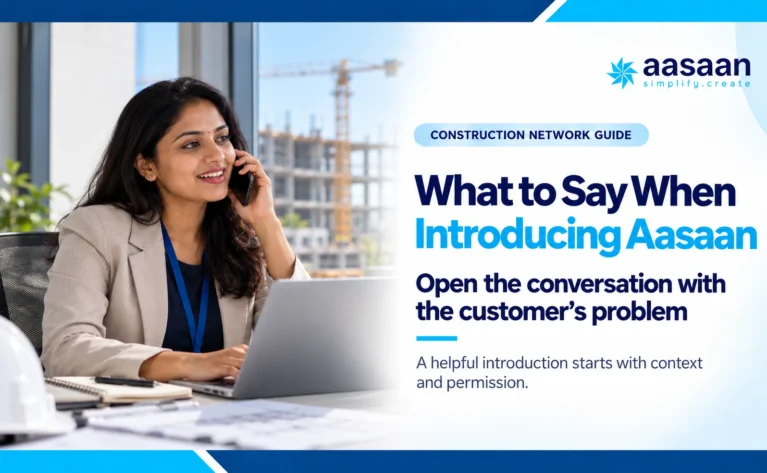
The most effective opening sounds like a relevant business conversation. Start with the problem the person has already mentioned, then ask whether a short introduction would be useful. Keep product claims within what you know and let the demonstration establish the fit.
For a builder or developer
You mentioned that site updates and purchase approvals take a lot of follow up. I know the team at Aasaan, which works on connected construction operations. Would you like me to introduce you so you can see whether it suits your process?
For a project head
Your team is already managing progress, material requests and site reports every day. Aasaan may be worth evaluating for how those records connect. If you are interested, I can help arrange a discussion around one actual workflow.
For an accounts or procurement contact
You mentioned the effort involved in matching bills with purchases and receipts. Would a demonstration of the connected request, PO, GRN and bill process be useful? I can introduce Aasaan and share the workflow you want to evaluate.
When explaining your referral relationship
I participate in Aasaan’s partner programme and may receive a commission if this becomes eligible business. I am suggesting the conversation because it relates to the problem you described. You can assess the product and commercial proposal directly with the team.
After an introduction, follow up on a useful next step: whether the right people attended, whether the workflow was demonstrated or whether a question remains unresolved. Avoid repeated messages asking for a purchase decision when the customer is still evaluating the product.
Aasaan referral commission and channel partner earnings

The confirmed programme gives you two ways to participate. For occasional introductions, the referral only option provides 5% of the applicable subscription amount, subject to eligibility and agreed commercial terms. For active business development, four channel tiers provide different shares of eligible one time, subscription and renewal revenue.
| Tier | Revenue target over six months | One time revenue share | Subscription share | Renewal share |
|---|---|---|---|---|
| Affiliate | ₹0 to ₹10 lakh | 5% | 15% | 2.5% |
| Silver | ₹10 to ₹20 lakh | 10% | 20% | 7.5% |
| Gold | ₹20 to ₹30 lakh | 10% | 25% | 10% |
| Platinum | ₹30 lakh and above | 10% | 30% | 10% |
These are separate revenue categories. Apply each percentage to its corresponding eligible revenue base, rather than adding the percentages together. The six month figures describe tier targets, not promised partner income. Confirm treatment of the exact ₹10 lakh, ₹20 lakh and ₹30 lakh boundaries with Aasaan because the published bands share endpoints.
What does up to 30% subscription share mean?
The highest listed subscription share is 30% under Platinum, associated with ₹30 lakh or more in applicable six month revenue. It is not the starting rate for every applicant. Affiliate lists 15%, Silver 20% and Gold 25%. Renewal shares are 2.5%, 7.5%, 10% and 10% respectively under the confirmed channel structure.
A simple referral example
If the agreed eligible subscription amount is ₹1,00,000 and an opportunity qualifies under the 5% referral only arrangement, the illustrative commission is ₹5,000 before any applicable tax treatment or other agreed adjustments. This example does not represent Aasaan pricing or a typical customer value. Do not assume a renewal rate for the referral only option: the reference lists its subscription share, while renewal eligibility must be confirmed separately.
Explore the partnership route that fits you

Use these tools to organise your next conversation. The route finder is guidance, and the calculator uses the confirmed programme percentages. Neither approves a partnership nor establishes your eligibility.
Partner route finder
Illustrative partner earnings calculator
Enter eligible amounts already agreed for a hypothetical opportunity. Subscription and renewal inputs are separate bases. This tool does not infer your tier from the amounts entered.
Illustrative only. Amounts exclude GST calculations and any commercial adjustments. Actual commission requires eligible business, confirmed attribution, the applicable agreement and customer payment. Renewals depend on customer continuation. The referral only renewal and one time rates are not specified in the reference.
The tools require JavaScript. The commission table above and the full article remain readable without it. Ask Aasaan to confirm your route and eligible calculations.
How to think about commissions and recurring income realistically

Separate the size of your network from the number of eligible customers it may produce. A useful relationship can lead to a conversation. Some conversations become demonstrations. Some opportunities proceed to a proposal and an eligible paid sale. Each step depends on the customer’s needs and decision.
For a programme with recurring commissions, distinguish initial eligible earnings from subsequent renewal earnings. A customer that continues can create another eligible event under the agreement. A customer that stops renewing will not produce the same continuing revenue. Treat those as separate scenarios rather than assuming every introduction becomes permanent income.
A planning framework without an invented commission rate
Initial eligible earnings = the applicable commission calculated on eligible paid business under your arrangement.
Renewal eligible earnings = the applicable renewal commission calculated on eligible customer renewals under your arrangement.
Net business result also accounts for the time and expenses you incur. Use Aasaan’s actual agreed percentages and eligible revenue definitions when preparing an earnings estimate.
Track the opportunity, not just the contact
A simple working record can include company name, permission to connect, decision maker, main requirement, introduction date, acknowledged attribution, next action, current stage and the applicable commercial arrangement. Keep client payment and partner payment status distinct.
If you are comparing programmes, ask how cancellations, refunds, renewals, plan changes and jointly developed opportunities affect eligibility. Clarify the process for checking and resolving a discrepancy. A useful programme should make the commercial journey understandable before you depend on forecast earnings.
Protect the relationships that make the opportunity possible

Your network is valuable because people trust your judgement. A sustainable referral business builds on that trust by making relevant recommendations, explaining commercial involvement and respecting the customer’s decision.
Obtain permission before sharing contact details. Keep confidential drawings, quotations, financial reports and project data within the agreed evaluation process. Describe the problem accurately and allow the provider to confirm scope, integration, implementation and commercial commitments.
Some professional roles, employment arrangements or client agreements may restrict commissions or require disclosure. Check the rules that apply to your role before accepting an arrangement. For example, someone responsible for independently evaluating a purchase should resolve any conflict before taking a financial interest in the recommendation. This is part of protecting the business relationship, not merely completing a form.
What to check before joining any construction software partner programme

- Who is eligible to join and what contribution is expected?
- Is the model referral, channel sales, resale or services?
- What commission applies to initial revenue and renewals?
- Which revenue is eligible and which payments trigger processing?
- How are introduced opportunities acknowledged?
- What happens when the provider already knows the company?
- How are contributions handled when more than one partner is involved?
- Who owns demonstrations, proposals, implementation and customer support?
- Do targets, territory rules or restrictions apply?
- How can a partner review earnings and resolve an attribution question?
Read these answers in the programme’s current terms and confirm the arrangement relevant to you. A general marketing statement does not replace the agreed commission calculation or operating responsibilities.
Your first month: build a repeatable introduction process

Use the first month to establish relevance and a reliable process. The outline below is a suggested working plan, not a promise of deals or earnings within a fixed time.
Week 1: understand the offer and your relationships
Read the programme terms and learn the construction workflows you can explain accurately. Review your existing relationships and identify people who have discussed a relevant operating challenge. Choose a manageable list rather than mass messaging your entire network.
Week 2: have discovery conversations
Ask about the present process, the affected teams and the desired outcome. Note whether there is genuine interest in evaluating a solution. Obtain permission for a suitable introduction and clarify the next step.
Week 3: make contextual introductions
Share the prospect’s agreed context with Aasaan, confirm account status and coordinate the right participants. Record what happened and which questions need answers. Review your involvement against the partner arrangement.
Week 4: improve the process
Look at the quality of the conversations and introductions. Were the contacts relevant? Did the right decision makers participate? Was the demonstrated workflow connected to the original problem? Improve your next introduction based on those observations.
Why consider Aasaan for a construction software partnership?
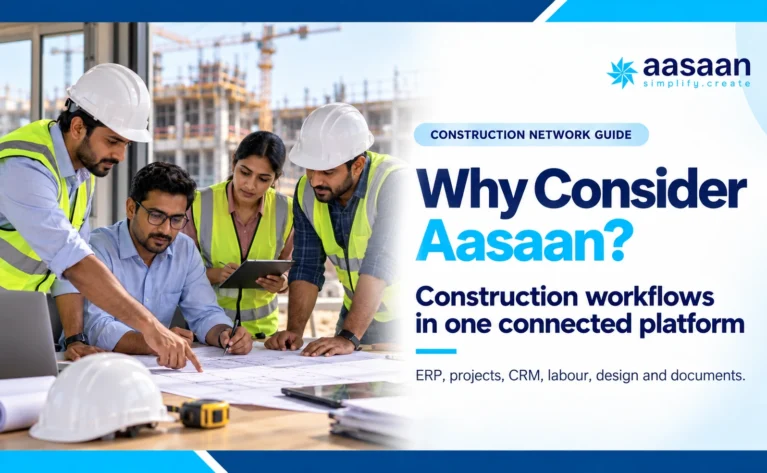
Aasaan’s proposition connects construction operations across ERP, projects, CRM, labour and HR, design and documents, alongside AI and WhatsApp workflows. For someone embedded in the industry, this creates several relevant conversation starters around everyday business processes.
The partner programme allows you to explore this opportunity without a current joining fee or required upfront investment, and without a territory restriction. The appropriate referral or channel structure depends on your role and contribution. Applicable renewal economics create a reason to think about customer fit and continuation, rather than only an initial introduction.
Aasaan’s CTS ’26 event recap shares its two ConTech awards and highlights from the event. Explore the recap to learn more about Aasaan’s participation and recognition. For a potential referral, use the product demonstration and agreed scope to assess whether Aasaan suits the customer’s requirements.
Questions about earning from construction connections

I have good connections in the construction industry. How can I use them to earn money?
Start by identifying the problems your contacts already discuss with you. Depending on your expertise, you could offer a scoped consulting service, make agreed business introductions, develop supplier relationships or refer companies to suitable construction software. Choose a route that creates genuine value for the customer and has a clear commercial arrangement.
For a software referral, understand the requirement, get permission to connect the company and make a useful introduction. Discuss eligibility and attribution before expecting commission. Aasaan’s programme is one route for professionals who know relevant construction businesses. The quality of the problem and relationship matters more than the size of your contact list.
Can I earn by referring builders and developers to software companies?
Yes, where the software provider offers an applicable referral arrangement and the introduction becomes eligible business under its terms. A builder or developer with recurring problems in reporting, procurement, labour, billing or customer management may have a reason to evaluate construction software.
Your role is to identify that need accurately and arrange an introduction with permission. The provider evaluates product fit and commercial scope. Ask how the opportunity is recorded, whether the account is already active and what triggers commission. Aasaan provides referral and channel options, but submitting a contact alone should not be confused with earning a payout.
What is a construction software channel partner?
A construction software channel partner develops relevant business opportunities for a software provider under an agreed programme. The work can include identifying suitable companies, understanding operating problems, coordinating introductions and supporting the agreed sales journey. More active tiers may involve targets and a repeatable account development process.
Responsibilities differ between providers and partner models. Some relationships focus on referrals; others involve sales, resale or authorised services. Aasaan’s programme includes referral participation and tiered channel arrangements. Confirm who handles demonstrations, proposals, implementation and support rather than assuming the same duties apply to every applicant.
Can construction consultants and PMCs build an additional income stream this way?
Construction consultants and PMCs often understand the operational context behind software requirements. They may recognise problems in reporting, procurement, document control or cost visibility across several clients. That makes them well placed to arrange a relevant technology conversation where the client wants one.
Keep professional advice and referral compensation clear. Review your client commitments and any independence or disclosure requirements before participating. If you separately provide consulting services, document that scope and fee instead of implying it is automatically part of the software partnership. A useful introduction should support the client’s decision and preserve the trust that makes your advice valuable.
Can architects and civil engineers become Aasaan partners?
Architects and civil engineers can apply to Aasaan’s programme. Their relationships may include developers, project owners, contractors and project heads who face recurring coordination or information problems. Drawing revisions, approvals, daily progress and site to office visibility can be practical starting points for discussion.
The introduction should relate to a genuine requirement and your contact should agree to the conversation. Check any professional, employment or client restrictions relevant to your role. Joining the programme does not require you to promise a particular result or represent yourself as a certified implementation expert. Let the appropriate Aasaan team establish the product fit.
Can construction material suppliers earn referral income?
Material suppliers can apply when they have relevant relationships with construction companies and can identify a software requirement. Their daily interactions with purchase teams, stores and site personnel may reveal problems involving requests, approval status, receipts or bill documentation.
Keep the software recommendation separate from pressure around an existing material order. Ask whether the customer wants an introduction and explain any applicable referral relationship. Earnings depend on eligible business under the agreed programme, rather than the value of the customer’s material purchases. A helpful introduction connects the business problem with the people who can evaluate a suitable solution.
Can real estate agents and consultants participate?
Real estate professionals with relevant construction business relationships can explore the programme. A contact at a developer may be evaluating property CRM, construction operations or better coordination between departments. Establish the nature of the requirement before arranging a software discussion.
A construction software referral is different from introducing a property buyer or earning a property sales commission. The software programme has its own eligibility, attribution and payment terms. Explain that distinction to the contact and confirm the arrangement with Aasaan. Focus on businesses whose needs match the product rather than assuming every property transaction creates a software opportunity.
Do I need technical knowledge to refer a construction company?
You need enough product understanding to make an accurate introduction, but you do not need to build the software yourself. Begin with the business workflow: what happens today, what is difficult, who uses the records and what management wants to improve. That context is useful even before technical questions are explored.
Aasaan can take the opportunity through relevant product demonstrations and commercial discussions. Your particular responsibilities depend on the selected arrangement. If you want to provide technical implementation or training services, discuss the skills and authorisation required separately. Avoid promising integrations, timelines or features that the team has not confirmed.
Is there a joining fee or upfront investment for Aasaan partners?
Aasaan’s current partner programme does not require a joining fee, deposit or upfront investment to enter. The contribution is based on relevant relationships, market understanding and the ability to identify or develop useful opportunities. The programme page expresses this as the only joining fee being trust.
Participation still requires time and effort. You may spend time learning the product, understanding client needs, coordinating introductions and following up. If you choose to incur travel, marketing or other business expenses, assess those separately. Zero joining fee describes programme entry; it does not mean every participant has identical costs or outcomes.
How much commission can I earn through Aasaan?
The confirmed referral only arrangement provides 5% of the applicable subscription amount. Channel subscription shares are 15% for Affiliate, 20% for Silver, 25% for Gold and 30% for Platinum. These tiers have applicable six month revenue targets. The highest percentage is not a universal rate for all participants.
Channel renewal shares are 2.5%, 7.5%, 10% and 10% respectively, applied to eligible renewal revenue under the agreement. Eligible one time revenue is a separate category. Confirm your tier, calculation bases, attribution and tax treatment with Aasaan. The calculator illustrates percentages; it does not approve your tier or promise income.
Can I earn recurring annual commission?
Applicable Aasaan partner arrangements include renewal earnings. Under the current programme, relevant annual renewal commission can continue while the eligible referred customer continues with Aasaan, subject to the applicable partner agreement. Confirm that your selected arrangement includes this benefit and which renewal revenue qualifies.
Recurring does not mean unconditional or guaranteed. Earnings depend on customer continuation, eligible payments and the agreed structure. Understand how plan changes, cancellations or other commercial events affect the calculation. Customer fit matters because an introduction that helps a company adopt a suitable product creates a stronger basis for a lasting relationship.
When is Aasaan partner commission paid?
Aasaan’s current programme states that applicable commission is generally processed within approximately one week after Aasaan receives the eligible payment from the client, including applicable GST according to the agreed commercial and invoicing terms. The relevant event is eligible client payment rather than simply booking a demonstration.
Confirm the documentation and calculation associated with your arrangement when joining. Keep opportunity status, client payment and partner payment as separate records so you can understand where the process stands. If an amount or attribution is unclear, raise the specific transaction with the team rather than assuming all stages trigger the same payout.
Who handles demonstrations, commercial discussions and implementation?
Aasaan can review the requirement and take the opportunity through relevant product demonstrations, commercial discussions and the customer journey. The partner contributes relationships and context, with the degree of sales involvement depending on the selected arrangement. A referral participant and an active channel partner may have different responsibilities.
Confirm the division of work before speaking on behalf of the company. Establish who coordinates the demonstration, confirms scope, issues a proposal and handles customer questions. Implementation and support commitments belong in the customer’s agreed commercial scope. A partner should communicate those commitments accurately rather than independently guaranteeing delivery dates or outcomes.
What if Aasaan already knows the company I want to refer?
An existing company relationship does not automatically rule out a partner opportunity. Aasaan’s current programme recognises that a partner may meaningfully develop an early stage opportunity. However, a company already at proposal stage or in an advanced conversation close to closure would generally not count as a new partner generated referral.
Discuss the account before investing significant effort or expecting commission. Share the business context and your intended contribution, then ask how the opportunity will be treated. Keep the acknowledgement and next steps clear. This protects both the partner relationship and the customer from competing or inconsistent approaches.
What happens if two partners refer the same construction company?
Aasaan describes a contribution led attribution approach. Where multiple partners are involved with the same company, attribution generally goes to the partner who meaningfully develops the opportunity and helps bring it to closure, rather than simply the first person to submit a company name.
Discuss shared opportunities early and record what each person contributes. A contextual introduction, access to the appropriate decision maker and useful coordination can be materially different from forwarding a number. The applicable arrangement and the team’s confirmation should guide expectations. Avoid assuring someone that a submission timestamp automatically establishes commission ownership.
Does a referral expire if the sales cycle takes several months?
Aasaan’s current programme says that a genuine referred opportunity can still count if it eventually closes even when the sales cycle takes several months. A long evaluation period alone does not remove the partner’s contribution. Eligibility still needs to follow the applicable attribution and commercial arrangement.
Maintain a clear record of the introduction and acknowledged opportunity. Follow up around useful customer next steps, such as a workflow question or evaluation meeting. Do not interpret an extended sales cycle as guaranteed future commission, and do not assume a generic online affiliate cookie rule determines this programme’s treatment of a relationship led opportunity.
Are there territory restrictions or limits to referring companies in another state?
Aasaan’s current programme has no territory restriction preventing partners from developing relevant opportunities outside their own city. A trusted relationship with a construction business in another state can therefore be worth discussing. The quality of access and the business requirement matter more than geographic proximity alone.
When introducing an account, explain the location, relevant teams and suitable way to coordinate the conversation. Ask the team about any delivery or commercial considerations specific to that opportunity. No territory restriction should be understood as programme access, rather than a promise that every business in every location automatically fits the product.
How can I recommend software without damaging client trust?
Start with the client’s problem, explain why the software conversation may be relevant and disclose your commercial involvement. Obtain permission for the introduction and let the customer evaluate the product, delivery scope and proposal directly. Keep independent professional advice separate wherever your role requires it.
Avoid promising a saving, integration or implementation result you cannot substantiate. A customer should be able to decline the software without harming the underlying relationship. Your long term value comes from making useful recommendations and accurate introductions. The referral fee should reflect a helpful contribution rather than become the basis for a recommendation that does not fit.
Is this passive income or guaranteed monthly income?
A construction software partnership can create additional earnings, including applicable recurring renewal earnings, but it should not be described as guaranteed monthly income. Finding suitable opportunities requires product learning, relevant conversations, permission, coordination and follow up. Different relationships require different levels of involvement.
The customer must choose the product, eligible business must result and payments must meet the agreed conditions. Renewals depend on continued customer participation. Treat initial and renewal earnings as outcomes of a business arrangement, and account for the time and expenses involved. This creates a more realistic plan than expecting every industry contact to produce automatic income.
How do I begin earning from my construction network through Aasaan?
Begin by reviewing the current programme and applying through the Earn with Aasaan page. Describe your construction relationships, the types of businesses you know and whether you want to make occasional referrals or develop a more active channel partnership. Confirm the relevant responsibilities and commercial structure with the team.
Next, identify a company with a genuine requirement, speak with the appropriate contact and obtain permission for an introduction. Share useful context and check account attribution before developing the opportunity. Focus your first effort on a relevant conversation you can support well, then improve the process as you learn from real customer requirements.
Your network becomes an opportunity when you solve a real problem

You may already know the people who need better construction processes. The next step is to understand the requirement, select a suitable way to help and agree the business arrangement around your contribution.
For some professionals, that means a defined consulting service. For others, it means introducing a suitable supplier or technology provider. If your contacts need connected construction software, Aasaan’s partner programme offers a way to explore that opportunity through relevant relationships and clear participation terms.