Construction CRM in India: Complete Guide for Construction
INDIA FOCUSED CONSTRUCTION CRM GUIDE
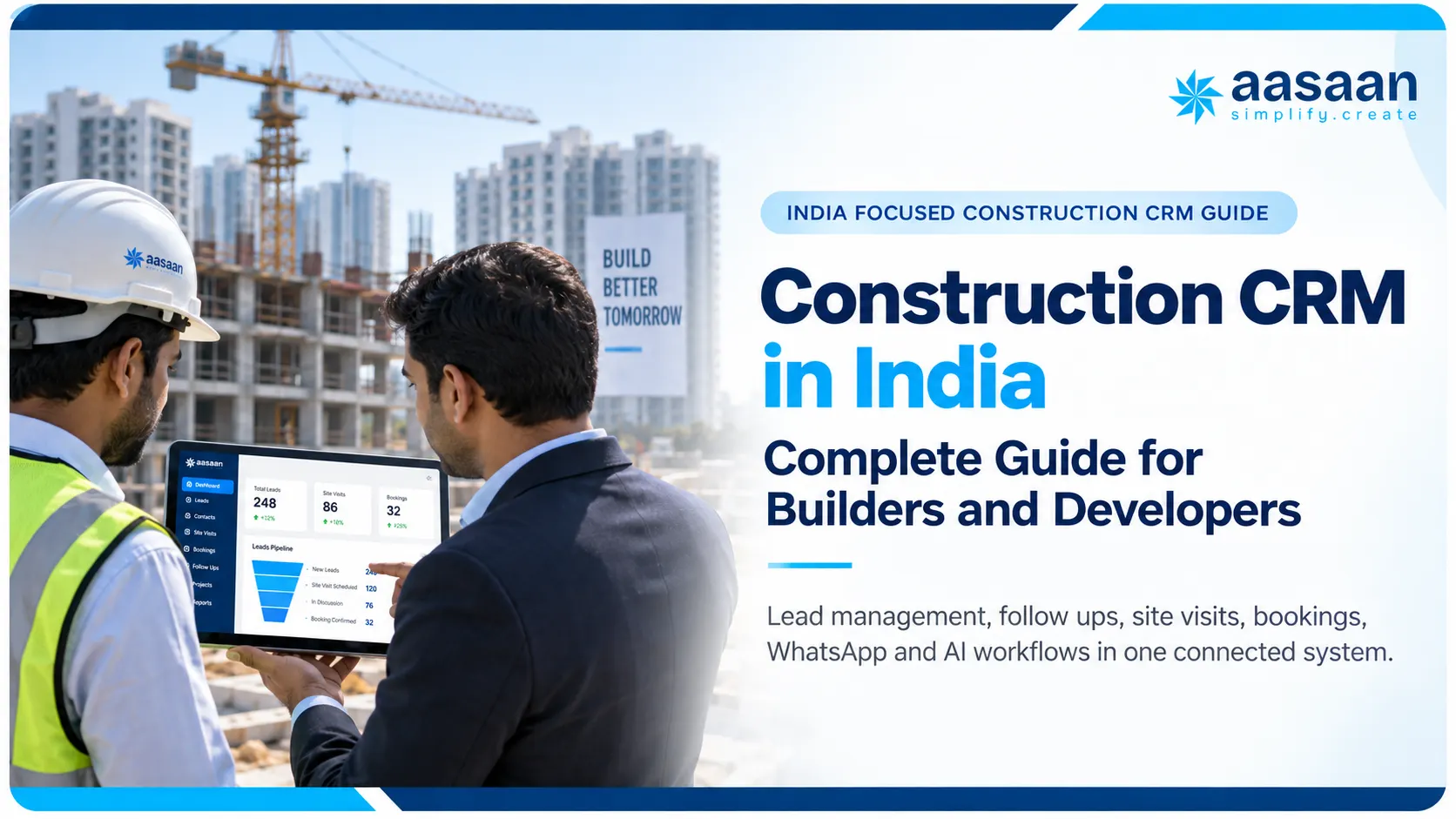
Construction CRM in India: Complete Guide for Builders and Developers
Construction CRM in India helps builders, developers and construction companies organise enquiries, leads, follow ups, site visits, proposals, bookings, customer communication and sales handover in one structured system. This guide explains what construction CRM should do, where generic CRM falls short, how WhatsApp and AI fit into the workflow and what buyers should test before choosing software.
Lead to project workflow WhatsApp and AI CRM plus ERP context
By: Takshil Sharma Last updated: September 2026 Estimated reading time: 28 minutes
Use this guide to evaluate
Lead captureQualification and ownership
Sales funnelFollow ups and ageing
Site visitsProposals and bookings
WhatsApp and AIConnected sales workflows
CRM to ERPProject handover
A
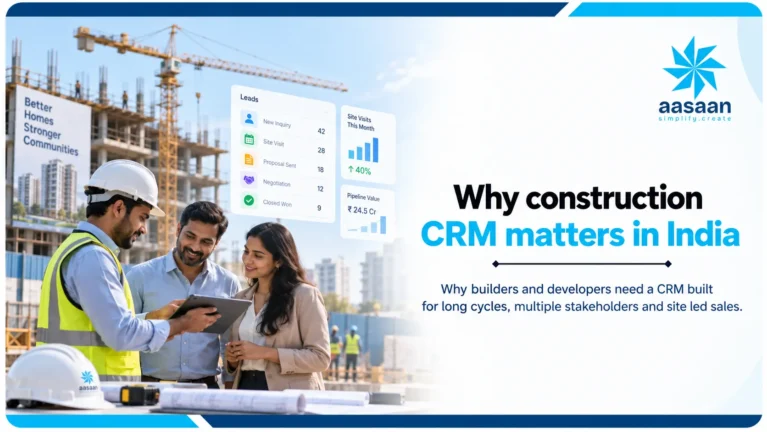
Quick answer: What is construction CRM in India?
Construction CRM is customer relationship management software designed around the longer, project driven sales cycles of builders, developers and construction businesses. It can connect enquiries, qualification, follow ups, site visits, opportunities, proposals, bookings, customer documents and post sale communication. For Indian teams, a practical evaluation should also cover WhatsApp adoption, multi project visibility, ERP handover, role permissions, reporting and implementation support.
AASAAN LIVE DEMO
See your own construction sales workflow inside Aasaan
Bring your current funnel, lead sources, follow up process and handover steps. Ask the team to demonstrate the journey from enquiry to qualified opportunity, customer communication and the next operational workflow.
Construction and real estate sales involve high value decisions, long follow up cycles and several handoffs. A single enquiry may move across a digital campaign, telecaller, sales executive, relationship manager, site visit team, commercial discussion, documentation, collections and finally project or customer service teams.
That complexity is increasing as the market grows. CREDAI and Liases Foras reported that India’s primary builders’ market recorded 6,14,218 unit sales worth ₹8.46 lakh crore in 2025. The report also noted a 16 percent year on year increase in sales value. A larger and higher value sales environment increases the importance of consistent lead ownership, response discipline, pipeline visibility and customer communication.
6,14,218Primary market unit sales reported for 2025 by CREDAI and Liases Foras.
₹8.46 lakh croreTotal primary builders’ market sales value reported for 2025.
16%Year on year increase in primary market sales value reported in the study.
For real estate developers, customer information also exists inside a regulated environment. The Ministry of Housing and Urban Affairs describes the Real Estate Regulation and Development Act as a framework intended to improve accountability, transparency and information symmetry between promoters and allottees. CRM is not a substitute for regulatory compliance, but disciplined customer records and controlled communication can support a more reliable operating process.
Important distinction: Construction CRM is not simply a contact database. It should make ownership, next action, customer context and handover visible across a long sales journey.
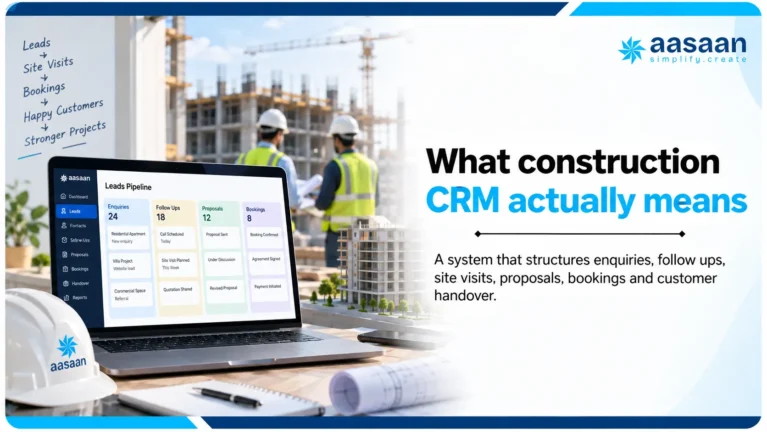
What construction CRM actually means
Construction CRM is software used to manage the relationships, opportunities and activities that exist before, during and after a construction sale. The exact workflow depends on what the business sells.
REAL ESTATE DEVELOPER
Property and buyer journey
Manage enquiries, project preference, site visits, unit or inventory context, booking, documents, collections and post sale communication.
BUILDER
Customer plus project context
Manage leads or accounts, proposals, commercial conversations and the transition from sales into delivery or customer service.
CONTRACTOR OR EPC
B2B opportunity management
Manage accounts, consultants, developers, decision makers, tenders, proposals, opportunity value and project handover.
The construction context appears when CRM records connect with the real object being sold. That may be a residential unit, an industrial package, a construction service, a project scope or a long term customer relationship. When the opportunity closes, the customer data often has to continue into execution, billing, collections, service or handover.
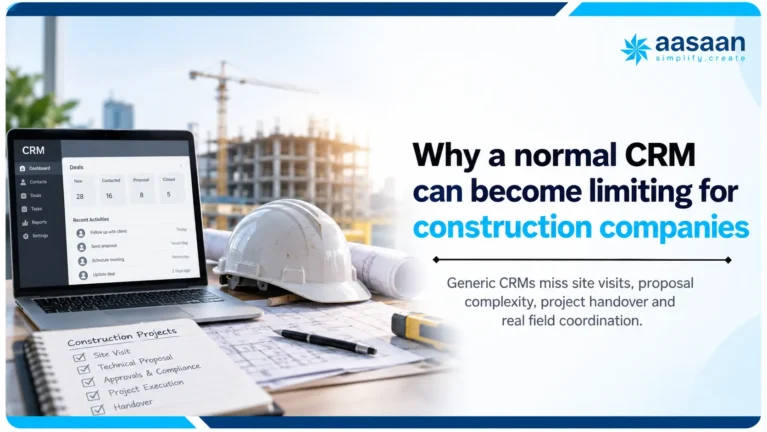
Why a normal CRM can become limiting for construction companies
Generic CRM software can be excellent at contact, task and opportunity management. The problem is not that it is generic. The question is how much configuration and integration is required to represent your construction sales journey correctly.
Evaluation area
Generic CRM
Construction CRM
What is being sold?
Product or service opportunity
Property, unit, project, construction service, tender or package
Booking, documentation, collections, project handover, milestone communication or service can continue
What context matters?
Sales activity and revenue
Sales activity plus project, property, unit, timeline, commercial and delivery context
What integrations matter?
Email, marketing and general business apps
ERP, accounting, project systems, WhatsApp, customer portals and document workflows
Do not buy the industry label. Buy the workflow.
A product should prove how it captures an enquiry, qualifies it, assigns ownership, records follow ups, manages a site visit or proposal and hands the customer to the next team. If that journey is clean, the software fits. If it needs five manual workarounds, the label does not matter.
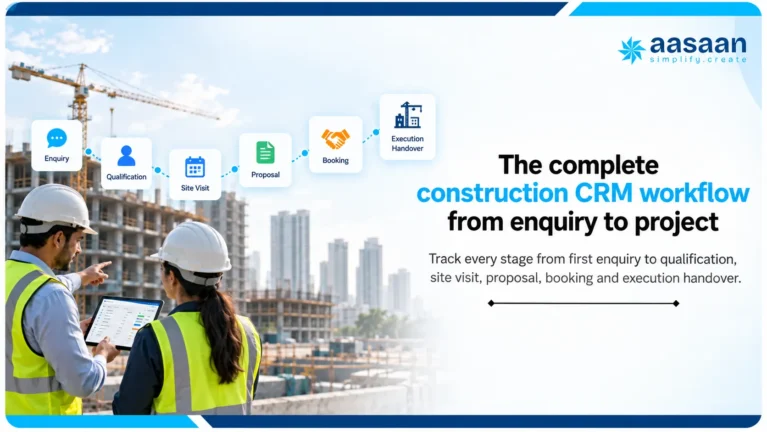
The complete construction CRM workflow from enquiry to project
The strongest way to evaluate construction CRM software is to follow one realistic opportunity from the first enquiry to the point where sales is no longer the only team responsible for it.
01
Enquiry
Website, ad campaign, referral, call, event, channel partner or manual entry.
02
Deduplicate
Check whether the person or account already exists before creating another fragmented record.
03
Qualify
Capture need, budget, project fit, authority, timeline and the next meaningful action.
04
Assign
Route by project, geography, source, team, business type or workload.
05
Follow up
Calls, WhatsApp, email, reminders, meetings and conversation history remain visible.
06
Visit or discovery
Record site visit, requirements meeting or technical discovery with a clear outcome.
07
Proposal
Cost sheet, quotation, scope, commercial terms and management approval.
08
Decision
Negotiation, booking, won opportunity or a structured lost reason.
09
Documentation
Customer, commercial and compliance records move into the next process.
10
Collections
Payment schedule and receivable context where the business model requires it.
11
Project handover
The delivery team receives the commercial, customer and project context it actually needs.
12
Post sale
Updates, service, handover, warranty or relationship management continue after closure.
Live demo challenge: Give every vendor one sample enquiry and ask them to move it through all twelve steps without jumping to slides or disconnected feature screens.
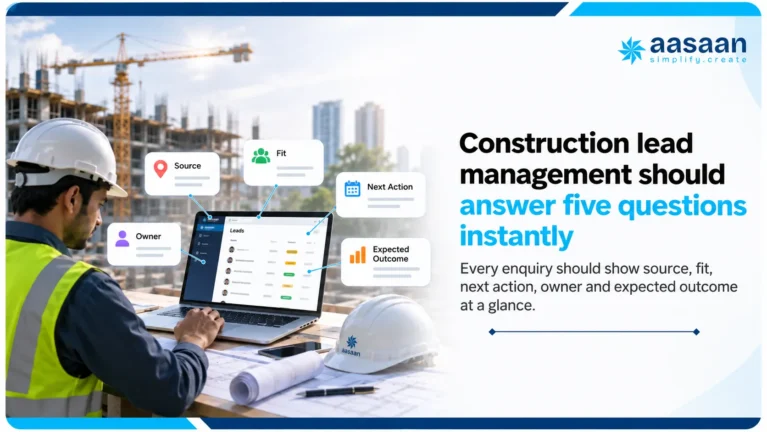
Construction lead management should answer five questions instantly
Lead management becomes useful when it makes the next decision obvious. A manager should not need to open several spreadsheets or ask three people to understand the condition of one opportunity.
Where did this lead come from and has it been deduplicated?
Who owns the lead right now?
What was the latest meaningful interaction?
What is the next action and when is it due?
Why is the lead moving forward, stuck or lost?
For a real estate developer, useful context can include project preference, configuration, unit type, budget, site visit history and channel partner attribution. For B2B construction sales, the equivalent context can include project stage, scope, estimated value, consultant, tender status and decision makers.
Your construction sales funnel should expose ageing, not hide it
A pipeline is useful only when stages have operational meaning. Stages such as “Interested” or “Follow up” can become dumping grounds if nobody defines what qualifies a lead to enter or leave them.
SIGNAL 1
Stage ageing
How long has the opportunity remained in the same stage and what is preventing movement?
SIGNAL 2
Next action
Does every active opportunity have an owner, action and due date?
SIGNAL 3
Response speed
How quickly does a new enquiry receive a meaningful first response?
SIGNAL 4
Lost reason
Are lost opportunities classified well enough to improve targeting, pricing and follow up?
Stage definitions should reflect evidence. For example, “Site Visit Completed” is stronger than “Warm”. “Proposal Shared” is stronger than “Interested”. “Commercial Approval Pending” is stronger than “Follow up”. Evidence based stages make conversion data more trustworthy.
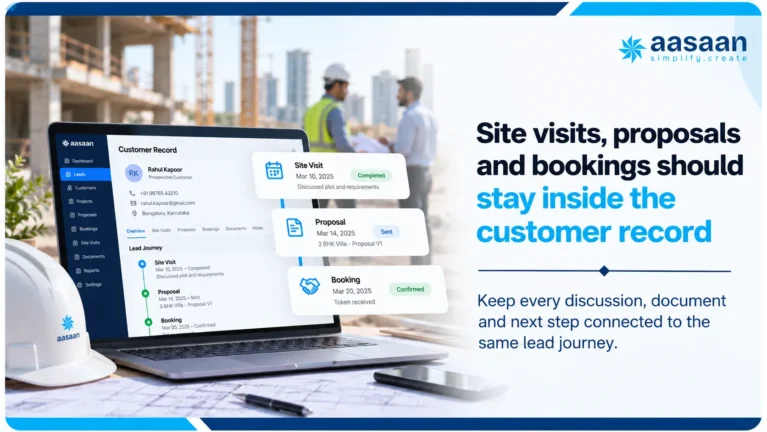
Site visits, proposals and bookings should stay inside the customer record
Construction and real estate sales often become most valuable after the first conversation. Site visits, technical meetings, commercial discussions and proposal revisions reveal whether the opportunity is becoming real.
SITE VISIT
Record the outcome
Capture who attended, project interest, objections, next action and the responsible sales owner instead of recording only that a visit occurred.
PROPOSAL
Control versions and approvals
Connect quotation, cost sheet, scope or commercial terms with the customer and approval history.
BOOKING OR WIN
Prepare the handover
Define what customer, project, commercial and document information must move to collections, operations or post sale service.
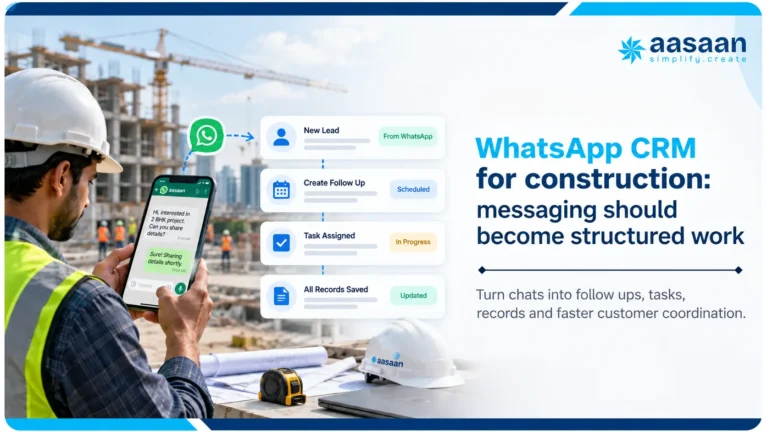
WhatsApp CRM for construction: messaging should become structured work
Calls and messaging are part of everyday sales behaviour. The risk appears when critical customer context lives only inside individual phones or chat threads. CRM should turn important communication into a shared record without making the salesperson duplicate every action manually.
BASIC INTEGRATION
Message from the CRM
The user can open or send a message, but ownership, stage and next action may still require manual updates.
STRUCTURED WORKFLOW
Communication changes the record
The CRM can connect the conversation with the correct customer, log the interaction, trigger a follow up or surface the next action for the owner.
Aasaan publicly positions WhatsApp Powered Sales CRM and Meta Verified Business Integration as part of its platform. Its brochure also describes WhatsApp inside the sales CRM so teams can govern chats without constant tab switching. During a demo, verify the exact message flow, user permissions, templates, opt in requirements and how conversation activity becomes structured CRM data.
Official platform reference: WhatsApp business messaging operates within Meta’s WhatsApp Business Platform rules and technical framework. Buyers should validate template, consent and messaging requirements during implementation rather than assuming any CRM can send unrestricted messages.
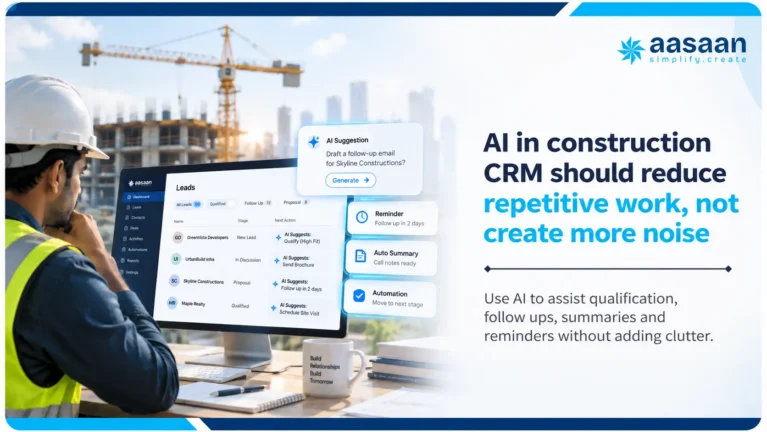
AI in construction CRM should reduce repetitive work, not create more noise
AI can improve CRM when the underlying process is already clear. If a team has no stage definitions, inconsistent ownership and duplicate customer records, AI will not repair the operating model by itself.
QUALIFICATION
Initial lead screening
AI can help ask structured questions, capture answers and identify which enquiries deserve faster human follow up.
SUMMARIES
Conversation intelligence
Calls or chats can be summarised into needs, objections, commitments and next actions when the system preserves the original evidence.
PRIORITISATION
Surface attention signals
AI can help highlight overdue, high intent or at risk opportunities, but the scoring logic should remain understandable to managers.
REPORTING
Ask questions in natural language
Managers can use AI to interpret pipeline data faster when the underlying CRM fields and stages are clean.
Aasaan’s public Property Sales CRM page describes AI enhanced lead management with an AI bot for initial qualification calls, automated follow ups and customer behaviour insights. Buyers should test what data the AI uses, how the result appears in the CRM and when a human takes control.
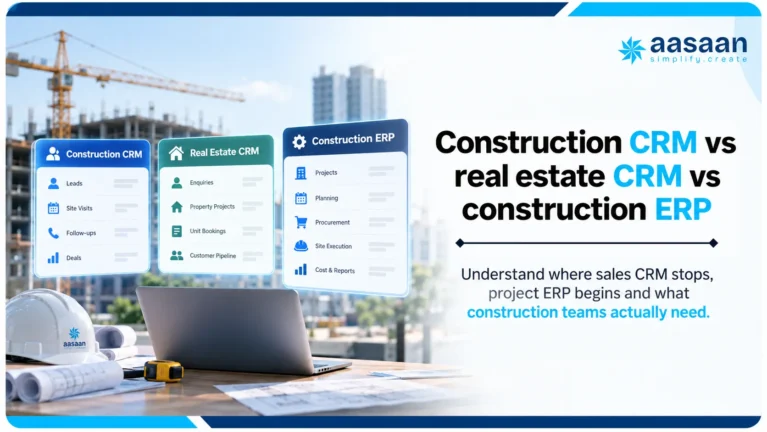
Construction CRM vs real estate CRM vs construction ERP
System
Primary job
Typical records
Best question to ask
Construction CRM
Manage demand, customers and revenue opportunities linked with construction context
Leads, accounts, site visits, opportunities, proposals, bookings, communication
Can it hand customer context into the next operational workflow?
Real estate CRM
Manage property sales and buyer journeys
Projects, units, site visits, bookings, cost sheets, payments, channel partners
Does it support our exact developer sales and post sale process?
How can sales or customer teams access reliable project status?
A developer may need all four functions. The buying decision is whether they should live inside one connected platform or several specialist systems with integrations between them. Read Aasaan’s Construction Management Software in India guide for the broader operating system context, and the Construction ERP guide for the operational side of the comparison.
AASAAN PROPERTY SALES CRM
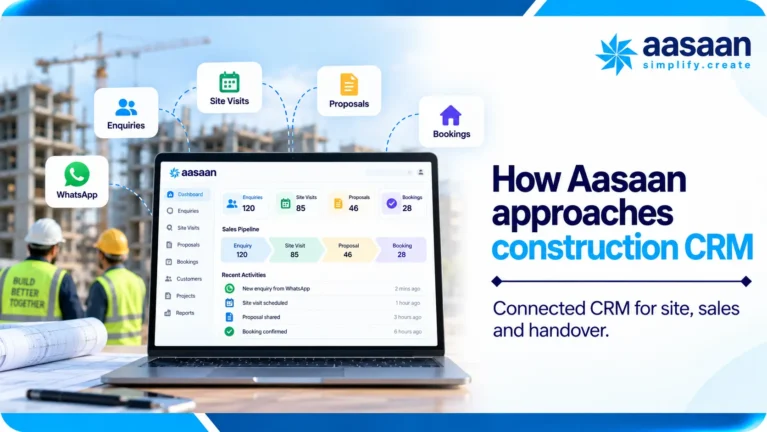
How Aasaan approaches construction CRM
Aasaan positions Property Sales CRM as part of a wider construction operating platform rather than as a separate contact database. Its public product information describes pre sales lead and enquiry management, AI enhanced qualification, automated follow ups, WhatsApp communication, customer behaviour insights and integration with construction ERP. Post sale capabilities include customer communication, warranty or service tracking, engagement analytics and project progress information.
PRE SALES
Lead and enquiry control
Qualification, follow ups, outreach and visibility can remain attached to one customer record.
CONNECTED OPERATIONS
CRM plus construction ERP
Sales teams can work with project or inventory context while management reduces repeated handoffs between disconnected systems.
POST SALES
Relationship after booking
Customer communication, project updates, service and handover can continue beyond the initial sale.
What to verify live: ask Aasaan to demonstrate your actual lead sources, qualification rules, sales stages, WhatsApp workflow, site visit process, proposal or booking flow, project or unit context, ERP connection and post sale journey.
Make Aasaan prove your CRM process with real examples
Use one current lead, one follow up scenario, one site visit or discovery call and one sales to project handover. This reveals far more than a feature presentation.
Evaluate construction software with a structured buyer framework.
Use the same practical framework across shortlisted vendors to compare workflow depth, total cost, implementation readiness, ROI and long term fit for your construction business.
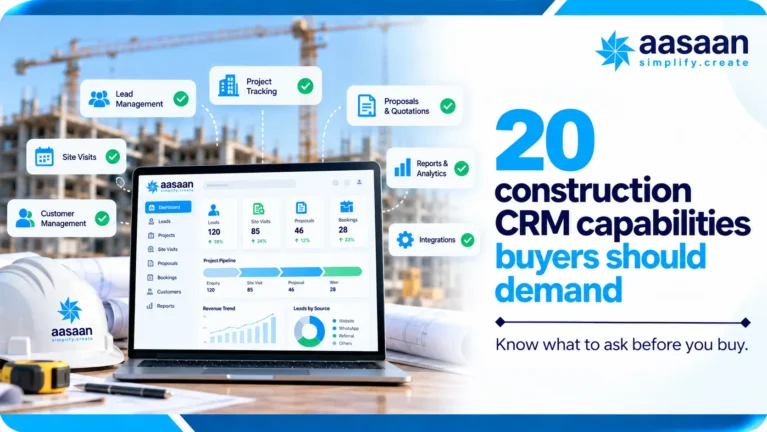
20 construction CRM capabilities buyers should demand
01
Lead capture
Website, campaigns, referrals, calls, events and manual sources.
02
Deduplication
Prevent multiple records from fragmenting customer history.
03
Assignment rules
Route enquiries by project, geography, team or workload.
04
Qualification
Structured questions, fit criteria and qualification status.
05
Pipeline stages
Clear stage entry and exit criteria based on evidence.
06
Follow up engine
Tasks, reminders, callbacks, ageing and escalation.
07
Site visits
Schedule, attendance, notes, outcome and next commitment.
08
Communication history
Calls, WhatsApp, email and important customer interactions.
09
Proposal workflow
Quotations, cost sheets, scope, versions and approval.
10
Customer documents
Keep customer and commercial records attached to the right journey.
11
Lost reasons
Structured reasons that management can analyse and act upon.
12
Source attribution
Compare lead quality across campaigns, referrals and channels.
13
Dashboards
Pipeline, ageing, source, team and conversion visibility.
14
Permissions
Role based access for sales, management and other teams.
15
Audit history
Track ownership changes and important record updates.
16
ERP handover
Move won opportunities into operational workflows cleanly.
17
Project or unit context
Connect the customer with what is actually being sold.
18
Collections context
Relevant for developers managing payment schedules and receivables.
19
Post sale workflows
Communication, handover, warranty or service after the sale.
20
AI assistance
Qualification, summaries, prioritisation and reporting where useful.
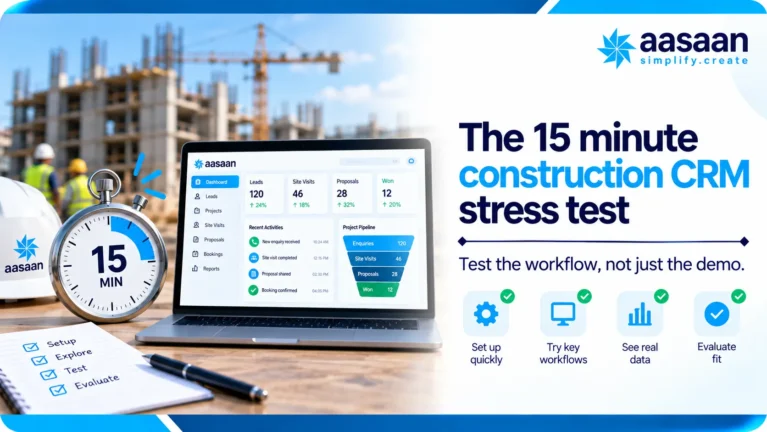
The 15 minute construction CRM stress test
Do not spend the entire demo listening to a presentation. Give the vendor a scripted workflow and ask them to complete it live.
Create one enquiry
Use a realistic name, source, project or account requirement and duplicate scenario.
Qualify and assign it
Show what information is mandatory and how ownership changes.
Log a call or WhatsApp interaction
Confirm whether the conversation updates the customer record and next action.
Schedule a site visit or discovery meeting
Record the outcome, objections and follow up requirement.
Move to proposal or booking
Demonstrate commercial approval, documents and stage history.
Hand the customer to the next team
Show exactly what data reaches ERP, project, collections or post sale workflows.
Pass condition: every step should preserve customer context, ownership, timestamps, evidence and the next action without asking the user to maintain a shadow spreadsheet.
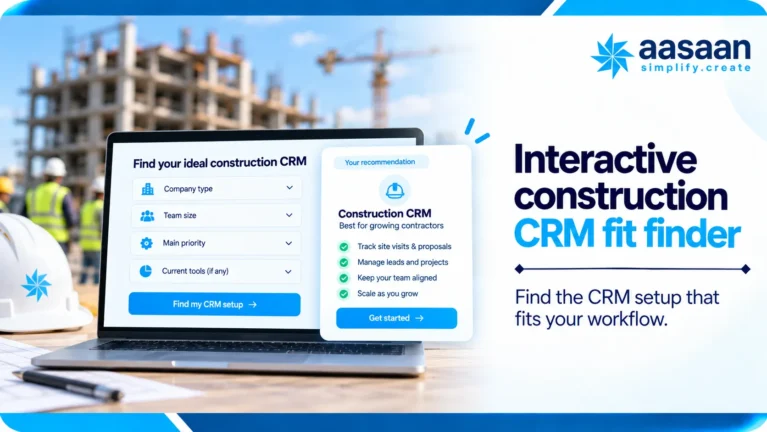
Interactive construction CRM fit finder
Answer four questions to create a practical demo brief for your CRM evaluation.
Your recommended starting point
Choose your current reality and click the button.
This tool is an evaluation aid, not a product recommendation engine. Use the output as a script for vendor demonstrations.
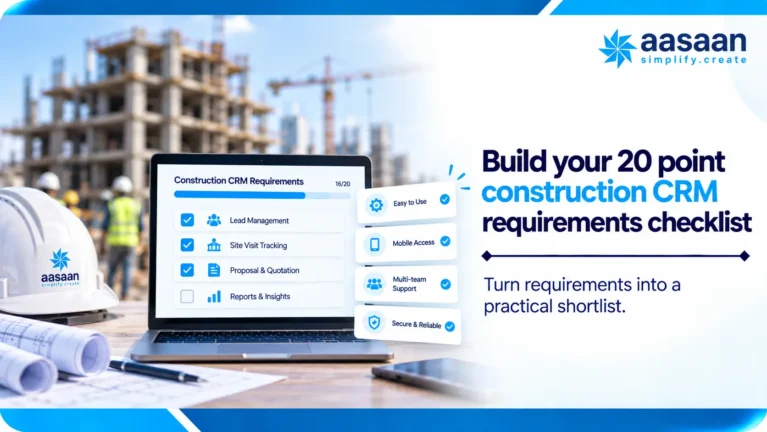
Build your 20 point construction CRM requirements checklist
Select the capabilities that matter to your team. Use the final count as the minimum scope every shortlisted vendor must demonstrate.
0 of 20 selected.
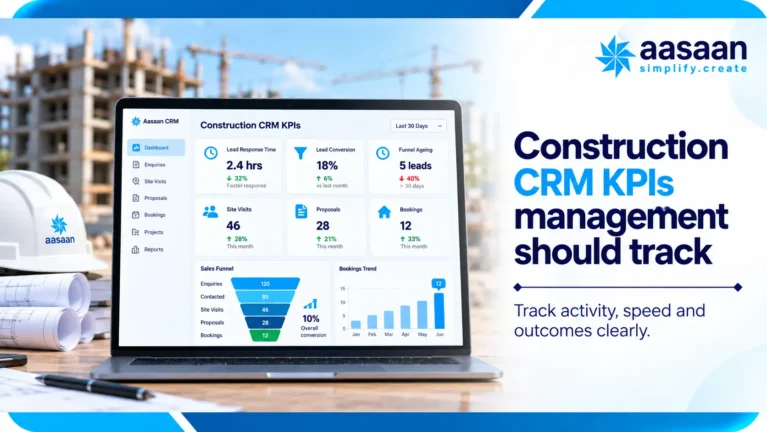
Construction CRM KPIs management should track
The best dashboard is not the one with the most charts. It is the one that helps management identify where demand is being lost and which actions need intervention.
KPI
What it reveals
Useful breakdown
First response time
How quickly new demand receives attention
Source, project, team, day and time
Lead to qualified rate
Whether marketing and targeting produce relevant enquiries
Campaign, source, geography, project
Stage ageing
Where opportunities become stuck
Stage, salesperson, project, value
Follow up compliance
Whether promised actions happen on time
Owner, team, stage
Site visit conversion
How visits translate into the next commercial step
Project, source, salesperson
Proposal conversion
How commercial discussions convert after proposal
Segment, project, salesperson
Win rate
How effectively qualified opportunities convert
Source, segment, project, salesperson
Lost reason mix
What repeatedly blocks conversion
Price, timing, fit, competition, finance
Handover completeness
Whether delivery or post sale teams receive usable customer context
Project, salesperson, workflow
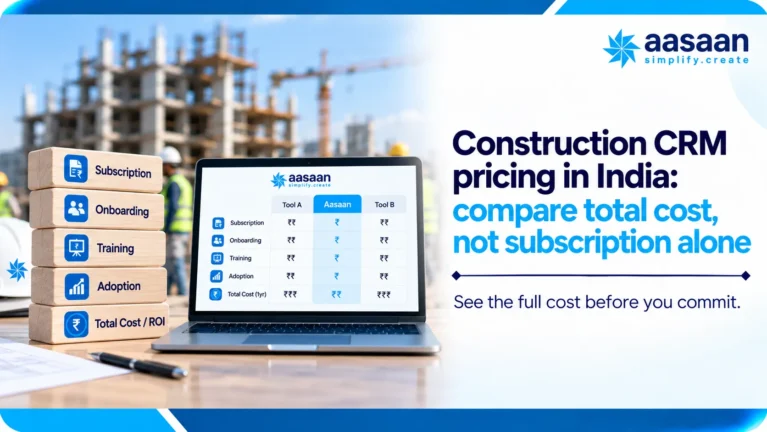
Construction CRM pricing in India: compare total cost, not subscription alone
CRM pricing can vary by user count, modules, automation, telephony, WhatsApp messaging, storage, integrations, implementation, data migration, custom workflows and support. A low monthly license can still become expensive if the business needs heavy configuration or separate tools for post sale and ERP handover.
LICENSE
Recurring software cost
Understand user limits, modules, automation limits, storage, API access and future expansion.
IMPLEMENTATION
Setup and migration
Include process mapping, master cleanup, data migration, configuration, testing and training.
INTEGRATION
Connected system cost
Account for WhatsApp, telephony, ERP, accounting, ads, portals or custom APIs where required.
Build a three year total cost view before selecting software. If CRM replaces manual reporting, repeated data entry or disconnected tools, calculate that operating value as well. If it only adds another system for the team to update, the software has not solved the process.
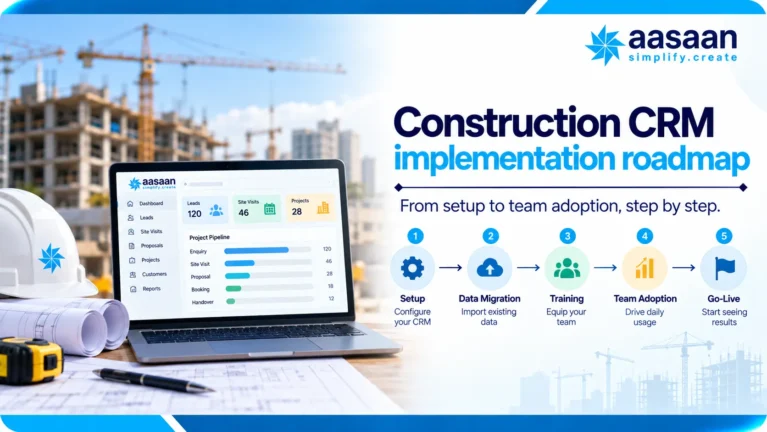
Construction CRM implementation roadmap
Map the current funnel
Document sources, qualification questions, stages, owners, approvals, site visits, proposals and handoffs before configuring software.
Clean customer and project masters
Standardise projects, lead sources, users, teams, stages and lost reasons before migration.
Define ownership and response rules
Decide who receives each lead, when escalation occurs and what counts as an overdue follow up.
Pilot one complete journey
Test enquiry to qualification to follow up to proposal or booking before expanding the rollout.
Connect WhatsApp, ERP and other systems
Integrations should follow clear ownership rules so teams know which platform is the source of truth.
Review outcomes, not login counts
Measure response time, follow up discipline, stage ageing, conversion and handover quality.
For a broader implementation framework, see Aasaan’s Construction ERP Implementation Guide for Builders. Many of the same change management principles apply to CRM: clean data, clear process ownership, phased rollout and measurable outcomes.
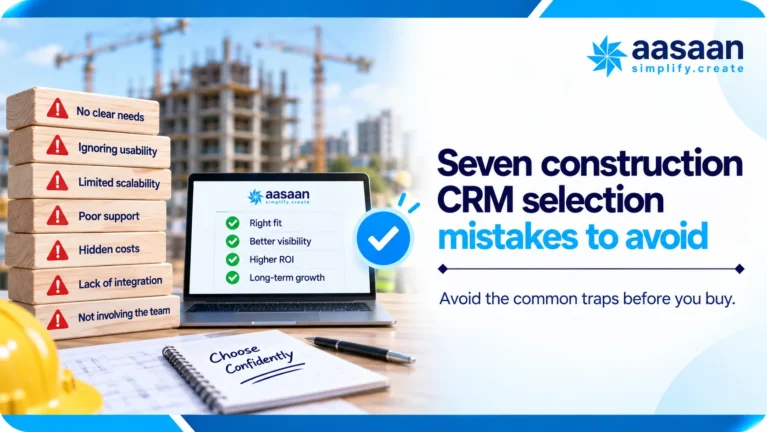
Seven construction CRM selection mistakes to avoid
MISTAKE 1
Buying on feature count
A long list does not prove the features work together across one customer journey.
MISTAKE 2
Copying the old spreadsheet exactly
Digitising a weak process can preserve the same confusion inside better looking software.
MISTAKE 3
Ignoring site visit and proposal workflows
The most valuable sales events often happen after initial lead capture.
MISTAKE 4
Leaving WhatsApp outside the process
If important customer decisions happen in chat, the CRM needs a clear strategy for that communication.
MISTAKE 5
Ignoring ERP handover
A clean sale can still create operational confusion if the next team receives incomplete information.
MISTAKE 6
Automating before defining stages
Automation amplifies whatever process already exists, including a poorly designed one.
MISTAKE 7
Measuring adoption through logins
Track response time, follow up discipline, stage ageing, data completeness and conversion instead.
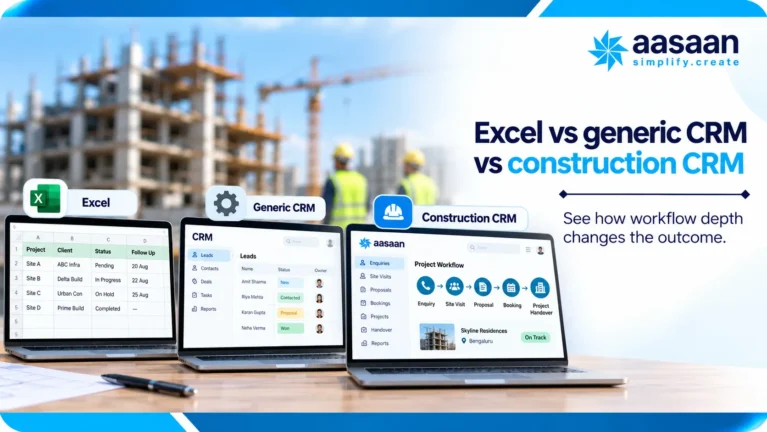
Excel vs generic CRM vs construction CRM
Approach
Works well when
Watch for
Excel and WhatsApp
Very small pipeline, few owners and simple follow up
Version control, missed actions, fragmented communication and weak reporting
Generic CRM
Sales process is standard and integrations can provide enough construction context
Configuration effort, project or unit context, post sale and ERP handover
Construction CRM
Sales and customer workflows need project, property, operational or post sale context
Do not pay for an industry label alone. Demand a live workflow demonstration.
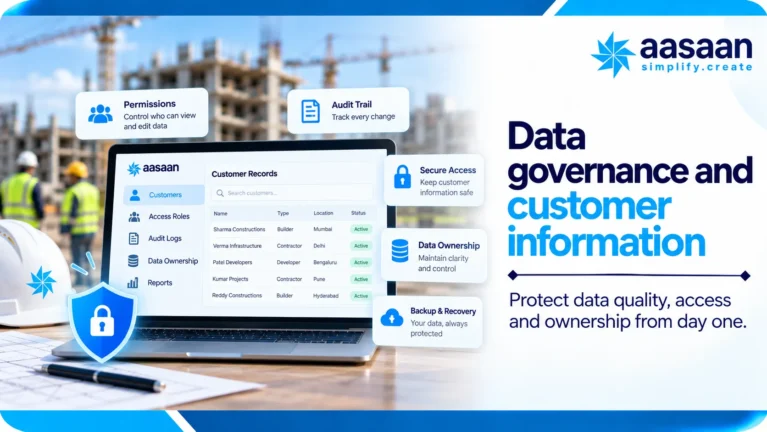
Data governance and customer information
Construction CRM can hold sensitive customer, commercial and project information. Buyers should evaluate role based access, record ownership, audit history, export capability, backups, integration permissions and user offboarding. Developers should also align CRM use with their legal, regulatory and privacy obligations.
The Ministry of Housing and Urban Affairs states that RERA was designed to improve accountability, transparency, fairness and information symmetry between promoters and allottees. Read the official MoHUA RERA FAQs and the Real Estate Regulation and Development Act, 2016 for regulatory context. CRM configuration should follow your legal team’s interpretation of applicable obligations.
Frequently asked questions about construction CRM in India
These answers are designed to be useful independently for buyers, search engines and AI answer systems.
What is construction CRM?
Construction CRM is customer relationship management software designed around the sales and customer workflows of builders, developers, contractors and other construction businesses. Unlike a basic contact database, construction CRM software can manage enquiries, construction lead management, account details, qualification, follow ups, meetings, site visits, proposals, bookings, documents, customer communication and post sale activity in one system. For real estate developers, a CRM may also connect the customer with a specific project, tower, property or unit, payment schedule and handover stage. For B2B construction companies, it may track developers, architects, consultants, PMCs, tender opportunities, decision makers and project value. The most useful construction CRM creates continuity from the first lead to the next business workflow. That can mean moving a qualified opportunity into booking, collections, project execution, ERP or customer service without repeatedly copying the same information between Excel sheets, WhatsApp conversations and separate applications.
What is construction CRM in India?
Construction CRM in India refers to CRM software and workflows adapted to the way Indian builders, real estate developers and construction companies manage sales, customer relationships and long sales cycles. A practical construction CRM in India should support lead capture from websites, digital campaigns, referrals, calls, events and channel partners, then connect those enquiries with qualification, salesperson assignment, follow ups, site visits, proposals, bookings and post sale communication. Indian teams also need to evaluate WhatsApp CRM workflows because customer and sales conversations often happen through WhatsApp alongside calls and email. Developers may require project and unit context, cost sheets, booking information, collections visibility and customer updates, while B2B builders or EPC companies may need account based sales, tender tracking, proposals and project handover. The right CRM for builders and developers in India should reflect the company’s actual sales process rather than forcing every business into a generic sales funnel.
Who should use construction CRM software?
Construction CRM software can be useful for real estate developers, builders, construction companies, contractors, EPC businesses, design and build firms, PMCs and other organisations that manage a structured sales pipeline or long term customer relationship. Real estate developers can use a property sales CRM to organise homebuyer enquiries, relationship managers, project preferences, site visits, bookings, documents, payment communication and post sale service. Builders and contractors selling B2B services can use construction CRM to manage accounts, consultants, developers, architects, tender opportunities, project value, proposals, negotiations and decision makers. A CRM for construction companies becomes more valuable when several salespeople, lead sources or projects are involved and management needs reliable visibility into ownership, next actions and stage ageing. Smaller teams can also benefit if Excel and WhatsApp are creating missed follow ups, duplicate customer records or inconsistent reporting. The deciding factor is workflow complexity, not simply company size.
How is construction CRM different from generic CRM?
A generic CRM normally manages contacts, accounts, opportunities, tasks, email activity and sales reporting. Construction CRM adds the industry context required by builders, developers and construction businesses. That context can include a project, property, unit, site visit, tender, scope, consultant, channel partner, construction milestone, proposal, booking, document, collection or project handover. For example, a normal sales CRM may close an opportunity when the deal is won, while a construction CRM for developers may need to continue into booking documentation, payment communication, project progress updates and handover. A CRM for contractors may need to preserve tender details, project value, decision makers and the information required by the execution team after award. Generic CRM can still work if it is configured deeply and integrated well. Buyers should compare the total implementation effort, customisation, integrations and manual workarounds required to reproduce the same construction sales workflow.
What is the difference between construction CRM and construction ERP?
Construction CRM and construction ERP solve different parts of the business, although the two systems can work together. Construction CRM focuses on customer facing and revenue workflows such as lead management, qualification, opportunity stages, follow ups, site visits, proposals, bookings, customer communication and post sale service. Construction ERP focuses on operational and commercial control such as procurement, inventory, material management, subcontractor billing, labour, assets, finance integration and project costs. For a real estate developer, the CRM may manage the customer journey while ERP and project management systems control construction execution. For a contractor or builder, the CRM can manage the account and opportunity until the project is won, then pass relevant customer, scope and commercial data into project or ERP workflows. CRM ERP integration is valuable because it reduces repeated data entry and gives management a clearer connection between sales commitments, project delivery and commercial operations.
Can construction CRM integrate with ERP?
Yes. Construction CRM can integrate with ERP so customer and sales information flows into operational, commercial or accounting workflows after an opportunity becomes a project, booking or active customer account. A useful CRM ERP integration can transfer approved customer details, project references, opportunity value, commercial information, booking data or other required records without forcing teams to re-enter the same information. For builders and developers, the key question is not simply whether an integration exists. Buyers should test which system owns each master record, what data moves in each direction, how duplicates are handled, whether project and customer IDs remain consistent and how failed synchronisations are resolved. A construction CRM in India may also need to coexist with accounting tools, project management software, property sales workflows and WhatsApp. During a demo, ask the vendor to show the exact handover from a won opportunity or booking into the next ERP or project process.
Can construction CRM work with WhatsApp?
Yes. WhatsApp can be a valuable communication layer for construction CRM, especially in India where sales teams, customers, channel partners and project stakeholders frequently use it for follow ups, site visit coordination, documents and quick updates. The important distinction is between a simple WhatsApp shortcut and a structured WhatsApp CRM workflow. A strong integration should associate communication with the correct lead, contact or customer, preserve ownership and status, and make the next action visible inside the CRM. It may also support approved templates, notifications, reminders or automated workflows depending on the platform. For construction lead management, this helps prevent important customer conversations from remaining only in an individual salesperson’s phone. Buyers should also validate consent, message templates, auditability, user permissions and how WhatsApp activity becomes a usable CRM record. Aasaan’s public positioning includes WhatsApp connected workflows, which should be tested live against your sales process.
How can AI help construction CRM?
AI can improve construction CRM by reducing repetitive sales work and helping teams understand large volumes of customer activity faster. Useful AI CRM applications include initial lead qualification, call or conversation summaries, lead prioritisation, suggested follow ups, customer sentiment signals, document capture, management summaries and identification of opportunities that have gone inactive. AI can also help sales managers review pipeline patterns without manually reading every activity record. For builders and developers, AI assisted construction lead management is most useful when it works on top of clean CRM data, defined sales stages, clear ownership rules and consistent follow up activity. AI should not replace commercial judgment, pricing approval or important customer decisions. It should make the workflow faster and more visible. During a construction CRM demo, ask the vendor to show how AI uses your actual lead, customer and project context, what information is stored and how users can verify or correct AI generated outputs.
What features should construction CRM software include?
Construction CRM software should cover the complete sales and customer workflow rather than offering only a lead list. Core features should include lead capture, source attribution, deduplication, lead assignment, qualification, sales pipeline stages, follow up reminders, activity history, site visits or meetings, proposals, customer documents, dashboards, permissions and audit trails. CRM for builders and developers may also require project or unit context, booking workflows, customer communication, payment or collections visibility and post sale service. CRM for construction companies selling B2B services may prioritise accounts, multiple decision makers, tender opportunities, project value, proposal tracking and sales to project handover. WhatsApp CRM, telephony, marketing integrations, ERP integration and AI lead qualification can add value when they are connected to the same structured customer record. Buyers should make every shortlisted construction CRM prove these workflows live instead of judging software only from a feature checklist.
How should a builder or developer choose CRM software?
A builder or developer should choose CRM software by starting with the real customer journey rather than a vendor feature list. Map how an enquiry enters the business, how it is deduplicated and qualified, who receives it, how follow ups are scheduled, when managers intervene, how site visits are recorded, how proposals or cost sheets are approved and what information is required after a booking or won opportunity. Then identify the reports management needs, such as response time, stage ageing, conversion, lost reasons and source performance. For construction CRM in India, also evaluate WhatsApp workflows, mobile usability, role based permissions, project or unit context, ERP integration, data export and implementation support. Ask each vendor to demonstrate the same realistic scenario using your stages and terminology. The best CRM for builders or real estate developers is the one that matches the operating process with the fewest manual workarounds and can scale as projects, users and lead sources grow.
Is Excel enough for construction lead management?
Excel can be enough for construction lead management when the pipeline is small, only one or two people update it and follow ups are simple. It becomes difficult to govern when multiple salespeople work on the same opportunities, lead sources multiply, response time matters or managers need reliable conversion and ageing reports. Spreadsheets do not naturally enforce lead ownership, next action, reminders, activity history, deduplication or stage rules. Teams often compensate with WhatsApp messages, calls and separate trackers, which can fragment the customer journey further. A construction CRM becomes more useful when missed follow ups, duplicate records, unclear ownership or inconsistent reporting are affecting sales performance. The decision should not be based on a fixed lead count. Compare the time spent maintaining Excel with the value of structured construction lead management, automated follow ups, sales funnel visibility, CRM dashboards and a cleaner handover into booking, ERP or project workflows.
What construction CRM KPIs should management track?
Construction CRM KPIs should measure both sales performance and workflow discipline. Useful metrics include first response time, lead to qualified rate, follow up compliance, stage ageing, site visit conversion, proposal conversion, win rate, lost reason mix, lead source quality, pipeline value and sales cycle length. Real estate developers may also track enquiry to site visit, site visit to booking, booking value, project wise conversion and customer service or collection related indicators. B2B construction companies may track account coverage, tender pipeline, opportunity value, proposal ageing and sales to project handover completeness. Management should analyse these CRM metrics by project, source, salesperson, geography or business segment so the numbers lead to action. Define the baseline before construction CRM implementation and then review whether response speed, follow up discipline, pipeline accuracy and conversion improve after go live. A dashboard is useful only when the underlying sales stages and activities are consistently recorded.
How long does construction CRM implementation take?
Construction CRM implementation time depends on the number of users, complexity of the sales process, data quality, integrations, custom fields, migration requirements and the amount of change management required. A focused implementation can begin with lead capture, deduplication, assignment, qualification, follow ups, pipeline stages and management dashboards. Additional phases can then connect WhatsApp CRM, telephony, marketing sources, ERP integration, booking, post sale communication or AI workflows. The most common delays are often process related rather than technical. If teams have inconsistent lead sources, duplicate customer records, unclear stage definitions or no ownership rules, those issues should be cleaned before migration. Builders and developers should appoint an internal CRM owner, test the workflow with real users and agree on success metrics before go live. A phased rollout usually produces better adoption than trying to configure every possible construction CRM feature in the first release.
How does Aasaan approach construction CRM?
Aasaan positions Property Sales CRM as part of a wider construction operating platform rather than as a completely separate contact database. Its public product information describes pre sales lead and enquiry management, AI assisted qualification, automated follow ups, WhatsApp communication, customer behaviour insights, construction ERP integration and post sale customer communication. This connected approach can be relevant for builders and real estate developers that want construction CRM, project information and operational workflows to share context instead of living in disconnected systems. For example, the value of CRM ERP integration increases when customer or booking information can move cleanly into the next business process and management can review customer activity alongside wider construction operations. Buyers should still validate the exact Aasaan CRM configuration they require during a live demo, including lead sources, stages, WhatsApp workflow, project or unit context, permissions, dashboards, ERP handover, data migration and post sale processes.
Is construction CRM useful for contractors and EPC companies?
Yes. Construction CRM can be useful for contractors, EPC companies and B2B construction businesses, but their workflow is usually different from a residential property sales CRM. Instead of managing homebuyer bookings, these companies may track developers, infrastructure owners, consultants, architects, PMCs, tender opportunities, project locations, estimated contract value, decision makers, technical meetings, proposals, negotiations and award status. A CRM for contractors should also support the handover of a won opportunity into estimation, contracts, project execution or ERP workflows so the delivery team receives the agreed scope and customer context. Account based visibility is especially important because one client may have several projects and multiple decision makers. Contractors should therefore test whether the construction CRM can represent B2B accounts, opportunities and project relationships without forcing them into a property sales structure. The right system should improve opportunity visibility, follow up discipline, proposal control and sales to project handover.
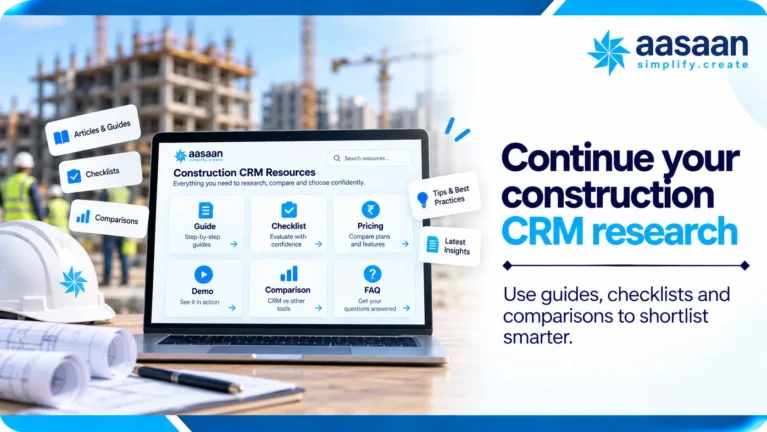
Continue your construction CRM research
AASAAN PRODUCT
Property Sales CRM
Review Aasaan’s pre sales, post sales, AI qualification, WhatsApp and ERP connected CRM capabilities.
Do not evaluate construction CRM from a slide deck
Bring one recent enquiry, your current funnel stages, a follow up scenario and the handover that happens after a deal is won. Ask Aasaan to demonstrate the complete journey using your process.

 Leads Management Capture, qualify, and follow up on every sales lead.
 Customer Management Keep customer profiles, history, and interactions in one place.
 Sales Funnel Track deals from first inquiry to final conversion.
 Task Management Assign and track sales follow-up tasks for the team.
 Documentation Store quotes, agreements, and customer documents together.
 Asset Register Maintain a complete register of machines, tools, and equipment.
 Machine Maintenance Schedule servicing and track breakdowns before they delay work.
 QR Code Updation Update asset details instantly by scanning QR codes.
 Asset Transfer/Depreciation Move assets across sites and track their value over time.
 GRN Record goods received against asset purchases and deliveries.
 Employee Attendance Mark daily attendance and keep a clear record of working hours.
 GPS/Location Tracking/GeoFence Verify on-site presence with GPS and geofence-based attendance.
 Payroll/Payslips Run payroll and share payslips without manual calculations.
 Expense Reimbursement Submit, approve, and settle employee expense claims easily.
 Leave Management Apply, approve, and track leave balances in one place.
 Daily Hajiri Record daily labour attendance and wages without paper registers.
 Biometric Devices Capture attendance from biometric devices at the site.
 Activity wise attendance Track which activity each worker was assigned to each day.
 QR Attendance Mark labour attendance quickly by scanning a QR code.
 Face Recognition Verify workers on site with face-based attendance.
 Purchase Request Raise and approve material purchase requests from site.
 Stock Management See live stock levels and avoid shortages or excess buying.
 Request for Quotation Collect vendor quotes before placing a material order.
 Site Transfer Move stock between sites and keep both inventories updated.
 Client Billing Raise client bills and track payments against work done.
 Supplier Billing Record supplier invoices and match them with received material.
 Ledger Record Keep party ledgers updated for every payment and receipt.
 Accounting and Payments Record accounts and process payments with a clear trail.
 Petty Expense Reimbursement Submit and settle small site expenses without cash leakage.
 Material Estimation/BOM Estimate materials and build a bill of materials before work starts.
 Location Breakdown Schedule Break the project into locations and plan work location by location.
 Activity BOQ estimation Estimate quantities and costs for each activity in the BOQ.
 Rate Analysis Build item rates from labour, material, and machinery costs.
 Depreciation & Scrap Track plant asset depreciation and scrap write-offs.
 Plant wise Production Track output separately for every plant and production line.
 Fuel Consumption Monitor fuel usage across plant machinery and vehicles.
 Maintenance, Service & Compliance Schedule plant maintenance, service, and compliance checks.
 Project Schedule Plan project timelines and keep every activity on schedule.
 Activity Based Tracking Track progress activity by activity instead of overall estimates.
 DPR Capture daily progress reports from site in a standard format.
 Track Progress Realtime See live project progress without waiting for end-of-day updates.
 Site Virtual walk 360° virtual site tours with AI issue detection.
 OCR Automation Extract data from challans, bills, and site documents.
 Command Ai Ask project questions and get instant AI answers.
 Voice Call BOT AI voice bots for follow-ups and negotiations.
 Intel Ai AI insights to control cost and project risks.
 WhatsApp Two-way WhatsApp updates for site and office teams.
 Google & Microsoft Connect Google and Microsoft tools with your workflow.
 RazorPay Accept and track payments through RazorPay.
 GST Portal Stay aligned with GST portal records and filings.
 SAP Connect SAP data with construction project workflows.


 Meta-Verified Business Integration Actionable project inbox with real-time alerts.
 Frictionless Stakeholder Collaboration Capture bills and GRNs directly to ERP.
 WhatsApp-Powered Sales CRM CRM chats with real-time sentiment analysis.
 WhatsApp-Powered Alerts & Reports Automated push notifications and daily reports.
 GPS - Live Tracking Real-time visibility of workforce and assets.
 Facial Scanning Secure, automated attendance via facial recognition.
 Labour Productivity Track workforce activity linked to payroll.
 Quote Comparison AI bots fetch and compare supplier rates.
 OCR - AI for Billing Auto-generate progress reports from site data.
 QR Based Asset Tracking Scan QR codes for instant asset history.
 Tally ERP Integration Seamlessly sync project data with Tally.
 Automated GST Compliance Automated GST compliance and reporting tools.